

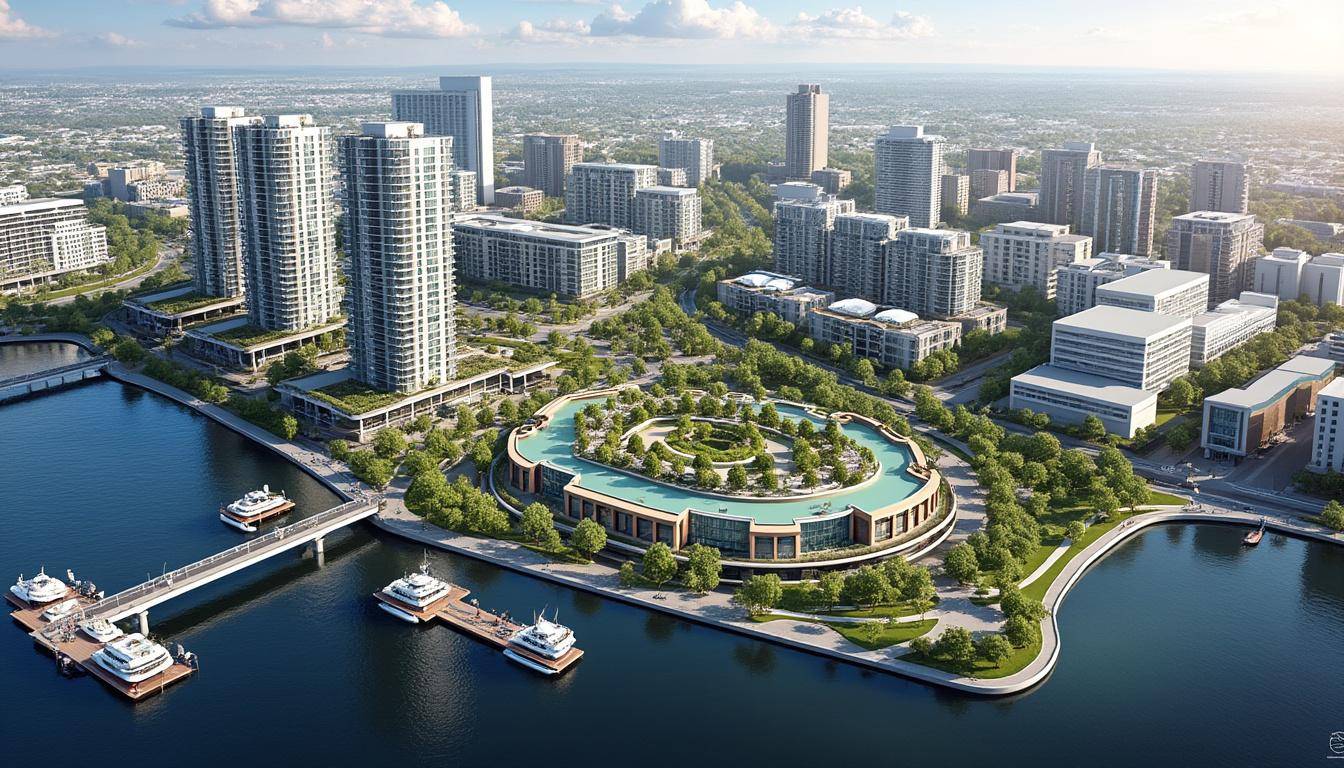
The waterfront at Portland’s eastern edge has quietly become one of New England’s most scrutinized development case studies. What started as the purchase of a former locomotive foundry for a modest sum has metamorphosed into the Portland Foreside Development Project Surpasses $1Billion Milestone, a multi-phase redevelopment that combines luxury housing, hospitality, historic preservation and a self-contained energy strategy. Over more than a decade, the site’s transformation has included a $27 million marina, a $100 million office building and painstaking relocation of heritage structures to create a mixed-use neighborhood envisioned to rival Portland’s Old Port in scale and economic impact. The latest construction phase, originally scoped at roughly $660 million, has risen to near $970 million as developers upgraded finishes and reallocated capital to match market demand uncovered through extensive tenant research.
Led publicly by Casey Prentice and his partners, the project has weathered pandemic pauses, financing shortfalls, contractor liens and intense public debate about affordability and scale. As site work resumes and financing closes, the debate shifts from whether the project will be completed to how it will affect Portland’s housing market, municipal finances and urban infrastructure. What follows is a deep-dive into the complex anatomy of this RealEstate Investment and Construction undertaking — the financial mechanics, regulatory hurdles, construction innovations like on-site cogeneration, community responses and the long-term economic calculations that will define whether this headline-making milestone translates into lasting public value.
Project Overview And Phase Breakdown For The Portland Foreside Development
The story of the Portland Foreside Development is best understood in phases. What began with a targeted purchase in 2013 has evolved into a 10-acre mixed-use district offering hospitality, residences, retail and marine services. The initial phases established critical infrastructure and momentum: a newly-built, yacht-ready marina completed for $27 million; a four-story office building developed at a cost near $100 million; and the careful relocation and adaptive reuse of a historic factory storehouse to host a waterfront restaurant and public-facing amenities.
Phase three represents the current investment wave. It includes a 130-room hotel with 38 branded residences, a 132-unit condominium building and a 200-apartment complex, of which 20 units are designated affordable under Portland’s inclusionary zoning. Developers expect substantial mixed-use activity: retail at ground level, a restored 13,000-square-foot brick warehouse repurposed as a year-round public market and events venue, plus co-working space on upper floors.
Timeline, Costs And Key Milestones
The master plan received city approval in 2016. Since then, incremental work and strategic investments have pushed the cumulative cost north of the billion-dollar threshold. The latest phase was permitted for a natural gas-fired cogeneration plant in mid-2025 and financing arrangement details were finalized in the spring, with over $330 million of private capital committed alongside federal clean-energy grants.
| Phase | Major Elements | Initial Budget | Current Cost Estimate | Target Completion |
|---|---|---|---|---|
| Phase 1 | Marina, site remediation | $27M | $27M | Completed 2018 |
| Phase 2 | Sun Life office building, historic building relocation | $100M | $100M | Completed 2021 |
| Phase 3 | Hotel, condos, apartments, cogeneration plant, market | $660M | $970M (latest) | 2029–early 2030 |
Translating these milestones into a local economic narrative requires context. The developers emphasize quality-driven upgrades based on market research among prospective tenants and guests. In practical terms, this meant enhancing materials, amenity programs and energy infrastructure — all of which raised the project’s capital intensity. For investors and city planners, those choices are a bet on longer-term asset value and neighborhood prestige rather than short-term absorption of lower-margin units.
Casey Prentice has framed the long road as a series of problem-solving exercises: overcoming neighborhood pushback, lost financing, pandemic shutdowns and rising borrowing costs. Each obstacle required additional capital or design adjustments but also offered an opportunity to refine the product for the market segment most likely to lease and buy in a waterfront setting.
Whether the development’s scale and cost ultimately justify themselves depends on occupancy, tourist draw, local job creation and spillover benefits for Portland’s economy. Those metrics will be measured in tax receipts, hospitality revenues and increased foot traffic for adjacent districts. The next section digs into how the project’s financing was structured to absorb these risks and move construction forward. Insight: the project’s phase-by-phase approach intentionally staggers risk while preserving optionality for future blocks.
Financing Strategy, Liens And The Practicalities Of Making A $1B RealEstate Investment Work
Large-scale waterfront projects require layered financing structures that can withstand volatility. For the Portland Foreside Development, the financing mix evolved as the project matured. Developers ultimately combined private equity, construction loans, and targeted public grants — including clean energy funding from federal sources — to close the capital stack. The developer reported that final financing should close within 90 days at the time site work resumed, with over $330 million in private capital already secured.
However, the path to financial close included familiar industry friction points: contractor claims, arbitration and temporary liens that can complicate cash flow. Notable among these was a $1.6 million lien filed by a major contractor over work on the marina, which was resolved through binding arbitration. More recently, a $1.2 million claim by an architectural firm remains on the registry; such claims are common, and legal counsel often treats them as negotiating levers or interim security until final invoices are reconciled.
Components Of A Robust Construction Finance Stack
- Equity commitments from development partners to signal skin in the game and lower loan-to-cost ratios.
- Senior construction loans with draw schedules tied to milestones and inspections.
- Mezzanine financing or preferred equity to bridge gaps when senior lenders limit leverage on mixed-use projects.
- Public grants and tax incentives (when available) for infrastructure or energy investments, though in this case developers reported limited municipal tax breaks.
- Reserve and contingency lines to handle inflation, delays and lien resolution.
These components work together to reduce the probability that a single setback — say, a supply chain delay or a hold on permitting — will derail the entire project. In Portland’s case, replacement of stalled financing in earlier years and the strategic decision to upgrade the product meant re-underwriting assumptions about expected rents, hotel ADRs and condominium pricing.
Case study: when yields compressed and interest rates rose during the 2020–2024 period, many development projects sought subsidy programs or decreased scope. The Portland Foreside team, however, recalibrated by shifting to higher-quality finishes that would command premium pricing and by locking in construction contracts for critical envelopes. That approach raised upfront costs but provided projection certainty, which helped attract institutional capital.
Legal and transactional structuring also addressed the practical realities of liens. University of Maine law experts note that liens are a common tool — not a fatal signal — and are routinely discharged once funds are available or disputes are arbitrated. The resolution pattern in this project supports that view: most liens were settled quickly, and those remaining continue to be negotiated while work proceeds.
For investors evaluating similar opportunities, two lessons stand out: maintain flexible capital allocation to respond to market signals, and ensure rigorous contract management to minimize lien exposure. The team’s ability to line up capital and proceed to visible construction activity by June demonstrates how disciplined financing can translate into tangible momentum. Insight: resolving short-term legal frictions and securing a diversified capital stack were critical to sustaining momentum toward the $1Billion milestone.
Construction, Energy Strategy And The Decision To Install On-Site Cogeneration
One of the most distinctive technical choices at Portland Foreside is the inclusion of an on-site cogeneration, or combined heat and power (CHP), system. Permitted by the state environmental agency in mid-2025, the $20 million natural gas-fired cogeneration plant is planned beneath the apartment complex to supply heat, hot water and electricity across the property. This configuration signals a strategic trade-off: localized energy resilience and lower operating costs versus community concerns around fossil-fuel infrastructure in a climate-conscious era.
Cogeneration delivers higher thermal efficiency because it captures byproduct heat from electricity generation to satisfy building heating loads. For a compact waterfront microgrid feeding dozens of residential and commercial units, this can mean lower utility expenditures and improved reliability during regional outages. The developers asked the Maine Public Utilities Commission for an advisory ruling that the system would not be considered a public utility under state law, a status that has implications for regulatory oversight and rate-setting.
Technical And Regulatory Considerations
From an engineering perspective, the plant’s placement under the residential structure required careful acoustic, ventilation and safety design. Permitting by the state Department of Environmental Protection included emissions analysis and community input. Proponents emphasize the system’s ability to reduce transmission losses and provide backup power during extreme weather, which is increasingly salient amid climate-driven storm events.
Critics, however, question the environmental trade-offs of investing in long-lived fossil fuel infrastructure. The developers counter that modern CHP systems have higher overall efficiency than separate electricity and boiler systems, and that the system’s longevity could be complemented by future fuel transitions (e.g., biogas blends or hydrogen-ready equipment). Regardless, the decision reflects a pragmatic approach to operational cost certainty for a high-end development where uninterrupted service is premium.
Economic modeling suggests that on-site generation can materially improve net operating income by lowering utility expense and increasing building appeal to tenants valuing resilience. For hospitality components — the hotel and residences — reduced utility volatility is an especially attractive marketing point. Still, the decision required balancing capital expenditures, long-term fuel price risk and regulatory uncertainty.
For cities and planners, the Portland example raises policy questions about how to classify and regulate private microgrids. If more private developers pursue similar strategies, states will need clear frameworks for coordination, safety and emissions accountability. Insight: the cogeneration decision underscores a developer’s calculus that operational resilience and tenant demand justified an integrated energy investment within the broader Construction plan.
Market Positioning, Housing Mix, And Community Reactions To The Development
The project’s market positioning combines luxury components with a measure of affordable housing. With a 132-unit condominium building, 200 rental apartments including 20 affordable units under inclusionary zoning, and a hotel with branded residences, the development targets multiple segments: second-home buyers, urban professionals, and tourists. Market research conducted by the developer drove the decision to enhance finish levels and amenities, reflecting a strategic bet that Portland’s premium waterfront market can sustain higher rents and condominium prices.
Community reaction has been mixed. Local advocates raise concerns about the limited number of affordable units relative to total housing stock, while supporters highlight the creation of new housing, jobs and a year-round public market that promises cultural and economic benefits. Former city councilor and local broker voices encapsulate this ambivalence: greater housing supply is welcome, but most new units will not be within reach of lower- and middle-income residents.
Economic And Social Impacts
From an economic perspective, the completed project is projected to produce significant year-round activity. The developers note that the full buildout will encompass roughly 1.4 million square feet of living and working space — a footprint comparable to Portland’s Old Port. That scale implies sustained demand for services, hospitality staff and construction-phase employment, offering measurable short-run and long-run benefits for local payrolls.
Employment and business development will extend beyond direct hires. Retail, restaurant and marina-related services will benefit from increased visitation and resident spending. For context on local job dynamics and dining-sector finance that often follows waterfront revitalizations, resources on sector employment trends can be helpful to compare how labor markets respond to new development.
Policy trade-offs persist. Municipalities often must balance community expectations for affordable housing against the economic reality that luxury units are easier to finance and deliver in constrained markets. Developers in Portland reported limited success in persuading city officials to offer tax breaks; this restraint shifted the burden of affordability to inclusionary zoning and developer-funded affordable units rather than public subsidy.
Anecdote: a mid-career hospitality manager named Elena — a fictional persona used by the development team in focus groups — represents an ideal tenant who seeks proximity to downtown amenities and values hotel-like services for occasional guests. The developer’s market research found multiple “Elena” profiles whose preferences justified elevated amenity investments, such as in-building concierge and resilient utilities. These small but targeted upgrades played a decisive role in the revised budget.
In short, the project’s social and market calculus trades broad-based affordability for a mixed portfolio that can attract capital and deliver visible urban renewal. Insight: while the development expands Portland’s housing and hospitality inventory, its greatest local impact may be catalytic rather than distributive, stimulating adjacent investments more than directly solving affordability shortfalls.
Risks, Legal Challenges And The Long-Term Investment Thesis For Portland
Every megaproject faces a constellation of financial, legal and political risks. For Portland Foreside, the interplay of liens, shifting capital markets and municipal expectations has shaped both timeline and strategy. The recurring presence of liens — though generally resolved — illustrates how contractor and consultant relationships influence liquidity. Legal advisors emphasize that liens function as negotiation tools and payment security rather than guarantees of failure.
Comparative examples highlight how sensitive civic processes can determine outcomes. Across Casco Bay in South Portland, an effort to redevelop a 30-acre shipyard site faltered after prolonged local opposition and procedural barriers. Those experiences underscore that a local permitting process calibrated for smaller projects may struggle with multi-decade undertakings that require integrated planning and clear community engagement strategies.
Investment Returns And Public Value Considerations
From an investment perspective, developers count on stabilized rents, hotel revenue and marina services to generate returns. The presence of a marina with berths for large yachts signals a premium clientele whose seasonal spending can amplify neighborhood retail and dining revenue. Yet long-term performance will be sensitive to macro inputs: national interest rate trends, tourism cycles and regional economic health.
Municipalities weigh property tax revenue uplift against the public need for infrastructure and social services. The developer’s claim that the project will create a district comparable to Old Port suggests meaningful tax base expansion; however, the absence of large tax incentives means the city receives the full benefit of that uplift more quickly, albeit after the developers cover elevated capital costs themselves.
Risk mitigation strategies used in this development include staged construction to limit exposure, clean energy funding to offset operating risk, and a diversified tenant mix to reduce demand concentration. For municipal stakeholders, a constructive stance that clarifies expectations around public access, marina facilities and affordable housing can reduce downstream legal friction and expedite complementary infrastructure projects.
Analysts tracking similar projects often recommend explicit contingency planning for construction inflation, a reserve for lien resolution, and ongoing community outreach to maintain social license to operate. Developers who anticipate local concerns and structure transparent benefit-sharing mechanisms tend to reach completion with fewer protracted disputes.
Final insight: the Portland Foreside Development’s ability to surpass the $1Billion threshold is an achievement of capital coordination and strategic risk-taking, but its legacy will depend on long-term operational performance, community integration and the degree to which the project stimulates inclusive economic benefits for Portland. For those studying urban redevelopment, the site offers a living lesson in balancing private investment, regulatory complexity and public expectations.
For further reading on financing nuances and housing policy comparisons, see the state land housing analysis and consumer finance trends that illuminate related market dynamics: state land housing analysis and consumer finance trends in payment innovation.