

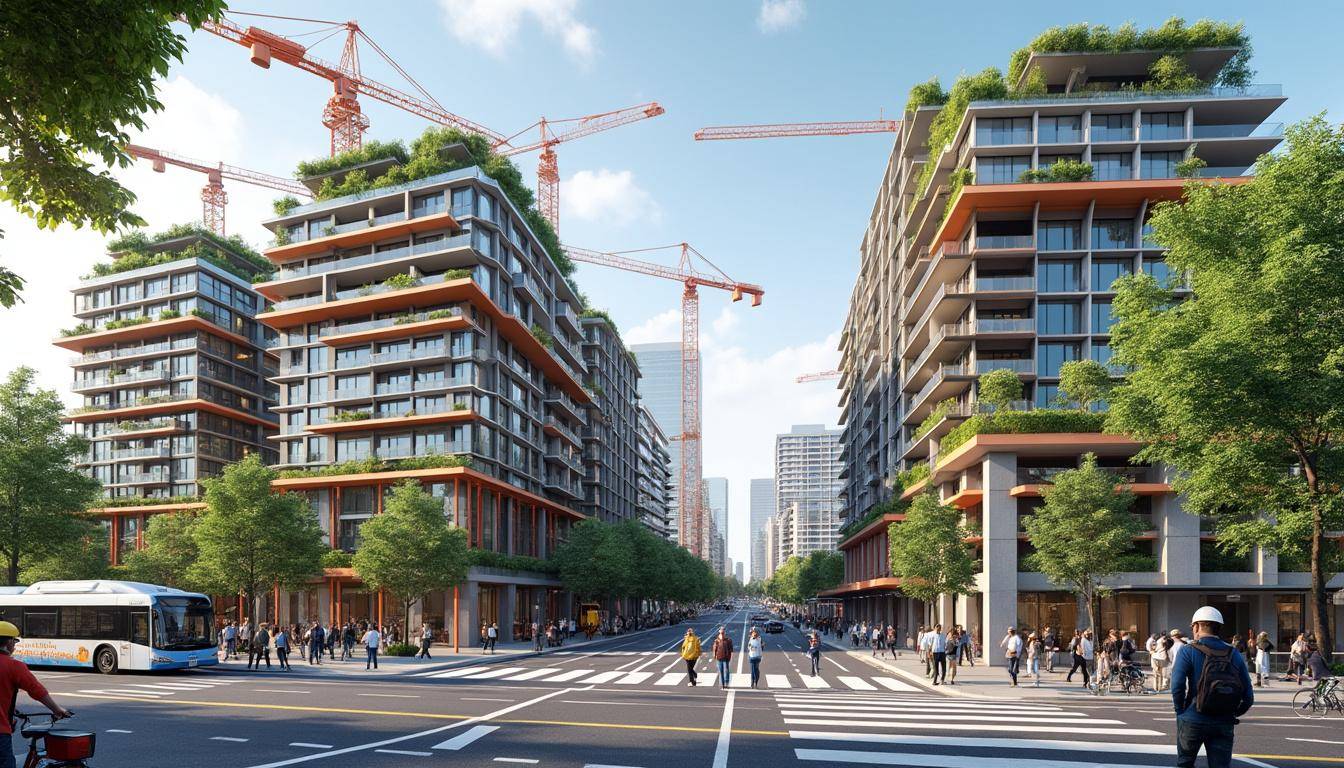
Governor Wes Moore’s push to convert idle public parcels adjacent to rail and bus corridors into productive, mixed-use neighborhoods has crystallized into a clear policy agenda in 2026. Built around an executive order called Housing Starts Here and companion legislation—the Maryland Transit and Housing Opportunity Act—the administration is focused on unlocking state land to accelerate homebuilding, create jobs, and concentrate growth at transit hubs. This strategy targets more than 300 acres of state-owned land near stations, with official estimates of upwards of 7,000 new housing units and nearly $1.4 billion in prospective tax revenue over time. For a state confronting a gap of roughly 96,000 housing units, the plan blends zoning relief, streamlined permitting, and targeted financing to nudge development from parking lots and underused lots into productive, transit-oriented districts.
As a finance expert based in New York who has worked across banking and capital markets, I follow these proposals with a pragmatic lens: the macro numbers are compelling, but the success of public land strategies turns on financing design, municipal capacity, and public-private partnerships that distribute risk and deliver affordable outcomes. This article follows a hypothetical project team led by Aisha Morgan, a mid-sized developer from Baltimore, as she evaluates parcels near the Capitol Heights Metro and Reisterstown Plaza stops. Through her experience we analyze policy mechanics, economic impacts, municipal concerns, and an actionable roadmap for turning policy into built places that deliver Affordable Housing, spur Economic Development, and strengthen Public Transportation.
Moore Champions Unlocking State Land: Policy Design and Legislative Mechanics
The heart of the governor’s agenda is to re-purpose state-owned parcels—often vacant parking lots or maintenance yards—into transit-oriented development (TOD). The proposed legislation (Senate Bill 389 and House Bill 894) and the executive directive together create a toolkit: identify candidate parcels; waive or relax minimum parking requirements for qualifying projects; enable mixed-use zoning near major stations; and give the state expanded authority to assemble or lease land for development. These provisions aim to shorten the timeline between a developer’s proposal and the delivery of units by clarifying land control and aligning state permitting.
A key design decision is the elimination of minimum parking requirements for eligible projects. Removing these mandates lowers construction costs per unit, increases density, and reinforces transit usage by not subsidizing excessive parking. For Aisha Morgan, that single change shifts project economics: instead of building structured parking that consumes capital and floorspace, she can allocate those resources to more units, deeper affordability, or placemaking amenities that increase long-term value.
State Authority, Local Roles, And The Balance Of Power
The bills contemplate giving the state authority to act on land adjacent to transit, but the administration is framing that power as a partnership with local governments. State leverage is highest when dealing with properties under direct state control, which explains the initial focus on state land. Still, city leaders like State Sen. Antonio Hayes have urged expansion to city-owned sites—particularly in districts such as Baltimore’s Black Arts and Entertainment District—where local ownership can unlock complementary benefits. Governor Moore responded by acknowledging state land is the highest-leverage target now, while leaving room for future negotiations with municipalities.
Intergovernmental friction is expected. The Maryland Municipal League has pointed to the fiscal mechanics—specifically the proposal to delay certain impact fees and apply automatic enterprise zone tax credits—which could shift up-front costs to municipalities. For the private sector, predictable fee structures are essential for underwriting financing. The administration has indicated it will workshop details with local governments so that necessary infrastructure investments—roads, stormwater, public safety—are properly financed and don’t saddle cash-strapped towns with undue risk.
From a financing viewpoint, these policy moves lower barriers but do not substitute for capital. Developers will depend on a mix of tax credits, gap financing, and market debt. The state’s authority to assemble parcels and reduce entitlement risk increases bankable predictability—an attractive prospect for institutional capital and community lenders alike. For Aisha, state-supported land assembly and predictable fees mean lower contingency buffers in her pro forma, which in turn translates to faster closings and more attractive pricing for mixed-income units. Final insight: well-calibrated state authority paired with municipal collaboration is the linchpin for moving projects from concept to construction.
Economic Development Case For Transit Hubs: Jobs, Revenue, And Long-Term Value
When assessing the fiscal case for converting underutilized state land into housing and commercial uses, the numbers in Governor Moore’s brief are persuasive. The administration forecasts approximately 7,000 housing units and nearly $1.4 billion in tax revenue from more than 300 acres. But a robust economic argument must go beyond headline figures to examine job creation, multiplier effects, and neighborhood uplift.
Construction activity alone generates short-term employment—carpenters, electricians, site workers—followed by enduring roles in property management, retail, transit operations, and professional services. For an illustrative project at Capitol Heights where Aisha seeks to build 450 units with ground-floor retail, conservative construction estimates imply hundreds of direct construction jobs over a multi-year build, and dozens of permanent positions after stabilization. These employment streams contribute to local incomes and expanded consumer spending near stations, reinforcing a virtuous cycle: more riders, higher retail revenue, and better justification for transit investments.
Quantifying Fiscal Benefits And Risks
To ground the projection, consider three buckets: upfront construction tax revenue (sales and payroll-related taxes), ongoing property and income tax streams, and regional spillovers (increased patronage of transit and local businesses). The nearly $1.4 billion figure appears to incorporate both one-time and recurring revenue streams over a multi-year horizon. Municipalities will weigh these benefits against the fiscal costs of service expansion—trash collection, policing, school capacity—and that is where delayed fee collection and enterprise zone credits become politically sensitive.
Private capital views the proposition through the lens of risk-adjusted returns. Transit-adjacent properties typically command a rent premium because they offer accessibility to employment centers, which supports both market-rate and workforce housing demand. For institutional equity and debt providers, state-led site preparation and streamlined permitting materially reduce entitlement risk, making TOD projects eligible for lower-cost financing and higher leverage. This dynamic improves the overall feasibility of mixed-income projects that include Affordable Housing units alongside market-rate homes.
Finally, the scenario underlines a broader economic development theme: aligning housing growth with transit fosters inclusive prosperity if paired with targeted workforce development and small-business support. Aisha’s project includes a local hiring covenant and retail leasing set-asides for minority-owned firms; those commitments convert theoretical economic uplift into tangible community outcomes. The insight: focusing growth at Transit Hubs amplifies economic value, but success depends on deliberate, measurable commitments to jobs and local business inclusion.
Financing Strategies And Affordable Housing Tools For Unlocking State Land
Translating policy into built housing requires careful layering of capital. The administration’s reforms—relaxed parking mandates, state land availability, and permitting acceleration—improve project viability, but developers still need equity, construction loans, and gap financing to deliver affordable units. Public sources like low-income housing tax credits, state trust funds, and targeted subsidy programs will remain central.
One practical resource for practitioners is the evolving universe of affordable housing finance. Developers can combine traditional LIHTC (Low-Income Housing Tax Credit) equity with state housing trust funds and municipal contributions to close funding gaps. For market-rate segments, conventional debt and institutional equity often suffice when entitlement risk is mitigated by state-led land assembly. Readers interested in financing mechanisms can review best-practice frameworks on affordable housing financing for guidance on structuring these transactions: models for financing affordable housing.
Mitigating Timing And Revenue Risks
Governor Moore’s proposal to delay certain developer fees until after construction is completed is designed to improve cash flow during development. While that improves short-term feasibility, it shifts timing risks to municipalities unless there are guarantees or state backstops. To balance this, the state could offer bridging loans or pay-as-you-go mechanisms that reimburse localities when projects generate tax revenue.
Developers also consider tax tools that create long-term affordability. Automatic enterprise zone credits can attract private investment into higher-need neighborhoods, but they must be carefully structured to avoid reducing long-term municipal revenue below sustainable levels. There are complementary private mechanisms—impact investors and social-purpose funds—that accept modest returns to ensure deeper affordability alongside market units. For insight into tax policy and affordability, see an analysis on affordable housing tax incentives that explains trade-offs: affordable housing tax incentives explained.
From Aisha’s perspective, the state’s land assembly reduces up-front land cost—often the largest single friction in dense, transit-proximate projects. That savings can be reallocated to affordability commitments or resiliency investments (stormwater management, EV infrastructure). The practical lesson: strategically blended financing—public subsidy, tax equity, and patient private capital—unlocks projects that deliver both market units and meaningful affordable housing. Final insight: financing innovation must match policy ambition to turn land into homes without excessive fiscal strain on local governments.
Community Impacts, Municipal Concerns, And A Practical Implementation Roadmap
Public acceptance is crucial. The Maryland Municipal League has highlighted concerns that delayed developer fees and automatic tax credits could shift immediate costs to local governments. These concerns are pragmatic: infrastructure upgrades, stormwater systems, and public safety expansions are real and often financed through upfront developer contributions. For the program to scale, state and local leaders must design explicit mitigation measures, such as escrowed contingency funds or phased reimbursement tied to revenue milestones.
Aisha’s approach in community engagement provides a model. She convenes neighborhood meetings early, publishes a phased infrastructure plan, and outlines workforce commitments upfront. Her sequence: negotiate a memorandum of understanding with the municipality, secure state gap financing contingent on local infrastructure commitments, and then proceed to finalize private financing. This sequence reduces surprises and distributes responsibilities where they belong.
Stepwise Roadmap For Scaling Transit-Oriented Projects
- Identify and catalog state parcels near transit and assess service capacity.
- Engage municipalities to quantify upfront infrastructure needs and co-design fee timing.
- Design financing stacks that blend tax credits, state gap funds, and private capital.
- Create workforce and small-business hiring covenants to amplify local job impact.
- Implement monitoring and revenue sharing to protect municipal fiscal health.
Below is a simple table summarizing projected impacts for a hypothetical first-phase program that repurposes 300 acres near transit.
| Metric | Projection | Notes |
|---|---|---|
| Acres Identified | 300+ | State-owned parcels near Metro and MARC stops |
| Housing Units | ~7,000 | Mixed-income target across multiple sites |
| Projected Tax Revenue | ~$1.4 billion | Combination of one-time and recurring streams |
| Short-term Construction Jobs | Hundreds per large site | Depends on phasing and build-out timeline |
As Maryland moves forward, there are external market signals to monitor—interest rate trajectories, investor appetite for mixed-income projects, and broader housing market dynamics. For readers tracking investment angles, resources on housing market investment can help frame the broader capital context: housing market investment trends.
The practical insight: a phased, transparent roadmap that pairs state land assembly with clear municipal protections and predictable financing will be the decisive factor in converting policy into homes and jobs around Transit Hubs. This approach both reduces developer risk and preserves local fiscal stability, setting the stage for scalable Economic Development anchored by Public Transportation.