

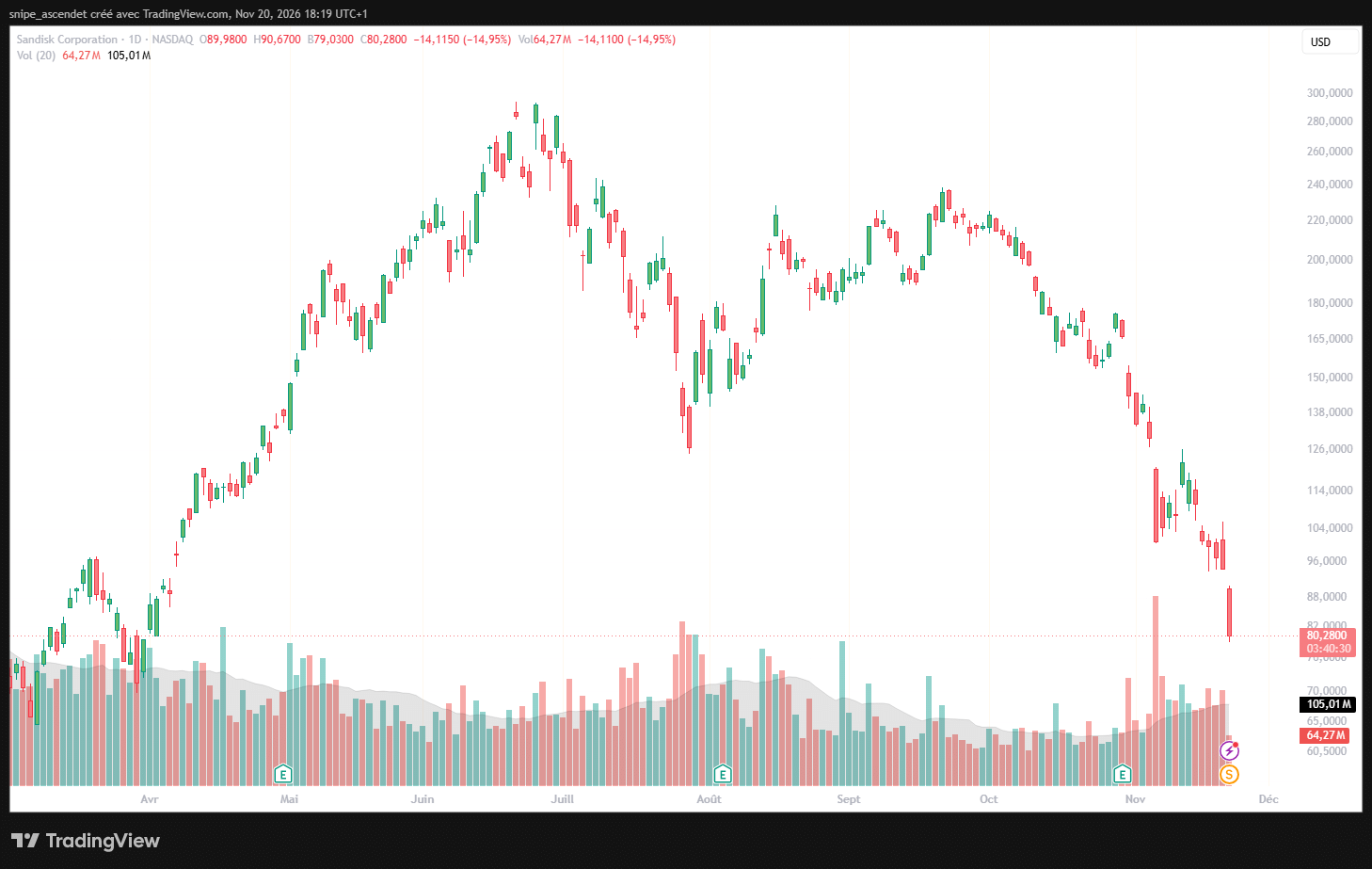
Sandisk (NASDAQ: SNDK) fell 14.95% to $80.28 and Micron Technology (NASDAQ: MU) dropped 12.51% to $604.06 at 12:19 p.m. ET on Friday, November 20, 2026, as memory stocks came under pressure following a bearish NAND flash forecast. TrendForce expects NAND contract prices to decline 0%–5% quarter over quarter in the first quarter of 2027 after a smaller-than-anticipated increase in late 2026. For shareholders, the key issue is how fast that pricing reversal could erode storage margins, and whether AI-related demand can protect diversified producers and South Korea’s chip-heavy export sector.
Why Did Sandisk and Micron Stocks Fall on November 20?
The selling was severe well before the closing bell. Sandisk traded between $79.03 and $90.67 on November 20, 2026, while Micron traded between $599.15 and $669.00 by 12:19 p.m. ET. Their losses far exceed the 0%–5% quarterly NAND contract-price decline projected for early 2027, highlighting how stock prices can reprice expectations for several future quarters rather than the immediate change in sales.
| November 20 intraday reading, 12:19 p.m. ET | Sandisk (SNDK) | Micron (MU) |
|---|---|---|
| Latest price | $80.28 | $604.06 |
| Decline vs. November 19 close | 14.95% | 12.51% |
| Session high | $90.67 | $669.00 |
| Session low | $79.03 | $599.15 |
| Volume at that time | 64.27 million shares | 28.06 million shares |
Sandisk’s price needs one important adjustment. The company completed an eight-for-one forward stock split, with split-adjusted trading beginning November 20. The split divided the per-share quotation by eight and multiplied the share count by eight. It did not itself destroy 87.5% of shareholders’ market value; the reported 14.95% daily decline is measured against the adjusted prior close.
The Micron selloff reflects a broader reassessment of memory profitability, even though the company sells DRAM and high-bandwidth memory as well as NAND. The sharp November 20 decline extends the stock’s retreat from its mid-2026 highs. NAND exposure is relevant, but a one-day share-price loss cannot be attributed exclusively to that product category.
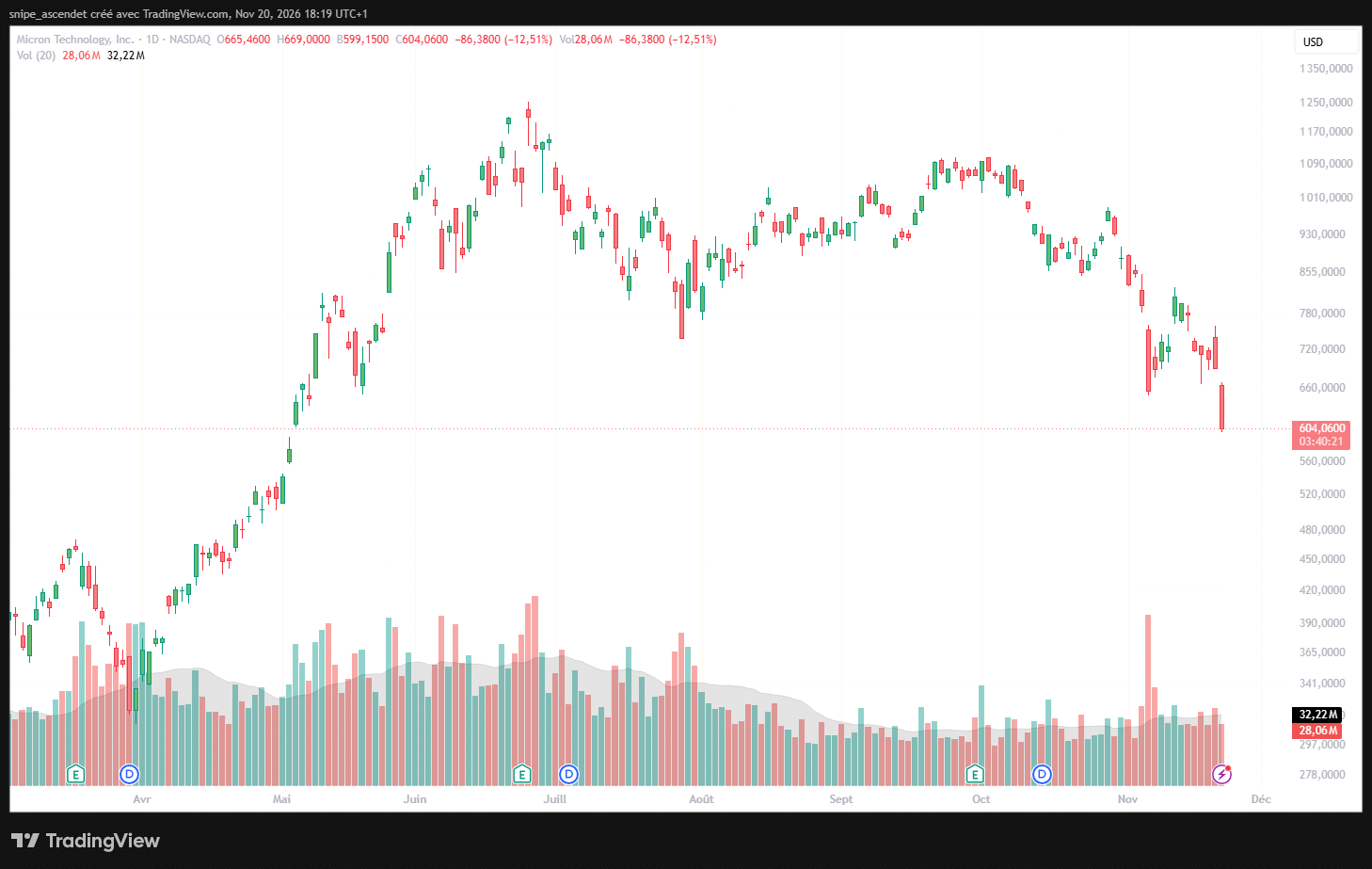
These readings are intraday, not closing prices. The volumes are cumulative at the stated time and should not be compared directly with final daily trading totals.
How Far Will NAND Flash Prices Fall in 2027?
Contract prices are negotiated between suppliers and customers. Spot prices cover smaller, immediate trades and may move much faster.
| Contract-price period | TrendForce projection | Comparison |
|---|---|---|
| Q4 2026 | Increase of 8%–13% | Quarter over quarter |
| Q1 2027 | Decline of 0%–5% | Quarter over quarter |
| Q2 2027 | Decline of 0%–5% | Quarter over quarter |
TrendForce had expected a 15%–20% fourth-quarter increase in its September 30 forecast. The revised 8%–13% range is seven percentage points lower at both ends. It also reports that NAND spot prices recently corrected by more than 20%, a sharper move than the expected decline in contract prices.
Two consecutive 5% quarterly declines would leave the Q2 2027 contract-price level 9.75% below Q4 2026, not 10%, because changes compound. That is a forecast boundary, not a universal price path.
Why Are NAND Prices Weakening Despite AI Demand?
TrendForce identifies a supply-demand mismatch. It projects global NAND industry capital spending to reach $29.9 billion in 2027, up 26.7% year over year, and worldwide NAND bit supply to grow 25%–30%. Higher-layer-count manufacturing and greater adoption of quad-level-cell (QLC) products allow producers to ship more storage capacity even without proportional increases in wafer starts.
Demand is moving in the opposite direction in important markets. Chinese cloud service providers have cut planned enterprise SSD orders amid excess inventories, constraints on advanced GPUs and tougher AI-service economics. TrendForce says those cuts exceed the incremental storage demand expected from U.S. cloud providers, where AI-agent and server projects are still supporting orders.
Consumer electronics add another weakness. Expensive finished devices are delaying some purchases, while manufacturers are considering less storage capacity per PC or smartphone to control bills of materials. Selling fewer devices with less storage weakens total NAND demand. The November 18 TrendForce market bulletin describes inventory liquidation and growing pressure on contract negotiations.
Which Memory Stocks Have the Greatest Exposure?
A decline in industrywide NAND pricing affects suppliers differently. Product mix, long-term agreements, manufacturing cost per bit and the size of their DRAM businesses all determine the earnings impact.
| Stock or company | Business exposure | Main shareholder question |
|---|---|---|
| Sandisk (NASDAQ: SNDK) | Focused on NAND flash and SSDs | Can data-center mix and customer contracts defend margins? |
| Micron (NASDAQ: MU) | NAND plus DRAM and high-bandwidth memory | Can stronger DRAM profits offset weaker NAND pricing? |
| Samsung Electronics (KRX: 005930) | NAND, DRAM, foundry, smartphones and other electronics | Will memory pricing pressure outweigh gains elsewhere? |
| SK Hynix (KRX: 000660) | DRAM/HBM, NAND and enterprise SSDs | Can HBM and enterprise storage cushion a NAND downcycle? |
| Kioxia (TSE: 285A) | NAND-focused storage manufacturing | How quickly will lower market prices reach realized selling prices? |
Sandisk is a particularly direct U.S.-listed way to monitor the NAND cycle. Its fiscal first-quarter 2027 results, for the period ended October 2, 2026, showed $11.031 billion in revenue and an 85.0% GAAP gross margin. Data-center revenue rose 61% sequentially to $4.802 billion, but consumer revenue fell 29% to $397 million. Data centers contributed approximately 43.5% of quarterly sales, making enterprise demand a major potential buffer, though not immunity from weaker prices.
The company also reported multi-year agreements with data-center and edge customers featuring pricing mechanisms and purchase commitments. Protection depends on each agreement’s pricing terms. Investors should compare realized gross margin and cash generation with the favorable assumptions embedded in Sandisk’s fiscal second-quarter 2027 outlook.
Micron has a different earnings mix. The company sells both NAND storage and DRAM, including memory used in AI servers. In its fiscal fourth-quarter 2026 release, Micron highlighted shipments of high-performance data-center SSDs and strong cloud-memory demand. NAND weakness matters, but it should not be treated as a forecast for the pricing of DRAM or high-bandwidth memory.
Valuations based on peak NAND margins are vulnerable to forecast revisions before revenues turn down. Premium storage, lower costs or DRAM strength could soften the effect.
Why South Korea Is Especially Vulnerable
South Korea’s exposure extends beyond individual share prices. According to figures from its industry ministry reported November 19 by Yonhap, semiconductor exports reached $397.7 billion from January through October 2026, equal to 42.7% of total merchandise exports over that period. NAND accounts for only part of those semiconductor shipments, but a sustained reversal in memory pricing could still weaken export receipts even if physical shipment volumes remain healthy.
Samsung’s third-quarter 2026 results showed a record quarter for its memory operations, alongside a shift toward HBM4, server DRAM and QLC enterprise SSDs. SK Hynix likewise reported strong enterprise SSD demand and said long-term customer agreements cover more than half its total planned 2027–2028 production capacity, with mechanisms that allow prices to respond to market conditions. Those agreements support visibility, but do not make selling prices fixed.
On November 20, Reuters reported that a planned conversion would give SK Hynix an indirect 14.1% stake in Kioxia, adding another connection to NAND industry profitability.
Foreign capital flows could amplify the reaction: Reuters reported on November 19 that overseas investors were on track for a seventh consecutive month of net selling in Korean equities.
Why DRAM and HBM Could Still Protect Earnings
NAND stores data persistently; DRAM temporarily holds data that processors need to access quickly; HBM is a specialized form of DRAM used alongside advanced AI accelerators. Their price cycles differ.
That distinction is central to South Korea’s investment case. Samsung and SK Hynix have exposure to NAND, but also sell higher-value server DRAM and HBM. The relevant question is not simply whether NAND prices fall: it is whether the profit contribution from DRAM and HBM is large enough to offset lower flash margins and any inventory adjustment.
This is also consistent with the broader debate over the durability of AI spending. Our earlier analysis examined cuts to long-term AI infrastructure forecasts, while our Nvidia earnings review addressed the scale of supply commitments. The forecast highlights divergent regional demand, not universal weakness.
What a 5% Price Decline Could Do to Profit Margins
Price changes can have an outsized effect on operating results when much of a semiconductor maker’s manufacturing cost is already committed. Consider an illustrative NAND product line, with unchanged unit shipments and costs held constant over the comparison period:
| Illustrative metric | Before price cut | After a 5% price cut |
|---|---|---|
| Revenue | $100 | $95 |
| Cost of goods sold | $70 | $70 |
| Gross profit | $30 | $25 |
| Gross margin | 30.0% | 26.3% |
Gross profit falls 16.7% in this simplified example, although selling prices decline just 5%. Actual results also depend on volumes, inventory accounting, efficiency and product mix.
For customers, cheaper NAND could eventually reduce the cost of SSDs, cloud storage and device configurations. But consumer retail prices will not necessarily track contract prices immediately, especially where manufacturers have already committed to higher-priced components or are reducing storage specifications.
What Should Investors Watch Next?
The next test is contract negotiations during Q1 2027 (January 1–March 31) and whether enterprise SSD prices hold up better than consumer NAND. The second is Q2 2027 (April 1–June 30), when TrendForce expects price declines to reach every NAND product category. Investors should follow quarterly realized selling prices, inventory days, shipments measured in bits, gross margins and revisions to 2027 capital spending.
Watch Korea’s monthly semiconductor-export values alongside company margins, but separate NAND from DRAM before drawing conclusions. Our analysis of the S&P 500’s break below its 200-day moving average explains why investors have been less tolerant of downside revisions across AI-related shares.
Bottom line: The November 20 selloff is pricing in an approaching NAND supply surplus, not a uniform collapse across all memory products. Sandisk and other NAND-focused companies have the most direct pricing exposure; Micron, Samsung and SK Hynix have additional DRAM, HBM or diversified earnings streams, while South Korea faces a wider export and stock-market sensitivity. The shareholder test for 2027 is whether enterprise demand and a richer product mix can protect gross profit as contract prices turn lower.
For informational purposes only; not investment advice.