


Update, 1:46 p.m. ET: Bitcoin traded at $64,934.64 on Coinbase at approximately 1:45 p.m. ET on Monday, November 16, 2026, according to TradingView, still below the $65,000 threshold. U.S. spot Bitcoin ETFs lost a net $2.347 billion between November 2 and November 13, while the Invesco QQQ Trust (NASDAQ: QQQ) traded at $662.40, down 2.57% from Friday’s close. The combination points to weaker institutional demand and a broader retreat from risk-sensitive assets rather than a single crypto-specific shock.
Bitcoin’s Latest Bounce Has Not Broken the Downtrend
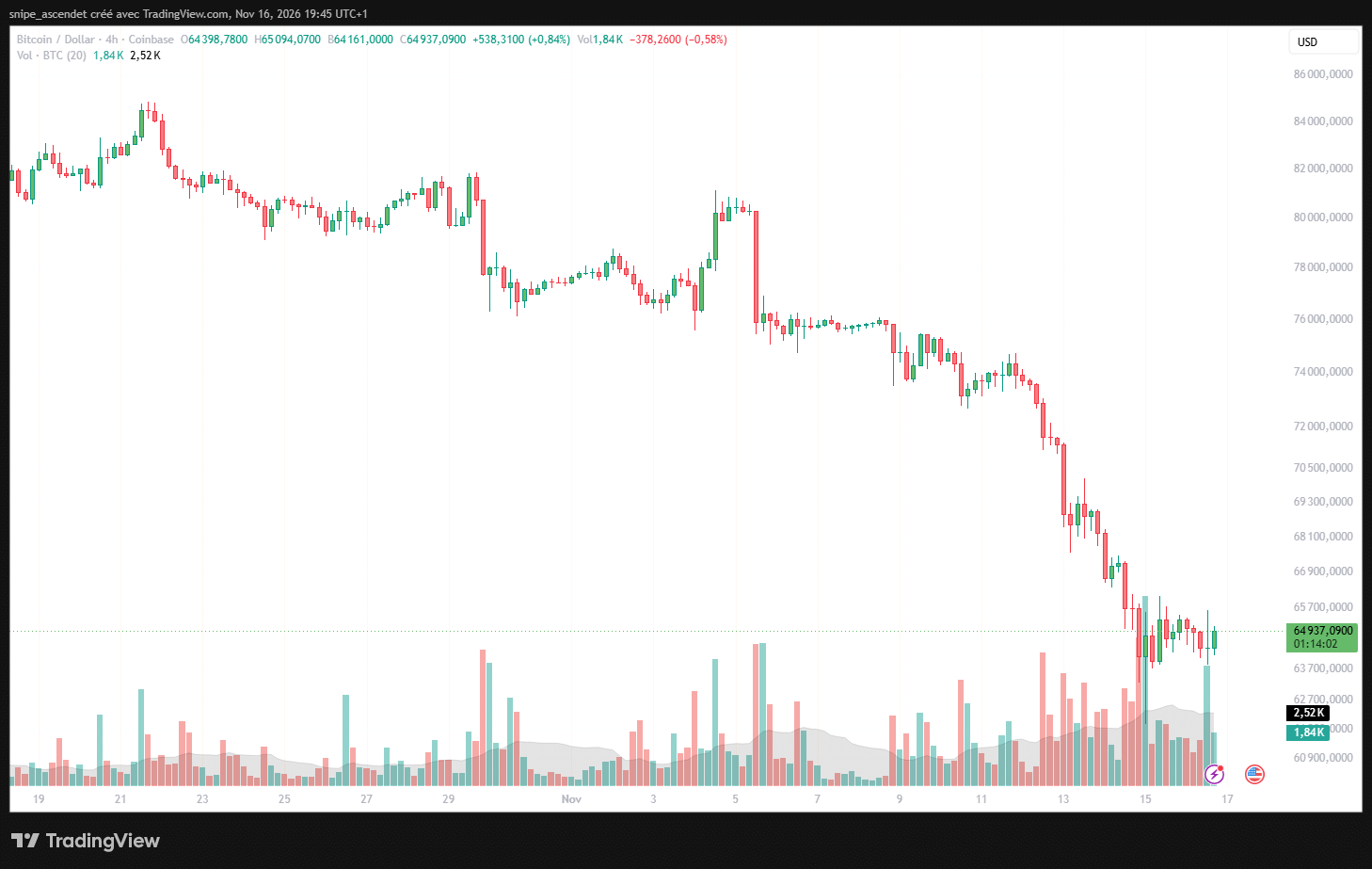
Bitcoin’s daily trading range on November 16 was $63,832.94 to $65,626.98 as of 1:45 p.m. ET. Its $64,934.64 quote was 18.83% below the $80,000 reference level it had exceeded earlier in November. The daily candle was down 0.58% at that point, but the larger concern is the sequence of lower highs and lower lows that developed after the early-November recovery.
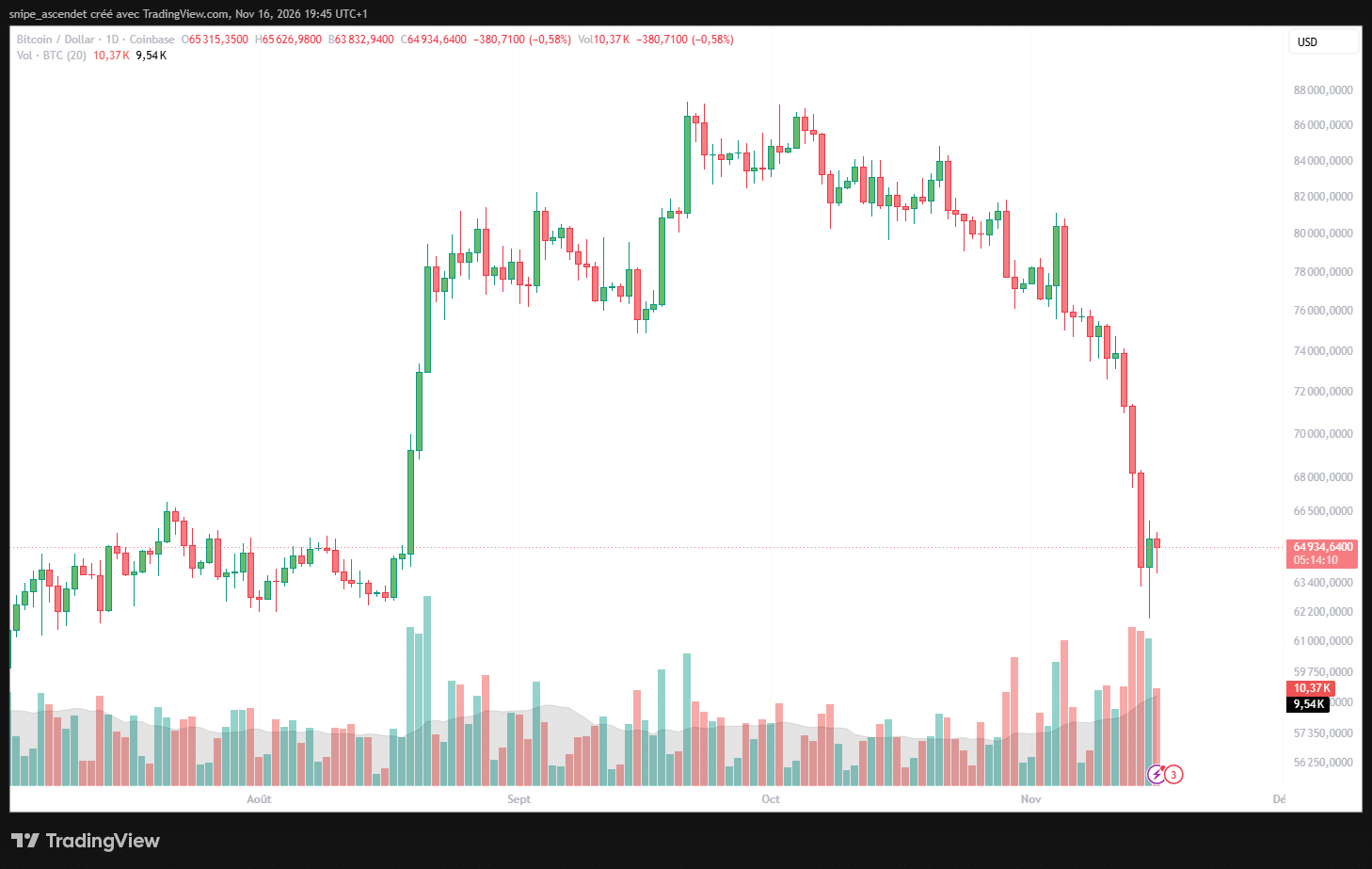
Selling accelerated during November 12–15 before Bitcoin stabilized near $64,000–$65,000. A short pause does not establish a trend reversal.
Spot Bitcoin ETFs Have Lost $2.35 Billion This Month
The most measurable demand warning comes from U.S. spot Bitcoin funds. Farside Investors’ daily fund-flow records show net withdrawals of $2,347.0 million across the ten trading sessions from November 2 through November 13. Seven consecutive sessions from November 5 through November 13 accounted for $1,907.4 million of that total.
| Period | US spot Bitcoin ETF net flows |
|---|---|
| November 2–4 | -$439.6 million |
| November 5–6 | -$842.1 million |
| November 9–13 | -$1,065.3 million |
| November 2–13 total | -$2,347.0 million |
Friday, November 13 alone brought $185.4 million in net outflows, including $143.5 million from BlackRock’s iShares Bitcoin Trust (NASDAQ: IBIT) and $41.9 million from Fidelity’s Fidelity Wise Origin Bitcoin Fund (NYSE Arca: FBTC). November 16 ETF flows were not finalized at the time of this update.
ETF redemptions weaken a source of potential spot demand, though they do not measure every Bitcoin sale. Exchange traders and long-term holders also influence prices. Sustained net creations would offer stronger evidence of recovering institutional interest than a brief bounce.
Inflation and Federal Reserve Policy Are Keeping Pressure on Risk Assets
Bitcoin’s weakness is occurring as investors reassess U.S. interest rates. The Bureau of Labor Statistics reported that October consumer prices rose 0.4% month over month, while core CPI increased 0.3%. Most October 2026 year-over-year CPI comparisons were not published because the equivalent October 2025 figures were unavailable.
At its October 28 meeting, the Federal Reserve held its target policy-rate range at 3.75%–4.00%. Two policymakers preferred a quarter-point increase. Elevated inflation and higher Treasury yields have made the outlook for another rate increase a factor in market pricing, although the December decision has not been made.
Bitcoin pays no interest, making higher Treasury yields an opportunity cost. Restrictive financial conditions can also hurt growth-stock valuations. DualFinances examined this shift in its analysis of the inflation-driven Treasury yield jump and its November 13 market recap.
QQQ’s Decline Shows That This Is Also a Broader Risk-Appetite Problem
The Nasdaq-100 ETF offers an important cross-check. QQQ was trading at $662.40 at approximately 1:46 p.m. ET on November 16, compared with its November 13 closing price of $679.89, a 2.57% decline. Its intraday four-hour low had reached $660.55. The prior close can be cross-checked against QQQ’s historical price record.
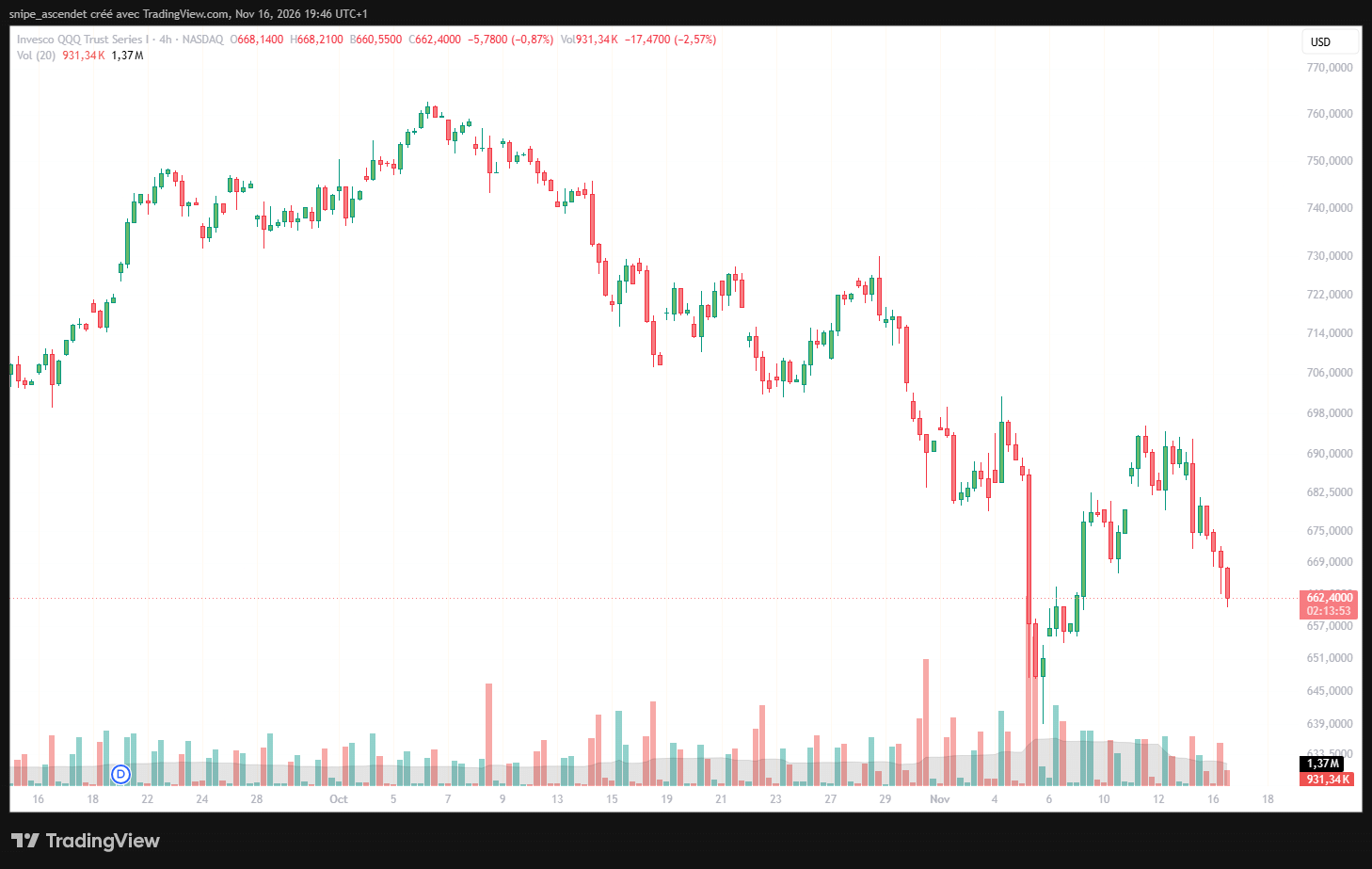
Bitcoin trades continuously, but QQQ trades during U.S. market hours. Their returns cannot be compared perfectly, yet their concurrent weakness points to reduced risk appetite. The November 12 Wall Street selloff had already highlighted the pressure from rising yields and technology-stock volatility.
Leverage Can Magnify a Selloff When Buyers Step Aside
Leverage can intensify crypto declines. When collateral falls below an exchange’s requirement, forced position closures add selling pressure. Repeated liquidations can accelerate losses.
That risk increases when prices break levels such as $70,000 and $65,000, although liquidations cannot be quantified from prices alone. Bitcoin ETF shareholders also face weekend gaps before U.S. markets reopen.
What Investors Should Watch Next
- ETF creations and redemptions: A sustained return to net inflows would signal improving demand; another week of withdrawals would keep the pressure on.
- Bitcoin’s price range: About $63,800 is the observed November 16 session low, with the recent area near $62,000 a deeper downside reference. A recovery through $65,000 and then $68,000–$70,000 would improve the short-term picture.
- Rates and technology stocks: Treasury yields, forthcoming inflation reports and QQQ’s ability to stabilize will help show whether the selling pressure extends beyond cryptocurrencies.
Bottom line: Bitcoin’s November decline reflects a difficult combination of persistent ETF outflows, restrictive financial conditions and pressure on other risk-sensitive assets. The price has shown signs of stabilizing near $65,000, but the more meaningful test is whether institutional flows and the broader market backdrop improve together.
Data as of 1:46 p.m. ET, November 16, 2026. For informational purposes only; not investment advice.