


The founder of Situational Awareness LP expects artificial intelligence to create extraordinary economic value. But Nvidia, Microsoft, Apple, Tesla and several other market leaders may eventually lose the competitive advantages that justify their valuations.
Leopold Aschenbrenner is increasingly bullish on artificial intelligence while questioning the long-term value of some of the world’s largest technology companies.
In a November 24, 2026, letter to investors, the founder of Situational Awareness LP outlined a scenario in which increasingly autonomous AI systems accelerate scientific research, semiconductor development and software engineering. The same technological progress could eventually undermine the intellectual property, pricing power and engineering expertise of established market leaders.
The analysis comes after a difficult period for his hedge fund. According to The Wall Street Journal, Situational Awareness lost 65% after fees during the third quarter of 2026, despite remaining profitable for the year through September.
His investment thesis raises a fundamental question: what if the greatest long-term risk to today’s AI stocks is not the failure of artificial intelligence, but its success?
Leopold Aschenbrenner’s AI Thesis: Three Years of Progress in 2027
Aschenbrenner’s original Situational Awareness analysis, published in June 2024, anticipated that artificial intelligence would eventually accelerate its own development.
This mechanism is known as recursive self-improvement, or RSI. AI systems assist researchers in developing more capable models, which subsequently accelerate further research.
His November 2026 investment thesis extends this concept to corporate valuations.
According to the fund, 2027 could deliver the equivalent of three years of AI progress at its earlier baseline pace. Aschenbrenner also considers the emergence of artificial superintelligence in 2028 plausible, although the timing remains highly uncertain.
| Indicator | Situational Awareness projection |
|---|---|
| Overall AI progress acceleration in late 2026 | 1.5 to 2 times the earlier pace |
| AI progress in 2027 | Equivalent to approximately three baseline years |
| AI research automation | Potentially superhuman researchers by the end of 2027 |
| OpenAI and Anthropic combined annualized revenue | Above $1 trillion by the end of 2027 |
| Artificial superintelligence | Potential emergence in 2028 |
Source: Situational Awareness LP, Q3 2026 investor letter; public reporting on the fund’s projections.
These projections represent the fund’s expectations, not established technological outcomes or official corporate guidance.
The distinction between AGI and ASI is essential. Artificial general intelligence could perform a broad range of tasks at approximately human levels. Artificial superintelligence would exceed human capabilities across a wide range of scientific, technical and economically valuable activities.
The first development could increase the profitability of technology companies. The second could fundamentally change the source of that profitability.
Why the World’s Most Valuable Companies Could Become Vulnerable
Much of the market value of large corporations reflects assets that are difficult for competitors to reproduce.
These include patents, proprietary software, engineering expertise, brands, distribution networks, customer relationships and accumulated organizational knowledge.
Aschenbrenner argues that superintelligence could dramatically reduce the cost of reproducing or surpassing many of these assets.
His fund’s analysis of Federal Reserve financial accounts, presented on page 115 of the investor letter, estimates the economic value of US nonfinancial corporations at $77 trillion, divided as follows.
| Component | Estimated value | Share |
|---|---|---|
| Physical assets and inventories | $28 trillion | 36.4% |
| Recorded intellectual property | $5 trillion | 6.5% |
| Residual value beyond recorded assets | $44 trillion | 57.1% |
| Total | $77 trillion | 100% |
Source: Situational Awareness LP calculations using Federal Reserve Financial Accounts, through Q2 2026. The $44 trillion figure is a valuation residual, not a direct measurement of human capital.
Approximately 57.1% of the estimated value is not represented by the physical assets and recorded intellectual property identified in the calculation.
This does not mean that AI will destroy $44 trillion of corporate wealth. It does, however, illustrate how much corporate value depends on expected future profitability rather than physical assets alone.
If AI reduces barriers to entry, companies could face declining margins even while economic output increases substantially.
Why Aschenbrenner Is Bearish on Nvidia’s Long-Term Moat
Nvidia (NASDAQ: NVDA) is the clearest example of the tension between near-term demand and long-term competitive risk. Aschenbrenner expects strong chip sales but questions whether today’s exceptional margins can persist for decades. His concern is that AI-assisted chip design and software portability could make the company’s technological advantages less durable, as public reporting on the letter explains.
Nvidia’s November 17 fiscal Q3 2027 results show the scale of its current franchise.
| Metric | Fiscal Q3 2027 | Fiscal Q3 2026 |
|---|---|---|
| Revenue | $115.8B | $57.0B |
| GAAP gross margin | 74.8% | 73.4% |
| GAAP operating income | $77.5B | $36.0B |
| GAAP diluted EPS | $2.70 | $1.30 |
The quarter ended October 25, 2026. Data Center revenue reached $107.6 billion, or approximately 92.9% of total sales. The company guided to fiscal Q4 revenue of $130 billion, plus or minus 3%, and gross margins of 71% to 72% on both a GAAP and non-GAAP basis. That quarter contains an additional week.
The bearish case rests on three mechanisms: cheaper custom-chip development, easier migration away from CUDA, and customers capturing more of the value previously earned by chip designers. Yet Nvidia can deploy the same AI tools, accelerate its roadmap and benefit from rising demand for computing power. Falling margins alone would not demonstrate that its moat has disappeared. See our Nvidia fiscal Q3 earnings analysis for the immediate financial risks.
Seven Other Semiconductor Companies Under Pressure
The letter explicitly discusses AMD, Broadcom, Qualcomm, Arm, Synopsys, ASML and TSMC, but the financial risks differ significantly. The following table applies the fund’s general thesis to each business model.
| Company | Business at risk | What could preserve value |
|---|---|---|
| AMD (NASDAQ: AMD) | CPU and accelerator design differentiation | AI-assisted engineering and higher accelerator market share |
| Broadcom (NASDAQ: AVGO) | Custom silicon and networking IP | Complex systems integration and customer relationships |
| Qualcomm (NASDAQ: QCOM) | Chip design differentiation and licensing economics | Standards-essential patents and device integration |
| Arm Holdings (NASDAQ: ARM) | Architecture licensing and royalties | Compatibility, software ecosystems and installed base |
| Synopsys (NASDAQ: SNPS) | Electronic design automation and reusable chip IP | Verification, manufacturing integration and AI-enabled design tools |
| ASML (NASDAQ: ASML) | Long-term lithography technology leadership | Precision manufacturing, supplier networks and installed equipment |
| TSMC (NYSE: TSM) | Fabrication scarcity if advanced factories become cheaper to build | Manufacturing yields, scale and near-term capacity constraints |
TSMC and ASML are not equivalent to fabless chip designers. Designing a better circuit does not automatically produce a commercial semiconductor. Manufacturing equipment, process qualification and production yields impose physical constraints. Aschenbrenner recognizes that TSMC may earn substantial cash during a capacity shortage; his concern is whether it captures enough of that value before competing capacity expands.
Why AI Agents Could Disrupt Microsoft, Apple and Enterprise Software
AI agents may increasingly operate software on behalf of employees or build internal applications directly. That could shift spending from traditional software licenses toward AI model usage and make some per-user subscriptions less valuable.
| Company | Potential financial exposure | Countervailing advantage |
|---|---|---|
| Microsoft (NASDAQ: MSFT) | Office and Windows licensing, premium Azure services | Cloud distribution, enterprise data and security |
| Apple (NASDAQ: AAPL) | Device differentiation and App Store commissions | Hardware integration, brand and installed base |
| Salesforce (NYSE: CRM) | CRM seat counts and pricing | Customer data, workflows and governance |
| Adobe (NASDAQ: ADBE) | Creative subscriptions and content production | Professional tools, integration and licensing |
| ServiceNow (NYSE: NOW) | Workflow subscription pricing | Enterprise permissions, process data and auditability |
| C3.ai (NYSE: AI) | Differentiation of application-layer AI products | Industry integrations and specialized deployment |
Microsoft and Apple are individually discussed in the letter. Adobe is used elsewhere as a software-disruption example. Salesforce, ServiceNow and C3.ai are applications of the sector thesis, not separately established bearish calls.
The relevant test is whether AI-related revenue replaces lost seat-based revenue at comparable margins. Building software cheaply is not the same as operating secure, compliant systems reliably at enterprise scale. Incumbents could also become the platforms through which AI agents access data and perform work.
Why Eli Lilly, Tesla and SpaceX Are Also Exposed
Eli Lilly (NYSE: LLY) could encounter more effective rival therapies if AI accelerates drug discovery. Its patents would not automatically lose legal protection, but superior treatments could weaken demand for existing products. Clinical trials, regulatory approvals and manufacturing remain essential.
Tesla (NASDAQ: TSLA) could face more capable competitors in autonomous driving and robotics. Faster development may narrow its technical lead, although manufacturing scale, deployed products and operational data could remain important advantages.
SpaceX (NASDAQ: SPCX) could similarly face AI-enabled aerospace competitors. The fund’s direct concern is broader than rockets: it questions the premium investors assign to exceptional management and engineering. It also recognizes that Tesla and SpaceX could earn considerable cash during the AI infrastructure and robotics transition.
Where Aschenbrenner Expects AI Investment Returns
The letter describes successive opportunities in accelerators, power, memory and AI laboratories. The underlying idea is to invest in whichever resource is scarce relative to rapidly expanding demand, rather than assume the same company captures the industry’s profits indefinitely.
| Investment theme | Thesis | Main risk |
|---|---|---|
| Memory | AI reasoning and agents consume memory capacity and bandwidth | Oversupply, falling memory prices |
| Spot computing | Short-term rentals can capture scarcity pricing | Lower GPU rental prices, falling utilization |
| Power | Electrical supply limits deployment | Project costs, delays and excess capacity |
| Frontier AI models | More capable systems could capture spending previously allocated to labor and software | Competition, inference costs and safety restrictions |
| Robotics | Automation expands into physical production | Hardware reliability, capital requirements and adoption |
The fund’s September 30, 2026, Form 13F lists shares in Bitdeer, CleanSpark, Fermi, IREN and SharonAI, plus calls referencing Bloom Energy, Nebius, Sandisk and the Roundhill Memory ETF. These are historical reportable holdings, not the current complete portfolio or the premiums paid for the calls.
The scarcity strategy also carries downside risk. Our analyses of AI data center debt, memory pricing and reported GPU rental price reductions illustrate why high demand does not guarantee attractive returns on capital.
How Superintelligence Could Reduce Stock Valuations
Consider a hypothetical company producing $10 billion of annual free cash flow with a 10% discount rate, no growth and no residual value after the specified period.
| Cash flow duration | Present value | Reduction versus perpetuity |
|---|---|---|
| Indefinitely | $100.0B | 0% |
| 20 years | $85.1B | 14.9% |
| 10 years | $61.4B | 38.6% |
| 5 years | $37.9B | 62.1% |
| 3 years | $24.9B | 75.1% |
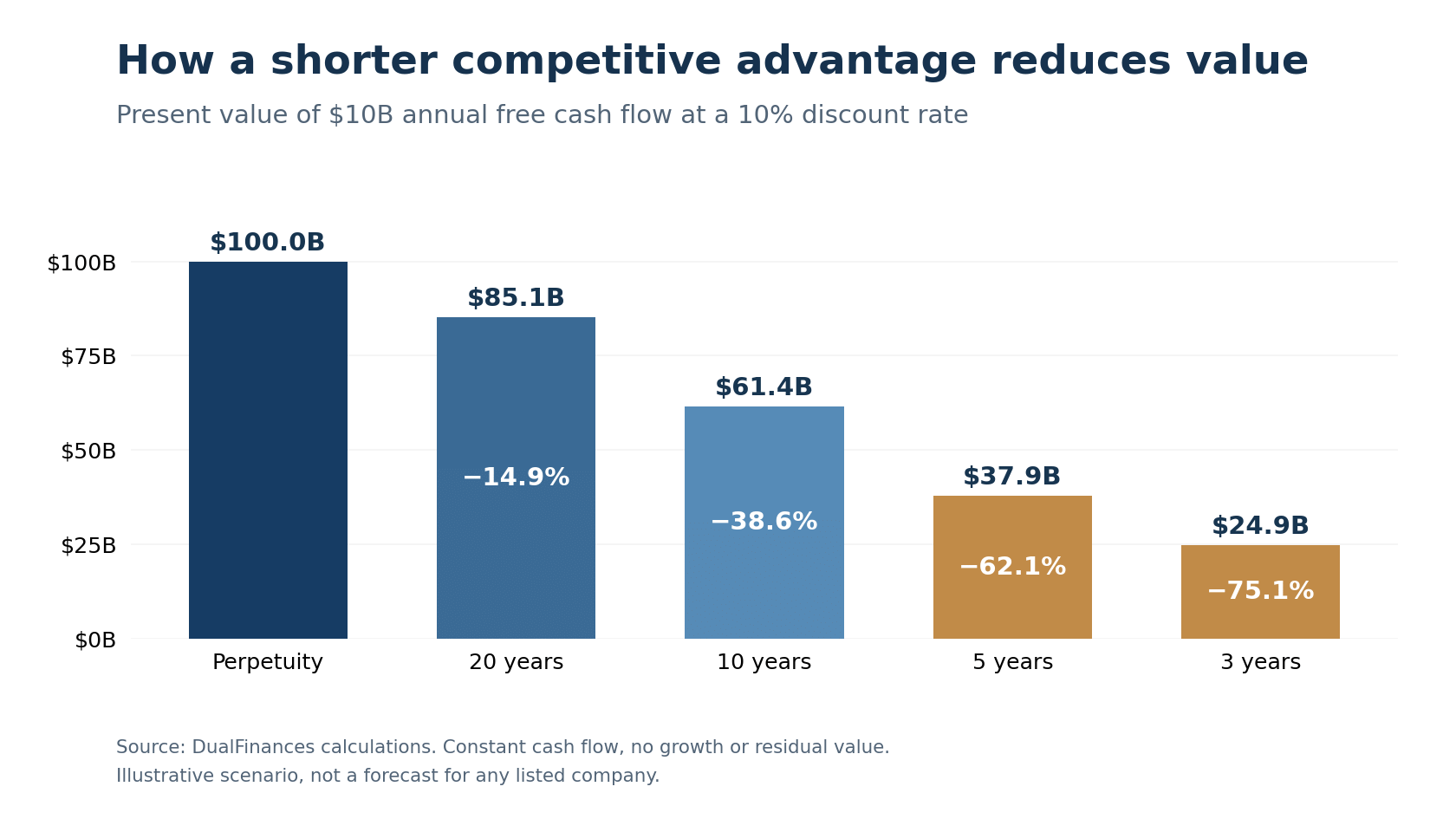
This example isolates the effect of earnings duration rather than predicting any company’s future. If competition shortens the expected life of a profitable franchise, its valuation can fall substantially even when near-term free cash flow remains unchanged. Conversely, incumbents that retain pricing power and reinvest productively can justify longer cash flow assumptions.
The 65% Quarterly Loss Exposes the Risk of the Thesis
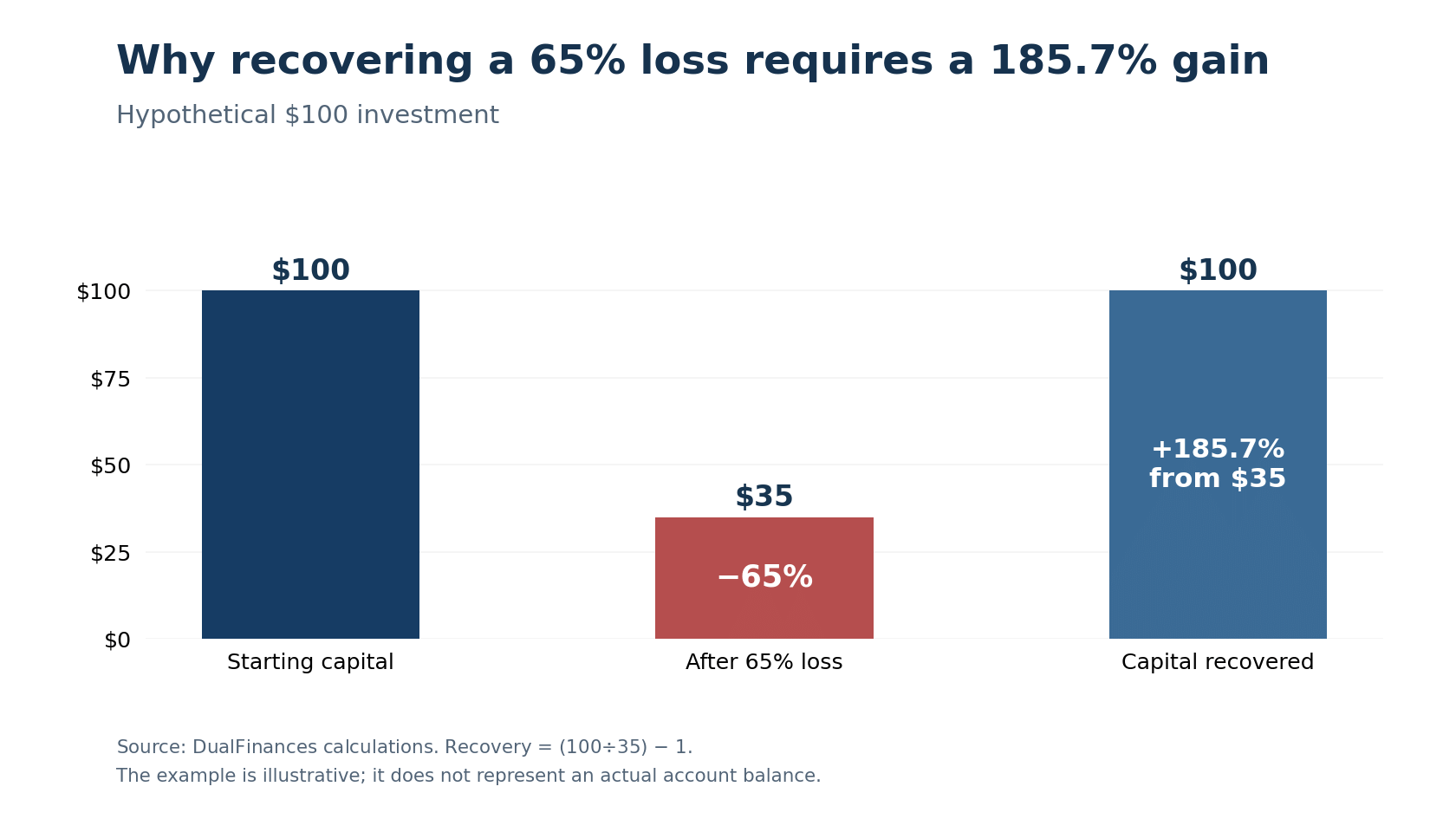
Reuters reported on November 26 that Situational Awareness lost 65% after fees in Q3 2026. The letter reports an 88.5% net gain year to date through September, following a 288.6% net gain in Q2 alone. A 65% loss requires a 185.7% gain to recover the starting capital.
The fund says it has paused conventional short selling, except for purchased puts and fully collateralized hedges of its own options, and stopped relying on prime broker financing leverage. Its bearish views therefore should not be confused with a list of active short positions. SEC Form 13F guidance explains that ordinary short equity positions are not included in the disclosure.
What Investors Should Watch Through 2027
The central assumption could fail if AI research accelerates less than expected, if experimental computing capacity limits progress, or if enterprises adopt agents more slowly. Physical construction, clinical validation, regulation and security requirements can delay competitive changes. Incumbents may also capture much of the productivity benefit themselves.
Investors should compare semiconductor gross margins and custom-chip adoption, enterprise software renewals and AI monetization, data center utilization and financing costs, and free cash flow after capital expenditure. The important test by December 31, 2027, is whether the projected technical acceleration translates into commercial substitution and whether OpenAI and Anthropic approach the fund’s annualized revenue forecast.
Bottom line: Aschenbrenner’s thesis is not that AI demand will collapse. It is that technological progress may reduce the period during which established companies can earn exceptional returns. Investors should distinguish the scale of an industry’s growth from the durability of individual companies’ profits, while treating the fund’s superintelligence timeline as a speculative scenario rather than a certainty.
For informational purposes only; not investment advice.