

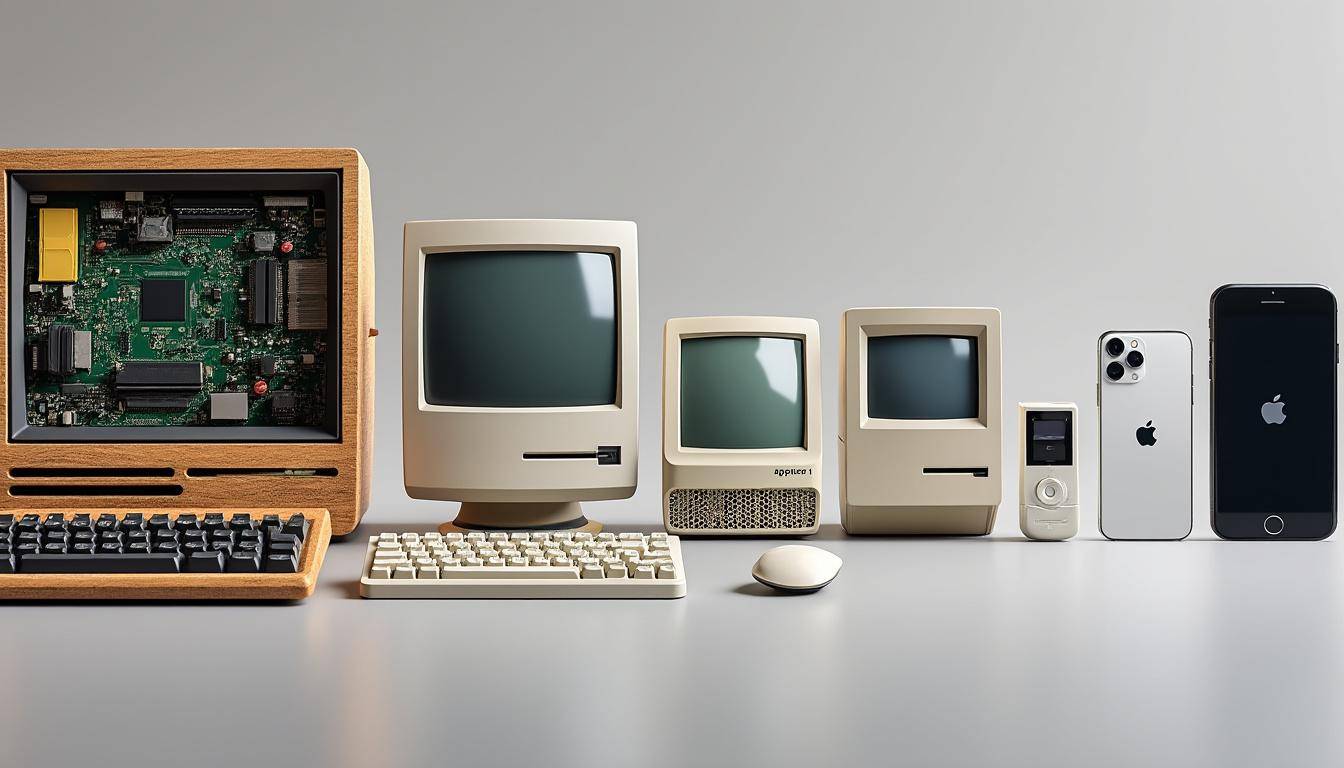
On April 1, a half-century after three young engineers and dreamers—Steve Jobs, Steve Wozniak and Ronald Wayne—took the first steps that would reshape the world, the company they seeded in a garage has become a defining force in global technology and finance. What began as a small operation to sell the Apple I to enthusiasts has repeatedly reinvented itself across eras: from early personal computers to the rise of the iPhone, then a pivot into services and streaming, and now an aggressive push into AI Innovations and broader Future Technology. The celebration in 2026 marks not only nostalgia for a brand that popularized the personal computer, but a critical inflection point as Apple confronts the disruptive wave of artificial intelligence and shifting competitive dynamics in Silicon Valley and beyond.
For investors, technologists and everyday users alike, Apple’s story is a study in strategic transformation. The company survived near-bankruptcy in the late 1990s, rose to become one of the most valuable publicly traded businesses, and today faces the complex calculus of hardware margins, services growth, and the need to integrate meaningful AI across devices without compromising privacy and user trust. This article follows a fictional New York-based investor and technology strategist, Maria Chen, who uses Apple’s milestones to frame her investment decisions and predictions about Mobile Computing and Consumer Electronics for the coming decade.
Apple Origins and Early Technology Evolution: From Apple I to Market Differentiation
The story of Apple begins with the first practical circuits and an entrepreneurial drive to make computers accessible to individuals rather than institutions. The original Apple I was, by modern standards, primitive: a circuit board sold to hobbyists that required an external keyboard, display and power supply. Yet this machine embodied the ethos of accessible computing. The follow-up, the Apple II, introduced a more complete system with integrated keyboard and power, and it began to demonstrate how design choices and product support could open computing to mainstream consumers.
Bill Fernandez, Apple’s first employee, later described a “palpable sense of magic” as the team transitioned from hobbyists to building systems for ordinary people. Marketing, quality, and a nascent retail and support strategy set Apple apart from contemporaries such as Radio Shack and Commodore. That difference was not just aesthetic; it was financial and strategic. Apple’s focus on product quality and end-user experience created a brand premium that translated into pricing power and higher margins—traits that would prove decisive when the company later expanded into portable music devices and mobile phones.
Comparing Early Products and Long-Term Impact
Examining these early products in context helps explain why Apple’s evolution mattered. The Apple I’s simplicity showcased the feasibility of personal ownership of a computing device, while the Apple II’s usability established the model for consumer adoption. Both machines taught Apple invaluable lessons about supply, distribution, and how to package technology for non-technical buyers—skills that would later inform the launch strategy for the iPhone and the company’s ecosystem approach.
| Product | Year | Core Contribution |
|---|---|---|
| Apple I | 1976 | Proof of concept for personal computing; hobbyist market penetration |
| Apple II | 1977 | Consumer-friendly packaging; early software ecosystem |
| iPhone | 2007 | Mobile computing redefined; platform for services and app economy |
These early lessons also underline a consistent theme in Apple’s strategy: an emphasis on integrated experience—hardware, software, and services—that created switching costs and deepened customer loyalty. For Maria Chen, pictured as a young analyst in Manhattan, the lesson is clear: product-led differentiation can create decades of economic advantage when paired with tight brand control. That advantage becomes harder to replicate in a world where software and AI can be ported across hardware platforms, a tension explored in later sections.
Apple’s early era concluded with both triumphs and hard lessons about capital, supply chains and execution. By mid-century, the company’s capacity to learn from its earliest product cycles continued to shape its decisions, and the marketplace began to recognize Apple as more than a manufacturer—rather, as an architect of consumer expectations. This framing prepares us to assess how the Technology Evolution from desktop to device to ecosystem set the stage for the smartphone revolution that followed.
iPhone Revolution and the Rise of Mobile Computing
When Apple unveiled the iPhone in 2007, it did more than launch another gadget; it catalyzed a redefinition of Mobile Computing and the wider Consumer Electronics market. The iPhone combined a phone, an iPod, and an internet communicator in one device, but the deeper innovation was the fertile platform it created for third-party applications and services. The App Store turned developers into entrepreneurs and established a new revenue stream that amplified Apple’s margins beyond hardware sales.
The transformation from device maker to ecosystem operator is best understood through specific examples. Consider how mapping, messaging and banking apps migrated from desktop habits to the palm of a hand. For Maria Chen, who tracks consumer adoption curves from her office on Wall Street, the iPhone marked the moment that user behavior permanently shifted toward always-on, always-connected computing. Investors who recognized this change early reweighted portfolios toward platform owners and application leaders, a strategy that paid off significantly as smartphone penetration accelerated globally.
Economic Effects and Market Behavior
From a financial perspective, the iPhone created three durable dynamics: strong hardware margins, recurring services revenue, and a growing ecosystem with network effects. Each dynamic reinforced the others. As customers invested in apps and subscriptions, switching costs rose; as switching costs rose, demand for newer Apple devices increased, renewing the cycle. This loop proved attractive to long-term investors because it implied recurring cash flows and predictable upgrades across large installed bases.
Yet the iPhone era introduced new competitive pressures. Component suppliers, global supply chains and rapid innovation cycles meant Apple needed to manage inventory and forecast demand with precision. The company developed sophisticated logistics and supplier relationships to protect margins and timing. These operational competencies, refined through the iPhone’s lifecycle, later supported Apple’s ambitions in services and content—streams that now represent a higher proportion of overall revenue than two decades earlier.
From a cultural perspective, the iPhone altered consumer expectations about design, privacy and integration. Apple’s insistence on user-friendly interfaces and closed ecosystems contrasted sharply with more open platforms and influenced regulatory and market debates about control and competition. For Maria, these shifts framed the regulatory risks she monitors when evaluating tech holdings. The iPhone’s legacy is therefore twofold: a commercial engine that underpinned Apple’s modern valuation and a benchmark for how platform control translates into both value creation and regulatory scrutiny.
Services, Silicon Valley Strategy, and Apple’s Financial Trajectory
As hardware cycles matured, Apple intentionally pivoted to a model that emphasized services—digital subscriptions, cloud offerings, and content distribution. This shift was not merely a response to margin pressure; it was a strategic recognition that recurring revenue offers far greater predictability for a company with a large installed base. By 2026 Apple sits among the most valuable public companies, a trajectory built on hardware excellence but now sustained by services that span music, video, finance-enabled features and app commerce.
Strategically, Apple’s approach mirrors classic Silicon Valley playbooks: keep control of the platform, incentivize third-party developers, and monetize through a fair share of transactions. But the company also distinguishes itself by staffing product teams that understand both design and capital allocation. Investors like Maria value this hybrid skill set because it aligns product innovation with financial discipline. In recent years, Apple’s market narrative shifted from “device-first” to “ecosystem-first,” and that reframing underpins many contemporary valuations.
Financial Outcomes and Market Position
Concretely, this strategy translated into measurable outcomes: higher average revenue per user, a steady rise in services gross margins, and less reliance on the fickle rhythm of hardware refresh cycles. That said, Apple’s 50th anniversary occurs at a complex time. The company is widely regarded as a leader, but it faces the challenge of integrating meaningful AI Innovations into its ecosystem without diluting its privacy stance. Competitors have been aggressive in hiring AI talent, and some industry observers note that Apple’s AI roadmap has lagged peers, a point of concern for market watchers.
These competitive dynamics influence how investors model Apple’s future cash flows. Traditional bullish arguments rest on services growth and the sticky nature of Apple’s ecosystem. Bearish scenarios highlight the possible erosion of differentiation if AI capabilities become commoditized and the premium for Apple’s integration diminishes. For Maria, scenario analysis focuses on probabilities: how likely is Apple to deliver AI features that preserve trust and enhance device utility? Her models assign value to both upside from successful AI rollouts and downside from talent attrition to rivals.
Public events in 2026—like the high-profile anniversary at Battersea Power Station—serve both celebratory and strategic communication roles. They reaffirm brand power but also signal a renewed strategic focus. Financially, Apple’s path depends on sustaining hardware desirability while accelerating services growth and making judicious investments in AI talent and infrastructure. This balancing act defines the firm’s financial horizon and informs investor positioning today.
AI Innovations, Talent Challenges, and the Race for Future Technology
As the marketplace pivots to AI as a primary axis of competition, Apple confronts a unique set of constraints and opportunities. The company’s historic emphasis on privacy and on-device processing complicates rapid adoption of cloud-driven AI models, which many rivals prefer for scale and iterative learning. Simultaneously, Apple’s expertise in silicon—custom chips optimized for performance and power—gives it a natural advantage for on-device AI inference. The question for investors and technologists is whether Apple can marry its silicon strengths with compelling AI experiences that justify premium pricing.
Talent dynamics matter. Apple has lost AI experts to competitors in recent years, a drain that highlights the strategic importance of workforce and culture in this new phase. The firm’s cautious stance on data usage and its reputation for careful rollout timelines mean that Apple may sacrifice speed for what it considers responsible deployment. That trade-off has real consequences: market share in emergent AI-driven features could tilt toward faster-moving players, even if Apple ultimately produces a more polished or privacy-respecting product.
Social and Economic Implications
The broader economic conversation around AI extends beyond product features to workforce impacts and inequality. Commentators and policymakers are debating how AI will reshape jobs and access to opportunity, and those concerns intersect with corporate strategy. For readers who study labor-market effects, resources analyzing the intersection of AI and employment offer important context. For example, commentary on AI-induced labor shifts provides insight into how tech transitions ripple through other sectors and influence consumer spending patterns.
Apple must also consider regulatory pressures. As governments scrutinize data usage, antitrust behavior and the concentration of AI capability, the company will need to navigate an increasingly complex legal landscape. Investors should monitor regulatory developments and their likely impact on Apple’s capacity to monetize AI-enhanced features across borders. Maria’s risk framework assigns material weight to regulatory outcomes because they alter pathway choices and capital allocation decisions.
Despite these headwinds, Apple has tangible assets in its favor: a vast installed base, premium silicon, deep distribution through its stores and partners, and a brand consumers trust. If the company can integrate AI Innovations in ways that align with its values—and if it can retain and attract the necessary human capital—Apple may redefine what on-device intelligence looks like at scale. That integration will determine whether Apple leads the next generation of Technology Evolution or cedes ground to more agile rivals.
Investment Implications and Strategic Considerations for the Future
From a finance-first perspective, the key question is not whether Apple will continue to be significant, but how its revenue composition and risk profile will change. Historically, Apple’s value rested on hardware sales and an expanding services attach rate. Today, investors must price the potential uplift from AI-enabled services alongside the risk of talent migration, regulatory intervention, and competitive displacement. Maria Chen assesses these forces using scenario-based valuation and a checklist that emphasizes optionality, balance sheet strength and execution capability.
Consider practical investment actions rooted in clear metrics: track services revenue growth, monitor average revenue per user, observe hiring trends for AI talent, and follow regulatory filings for antitrust scrutiny. These signals help calibrate the market’s expectations against Apple’s operational performance. Additionally, watch for strategic acquisitions that fill AI capability gaps or bolster cloud-related services; such moves can materially alter the investment thesis and accelerate the company’s AI roadmap.
Investor Checklist and Tactical Steps
For clarity, here is a practical checklist Maria uses when evaluating Apple as a long-term holding:
- Monitor quarterly services growth and margin expansion to confirm recurring revenue resilience.
- Evaluate Apple’s AI hiring, partnerships and acquisitions as indicators of execution speed.
- Assess supply-chain flexibility and silicon roadmap for sustained hardware differentiation.
- Watch regulatory developments that could affect platform economics and app-store rules.
- Compare valuation multiples to peers while adjusting for Apple’s unique ecosystem advantages.
Beyond the checklist, Maria considers macro factors such as global consumer demand, currency fluctuations, and the broader pace of AI adoption. She also reads analyses that contextualize workforce transitions and the labor market impacts of automation and AI. For grounded commentary on employment and data trends, content exploring job-seeker struggles in a data-driven market offers useful context for demand-side risk assessment.
Finally, the investor must accept that Apple’s next decade will likely be defined by how successfully it layers AI over an existing ecosystem without sacrificing the privacy and quality that built its brand. The firm’s future hinges on balancing innovation speed with the careful stewardship of customer trust. For Maria, that balance determines whether Apple remains not only a technology icon but a resilient, compoundable financial asset.
Key insight: Apple’s 50-year journey demonstrates that sustained value creation stems from repeatedly redefining product categories while preserving core brand promises; the coming phase will test whether Apple can translate its silicon advantage and ecosystem into leading AI-driven experiences without undermining the trust that underpins its economic moat.
Relevant reading and context: analysis of AI and finance hubs provides background on talent flows and corporate strategy, while commentary on AI and labor inequality offers broader social context for the technology transition. For deeper exploration of how AI affects finance and jobs, see this overview of financial sector changes in regional AI hubs and a discussion on AI’s broader social impact.
Analysis of AI and finance hubs in Stamford and discussion on AI and jobs inequality offer useful perspectives for readers who want to connect technology evolution to labor-market outcomes.