

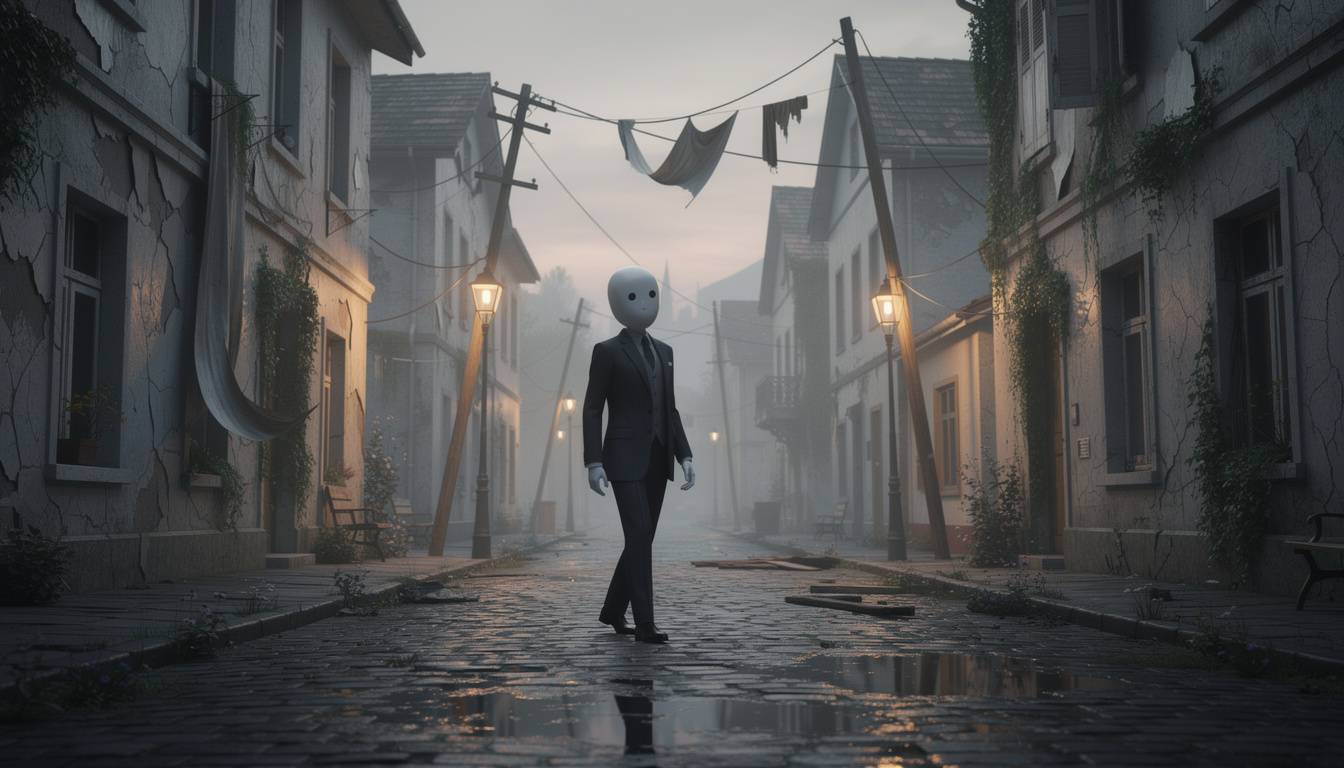
Decorado doesn’t behave like a safe festival cartoon. It opens up as a cold, unsettling adult animated film about routine, control, and the suspicion that life has been staged by someone else. Directed by Alberto Vázquez, one of the sharpest names in Spanish animation, it expands the ideas of his earlier animation short into a feature that feels harsher, funnier, and more complete. For viewers who follow auteur-driven animation rather than family franchises, this is the kind of animation masterpiece that explains why Vázquez is widely treated as an animation visionary.
Decorado And Why Alberto Vázquez Turned An Animation Short Into A Major Feature
The central figure is Arnold, a mouse caught in a midlife collapse who begins to suspect that his world is not real life but a constructed set. That idea gives Decorado its pressure. Every wall, every social interaction, every routine task seems rigged, and the film keeps asking whether modern life is any less artificial.
Vázquez didn’t pull that premise from nowhere. The feature grows out of his earlier short of the same name, which screened at Cannes’ Directors’ Fortnight in 2016 and drew strong attention. A later attempt to expand the material into a series stalled, but those abandoned threads didn’t disappear; they fed the feature and gave it a larger dramatic frame.
That evolution matters because the feature doesn’t feel stretched from a sketch. It feels rewritten for scale. The short-form concept becomes a wider satire about work, frustration, inequality, and the dull violence of social systems that keep running whether people understand them or not.
Why This Story Feels So Contemporary
Plenty of adult animation talks about alienation, but Vázquez pushes the idea into material reality. Arnold doesn’t just feel disconnected. He sees his environment as a literal stage design, a fake world with painted surfaces and roles assigned in advance.
That makes the film’s social critique more pointed. Unemployment, precarity, and corporate domination aren’t treated as policy slogans. They show up as daily pressure, as rules everybody follows even when those rules are hollow or cruel. The “show must go on” mentality becomes one of the film’s ugliest truths.
There’s a reason this approach lands. Artistic animation can say difficult things without flattening them into realism, and Vázquez has always been better when he lets horror, satire, and absurdity share the same frame.
Why Decorado Stands Out In Spanish Animation In 2026
By 2026, Spanish animation has a stronger international profile than it did a decade ago, but few filmmakers have built a body of work as distinct as Alberto Vázquez. His films don’t chase mainstream softness. They cut into loneliness, violence, class pressure, and emotional rot with drawings that look handmade and unstable in exactly the right way.
Decorado completing the circle with a Goya win for animated feature carries extra weight. Vázquez had already earned major recognition in shorter formats, and producer Iván Miñambres has backed his work since Birdboy. Their partnership now stretches across five shorts and three features, which is rare in European independent animation and even rarer at this level of consistency.
Miñambres has described the project as deeply auteur-driven, and that’s the right reading. This isn’t content assembled for broad algorithmic approval. It’s a film built around a personal worldview, then sharpened through production discipline rather than diluted by it.
Festival response helped confirm that the film’s severity wasn’t a barrier. After premiering at Fantastic Fest and moving through the international festival circuit, it earned praise from critics and audiences who tend to disagree on adult animation. That crossover is hard to fake, and harder still with a film this prickly.
| Element | What Matters | Why It Strengthens The Film |
|---|---|---|
| Source material | Expanded from a 2016 short | Gives the feature a tested concept with room for wider social critique |
| Director | Alberto Vázquez | Brings a recognizable visual and thematic signature |
| Producer | Iván Miñambres | Long-term collaboration protects the film’s authorial edge |
| Awards path | Festival tour and Goya recognition | Positions the film as a major recent work in European adult animation |
| Industry context | Backed in Spanish showcases tied to Cannes promotion | Helps push the title beyond local acclaim into export conversation |
By the time it reached showcases linked to Spain’s international push for new films, the movie had become more than a niche success. It was being presented as proof that a Spanish filmmaker can make unsettling, auteur-led work and still carry serious international interest.
How The Production Of Decorado Balanced Auteur Style And Industrial Reality
Independent feature animation always sounds romantic until you look at the spreadsheet. Decorado was mounted as a Spanish-Portuguese co-production, with a budget of more than €3 million, roughly $3.5 million. For studio animation that’s modest. For independent European work with a demanding visual identity, it’s a serious operation.
The production involved several companies and teams, including Glow in Extremadura, Abano in Galicia, UniKo in Bilbao, and the Portuguese studio Sardinha em Lata. That kind of structure brings range, but it also creates friction. Different schedules, methods, and local production cultures don’t align by magic.
One challenge was far more painful than normal production delays. During the film’s making, producer Diogo Carvalho passed away, which forced the team to absorb both personal loss and practical disruption. Projects like this don’t survive that kind of shock unless the core collaborators are stubborn about finishing them.
The Visual World Is Doing Narrative Work, Not Decoration
One of the film’s smartest choices is right there in its title. A set is never just a backdrop in this story. The environments are active, manipulative, and accusatory, making Arnold’s paranoia look less like madness and more like perception.
That effect depends on design. Art director José Luis Ágreda played a central role in shaping backgrounds that feel familiar at first glance and wrong a second later. Colors push the unease further. Nothing sits in a comfortable register for long, which keeps the viewer inside Arnold’s suspicion rather than outside it.
If you compare this to cleaner commercial productions, the difference is stark. Many polished films want the background to disappear into smooth immersion. Vázquez wants the set to stare back.
Sound And Music Tighten The Trap
The sonic work matters just as much as the drawings. Iñaki Alonso handled sound and Joseba Beristain composed the music, and both contributions are central to the film’s off-balance mood. You don’t watch this movie in a purely visual way; you’re boxed in by it.
That’s where many ambitious animated features slip. They get the image right and treat sound as support. Here, the audio reinforces artificiality and dread, turning silence, texture, and tonal shifts into part of the same theatrical illusion. A world that looks fake has to sound wrong too.
For viewers tracking experimental animation, that blend of graphic style and sonic discomfort is one reason the film keeps lingering after the credits.
What Makes Decorado An Animation Masterpiece Rather Than Just A Festival Curiosity
A lot of acclaimed adult animation earns respect more than affection. You admire the craft, note the themes, and move on. Decorado avoids that trap because it keeps its ideas attached to a character’s crisis. Arnold’s breakdown gives the satire a pulse.
The film also understands violence in a smarter way than many prestige animated projects. It isn’t there for shock value. It appears as systemic pressure, as normalized cruelty, as absurd behavior baked into the rules of the world. That approach is more disturbing than splatter because it feels recognizable.
Then there’s Vázquez himself. Calling him an animation visionary isn’t empty flattery when the evidence is on screen. He works in a space where fable, social anger, black comedy, and visual instability all reinforce each other. Few directors can hold those tones together without making a mess of the film.
For anyone deciding whether to seek it out, these are the strongest reasons:
- It expands a proven short-form idea into a feature without losing tension.
- Its social critique has bite, especially around work, inequality, and manufactured routine.
- The design is narratively active; sets and color do more than create mood.
- The sound work is integral, not ornamental, which deepens the film’s sense of artificiality.
- It stands apart from mainstream adult animation by refusing easy irony or generic bleakness.
There’s also a wider point here. Spain has produced major animators before, but Vázquez belongs to the group proving that adult European animation can stay personal, abrasive, and exportable at the same time. That’s a better long-term model than chasing studio imitation on smaller budgets.
If you’re mapping the recent high points of auteur-led animated film work, start with Birdboy, move through Vázquez’s shorts, and put Decorado near the top of the current list. Its afterlife will likely grow through repertory screenings, festival retrospectives, and Cannes-market conversations built around Spain’s latest film push.