

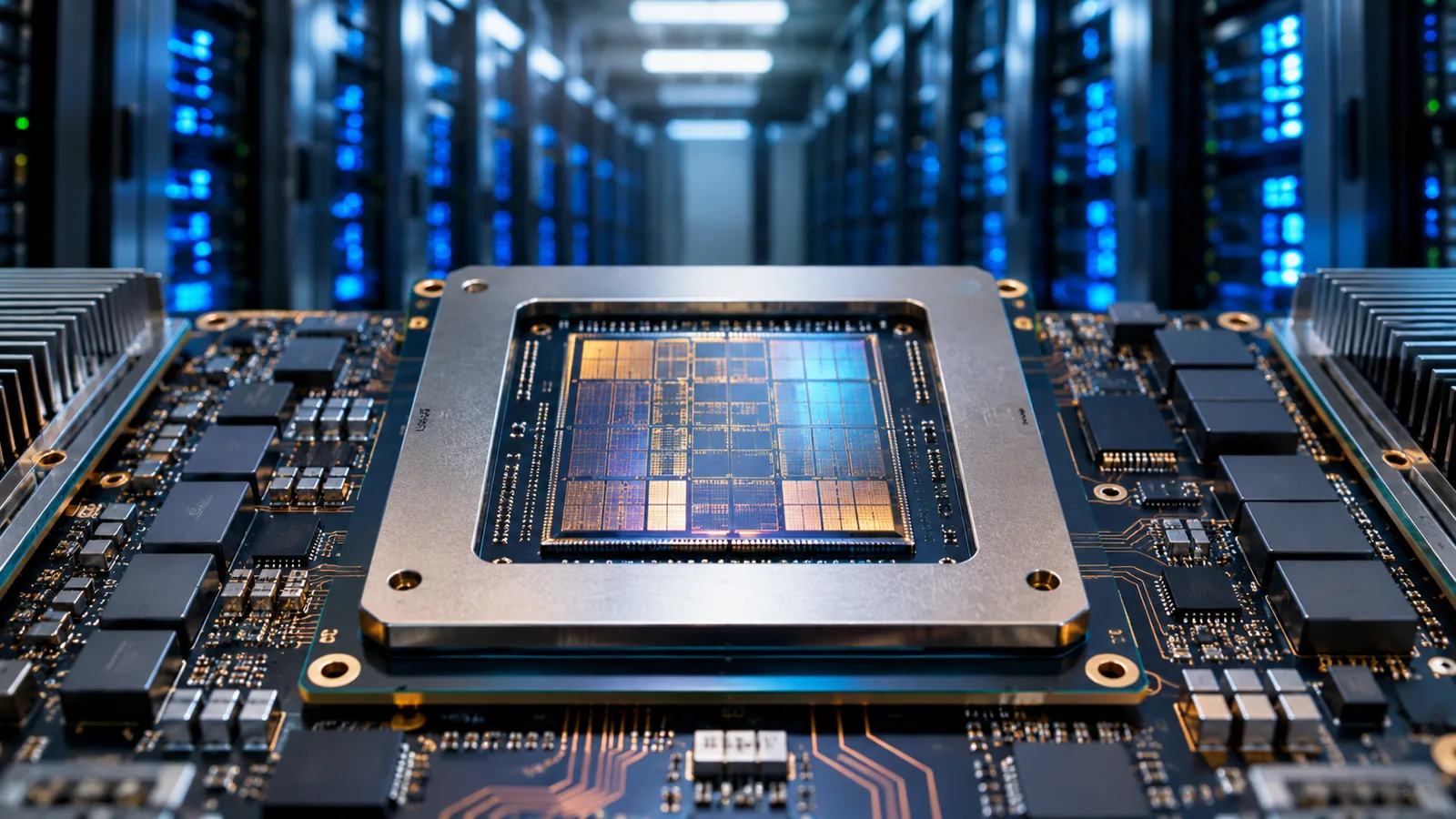
Broadcom (NASDAQ: AVGO) traded at $310.87 at 12:09 p.m. ET on Friday, November 20, 2026, down 10.32% from its November 19 close of $346.65, after analyst Ming-Chi Kuo reported that Google had reduced planned 2027 shipments of Broadcom-designed TPU 8i accelerators by roughly one million chips, or 20%. Most of the reported reduction targets the more expensive 8i Max version, while Google may raise orders for a MediaTek-designed alternative, according to the account of Kuo’s supply-chain research.
The distinction for shareholders is critical: a 20% cut to one chip family is not a 20% cut to Broadcom’s total AI revenue. The shares’ steep intraday fall instead reflects concern about future growth assumptions and the profitability of the products Google ultimately orders.
What Did Google Reportedly Change in Its 2027 TPU Plans?
Kuo said the revision affects the TPU 8i line designed by Broadcom, particularly the high-priced 8i Max, also called Whalefish. He reported that Google plans to expand shipments of its TPU 8t family designed by MediaTek, but the report said the replacement volumes were not yet finalized.
| Reported measure | 2027 estimate or change | Investor interpretation |
|---|---|---|
| Broadcom-designed TPU 8i reduction | About 1 million units | Product-family forecast, not total Google TPU demand |
| Size of reduction | About 20% | Implies a previous 8i plan of roughly 5 million units |
| Revised TPU 8i plan | Roughly 4 million units, implied | Illustrative arithmetic, not a separate company forecast |
| MediaTek-designed TPU 8t | Orders may increase; quantity undisclosed | Potential mix shift, not a confirmed one-for-one transfer |
The implied five-million-unit starting point comes from dividing one million by 20%; subtracting the reported reduction gives four million. No confirmed average selling price, gross profit per unit, or final 8t replacement quantity has been disclosed, so treating the entire difference as lost revenue would exaggerate the precision of the estimate.
In a November 16 supply-chain analysis, Kuo anticipated rising Google TPU deliveries through 2029 and a growing design role for MediaTek. The newer report affects Broadcom’s 8i mix, not all Google TPU demand.
Why Did Broadcom Stock Fall More Than 10%?
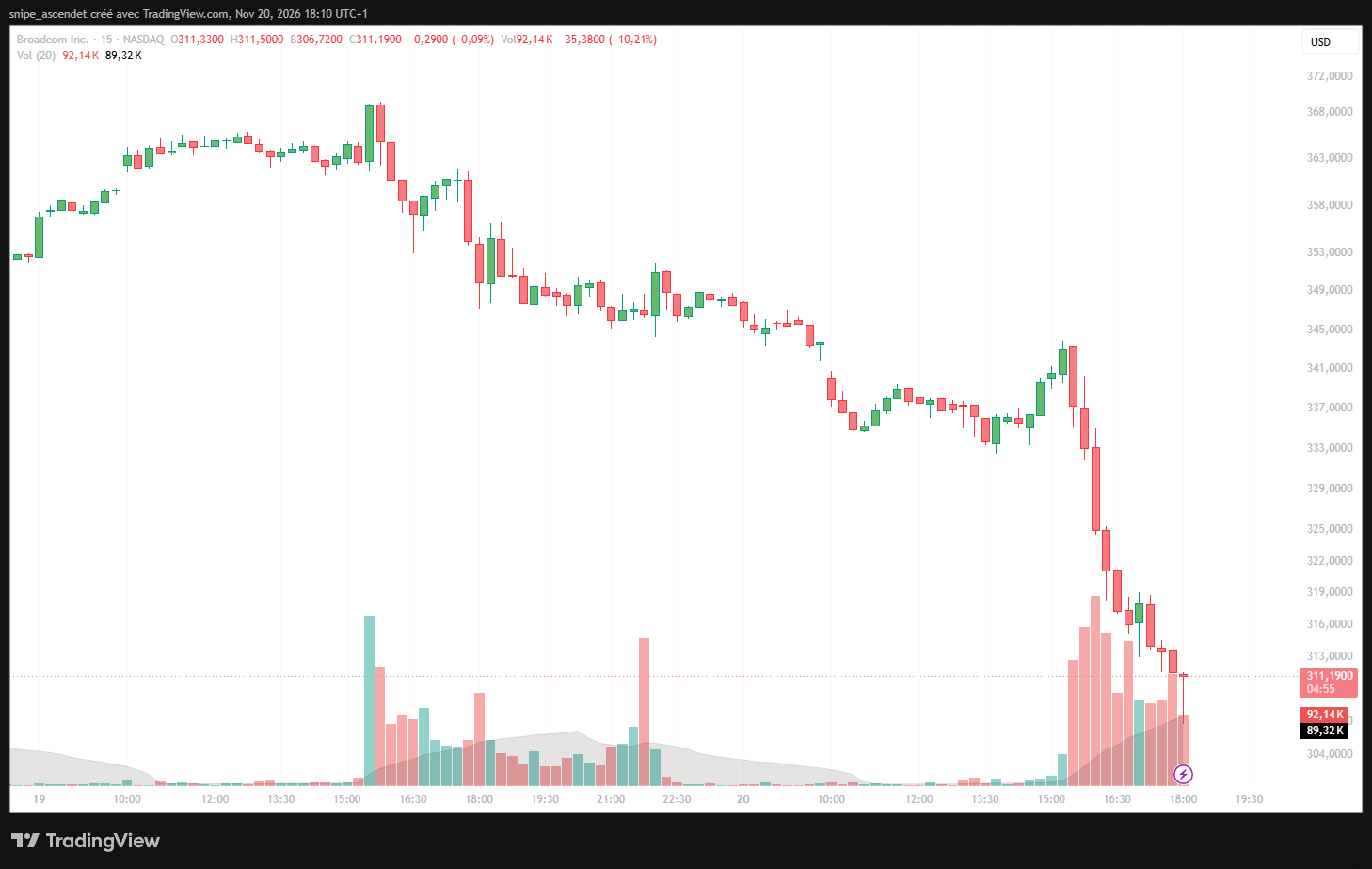
The November 19 closing price was $346.65. By 12:09 p.m. ET on November 20, AVGO was $310.87, a decline of $35.78 per share or 10.32%, with 20.33 million shares traded at that point in the session. The intraday low on the chart was $306.72, representing a fall of as much as 11.52% from the previous close.
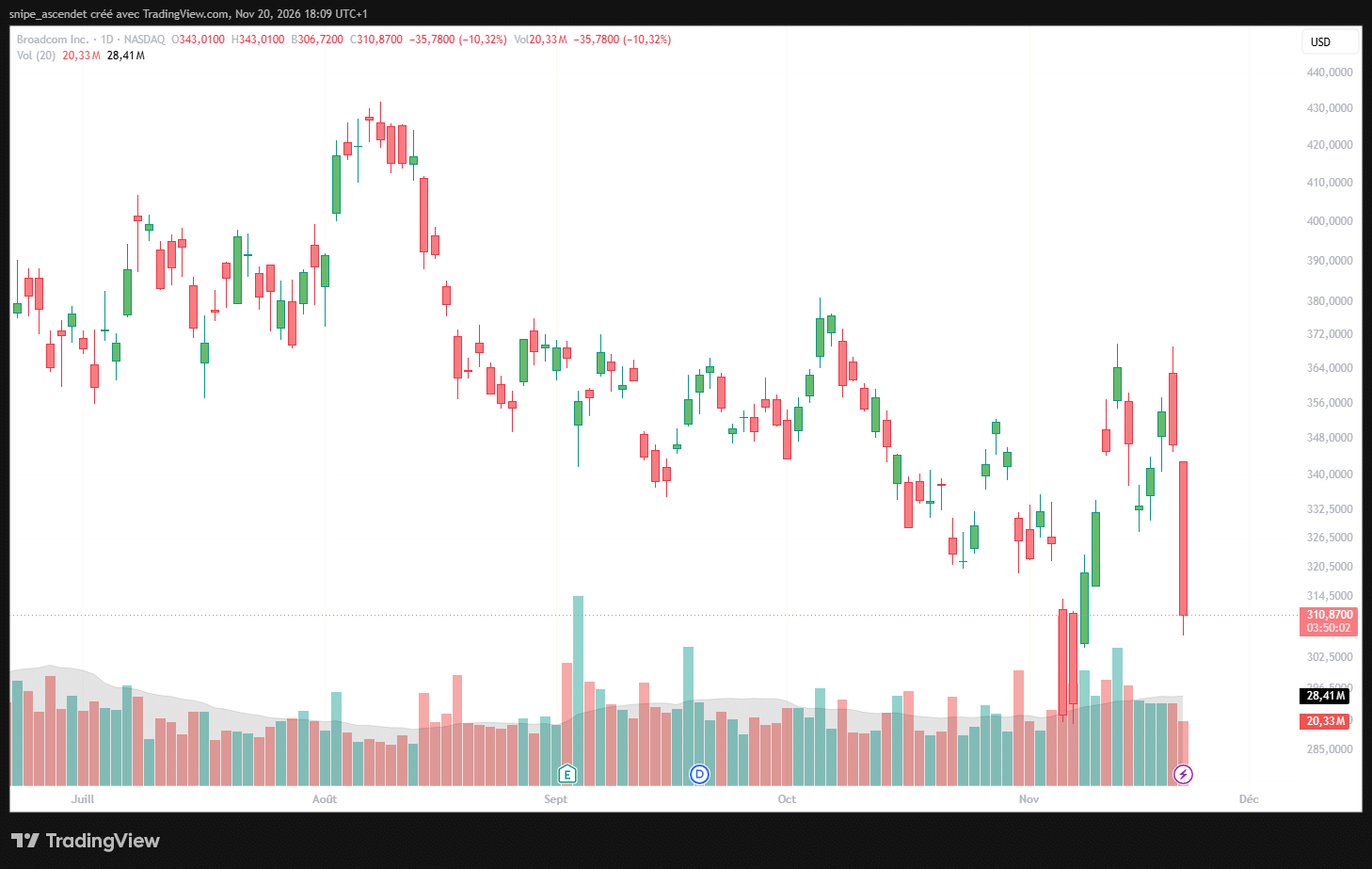
Using the 4,773,629,865 shares outstanding that Broadcom reported as of August 28 in its fiscal third-quarter Form 10-Q, the $35.78 share-price decline translates to approximately $170.8 billion in equity market value at that instant. That is a mark-to-market valuation change, not a booked operating loss, and it can move substantially before the closing bell.
Selling accelerated late in the November 20 morning session after an already weak November 19 session. The 15-minute chart shows a failed rebound toward $343 followed by a rapid move through the low $320s; $306.72 is the immediate intraday reference, rather than a verified long-term support level.
The company-specific news arrived amid the broader retrenchment in AI equities described in the S&P 500’s November 19 break below its 200-day moving average. The broader selloff also pressured AVGO.
How Much AI Revenue and Cash Flow Are at Stake?
Broadcom’s fiscal third-quarter 2026 results, for the period ended August 2, showed $29.591 billion in GAAP revenue, up 86% year over year. AI semiconductor revenue reached $16.7 billion, up 221% from the prior-year quarter, while free cash flow was $13.665 billion, equivalent to 46.2% of revenue.
| Metric | Fiscal Q3 2026 result | Fiscal Q4 2026 company outlook |
|---|---|---|
| Total revenue (GAAP) | $29.591 billion | About $34.8 billion |
| AI semiconductor revenue | $16.7 billion | About $21.7 billion |
| AI share of total revenue | 56.4% | 62.4% implied |
| Non-GAAP operating margin | 67.9% | About 66% |
| Free cash flow | $13.665 billion | Not quantified in guidance |
Those figures explain why a relatively narrow supply-chain change can matter: AI chips already represent more than half of reported company revenue, and management expects that mix to rise. A downgrade to a premium accelerator could affect both revenue per unit and gross profit per unit if the replacement business carries less favorable economics.
On its September earnings call, management forecast roughly $115 billion in AI semiconductor revenue for fiscal 2027, a forward-looking target rather than realized sales. Without verified unit pricing and costs, there is no defensible way to convert Kuo’s one-million-chip estimate into a specific reduction in Broadcom’s 2027 revenue, earnings per share, or cash flow.
Why Is the TPU 8i Max Mix Important for Profit Margins?
The concern is not simply that fewer chips might ship. Kuo’s earlier supplier assessment said Broadcom’s 8i design had higher gross margins than MediaTek’s 8t design, while the November 20 revision was concentrated in the higher-priced 8i Max. That combination increases the sensitivity of projected profit to which chip family ultimately ships.
Management had already forecast fourth-quarter consolidated gross margin near 73%, down from about 78% a year earlier, describing a growing mix of memory-heavy custom accelerators. That guidance predates the new 2027 report, so it should not be presented as the estimated margin effect of the TPU 8i revision. The proper questions are whether Broadcom retains design and integration content, who procures expensive memory, and how deployment schedules translate into invoices.
Is MediaTek Really Winning Google Orders?
The order-mix report identifies MediaTek (TWSE: 2454) as a potential beneficiary, but its shares did not rise on November 20. They finished at TWD 3,350, down 9.95%, according to Taiwan market data; the Taiwanese trading session ended before the U.S. midday AVGO observation.
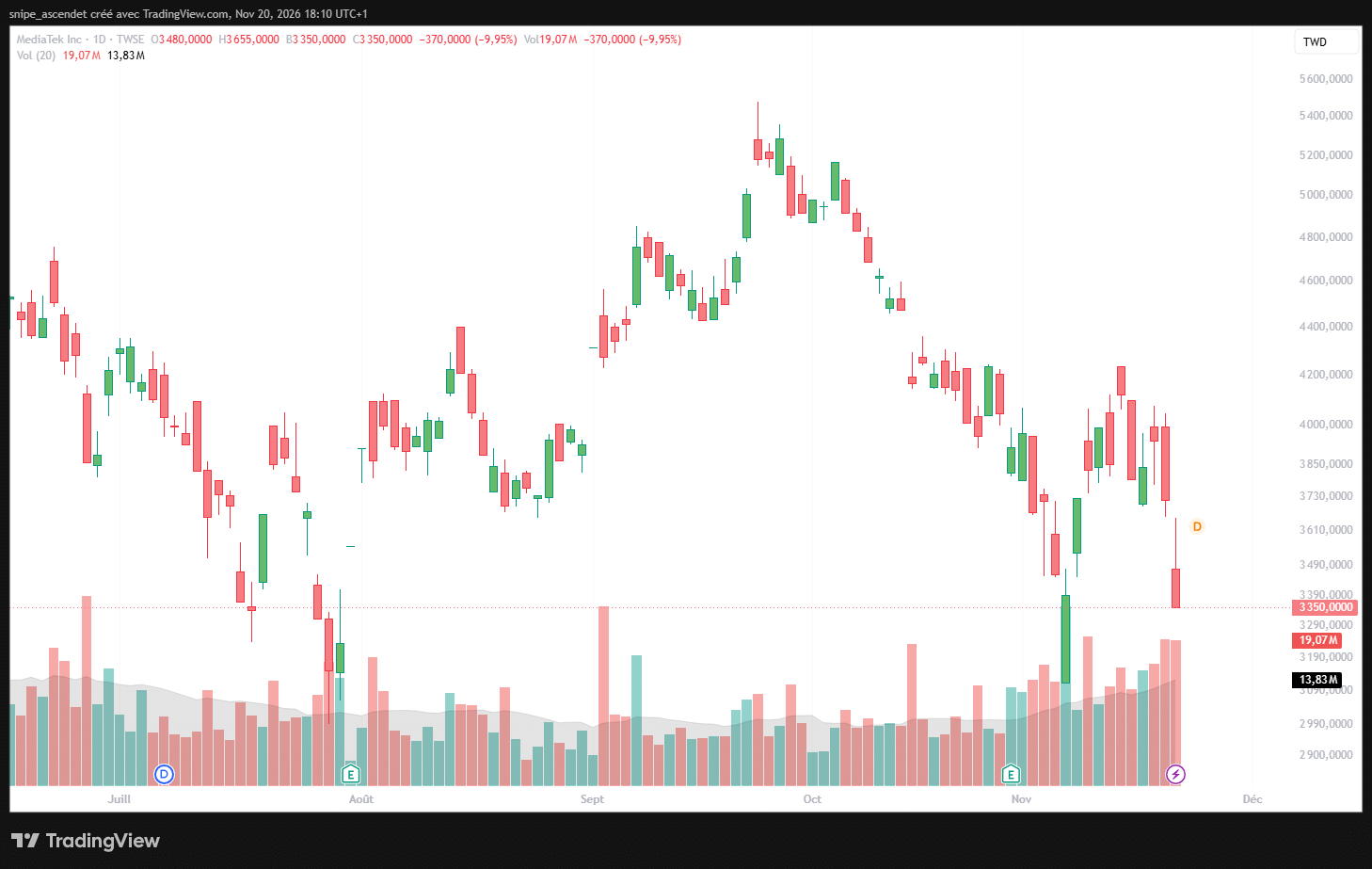
MediaTek’s price action makes a simple winner-versus-loser narrative misleading. Potential orders would still depend on pricing, profitability, and delivery capacity.
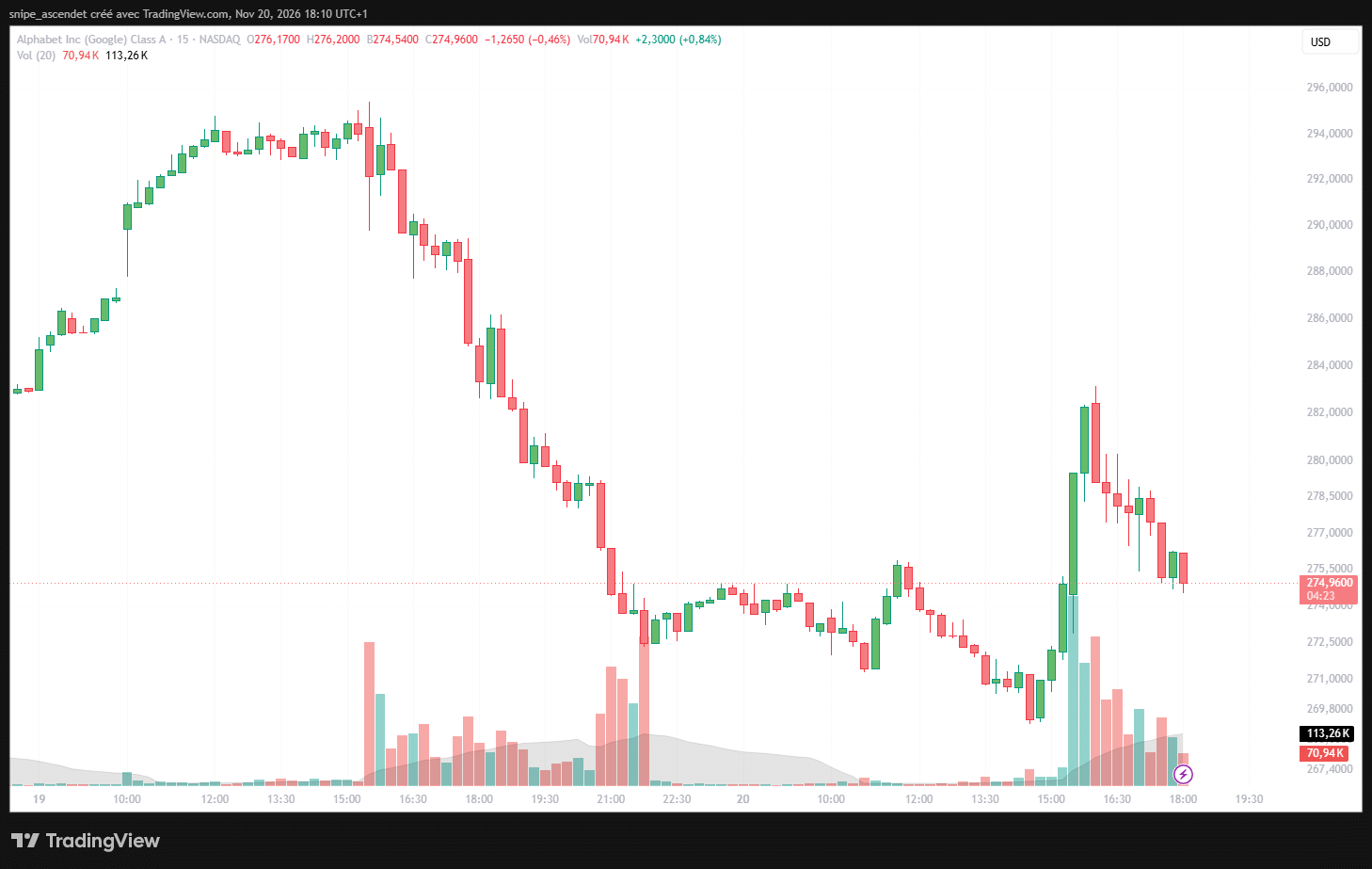
Alphabet (NASDAQ: GOOGL), Google’s parent, traded around $274.96 at approximately 12:10 p.m. ET on November 20, up about 0.84% from the previous close. For Alphabet shareholders, the possible advantage is greater supplier flexibility, though the report does not establish a realized reduction in the cost of a deployed TPU system.
Does Broadcom Still Have a Long-Term Google Agreement?
Yes. In an April 6, 2026 SEC filing, Broadcom disclosed a long-term agreement to develop and supply future Google TPUs, along with networking and other components for next-generation AI racks through up to 2031. The filing also described expanded arrangements involving Anthropic and approximately 3.5 gigawatts of next-generation TPU-based computing capacity starting in 2027.
The agreements span more than one chip generation but do not guarantee shipments of the 8i Max.
Broadcom also designs custom accelerators and networking technology for a broader set of AI customers, meaning the Google news does not describe its entire AI pipeline. The latest Nvidia earnings analysis offers a useful comparison: large AI revenue numbers are only one part of evaluating margins, cash conversion, and the sustainability of spending forecasts.
- December 9, 2026: Broadcom is scheduled to release fiscal fourth-quarter and full-year 2026 earnings after the U.S. close, followed by a 5:00 p.m. ET conference call. Investors can compare the $21.7 billion AI semiconductor revenue outlook with reported results and listen for revised fiscal 2027 guidance.
- TPU 8i versus 8t mix: Any confirmation from Google, Broadcom, or MediaTek of the final order volumes, design responsibilities, and 2027 ramp schedule would materially improve the revenue estimate.
- Margin and cash conversion: Monitor consolidated non-GAAP margins, free cash flow, and the costs of scaling custom chips rather than treating shipment counts as interchangeable with earnings.
- Price levels: The November 20 intraday low of $306.72 and the prior November 19 close of $346.65 frame the observed selloff. A sustained recovery or another breakdown requires subsequent trading data.
Bottom line:
Broadcom’s 10.32% intraday decline on November 20 prices in a risk that the premium Google TPU 8i opportunity may be smaller than investors expected. The more important shareholder question is how much profitable chip content Broadcom keeps in 2027, especially as higher-value TPU configurations and customer deployment plans change.
For informational purposes only; not investment advice.