

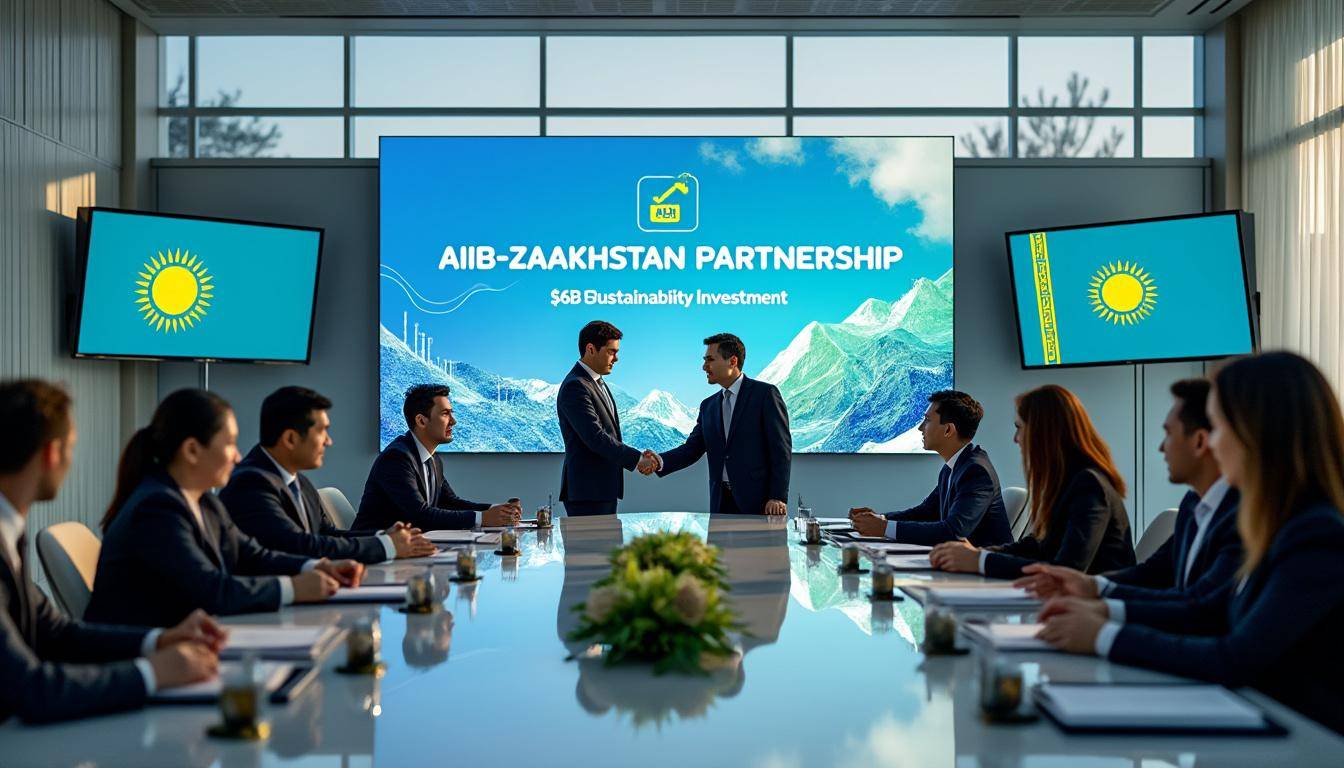
The signing of a high-profile memorandum between the Asian Infrastructure Investment Bank and Kazakhstan in 2025 signals a decisive shift in how Central Asian infrastructure will be financed and delivered. At its core, the agreement establishes a multi-year rolling pipeline designed to systematically mobilize financing up to USD6 billion through 2029 for projects that prioritize transport, green energy, and social infrastructure. Observers note that this is not a one-off lending operation but a programmatic framework intended to synchronize sovereign planning, private-sector participation, and multilateral financing. The plan identifies a set of 14 sovereign-backed projects tailored to accelerate Kazakhstan’s economic diversification and strengthen its role as a regional transit hub.
This development reflects the evolution of the AIIB from a project lender to a program partner capable of shaping national pipelines and crowding in private capital. The memorandum was signed by senior representatives of both sides and witnessed by national leaders, underlining the political will driving the initiative. For financial professionals and policy makers, the implications extend beyond capital flows: they include governance mechanisms, procurement strategies, and the creation of investable project structures that can attract institutional capital. Below, five in-depth sections explore the strategic, financial, technical, social, and regional facets of this landmark partnership.
AIIB and Kazakhstan Agreement: Strategic Vision to Mobilize USD6 Billion for Infrastructure
The newly forged Agreement between the AIIB and Kazakhstan embodies a strategic approach to long-term infrastructure programming. Unlike stand-alone loans, a multi-year rolling pipeline (MYRP) creates visibility for investors by sequencing projects, aligning them with fiscal plans, and setting predictable procurement windows. This predictability matters to large institutional investors who demand transparency and stable cashflow projections before committing capital.
From a governance perspective, the MYRP formalizes a collaboration platform. The memorandum identifies institutional touchpoints that coordinate project preparation, sovereign backing, and environmental and social safeguards. It also creates room to leverage AIIB’s AAA-rated balance sheet and its ability to partner with commercial banks and development partners. The result should be a lower blended cost of capital for major public works, with a clear pathway to bring private capital into sectors historically dominated by public funding.
How the Framework Changes Project Execution
A practical example helps illustrate the change. Consider a hypothetical rail upgrade between Almaty and the western corridor, championed by a fictional firm, SteppeRail, led by project director Aidar. Under earlier models, Aidar would have sought individual project loans, faced fragmented donor requirements, and encountered cashflow timing issues. Under the MYRP, the project enters a prioritized list with pre-agreed standards and a staged financing plan. That lowers transaction costs, shortens time to financial close, and improves prospects for long-term private financing.
The framework also accelerates the green transition. A chunk of the pipeline is devoted to renewable energy and grid modernization, which aligns with the sustainable growth ambitions of both parties. AIIB’s expertise in structuring blended finance can help design instruments where concessional tranches absorb early-stage risks, enabling commercial tranches to follow. For Kazakhstan, this translates into faster deployment of wind and solar farms, with off-take arrangements and grid upgrades built into the MYRP.
Finally, the strategic nature of the pipeline enhances regional connectivity. By committing to prioritized corridors and logistics nodes, Kazakhstan reaffirms its aspiration to be an international transit hub in Central Asia. That has spillover effects for neighboring economies and cross-border trade facilitation. The takeaway is clear: the MYRP is less an isolated financial event and more a program that integrates planning, financing, and implementation to create bankable, investable infrastructure. This section’s key insight: programmatic pipelines reduce deal friction and significantly raise the odds of crowding in private capital for long-term development.
Kazakhstan’s Development Priorities and the Role of Investment in Diversification
Kazakhstan has long sought to move beyond commodity dependence toward a diversified economic base. The Investment plan under the MYRP explicitly targets sectors that enable this transition: transport corridors, energy transition, and social infrastructure such as perinatal healthcare facilities. These choices are tactical: transport improves trade logistics and reduces cost-to-market; green energy lowers import volatility and supports industry competitiveness; social infrastructure improves human capital outcomes and labor productivity.
An illustrative case: the financing of modern perinatal healthcare centers in regional cities. By developing sovereign-backed, high-impact healthcare projects, the program addresses pressing demographic and public-health priorities while creating construction and operations jobs. Studies of municipal finance and job creation demonstrate that well-structured public investments can produce sustained local employment—an outcome that aligns with municipal policy objectives and long-term growth performance. See more on municipal finance and job creation in analyses like municipal finance and job creation.
Private Sector Mobilization and Employment Effects
Mobilizing private capital is a central aim of the pipeline. Instrument design—whether through PPPs, credit enhancements, or revenue guarantees—will determine how effectively commercial lenders and institutional investors participate. There is growing evidence that when trade finance and structured credit products are available, employment-supporting sectors expand more rapidly. Practical tools such as export credit, local-currency hedging, and blended capital structures play a role. Readers can explore parallels in the trade finance realm via trade finance solutions for employment support.
To ensure inclusive development, the pipeline must integrate small business resilience and financial access. For instance, local SMEs supplying construction or renewable operations require credit and technical assistance. Case material on MSME access elsewhere—like Ecuador—offers lessons on tailored financial products for small firms, which Kazakhstan might adapt: MSME financial access case study. The key insight: targeted investments that combine infrastructure with SME support maximize both macroeconomic impact and grassroots job creation.
Financing Mechanics: Blended Capital, Risk Allocation, and Investor Mobilization
Translating a USD6 billion program into deployed capital requires careful financial engineering. AIIB’s role is often catalytic: providing anchor financing, structuring blended instruments, and coordinating co-financiers. The MYRP’s success depends on three pillars: credit enhancement, project preparation capacity, and a pipeline of bankable projects. Each pillar addresses a major friction point that deterred private investors in the past.
Credit enhancement takes multiple forms: partial risk guarantees to address political or sovereign risk, concessional tranches to absorb first-loss exposures, and structured pay-for-performance mechanisms tied to environmental or social outcomes. For example, a wind farm with conservative revenue projections may receive subordinated concessional funding to bridge early-stage volatility, while senior commercial lenders finance the bulk of the asset. This layering improves the effective credit profile and reduces the cost of capital.
Table: Sample Allocation Across Project Categories
| Project Category | Estimated Allocation (USD Millions) | Primary Financing Instruments |
|---|---|---|
| Transport & Logistics Corridors | 2,100 | Project bonds, syndicated loans, sovereign-backed PPPs |
| Green Energy & Grid Modernization | 1,800 | Blended finance, concessional tranches, long-term offtake contracts |
| Social Infrastructure (Healthcare, Education) | 900 | Sovereign loans, development grants, service-concession models |
| Regional Connectivity & Trade Facilitation | 1,200 | Multilateral co-finance, export credit, technical assistance funds |
This illustrative split demonstrates how the portfolio approach allows for diversified instruments tailored to risk-return profiles. It also opens multiple entry points for private capital. For institutional investors, the presence of sovereign backing and an established development bank partner reduces perceived risk and can align long-term liabilities with infrastructure yields.
Project preparation is equally crucial. The MYRP commits resources to project preparation facilities that refine feasibility, environmental assessments, and procurement packaging, making projects “bankable.” On the investor side, robust preparation shortens due diligence timelines and lowers transaction costs. The clear takeaway: combining blended capital with strong project preparation mobilizes deeper pools of private finance. End insight: structured finance and rigorous preparation materially improve the odds of achieving the USD6 billion mobilization target.
Implementation Challenges and Policy Measures to Ensure Sustainable Growth
Implementation of a program of this scale inevitably faces political, technical, and institutional challenges. Public procurement capacity, local currency financing availability, and environmental and social safeguards are common bottlenecks. Addressing them requires a mix of policy reforms and capacity-building initiatives that the AIIB can support through technical assistance and policy dialogue.
One practical policy measure is improving procurement transparency. Transparent and competitive procurement lowers costs and shields projects from corruption risks. Another measure is strengthening municipal finance frameworks, which directly affects local project execution and job creation. Empirical research on municipal finance suggests that countries that reform municipal borrowing frameworks see faster infrastructure rollout and more sustainable outcomes; readers interested in municipal implications can consult analyses like municipal finance and job creation for parallels.
Social and Environmental Safeguards
The pipeline emphasizes sustainability, so implementing robust environmental and social safeguards is non-negotiable. For green energy projects, this means lifecycle assessments, community consultations, and biodiversity management. For social infrastructure, it means ensuring equitable access and operational sustainability. Real-world experience shows that projects with integrated safeguard plans face fewer delays and engender stronger local support.
To mobilize private capital at scale, policymakers must also create incentives for green investment. Mechanisms such as tax incentives for renewable energy, clear grid-connection frameworks, and predictable tariff regimes are essential. The lessons from global practice in sustainable finance—captured in analyses like sustainable finance trends—are instructive for Kazakhstan as it aims to accelerate its energy transition.
In summary, the MYRP offers a structured pathway to transform planning into investment and investment into impact. The final word for practitioners: implementation hinges on aligning incentives, strengthening institutions, and maintaining transparent governance. That alignment will determine whether the program achieves its intended development and sustainable growth outcomes.
Regional Impact, Partnership Opportunities, and the Road Ahead for Sustainable Development
The pipeline’s significance extends beyond Kazakhstan’s borders. By improving transit corridors, enhancing energy interconnections, and promoting cross-border cooperation, the program can catalyze broader Central Asian development. It positions Kazakhstan as a linchpin for Eurasian connectivity and a platform for regional economic integration.
Partnerships will be central. AIIB’s role is to act as a financier and convenor, bringing in co-financiers and technical partners. Multilateral collaboration can incorporate climate funds, export credit agencies, and private sponsors. Marketing and finance strategies that emphasize sustainability and long-term returns will be essential to attract global capital—see complementary thinking in resources like marketing and finance for sustainable growth.
Practical Steps for Investors and Policymakers
- Adopt clear procurement timelines and standard contract templates to reduce transaction risk.
- Prioritize project preparation funding to produce bankable pipelines with standardized documentation.
- Use blended finance to allocate risk efficiently and attract different investor classes.
- Create targeted SME credit lines to integrate local suppliers into project value chains.
- Monitor and report impact metrics to demonstrate progress toward sustainable growth objectives.
These steps are actionable and draw on best practices from global infrastructure programs. For capital providers, the pipeline represents a diversified opportunity set that blends sovereign security with long-term cashflows—an attractive profile for pension funds and insurance companies. For Kazakhstan, the partnership is an instrument to accelerate modernization while preserving fiscal discipline.
A final practical resource for stakeholders concerned with financial stress in small enterprises and their role in larger development agendas can be found here: small business financial stress insights. This kind of granular analysis helps ensure that macro projects translate into microeconomic resilience.
The MYRP is neither a magic wand nor a guarantee; it is a structured opportunity. If Kazakhstan, AIIB and partners adhere to disciplined preparation, transparent procurement, and smart risk allocation, the program stands to unlock meaningful investment and sustainable development across the region. Key insight: regional transformation requires persistent partnership and credible institutions to convert a multi-billion-dollar ambition into everyday improvements for citizens.