


Cloudflare increased third-quarter 2026 revenue 39% year over year to $782.5 million, compared with 6% growth and $1.122 billion in revenue at Akamai. Yet Akamai has signed more than $14 billion in multiyear cloud infrastructure commitments during 2026 and is forecasting a much faster growth rate in 2027. The distinction matters: Cloudflare is already growing rapidly, while Akamai is investing heavily in a potentially transformative expansion.
The investment case comes down to a clash between growth, profitability and price. Cloudflare trades at a much higher sales multiple despite a GAAP operating loss. Akamai is profitable on an operating basis, but expects roughly $6.8 billion of additional capital expenditures for major cloud arrangements over the coming years. Investors need to separate contracted demand from recognized sales and future free cash flow. Cloudflare’s November 5 earnings release and Akamai’s third-quarter results provide the starting point.
Cloudflare vs. Akamai: The Q3 2026 Scorecard
| Q3 2026 measure | Cloudflare (NET) | Akamai (AKAM) |
|---|---|---|
| Revenue | $782.5 million | $1.122 billion |
| Year-over-year revenue growth | 39% | 6% |
| GAAP operating margin | -8.7% | 10% |
| Non-GAAP operating margin | 17.5% | 25% |
| GAAP net income (loss) | -$34.1 million | +$117 million |
| Non-GAAP diluted EPS | $0.38 | $1.77 |
| Operating cash flow | $215.4 million | $433 million |
| Cash and marketable securities | $5.129 billion | $4.239 billion |
Both reports cover the quarter ended September 30 and were released November 5. Adjusted operating margins and EPS are company-defined non-GAAP measures; they are not perfectly comparable substitutes for GAAP profits.
Cloudflare: Faster Growth, but the Profit Gap Persists
Cloudflare is expanding across application security, network connectivity and developer services. Its current remaining performance obligations rose 37% year over year, a useful forward indicator of contracted revenue expected to be recognized within the next 12 months. Management forecasts $845 million to $846 million in fourth-quarter revenue and $2.963 billion to $2.964 billion for the full year. These figures are company guidance, not results already earned.
The growth rate is impressive, but the quality of earnings deserves equal attention. Cloudflare recorded a $67.9 million GAAP operating loss in Q3, compared with a $37.5 million loss a year earlier. Its adjusted operating margin rose to 17.5% from 15.3%, while the GAAP margin deteriorated to -8.7% from -6.7%. Stock-based compensation and related payroll taxes accounted for approximately $174.1 million of non-GAAP operating adjustments in the quarter. Those charges are economically relevant to shareholders even when much of the expense is noncash.
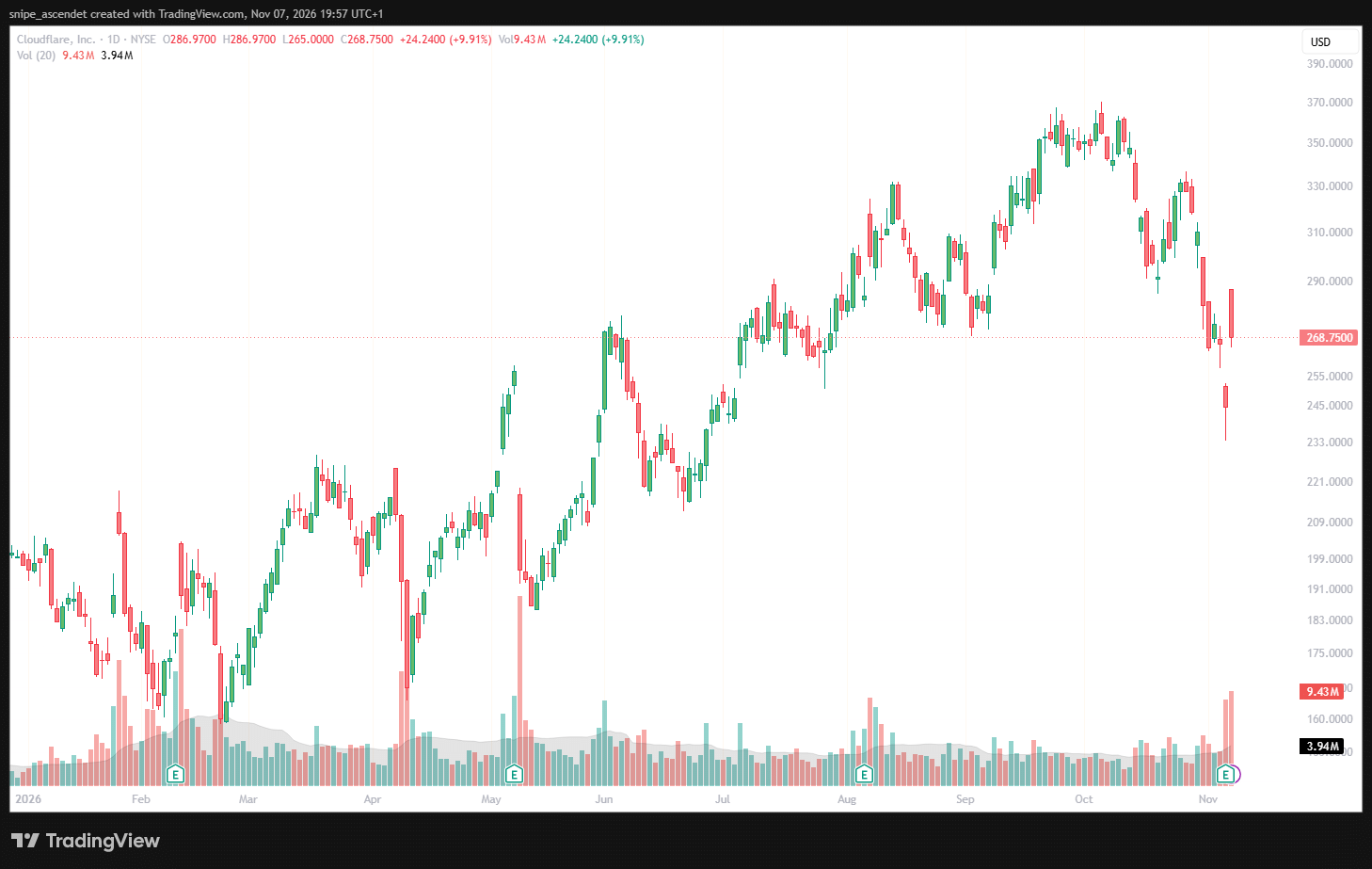
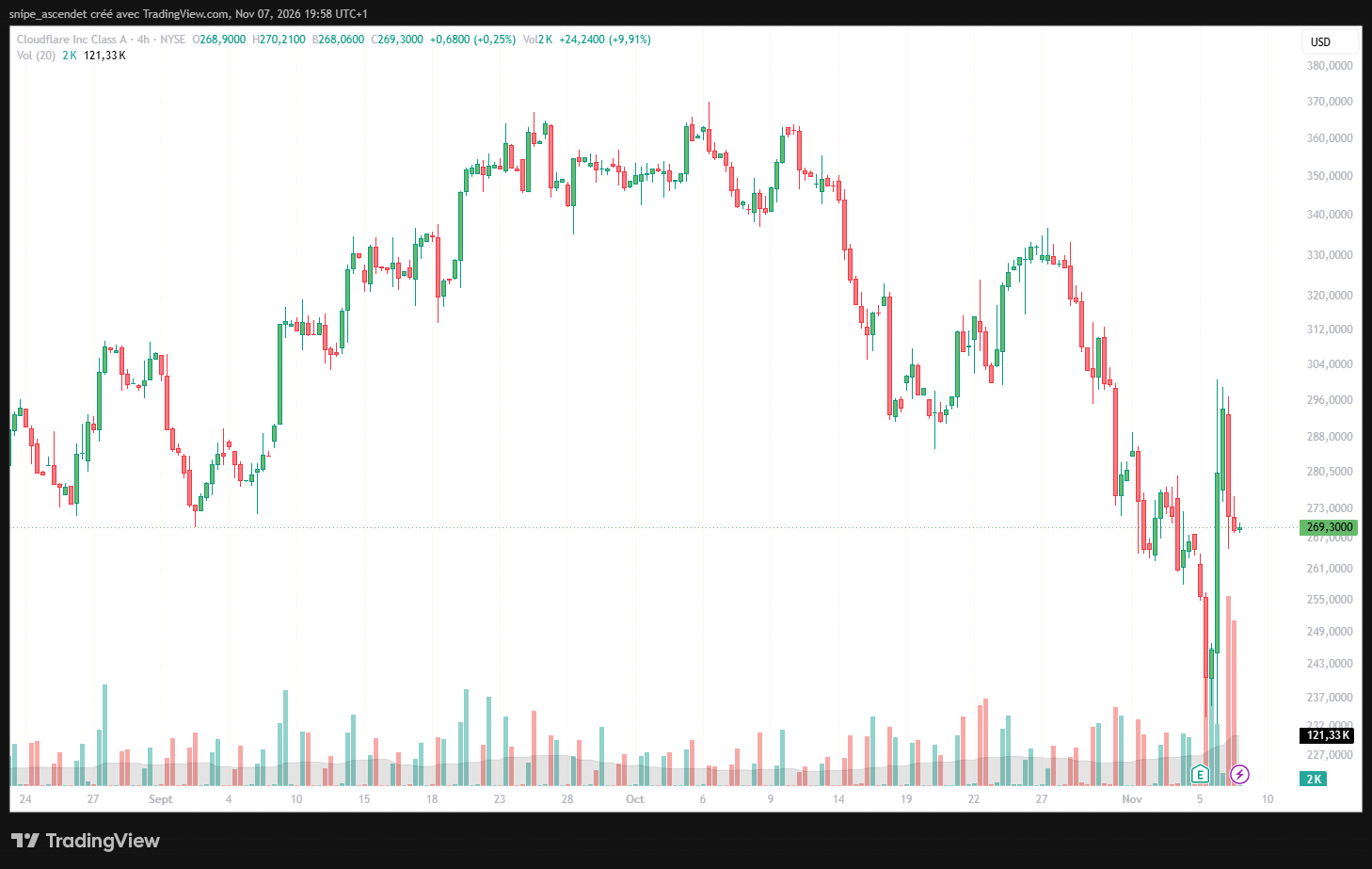
NET closed at $268.75 on November 6, up 9.91% for the session. That rebound followed a sharp pullback from October levels; a strong one-day move does not by itself establish a durable recovery. Four-hour trading around the earnings announcement also showed significant volatility.
Akamai: AI Cloud Contracts Change the Growth Narrative
Akamai still earns most of its revenue outside the new cloud infrastructure engine. In the third quarter, security revenue was $622 million, up 9%; delivery and other cloud applications brought in $391 million, down 3%; and cloud infrastructure services contributed $109 million, up 34%. The last business represented less than 10% of current quarterly sales, even though it has become central to the investment thesis.
Management says it signed more than $14 billion of multiyear cloud commitments during 2026 and now expects $1.1 billion to $1.3 billion of cloud infrastructure services revenue in 2027. It also forecasts 17% to 22% company-wide revenue growth in 2027 on a constant-currency basis, with total revenue exceeding $7 billion in 2028. These are forward-looking management estimates, not guaranteed customer payments or 2026 revenue.
Akamai is developing AI-oriented infrastructure offerings including Akamai Inference and Agent Sandbox, while its established security portfolio protects applications and APIs. That is a different economic model from Cloudflare’s faster-growing connectivity and developer platform: Akamai is assuming significant infrastructure deployment costs to satisfy customer capacity commitments.
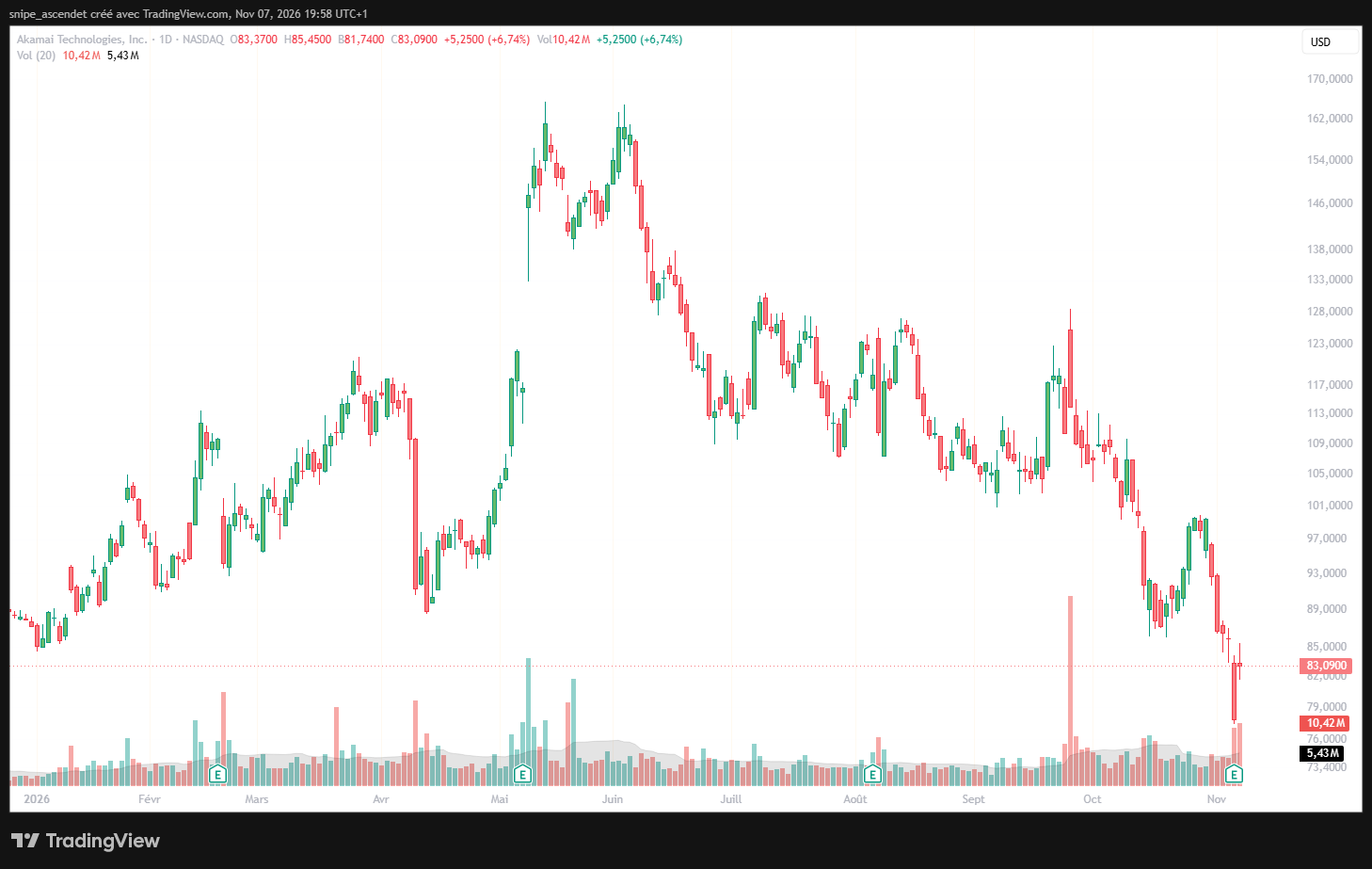
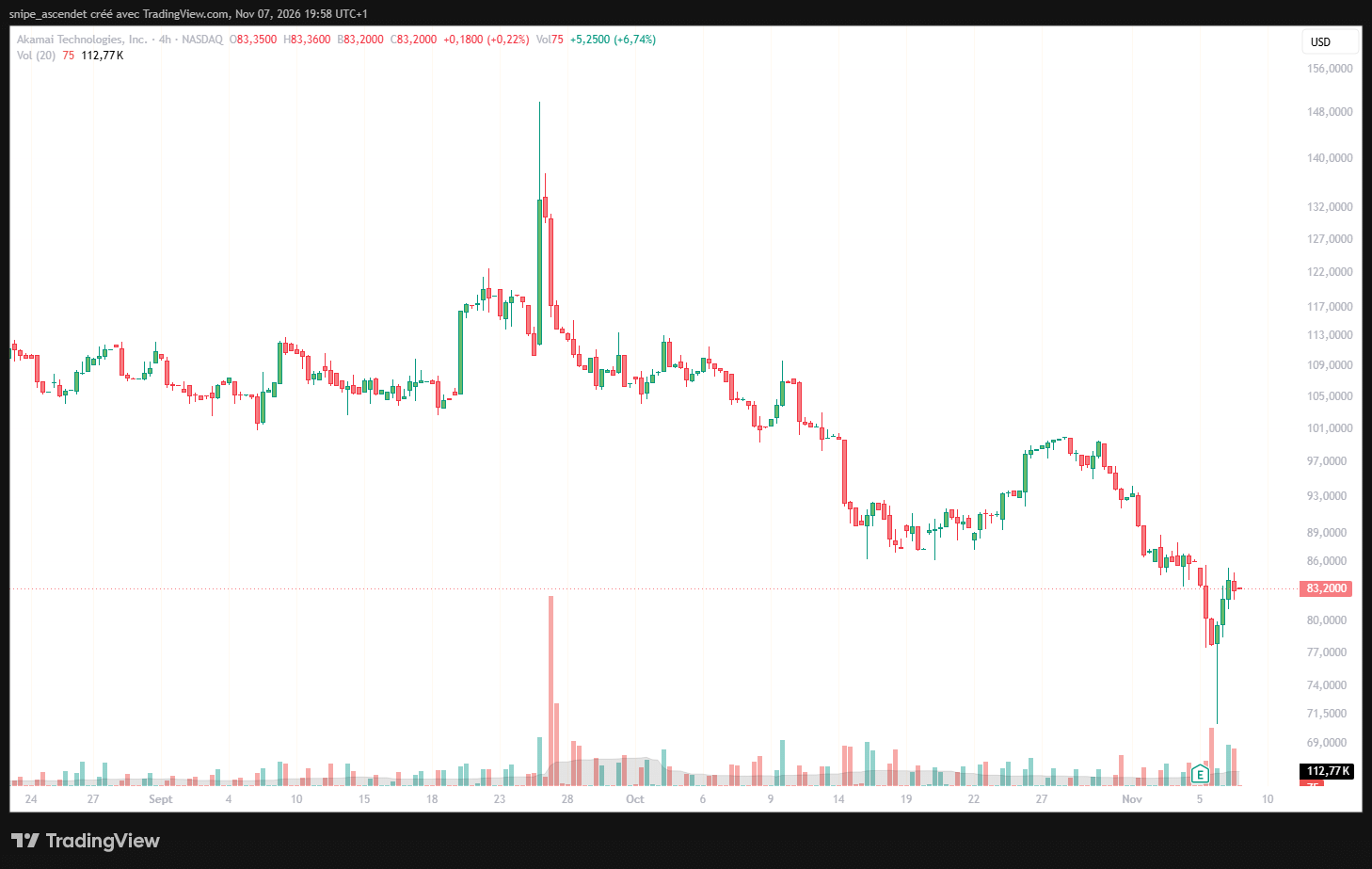
AKAM finished November 6 at $83.09, up 6.74%. The stock nevertheless remained far below its spring levels. Trading around the earnings announcement was volatile; the final close should not be confused with the lows reached intraday.
Margins and Free Cash Flow: The Critical Difference
Akamai reported $109 million in GAAP operating income and a 10% GAAP operating margin in Q3, but that margin was six percentage points below the year-earlier quarter. Its 25% non-GAAP operating margin was also down six points. In other words, Akamai is profitable today, but the most recent quarter did not show margin expansion. Cloudflare is improving adjusted margins while still reporting operating losses under GAAP.
The first nine months of 2026 present an even more revealing cash-flow contrast. Cloudflare reported $491.3 million in operating cash flow and $222.5 million in free cash flow after property purchases and capitalized internal-use software. Akamai reported $1.072 billion in operating cash flow, but spent about $1.023 billion on property and equipment and capitalized software, leaving approximately $49.1 million by the same basic free-cash-flow calculation. This is a matched nine-month comparison, rather than mixing quarterly and year-to-date periods. The Cloudflare 10-Q and Akamai 10-Q contain the underlying cash-flow statements.
Akamai’s financing requirements could increase. Its September 30 filing estimates approximately $6.8 billion of capital expenditures for new multiyear cloud arrangements, starting in Q4 2026 and accelerating in 2027. It also discloses $2.4 billion in additional co-location operating leases that had not yet commenced. These are distinct disclosures and should not simply be added together as if both were cash capital expenditures.
Akamai held $4.239 billion of cash and marketable securities at quarter-end, but also had $7.64 billion in outstanding convertible notes by principal amount. Its filing explicitly warns that capital spending is expected to precede a significant portion of customer cash inflows and that alternative financing, including potentially dilutive financing, may be considered. Cloudflare also has financial obligations, including about $4.44 billion of convertible notes at carrying value against $5.129 billion of liquid cash and securities. Neither company should be evaluated solely on cash balances.
Valuation: A Roughly 12-Fold Sales-Multiple Gap
Using the November 6 closing prices and the most recently disclosed basic shares outstanding, Cloudflare’s approximate equity market value was $96.3 billion, against about $12.0 billion for Akamai. Dividing those market values by each company’s midpoint 2026 guided revenue gives a price-to-sales ratio of approximately 32.5 times for NET and 2.7 times for AKAM. Cloudflare therefore traded at roughly 12 times Akamai’s sales multiple on this defined basis.
These are illustrative equity price-to-sales calculations, not enterprise-value-to-revenue ratios. They use Cloudflare’s October 22 Class A plus Class B share count, Akamai’s November 2 common share count and each company’s November 5 full-year revenue guidance. They exclude potential dilution from convertible securities, future awards and warrants. The gap reflects differences in growth expectations and business economics, but it is not proof that Akamai is undervalued or Cloudflare is overvalued.
This matters particularly after the fragile November 6 technology-sector rebound. Equity multiples can contract quickly when long-duration growth expectations weaken. The same week, Lam Research’s major stock-buyback authorization underscored how closely investors were scrutinizing capital allocation across technology-linked businesses.
Does AI Networking Demand Benefit Both Stocks Equally?
No. A rise in AI traffic can create more demand for secure application access, content delivery, API defense and developer tools without producing the same revenue per request for every supplier. Cloudflare may benefit from customers deploying and securing applications on its network; Akamai may benefit from security, delivery and from selling computing infrastructure for AI inference. Neither issuer breaks out a clean, independently auditable figure that isolates all AI-generated revenue in the Q3 figures used here.
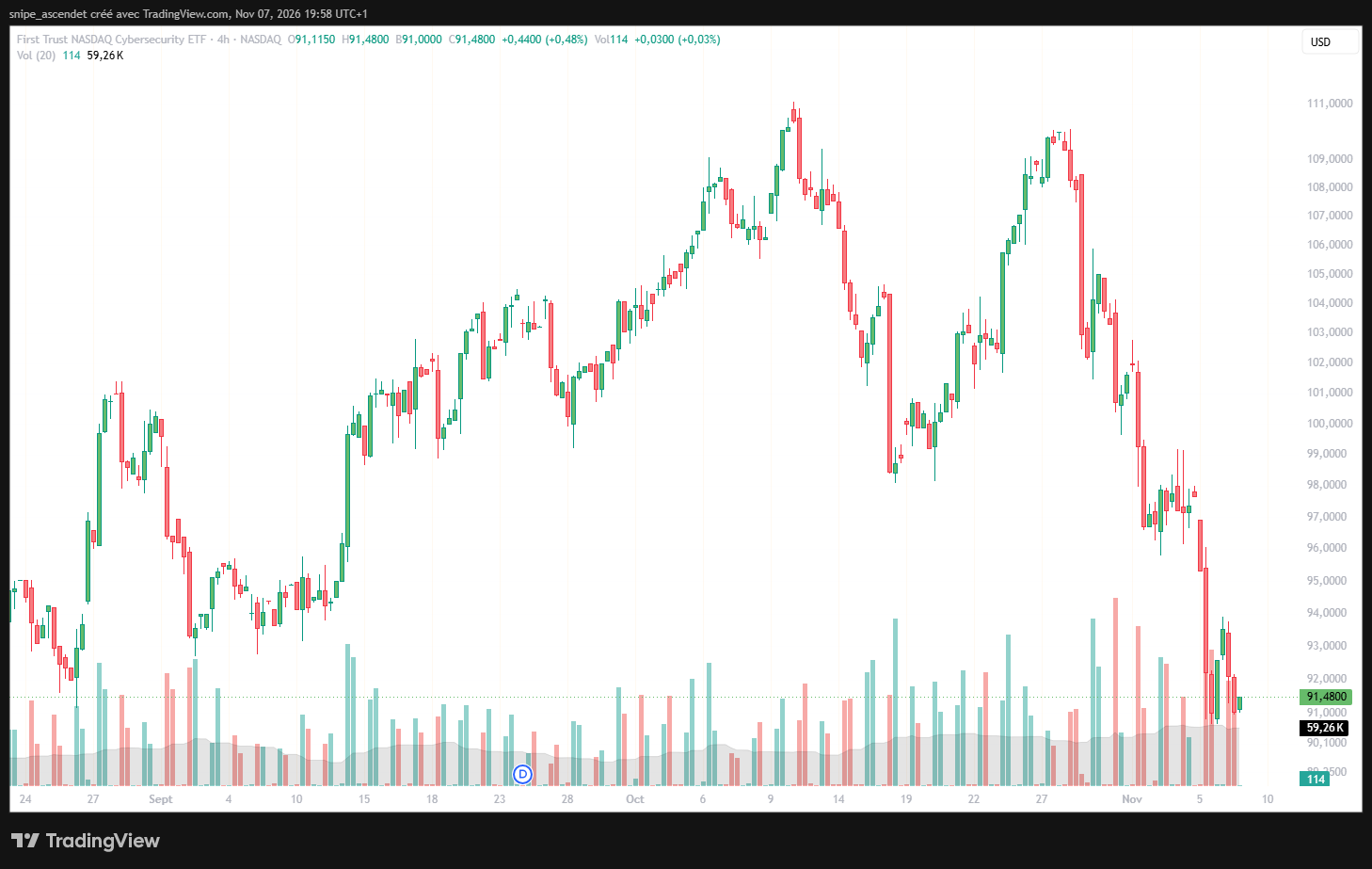
The First Trust Nasdaq Cybersecurity ETF (CIBR) provides context for broader security-stock sentiment, not a direct benchmark for either company’s AI revenue. The sector ETF also experienced late-October to early-November volatility. This proxy cannot establish that changes in NET or AKAM prices were caused by AI demand.
Bull and Bear Cases for 2027
Cloudflare: Growth execution versus valuation risk
- Bull case: Strong contracted growth converts into sustained revenue gains, with adjusted margins and free-cash-flow conversion expanding as security and developer adoption deepen.
- Bear case: Growth decelerates, GAAP losses or dilution remain elevated, and investors reduce the premium they are willing to pay for future profits.
Akamai: Cloud reacceleration versus financing risk
- Bull case: The multiyear cloud commitments convert into recognized infrastructure revenue on schedule, supporting management’s 2027 growth guidance and eventually stronger cash generation.
- Bear case: Deployment costs, lease obligations, financing needs and shrinking legacy delivery revenues outweigh cloud gains before cash collections ramp up.
Which Stock Looks Better Positioned?
Cloudflare currently has the clearer record of company-wide growth. Its latest results demonstrate faster sales expansion, positive free cash flow and improving adjusted operating margins. The weakness is valuation: paying more than 30 times guided annual sales leaves little tolerance for execution disappointments.
Akamai offers the lower entry sales multiple and an unusually large contracted cloud opportunity, but 2027 will test whether capacity spending can become sustainable revenue and free cash flow. Its legacy delivery decline, falling operating margins and large convertible debt balance make the apparent valuation discount less straightforward than it first looks.
The next decisive evidence will be Cloudflare’s continued revenue and cash-flow conversion, alongside Akamai’s cloud deployment milestones, financing choices and reported revenue recognized from its customer commitments. On the evidence available November 7, the stronger growth company is not automatically the more attractively valued stock, and the cheaper sales multiple is not automatically the safer investment.
Disclosure: This analysis is for informational purposes only and is not personalized investment advice. Prices refer to November 6, 2026 closing data from TradingView.