


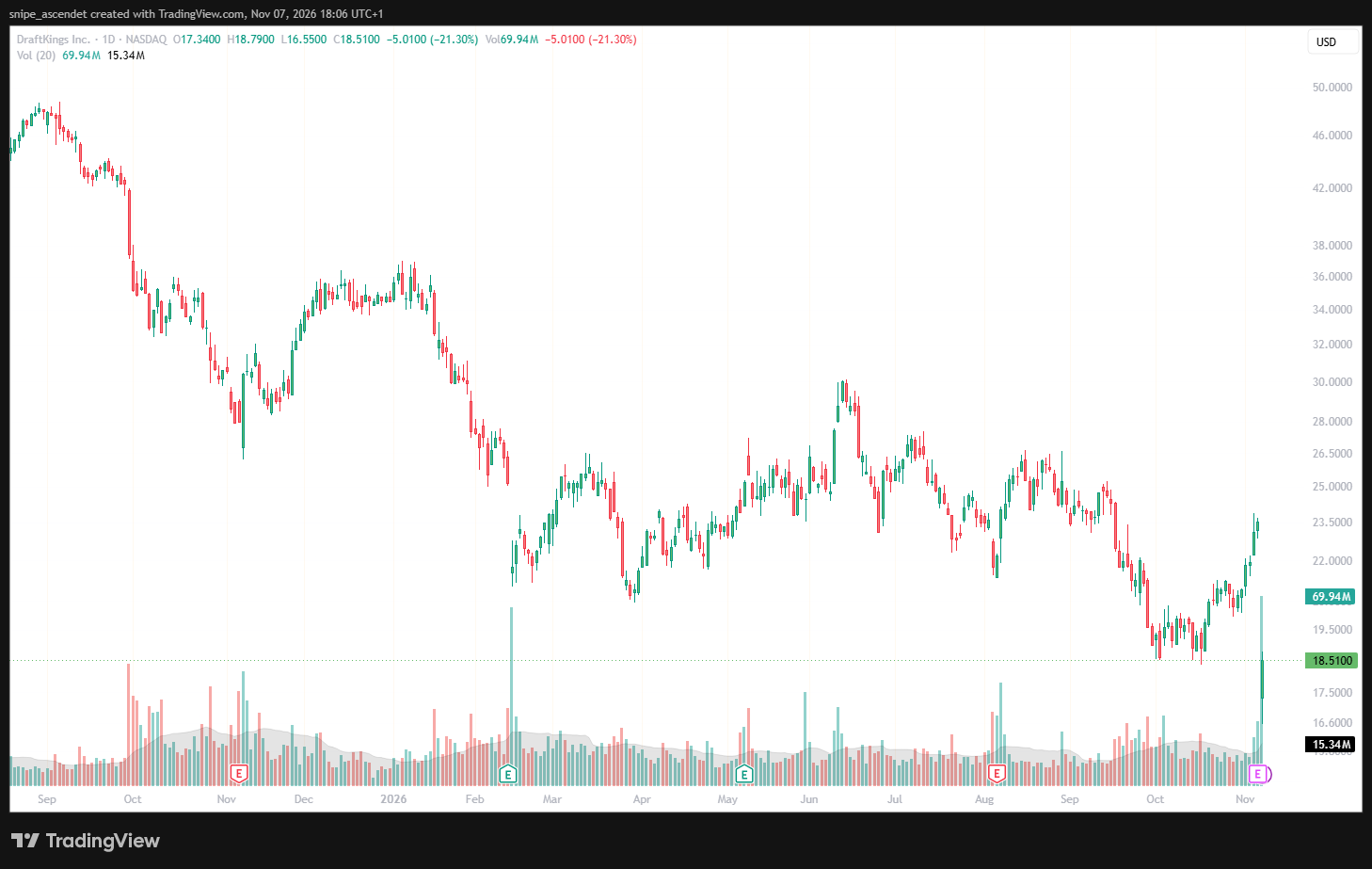
DraftKings shares plunged 21.30% on Friday, November 6, 2026, after the sports-betting operator sharply reduced its full-year profit forecast to fund an expensive expansion into prediction markets. Nasdaq-listed DraftKings (DKNG) closed at $18.51, down from $23.52 the previous session, with approximately 69.9 million shares changing hands. The selloff followed the company’s November 5 third-quarter earnings release, which disclosed stronger revenue but much heavier spending.
The immediate problem is not that customers have stopped using DraftKings. Third-quarter revenue grew 16% year over year, and monthly unique payers increased 13%. The more consequential change is in the economics of growth: DraftKings lowered its 2026 adjusted EBITDA outlook to $175 million-$275 million from $700 million-$900 million, primarily as it accelerates investments in its Predictions business. The market must now decide whether that spending buys a defensible new customer base or starts a costly race against Kalshi, Polymarket and FanDuel.
Why DraftKings stock fell 21% after earnings
The November 6 session was unusually volatile. DKNG opened at $17.34, traded as low as $16.55, recovered to $18.51 by the regular-session close and still ended down $5.01 per share. Volume of roughly 69.9 million shares was nearly three times the previous day’s 23.7 million. These figures describe regular trading, not the lower-priced after-hours indications that circulated following the announcement. Historical trading data confirms the close and the exceptional volume.
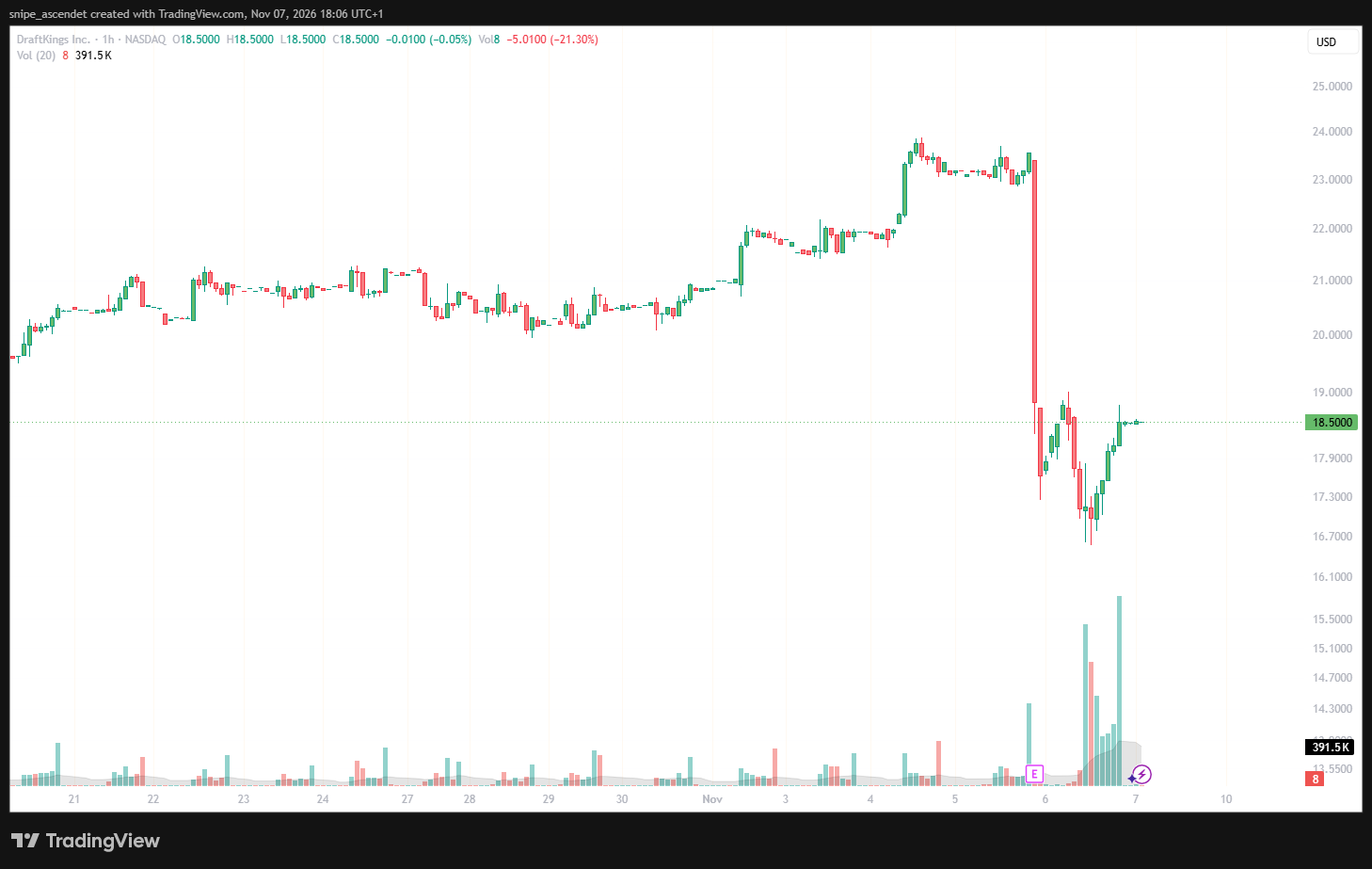
The one-day decline matters because it came despite growth in underlying activity. DraftKings is asking investors to accept materially lower near-term profit in return for a business whose future operating economics are less tested than those of its sportsbook. A sharp share-price fall is not proof that prediction markets will fail; it indicates a repricing of execution risk and the time required to convert promotional spending into profit.
Third-quarter results: customer growth, but costs rose faster
According to the company’s November 5 earnings release and SEC Form 10-Q, revenue reached $1.329 billion, versus $1.144 billion a year earlier. Sports consumer volume rose about 22%, sports revenue rose about 31%, and the reported sportsbook net revenue margin improved to 5.6% from 5.2%.
| Metric | Q3 2026 reported | Q3 2025 reported | Year-over-year change |
|---|---|---|---|
| Revenue | $1.329 billion | $1.144 billion | +16.2% |
| GAAP net loss | $468.7 million | $256.8 million | Loss widened |
| GAAP diluted EPS | -$0.94 | -$0.52 | -$0.42 |
| Adjusted EPS (non-GAAP) | -$0.53 | -$0.26 | -$0.27 |
| Adjusted EBITDA (non-GAAP) | -$316.9 million | -$126.5 million | Loss widened |
| Sales and marketing expense | $605.7 million | $360.4 million | +68.1% |
The sales-and-marketing line is especially revealing. The expense increased approximately $245 million year over year, more than the $185 million increase in quarterly revenue. This comparison does not establish how much of the additional expense came specifically from Predictions, but it illustrates the near-term cost pressure on the consolidated business. Monthly unique payers reached 4.1 million and average revenue per monthly unique payer increased 3% to $109, suggesting customer engagement alone is not the principal weakness.
The guidance reset changes the investment case
The company’s revised outlook is more consequential than any single earnings-per-share figure. In its official release, DraftKings provided these ranges:
| Financial metric | Previous 2026 guidance | Updated 2026 guidance | Midpoint revision |
|---|---|---|---|
| Revenue | $6.50B-$6.90B | $6.35B-$6.55B | -$250M |
| Adjusted EBITDA | $700M-$900M | $175M-$275M | -$575M |
Management expects $650 million-$700 million of 2026 adjusted EBITDA investment in Predictions, while estimating $875 million-$925 million of adjusted EBITDA from its core business. The two figures should not be confused: the Predictions investment represents a negative adjusted EBITDA contribution, not a conventional capital-expenditure budget or a cash outflow with identical timing.
For 2027, DraftKings forecasts $7.35 billion-$7.75 billion in total revenue and $800 million-$1.0 billion in adjusted EBITDA. The corresponding core-business targets are $6.7 billion-$7.0 billion of revenue and $1.15 billion-$1.25 billion of adjusted EBITDA. Predictions is projected to contribute $650 million-$750 million in revenue but still require $250 million-$350 million in adjusted EBITDA investment. In short, 2027 is modeled as a year of substantial recovery, not the year Predictions necessarily becomes profitable on an adjusted EBITDA basis.
Are Kalshi and Polymarket taking the sports-betting market?
Kalshi and Polymarket have expanded awareness of trading event outcomes, including sporting events. They compete for user attention and marketing dollars with traditional online sportsbooks, but the two business models are not identical. Conventional sportsbooks operate under state gambling frameworks, while platforms offering event contracts argue that federally regulated derivatives-market rules govern those products. The interaction between federal commodities law and state gaming law remains contested in several courts, as summarized by Foley & Lardner’s litigation tracker.
For DraftKings, the competitive threat has two parts. First, event contracts may attract customers in jurisdictions where conventional online sports wagering is unavailable or limited. Second, acquiring those customers through promotions can raise industry-wide customer acquisition costs even without clear evidence of lasting sportsbook-market-share losses. DraftKings is simultaneously defending its established sportsbook and investing in Predictions rather than waiting for a definitive regulatory outcome.
Management reported more than 1.6 million customers engaged with Predictions during 2026 and said on its earnings call that it expects its 2026 acquired cohort to repay acquisition costs in about 20 months. That is a management forecast, not an independently demonstrated lifetime return. Retention, effective take rate, future promotions and the eventual legal scope of sports event contracts will determine whether the payback actually materializes.
Flutter and PENN show that investors are separating business models
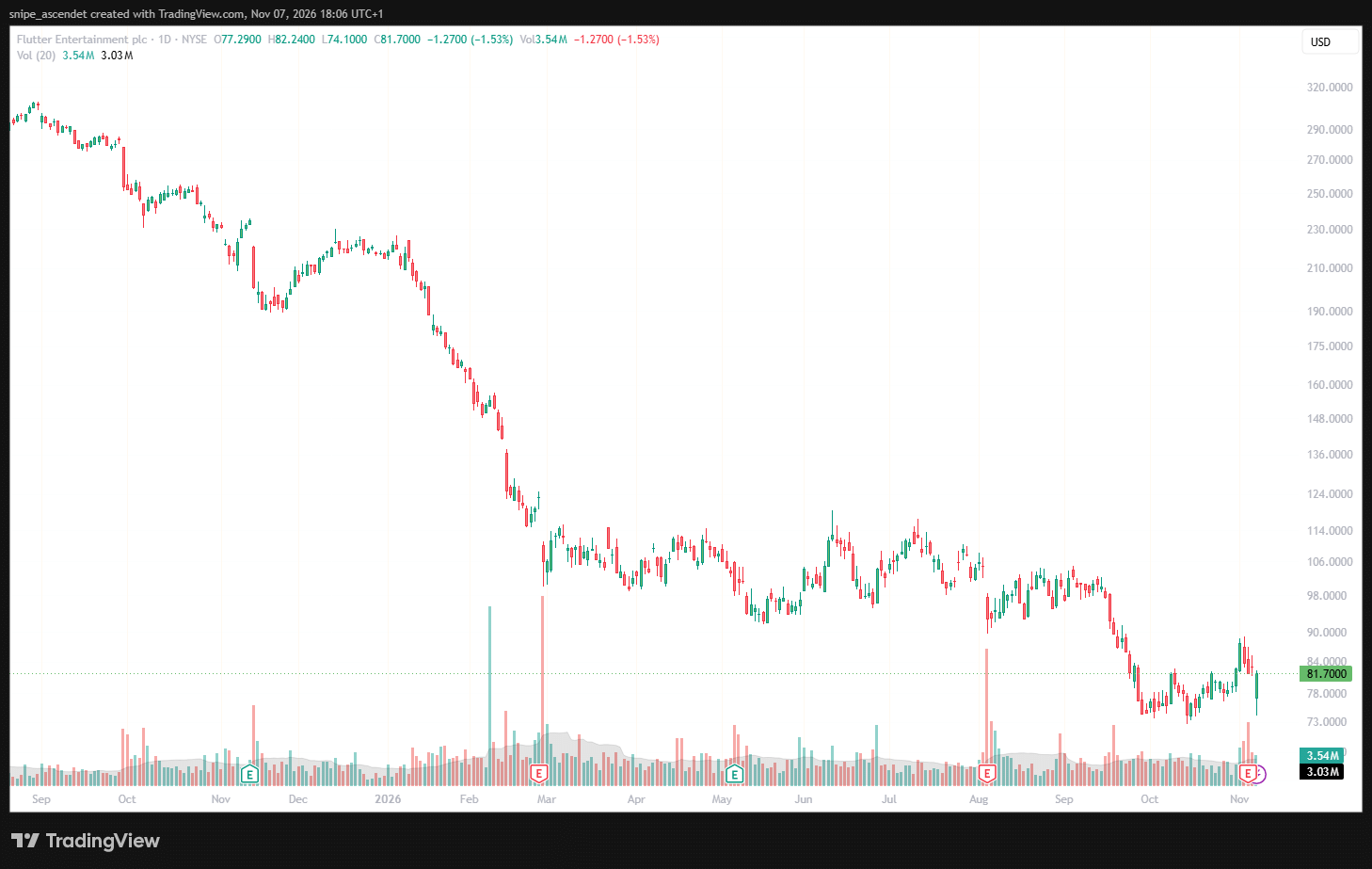
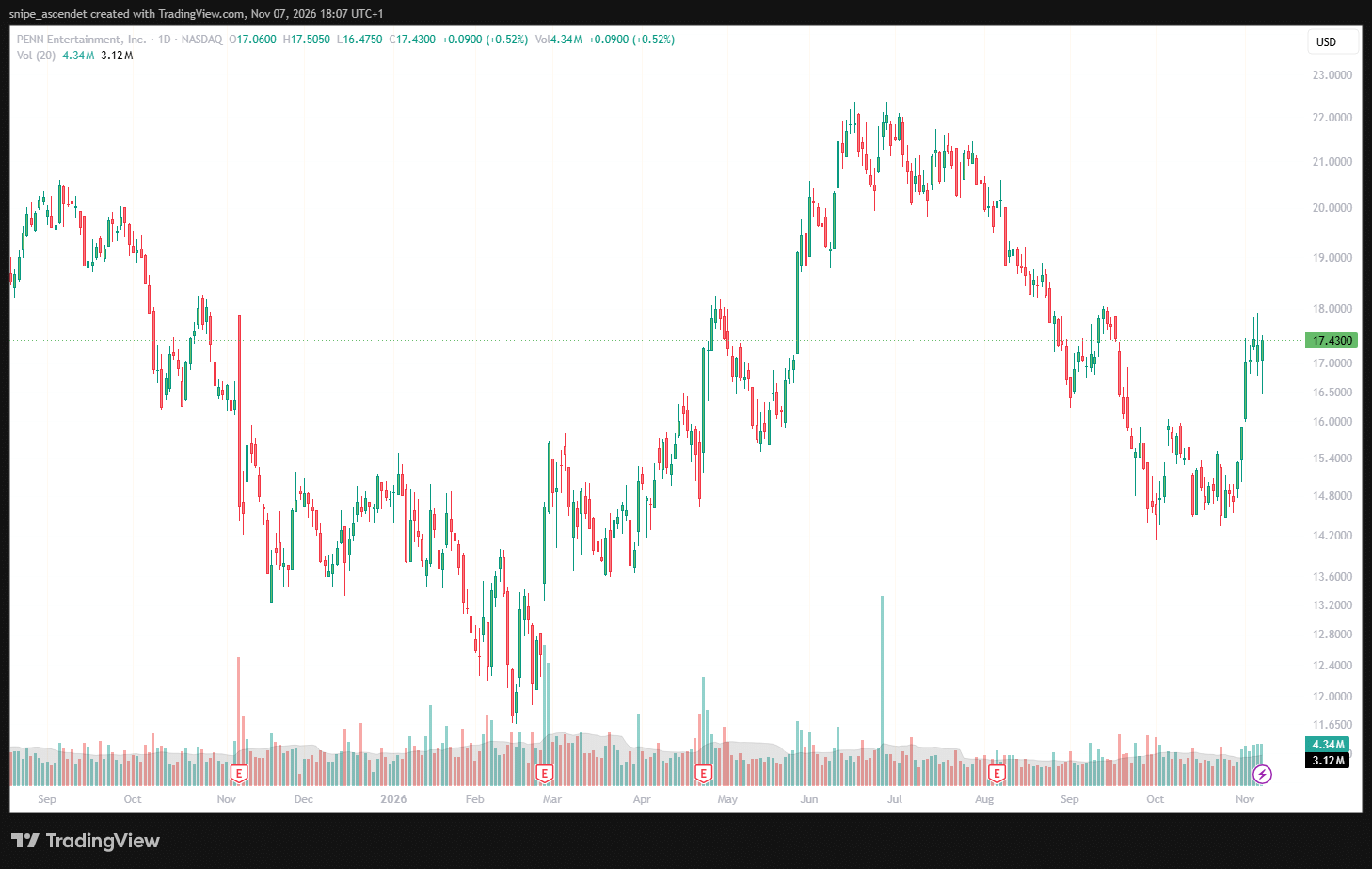
The same November 6 close provides an instructive comparison. Flutter Entertainment (FLUT), owner of FanDuel, fell 1.53% to $81.70 on the NYSE. PENN Entertainment (PENN) gained 0.52% to $17.43 on Nasdaq. These are close-to-close moves for the same session, not prices taken from different intraday moments.
| Stock | Exchange | November 6 close | November 6 change |
|---|---|---|---|
| DraftKings (DKNG) | Nasdaq | $18.51 | -21.30% |
| Flutter (FLUT) | NYSE | $81.70 | -1.53% |
| PENN Entertainment (PENN) | Nasdaq | $17.43 | +0.52% |
Flutter faces similar competitive pressures. Its November 4 earnings release reported $3.874 billion in quarterly revenue, up 2%, and adjusted EBITDA of $360 million, down 25%. FanDuel Predicts had approximately 66,000 average monthly players and $119 million in third-quarter volume. Flutter also warned that prediction-market spending could continue at comparable or higher levels in 2027. Its diversified international footprint, however, means investors are not assessing precisely the same exposure as at DraftKings.
PENN is a different comparison. Its third-quarter release showed $1.84 billion in revenue and a $18.3 million adjusted EBITDA loss in the Interactive segment, alongside strong retail casino performance. The retail property business and a more selective digital strategy make PENN’s earnings drivers different from those of a digitally focused company such as DraftKings. PENN’s positive November 6 return is evidence that the entire gambling sector did not experience an equivalent daily collapse, not evidence that PENN is immune to competitive pressure.
Balance sheet and valuation: what can $18.51 support?
DraftKings reported $1.10 billion in cash and cash equivalents as of September 30, excluding restricted cash and cash reserved for users. Its balance sheet also carried approximately $942 million in convertible notes and $1.25 billion in term loans, net of issuance costs. The company is not debt-free, and customer-reserved funds should not be treated as discretionary corporate liquidity.
Nine-month operating cash flow was $63 million, versus $342 million in the comparable 2025 period. Cash spending on property and equipment totaled $55.4 million, while internally developed software cost another $113.5 million over those nine months. These cash-flow figures are distinct from adjusted EBITDA. They are an important check on the proposition that the expansion can be funded indefinitely without diluting financial flexibility.
At the November 6 closing price, the market valued DraftKings far below its earlier trading levels. Calling the stock cheap solely because it fell 21% would be premature: the earnings denominator has also changed. A valuation based on 2027 adjusted EBITDA requires investors to underwrite both a sharp recovery in the core business and a substantial reduction in Predictions losses. The same discipline applies to other growth stocks analyzed in DualFinances’ coverage of Microvast’s valuation and execution risk and its assessment of earnings quality in a U.S. fintech short thesis.
What could drive the next move in DKNG stock?
Bull case: Predictions retains its acquired users, promotional intensity normalizes, and the projected 20-month customer payback holds up. Under that scenario, 2027 Predictions investment declines toward management’s $250 million-$350 million range while core adjusted EBITDA approaches the company’s $1.15 billion-$1.25 billion target. The decisive signal would be revenue conversion accompanied by lower net acquisition expense, not user registrations alone.
Bear case: Kalshi, Polymarket and FanDuel keep bidding up acquisition costs; event-contract regulation restricts distribution; or sportsbook results remain customer-friendly. If Predictions still needs heavy promotions in 2027, the expected rebound in consolidated adjusted EBITDA could fall short even while headline revenue grows. The business would then be competing on two fronts without yet earning the returns assumed in its investment model.
The next checkpoints are the fourth-quarter update, 2027 profitability guidance, Predictions net revenue after promotions, cohort retention and actual cash generation. Investors should also monitor court rulings affecting sports event contracts. This is fundamentally a capital-allocation question: as discussed in DualFinances’ analysis of corporate growth spending and capital discipline, long-run strategic potential matters only when the returns justify the resources deployed.
For now, DraftKings’ 21.30% slide is best understood as a sharp reset of expectations around customer acquisition, regulatory uncertainty and the timing of profitability. Prediction markets are a credible competitive threat, but the most immediate risk visible in the numbers is the cost of competing in them.
Market data reflect the U.S. regular-session close on November 6, 2026. Financial guidance is management’s forward-looking estimate, not a guaranteed outcome. This article is for information only and is not investment advice.