

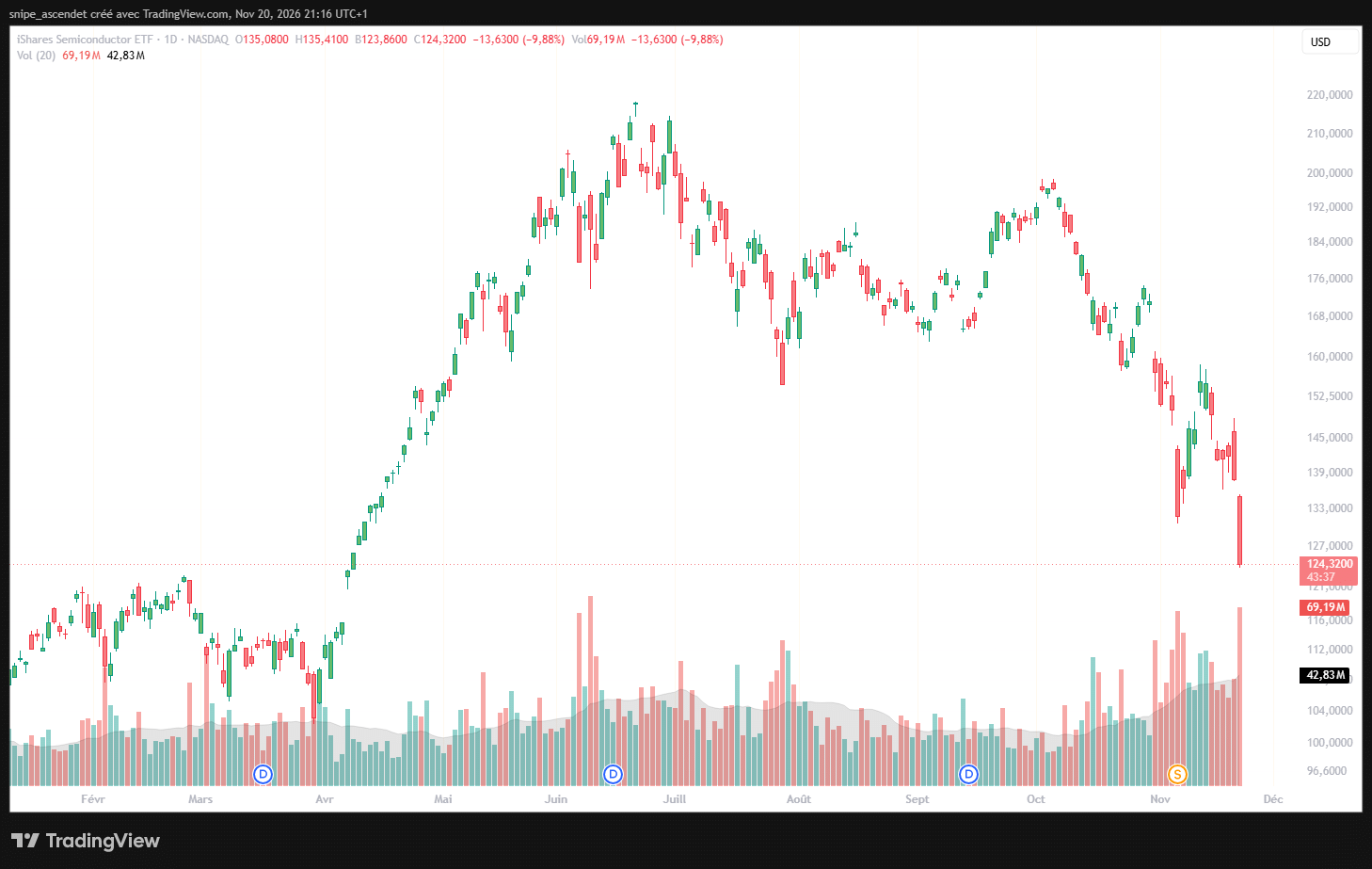
Nvidia (NASDAQ: NVDA) plunged 12.83% to $127.25 at approximately 3:16 p.m. ET on Friday, November 20, 2026, after Reuters reported that the Securities and Exchange Commission is examining potential accounting issues at the AI chipmaker. The disclosure added a new financial-reporting concern to the company’s leadership crisis, while the iShares Semiconductor ETF (NASDAQ: SOXX) fell 9.88%. For shareholders, the central question is whether Nvidia’s reported growth, cash generation and financial disclosures will withstand heightened regulatory scrutiny.

What Is the SEC Investigating at Nvidia?
Reuters reported at 2:13 p.m. ET on November 20 that SEC enforcement staff were examining potential accounting issues at Nvidia, citing two people briefed on the investigation. The Wall Street Journal had disclosed the existence of an SEC inquiry on November 17, but the accounting focus was previously unknown.
The scope remains uncertain. Reuters could not establish when the investigation began or which specific accounting practices regulators are examining. The SEC declined to comment, and Nvidia had not immediately responded to Reuters’ requests for comment. An investigation does not establish wrongdoing.
The distinction matters because financial-reporting inquiries can reach beyond an isolated transaction. Depending on their scope, they may examine revenue recognition, geographical disclosures, customer financing, guarantees or the completeness of information provided to investors. Those are areas of potential investor concern, not confirmed subjects of the SEC inquiry.
Why Did Nvidia Stock Fall 12.83% on November 20?
Nvidia’s November 19 closing price was $145.98. By approximately 3:16 p.m. ET on November 20, shares had fallen $18.73 to $127.25, a 12.83% decline.
| Market indicator | November 20 reading | Interpretation |
|---|---|---|
| Nvidia (NVDA) | $127.25 | Down 12.83% |
| Nvidia intraday low | $126.65 | Down as much as 13.24% |
| NVDA volume | 434.8 million shares | 56.6% above 20-day average |
| SOXX semiconductor ETF | $124.32 | Down 9.88% |
| SOXX volume | 69.19 million shares | 61.5% above 20-day average |
These are intraday readings at approximately 3:16 p.m. ET on November 20, 2026, not final closing prices.
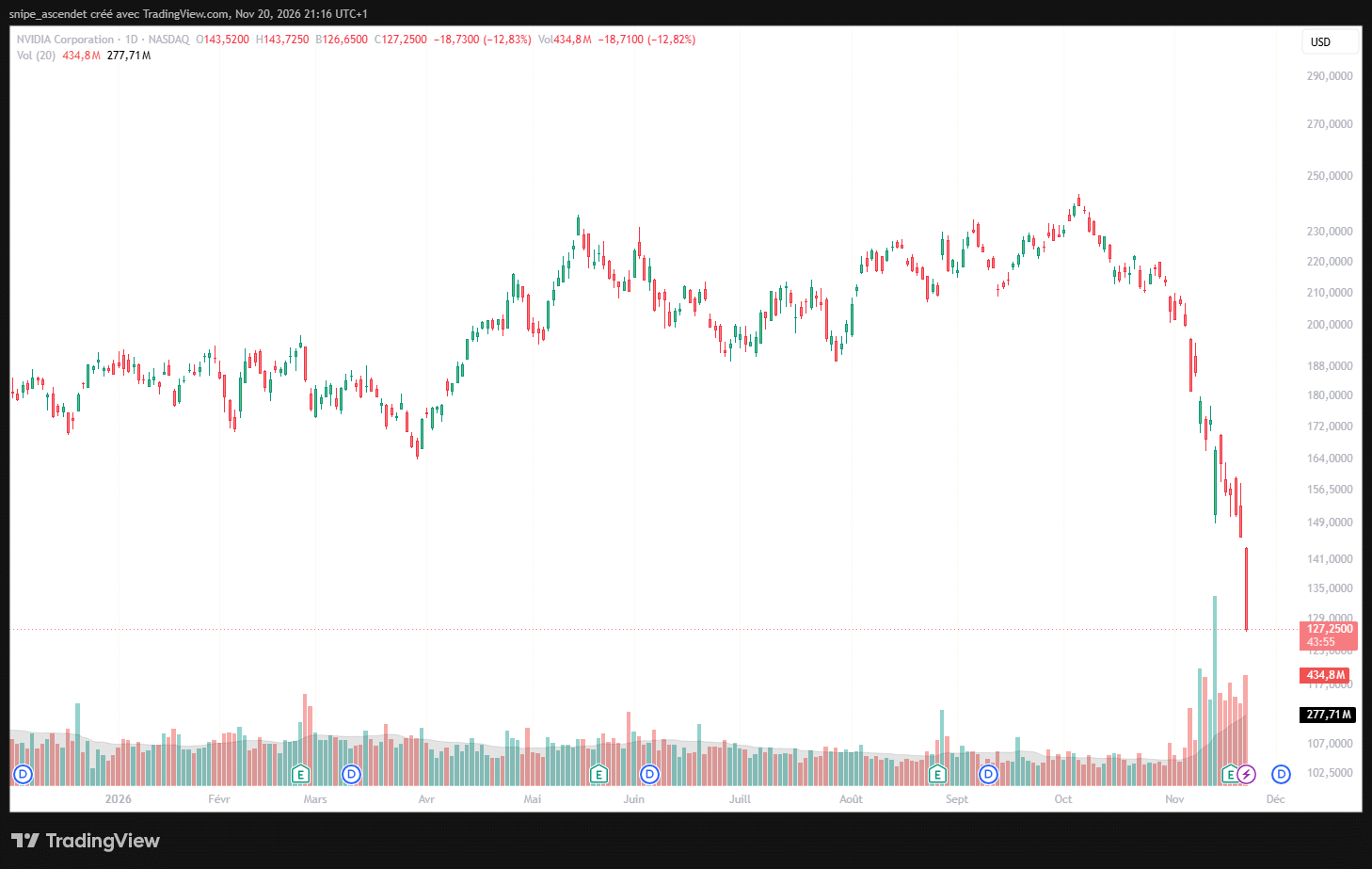
Nvidia underperformed SOXX by 2.95 percentage points. This suggests that investors were selling semiconductor shares broadly while also demanding a steeper discount for Nvidia-specific uncertainty.
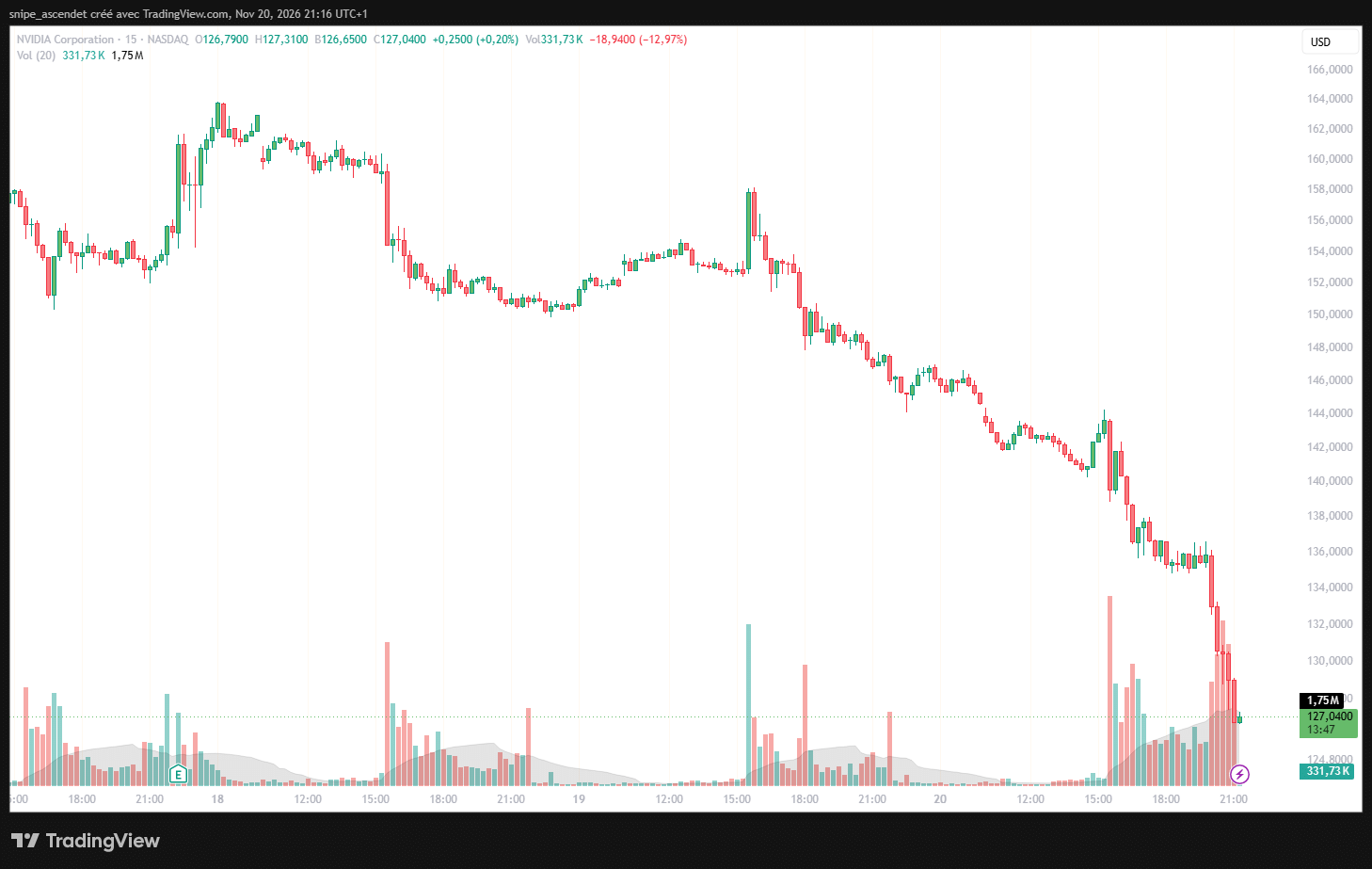
The 15-minute price pattern showed an accelerated decline following the Reuters report, with NVDA moving through the $135 and $130 areas. Daily trading volume reached roughly 1.57 times its 20-session average before the closing bell.
The stock had already experienced a severe decline before the accounting disclosure. Its 2026 price pattern shows a succession of lower highs through November, followed by increasingly forceful selling. The November 20 break below $130 extended that trend rather than starting it.
Why Is Nvidia’s Singapore Revenue Reporting Under Scrutiny?
A separate issue attracting attention concerns how Nvidia reports revenue by geography.
Reuters reported that Nvidia changed its geographical revenue presentation in 2025, moving from customer billing addresses to the locations of customer headquarters. The company said the revised approach better reflected the geographical distribution of its business.
Under the new methodology, Singapore disappeared as a separate category in Nvidia’s geographical revenue breakdown. Reuters also cited Financial Times reporting that sales attributed to Singapore had previously risen to almost half of Nvidia’s global revenue.
These reporting methods answer different questions. A billing address identifies an invoicing relationship, while a customer’s headquarters identifies where that customer is based. Neither necessarily establishes where a chip was physically installed or ultimately used.
That distinction has become particularly important because Singapore-based Megaspeed, historically a significant Nvidia customer, is under investigation by U.S. authorities over suspected export-control violations involving AI chips and China. Megaspeed has maintained that it conducted lawful business.
The SEC has not publicly identified Nvidia’s geographical reporting change as a subject of its inquiry. Nevertheless, shareholders have reason to examine whether customer concentration, delivery destinations and export-related exposure are sufficiently transparent.
Can Nvidia’s $115.8 Billion Quarter Withstand the Accounting Questions?
Nvidia’s operating performance remained exceptionally strong in its fiscal third quarter of 2027, which ended October 25, 2026. According to its November 17 earnings release, revenue more than doubled year over year.
| GAAP metric | Fiscal Q3 2027 | Fiscal Q3 2026 | Change |
|---|---|---|---|
| Revenue | $115.8B | $57.0B | +103% |
| Gross margin | 74.8% | 73.4% | +1.4 pts |
| Operating income | $77.5B | $36.0B | +115% |
| Net income | $65.3B | $31.9B | +105% |
| Diluted EPS | $2.70 | $1.30 | +108% |
| Operating cash flow | $48.3B | $23.8B | +103% |
| Free cash flow (non-GAAP) | $43.8B | $22.1B | +98% |
Data Center revenue reached $107.6 billion, or approximately 92.9% of total revenue. Nvidia also forecast $130 billion in fiscal fourth-quarter revenue, plus or minus 3%, although it expects its GAAP gross margin to decline to 71%–72%.
The earnings figures establish that Nvidia continues to generate substantial profit and cash. However, they also highlight why the reliability of financial disclosures matters so much when investors are valuing a company on extraordinary growth expectations.
For a more detailed breakdown of the financial performance, see our Nvidia fiscal Q3 2027 earnings analysis.
Are Nvidia’s Cash Flow and Receivables Warning Signs?
Nvidia generated $48.25 billion in operating cash flow and $43.78 billion in free cash flow during fiscal Q3 2027. Its free-cash-flow margin was approximately 37.8%, a substantial indication of cash generation.
However, operating cash flow represented approximately 73.9% of GAAP net income. The difference deserves monitoring, particularly as Nvidia expands its relationships with AI infrastructure customers.
Its balance sheet also showed net accounts receivable of $81.03 billion as of October 25, 2026, compared with $38.47 billion on January 25, 2026. That represents an increase of approximately 110.7% across the first nine months of the fiscal year.
Receivables can grow rapidly when revenue doubles, so their increase is not, by itself, evidence of improper accounting. Investors should instead watch collection periods, overdue balances, customer concentration and whether future cash flow continues to support reported profits.
Another concern involves Nvidia’s financial relationships with AI customers. The company has made investments, provided guarantees and entered into commitments associated with AI infrastructure projects that may also purchase its equipment.
Such arrangements can create interconnected risks: a customer’s financial difficulties may affect Nvidia’s investments, contractual commitments and demand outlook simultaneously. Our earlier analysis of Nvidia’s $530.5 billion in commitments and maximum guarantees explains the distinction between financing exposure, purchase obligations and conventional debt.
Why Is the SEC Probe a Bigger Problem After Jensen Huang’s Exit?
Nvidia is managing the investigation during an unusual leadership transition. Founder Jensen Huang resigned as chief executive earlier in November, and former finance chief Colette Kress is serving as interim CEO.
The company is also facing questions surrounding Megaspeed and regulatory scrutiny of its proposed $12.9 billion acquisition of Hugging Face. Reuters reported that the Justice Department is reviewing that transaction alongside broader competition concerns.
For investors, the combination raises the importance of independent oversight and consistent financial communication. A company can deliver strong results while still facing a governance-related valuation discount.
Sector conditions are also deteriorating. Broadcom (NASDAQ: AVGO) suffered a separate double-digit selloff on November 20 following reports of reduced Google TPU orders. That development, detailed in our Broadcom and Google TPU order analysis, shows that investors are reassessing both AI spending forecasts and individual chipmakers’ execution risks.
The immediate priorities are any clarification from Nvidia about the SEC inquiry, developments in its forthcoming fiscal Q3 Form 10-Q, and further information about customer financing or geographic revenue disclosures.
The next scheduled financial-community presentation is the UBS Global Technology and AI Conference on Tuesday, December 1, 2026, at 9:35 a.m. ET, according to Nvidia’s November 19 announcement. The company has not indicated that this presentation will specifically address the investigation.
On the price chart, $126.65 is the November 20 intraday low to monitor, while the $130–$135 area marks the latest breakdown zone. These are observed trading reference points, not guaranteed support or resistance levels.
Continued heavy selling could extend the downside, while a rebound without greater regulatory clarity may remain vulnerable. The more important long-term indicators are cash conversion, the quality of reported revenue and management’s ability to reduce uncertainty.
Bottom line: Nvidia’s 12.83% intraday selloff on November 20 reflects a severe repricing of risk after Reuters identified accounting as a focus of the SEC inquiry. The chipmaker still reports powerful revenue growth and cash generation, but investors now face a more complicated assessment of governance, customer financing and financial transparency.
For informational purposes only; not investment advice.