

Lam Research (NASDAQ: LRCX) authorized an additional $25 billion in stock repurchases on November 5, 2026, offering a major capital-return signal after a punishing selloff in semiconductor equipment shares. LRCX closed the following session at $200.44, up 8.23% from Thursday’s $185.20 close, but the rebound did not erase the preceding 16.36% drop. The decision gives management considerable flexibility to retire shares, although it does not require Lam to spend the full amount or specify when purchases will occur. Lam’s announcement and the related SEC filing confirm the authorization.
For investors, the central issue is not the headline size of the program. It is whether Lam can sustain cash generation through the next semiconductor capital-spending cycle, and whether buybacks at current valuations will improve long-term per-share value rather than simply offset a period of sector volatility.
What Lam Research Actually Announced
The board approved $25 billion of additional repurchase authority, supplementing the unused authorization from earlier plans. Lam had approximately $3.03 billion remaining under the earlier program as of September 27, according to its fiscal first-quarter 2027 Form 10-Q. That September balance should not be mistaken for a confirmed amount remaining on November 5: repurchases could have occurred in the intervening period.
The new plan has no expiration date. Purchases can occur in the open market or privately, including through structured agreements, and management may suspend or discontinue the program. Lam also declared a quarterly dividend of $0.33 per share, payable January 6, 2027, to shareholders of record on December 2, 2026. Neither the buyback authorization nor the dividend declaration is evidence that $25 billion has already been spent.
At Friday’s $200.44 closing price, the new $25 billion authorization is equivalent to roughly 125 million shares, or about 10% of Lam’s approximately 1.249 billion shares outstanding at September 27. This is a static illustration, not a forecast: the actual shares retired will depend on execution prices, timing, dilution and whether the board uses all the authorization.
Market Reaction: A Strong Bounce, Not a Confirmed Recovery
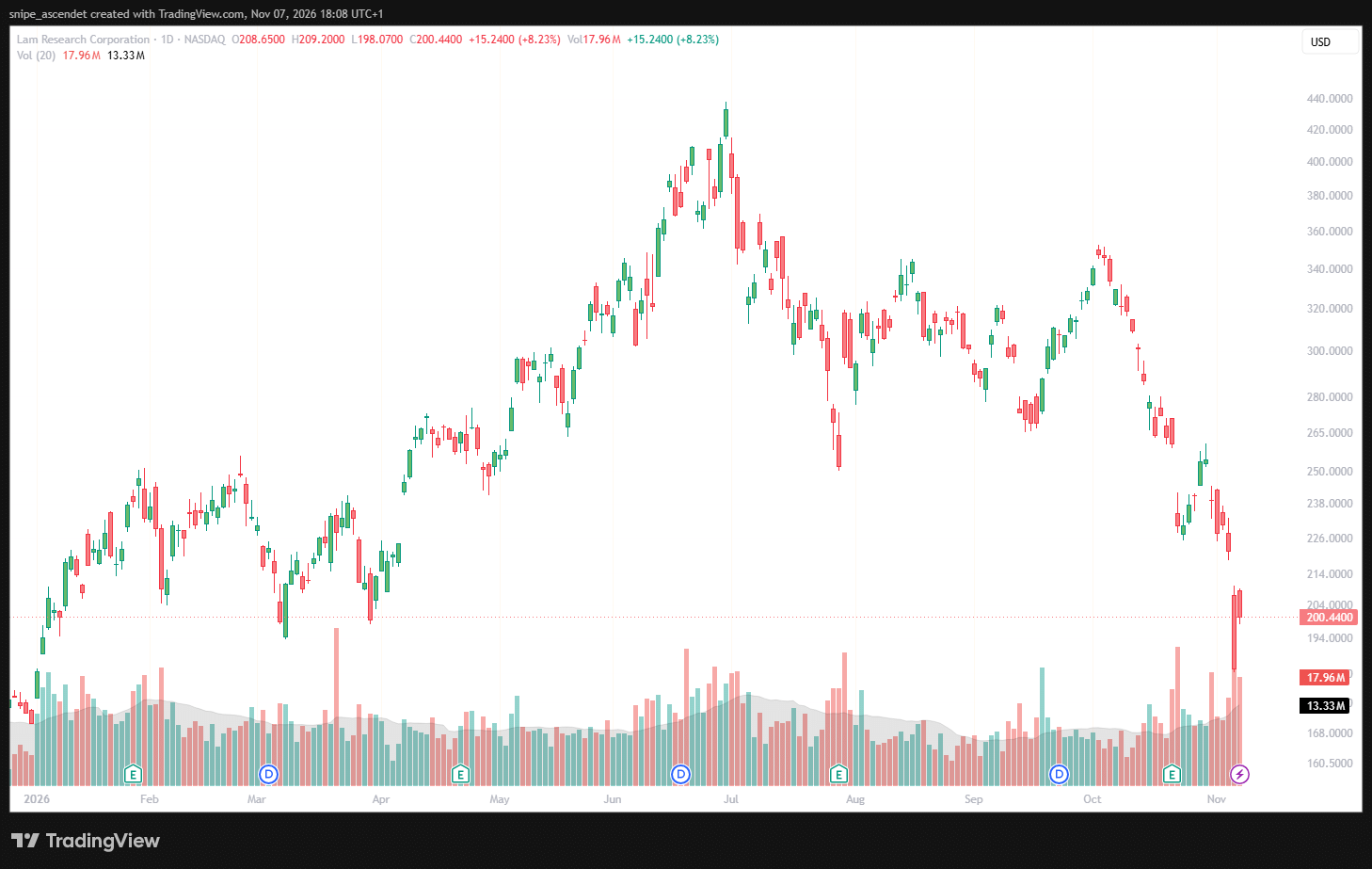
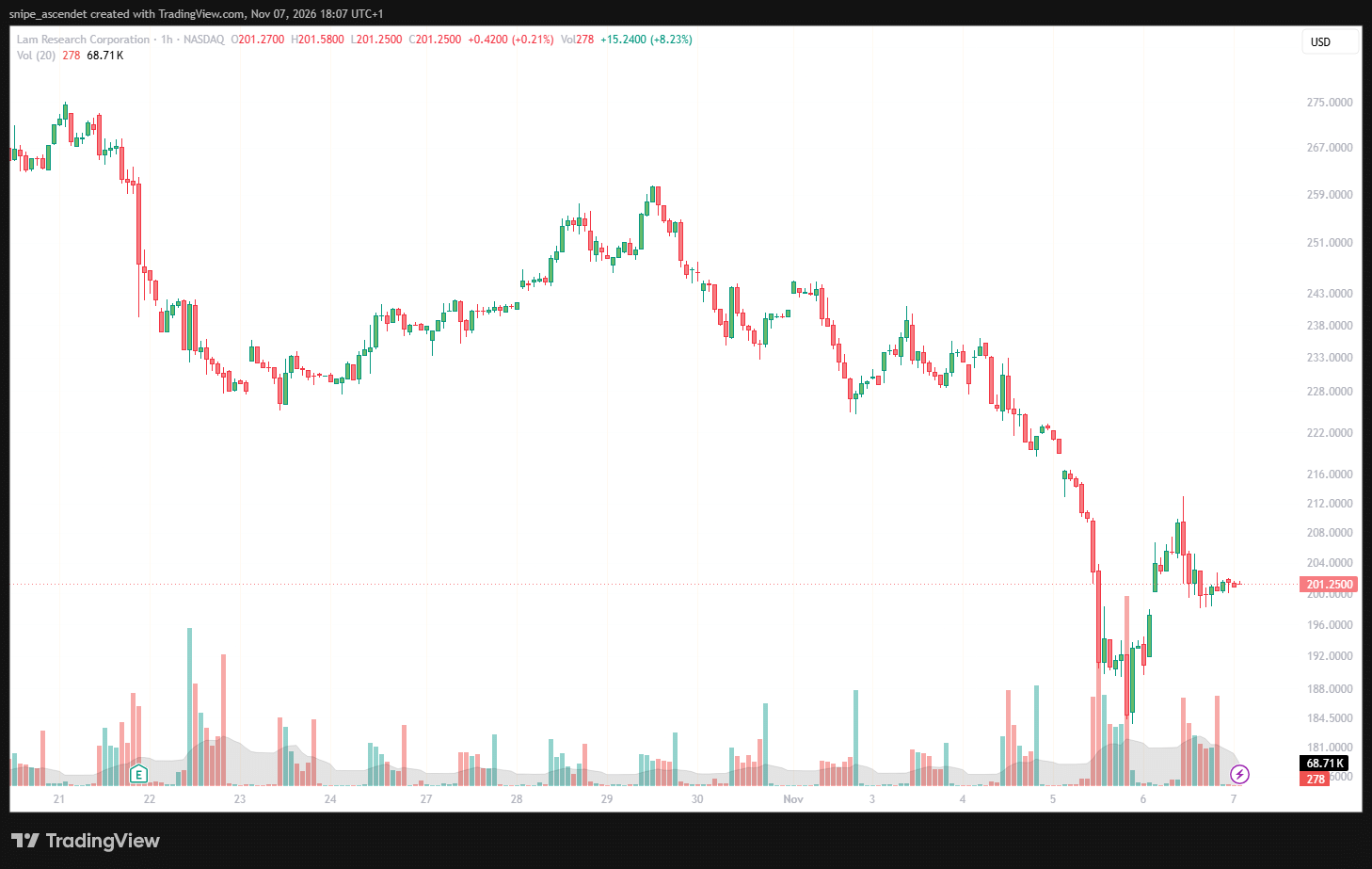
Lam shares fell from $221.43 on November 4 to $185.20 on November 5, a 16.36% one-day decline on approximately 31.45 million shares of volume. On November 6, the stock opened at $208.65, traded as high as $209.20 and finished at $200.44 on roughly 17.96 million shares. That was an 8.23% close-to-close gain but a roughly 3.9% decline from the opening price, suggesting that a substantial early rebound faded by the closing bell. These are regular-session prices, not after-hours indications, as corroborated by historical market data.
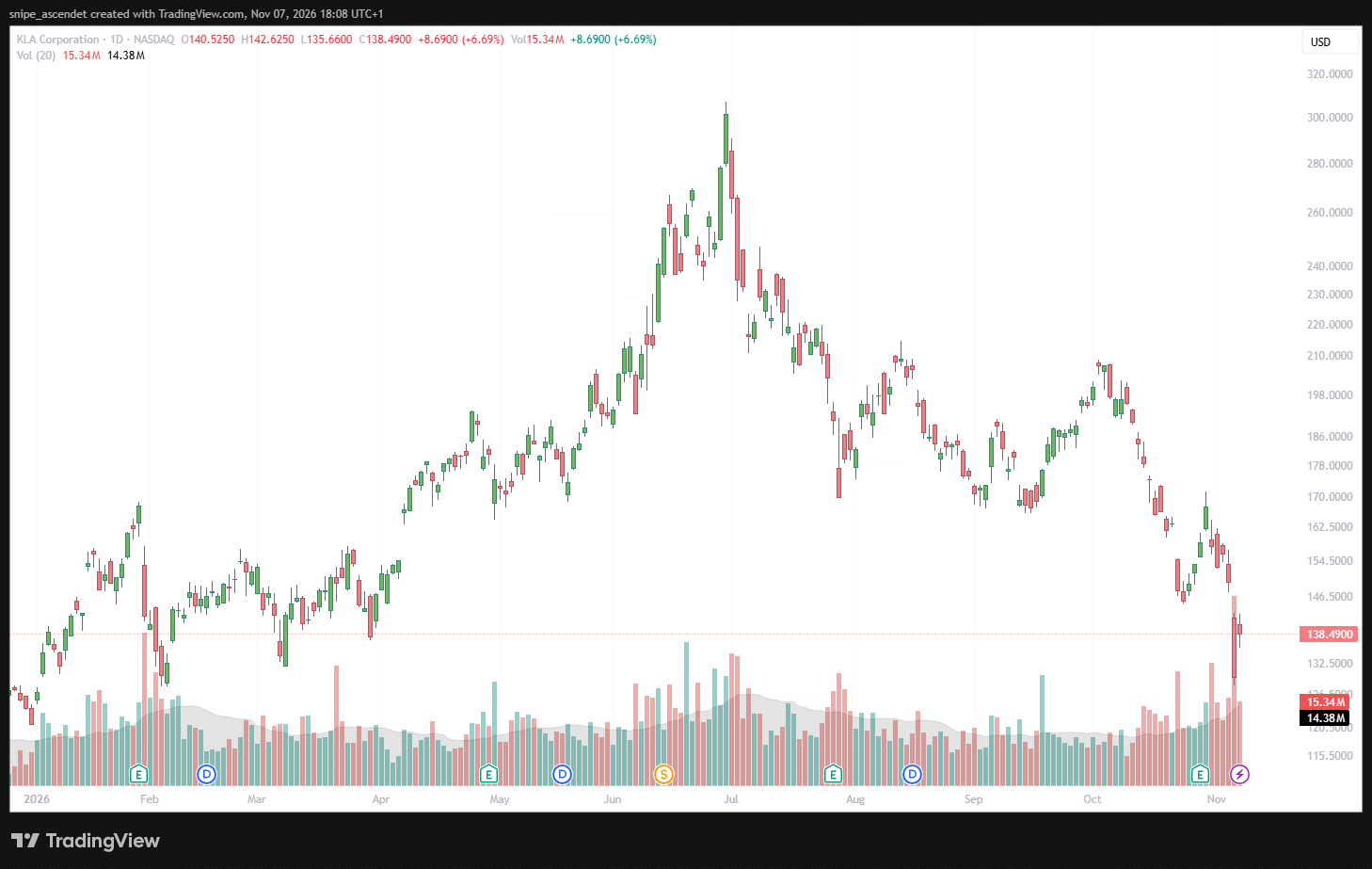
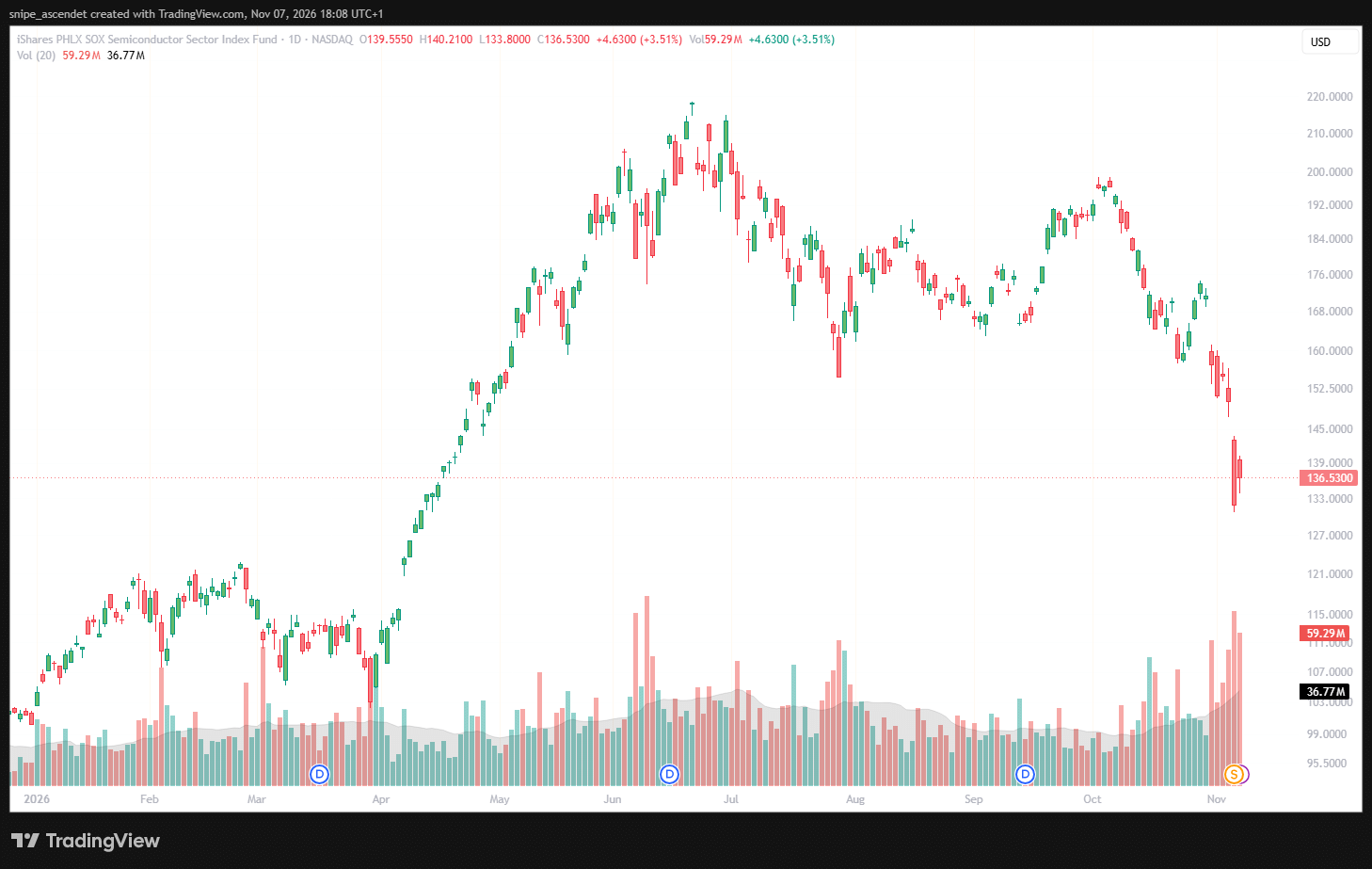
Lam’s announcement coincided with a broader semiconductor recovery. Equipment peer KLA and the iShares Semiconductor ETF also advanced on Friday. Their moves matter because they show that the response cannot be attributed solely to Lam’s corporate action. The comparison below uses identical November 5 and November 6 regular-session closes, so the percentage changes are directly comparable.
| Security | Nov. 5 close | Nov. 6 close | Nov. 6 change |
|---|---|---|---|
| Lam Research (LRCX) | $185.20 | $200.44 | +8.23% |
| KLA (KLAC) | $129.80 | $138.49 | +6.69% |
| iShares Semiconductor ETF (SOXX) | $131.90 | $136.53 | +3.51% |
KLA and SOXX prices are from their respective KLAC history and SOXX history. The breadth of the rebound is consistent with a sector-wide adjustment after heavy selling, not proof that the risks surrounding AI-related capital expenditure have disappeared. As discussed in our earlier assessment of market volatility and feedback loops, price moves can become amplified when positions are unwound quickly.
The Earnings Behind the Buyback
Lam’s financial position was strong before the authorization. In the quarter ended September 27, 2026, revenue rose to $8.22 billion, up 22% sequentially from $6.72 billion and roughly 54% from the prior-year quarter. Its GAAP operating margin reached 40.0%, while non-GAAP diluted earnings per share totaled $2.20. Those results are detailed in the company’s October 21 earnings release.
| Metric | September quarter | June quarter |
|---|---|---|
| Revenue | $8.22 billion | $6.72 billion |
| GAAP operating margin | 40.0% | 37.4% |
| GAAP diluted EPS | $2.19 | $1.81 |
| Non-GAAP diluted EPS | $2.20 | $1.82 |
A reported-versus-consensus earnings comparison is omitted because a sufficiently reliable, like-for-like analyst consensus was not established. More important for the buyback thesis, Lam expects December-quarter revenue of $8.6 billion, plus or minus $400 million, and a GAAP operating margin of 40.5%, plus or minus one percentage point. These are company guidance figures, not guaranteed outcomes.
Semiconductor equipment sales are especially sensitive to customer investment plans. Lam supplies etch, deposition and other wafer-fabrication technology, with AI-driven device complexity and memory manufacturing offering potential growth. A stronger tool market can drive operating leverage, but a delayed fab expansion can affect orders and earnings even when end-market chip demand remains healthy.
Cash Flow and Balance Sheet: Can Lam Fund $25 Billion?
The strongest argument for financial flexibility is cash generation. Lam recorded $3.50 billion of operating cash flow in the September quarter and $257.7 million of capital expenditures and intangible-asset spending. Using the company’s definition, free cash flow was approximately $3.24 billion. The figures come from its Form 10-Q cash-flow statement; free cash flow is calculated as operating cash flow less capital expenditures and intangible assets.
The quarter also included approximately $1.02 billion in treasury stock purchases, including related settlement and excise-tax effects, and $325.4 million in dividends paid. Lam held $7.44 billion in cash and cash equivalents on September 27, compared with approximately $3.74 billion of current and long-term debt and finance-lease obligations. That balance sheet provides flexibility, but the full new authorization is substantially larger than the cash balance.
A $25 billion buyback equals about 7.7 times the latest quarterly free cash flow. It therefore should be understood as a multi-period allocation option, potentially funded through future operating cash generation or other financing sources, rather than cash reserved for immediate repurchases. The September quarter also benefited from favorable changes in operating assets and liabilities; projecting its free cash flow indefinitely would be imprudent.
Execution price is as important as execution size. A buyback undertaken when intrinsic value exceeds the share price can benefit continuing investors, while aggressive purchases during an earnings peak can destroy value. Investors should look for reported shares actually retired, changes in debt and liquidity, and the weighted economic cost of repurchases rather than treating authorization size as an automatic gain.
Valuation: Cheaper Than the Peak Does Not Mean Cheap
At $200.44, Lam traded around 30 times trailing diluted earnings using a roughly $6.71 trailing EPS snapshot, according to market valuation data. That multiple reflects strong recent profitability but still leaves the stock sensitive to changes in expected growth and risk appetite. The sharp decline from the summer highs does not by itself establish an undervaluation.
An earnings-driven rebound would require evidence that sales and margins can remain resilient despite worries about the pace of AI infrastructure investment. Buybacks may increase future earnings per share by reducing the denominator, but the scale of that effect depends on net shares retired and actual earnings. Investors should separate financial engineering from operating performance.
Peers, AI Investment and China Exposure
KLA provides a useful equipment-sector comparison, although its process-control and inspection businesses differ from Lam’s etch and deposition concentration. SOXX broadens the lens to chip designers, manufacturers and equipment suppliers. When all three advance after a sharp selloff, the market may be reassessing sector risk rather than expressing a company-specific judgment about Lam.
Geography adds another risk dimension. China accounted for 35% of Lam’s September-quarter revenue, while Korea represented 20% and Taiwan 18%. Export restrictions, trade policy and changes in customer spending can materially affect results. For broader context, DualFinances previously examined Nvidia, US-China trade tensions and AI valuations. Investors should not assume that growth in global AI compute automatically produces an uninterrupted cycle of equipment orders.
Cash conversion is also a competitive differentiator. Our separate review of SUSS MicroTec’s earnings quality illustrates why equipment investors need to look beyond headline revenue toward the timing of cash receipts and the sustainability of margins.
What Comes Next for LRCX Investors?
Bullish scenario
The constructive case requires December-quarter results broadly consistent with Lam’s $8.6 billion midpoint revenue guide, continued margins near current levels and robust free cash flow. Additional disclosure showing meaningful, disciplined share retirement would strengthen the thesis. A more durable sector recovery, rather than a single-day spike, would provide independent confirmation.
Bearish scenario
The adverse case would emerge if customers delay wafer-fabrication investment, China-related restrictions constrain equipment sales, or weaker mix compresses margins. Under those conditions, cash generation could fall while the company still trades at a substantial earnings multiple. The repurchase authorization would offer flexibility, not a floor under the stock price.
Levels and disclosures to monitor
- November 5 low, $184.24: the recent intraday trough provides an observed reference for downside volatility, not a guaranteed support level.
- November 6 high, $209.20: a recovery through the rebound-session high would indicate firmer near-term buying, though it would not by itself establish a long-term trend.
- Next quarterly filing: executed repurchases, outstanding shares, cash balances, debt and operating cash flow will show how the capital-return plan is progressing.
- December-quarter guidance: revenue, margin and orders will help determine whether weakness in the share price is preceding weaker fundamentals or merely reflecting risk aversion.
Bottom line: Lam Research’s $25 billion authorization is substantial, and its latest cash-flow results give the company credibility as a recurring buyer of its stock. The November 6 rally nonetheless occurred alongside a broad semiconductor bounce and faded from the opening price. Whether LRCX can sustain a recovery will depend more on the durability of wafer-fabrication spending and the discipline of repurchase execution than on the headline authorization alone.
Market data are as of the November 6, 2026 US regular-session close. This analysis is for information only and is not individualized investment advice.