


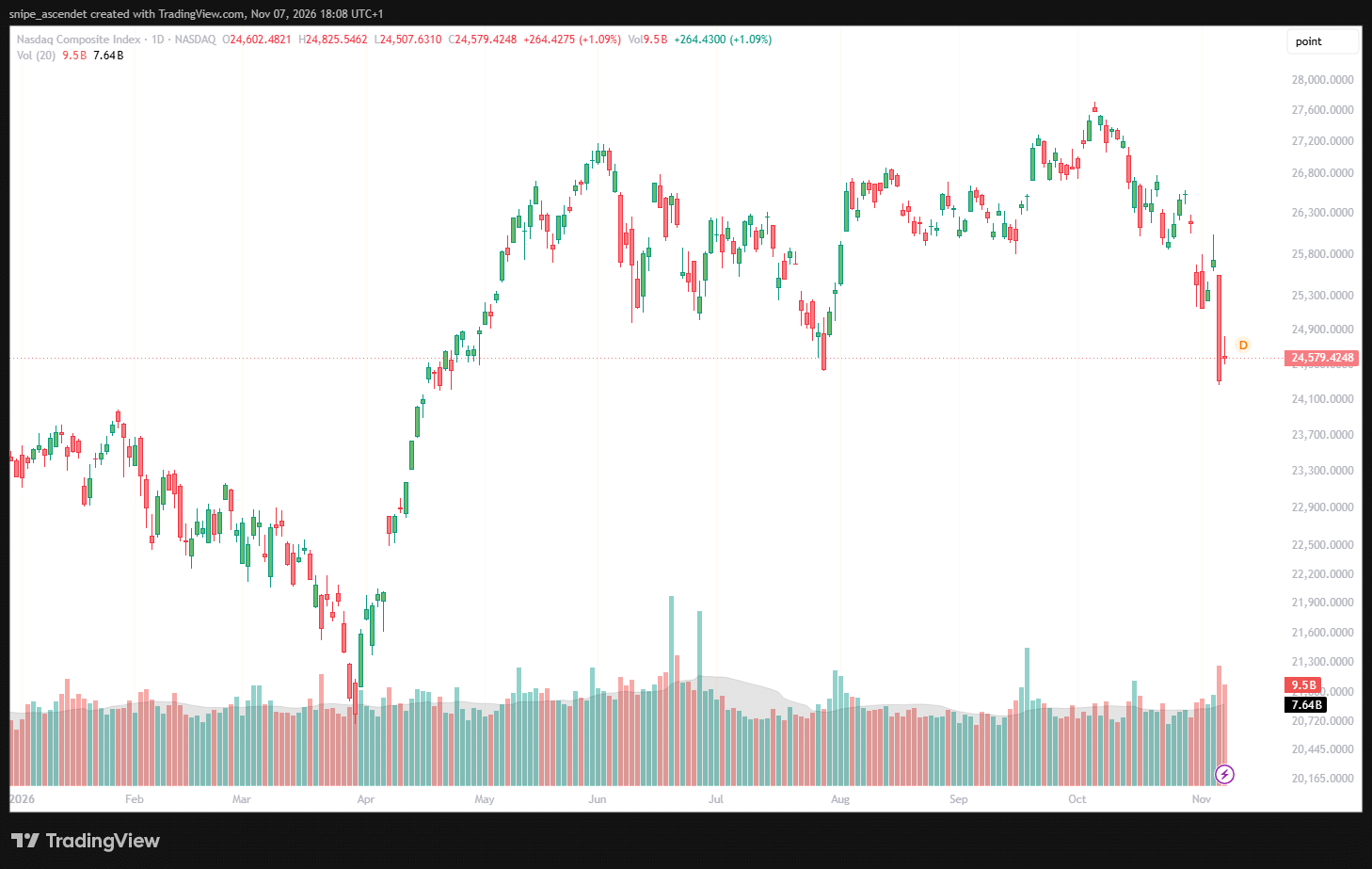
US technology stocks recovered some ground on Friday, November 6, after a brutal selloff, but Wall Street has not established a convincing bottom. The Nasdaq Composite advanced 1.09% to 24,579.42, and chipmakers led the rebound. Yet the tech-heavy index still lost 3.4% for the week, its fourth consecutive weekly decline, while an equal-weight measure of the S&P 500 slipped again on Friday.
This disconnect matters. Investors were willing to buy semiconductor shares after Thursday’s rout, but the wider market showed less enthusiasm. At the same time, stronger US hiring has complicated expectations for Federal Reserve policy, and questions about the financing and political outlook for artificial-intelligence data centers have not disappeared. The next test is whether lower prices attract sustained buyers across the market, rather than just a short-lived rebound in the most heavily sold stocks.
Wall Street Rebounds, but the Weekly Damage Remains
The Nasdaq rose 264.43 points on Friday after falling 5.52% on November 5, its biggest one-day percentage decline in 19 months. The S&P 500 gained 0.31%, but the Dow Jones Industrial Average slipped 0.46%. The Russell 2000 rose about 0.9%. The recovery was meaningful for technology shares, though nowhere near enough to erase Thursday’s losses or the broader weekly decline. The Associated Press closing summary and Reuters market report document the contrast.
| Benchmark | November 6 close | Friday change | Weekly change |
|---|---|---|---|
| Nasdaq Composite | 24,579.42 | +1.09% | -3.4% |
| S&P 500 | 7,376.86 | +0.31% | -2.7% |
| Dow Jones Industrial Average | 51,285.73 | -0.46% | -0.9% |
| Russell 2000 | 2,754.11 | +0.9% | -2.1% |
The Nasdaq had already entered correction territory after retreating more than 10% from its October peak. Friday’s session lifted the index off the week’s low, but its close remained beneath price areas that had supported trading before the November selloff. The November 6 trading range of approximately 24,508 to 24,826 provides an immediate reference: holding above the lower end would be constructive, while a move back toward the pre-selloff area around 25,300–25,800 would offer stronger evidence of recovering demand. These are observed price zones, not forecasts or guaranteed support levels.
Semiconductors Lead, but Have Further to Recover
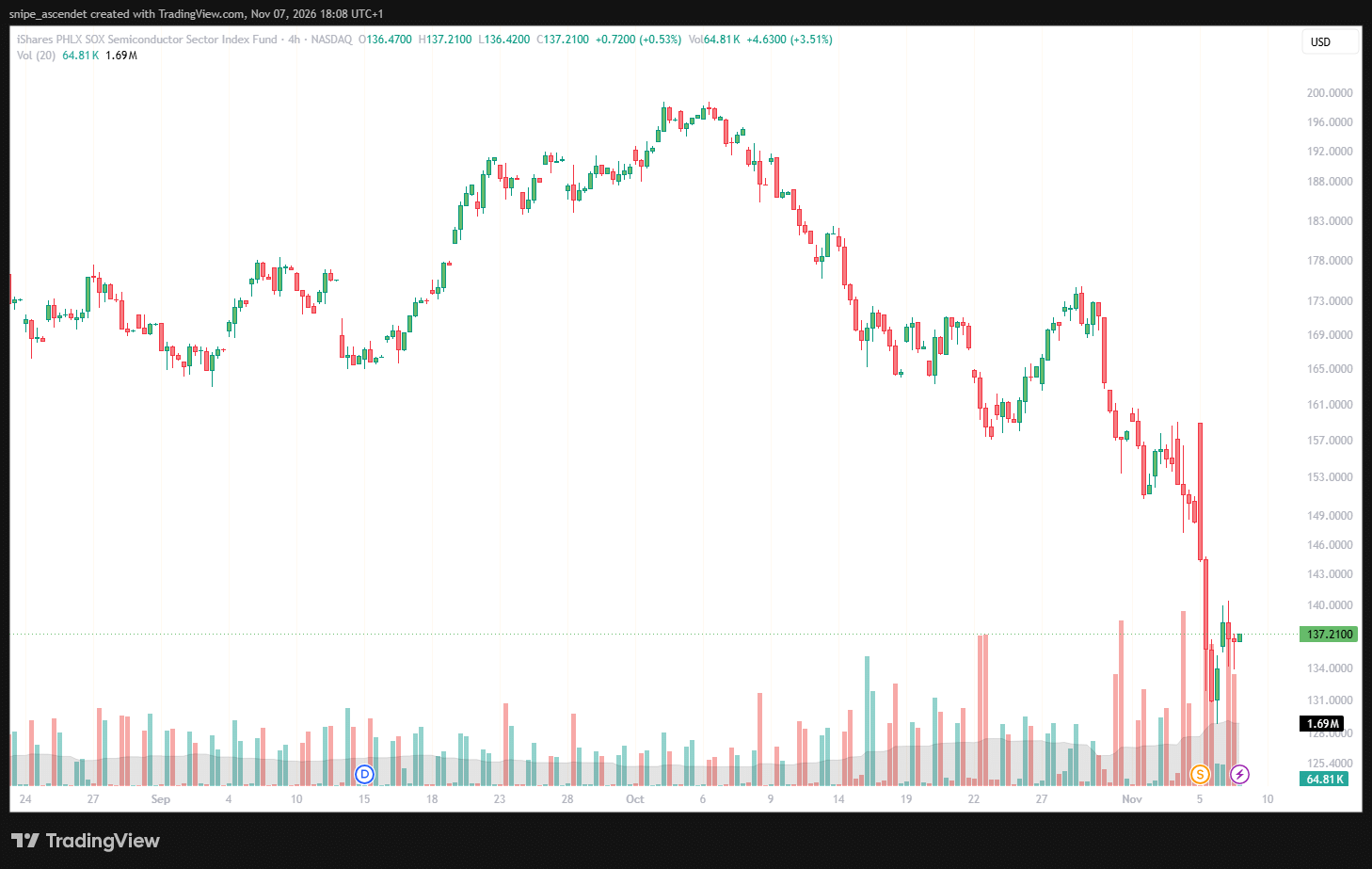
The Philadelphia Semiconductor Index gained about 4.2% on Friday, following a decline of more than 12% on Thursday, according to Reuters. The iShares Semiconductor ETF (SOXX) rose 3.51% to $136.53 in regular trading. Chip stocks therefore outperformed the broad market, but a one-day gain of 3.51% does not reverse a previous-session loss of 12.15%: after a steep decline, a smaller percentage recovery applies to a lower base.
SOXX was trading near $198 in early October before collapsing into the low $130s during the November selloff. Its recovery was accompanied by substantial turnover, yet the price remained far below its October highs. Investors should distinguish between buying after a sharp liquidation and renewed confidence in earnings forecasts. Semiconductor demand may benefit from sustained AI investment, but customer spending plans, export restrictions, inventory cycles and valuation still determine the sector’s medium-term prospects.
The distinction between accounting performance and actual cash generation has long mattered for equipment suppliers. DualFinances previously examined this issue in its analysis of SUSS MicroTec’s earnings and free-cash-flow divergence. That example is not a direct valuation comparison with US chipmakers, but it illustrates why investors should scrutinize cash conversion when capital-spending cycles become uncertain.
Nvidia’s Bounce Does Not Erase the AI Selloff
Nvidia rose 2.78% on November 6 to a regular-session close of $186.64, after dropping 9.26% on November 5. Friday’s regular-session trading volume was about 180 million shares, compared with roughly 306 million the day before. The stock’s four-hour series also shows a late rise after the official close; those extended-hours prices should not be mistaken for the $186.64 closing price.
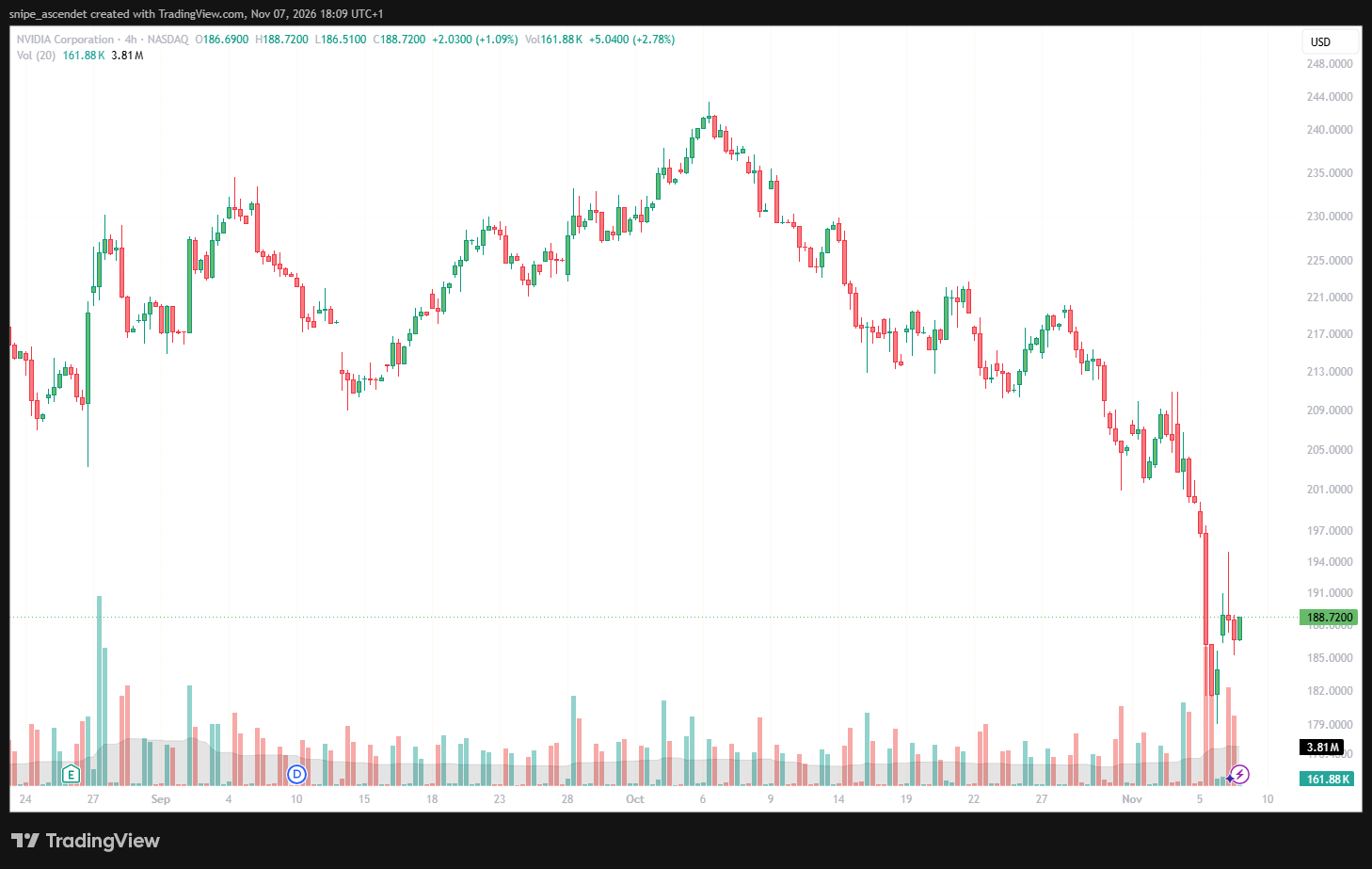
Nvidia remains a central indicator of investor confidence in AI infrastructure because its accelerators and networking products sit near the center of the investment cycle. The near-term test is whether customers continue converting ambitious compute plans into orders and, ultimately, revenue for suppliers. Its bounce does not establish that those fundamentals have weakened, just as the previous day’s decline does not by itself prove that AI demand has collapsed.
Investors should pay closer attention to revenue guidance, gross margins, customer concentration and the pace of AI server deployment than to any single volatile session. The market’s reaction to the next round of earnings and spending updates will help reveal whether the selloff was primarily a valuation reset or an early signal of slower investment.
CoreWeave Shows the Financing Risk Beneath the Rally
CoreWeave is a particularly useful counterpoint to Nvidia. The AI-cloud infrastructure company rebounded 6.28% to $46.40 on Friday, but its shares had declined 9.83% on Thursday and 9.90% on Wednesday, according to historical closing data. Friday’s gain therefore recovered only part of the damage. Approximately 59.4 million shares changed hands during the regular session, reflecting intense attention ahead of results.
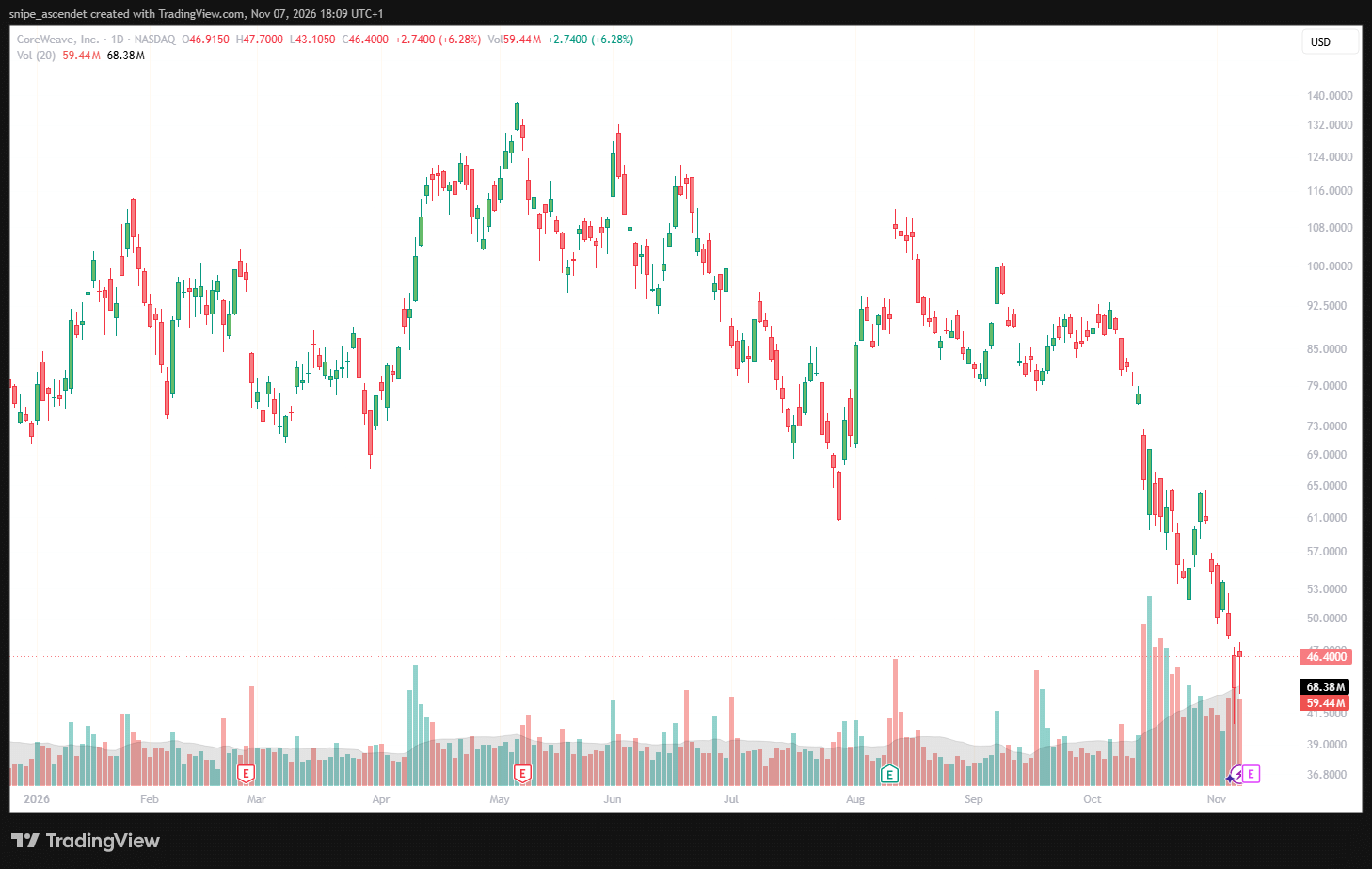
The investment issue is different from the one facing established chip suppliers. Data-center operators must secure costly computing hardware, power and facilities before they can fully monetize contracted capacity. The key measures are not just revenue growth, but capital expenditures, debt and interest costs, contracted demand, customer concentration and the timing of positive free cash flow. Rising financing costs or delayed deployment can undermine equity values even when long-term demand for AI computing remains substantial.
CoreWeave has formally scheduled its third-quarter 2026 earnings conference call for Tuesday, November 10, at 5:00 p.m. Eastern, according to its October 27 investor-relations announcement. That update offers a near-term opportunity to test management’s outlook and the market’s assumptions. Before the company reports, there is no basis for claiming that its pending numbers will confirm or contradict the selloff.
Policy also matters. Reuters reported renewed uncertainty after the US midterm elections over the future pace of data-center construction, amid local environmental and infrastructure concerns. Regulation, permitting and electricity availability could affect project schedules, but the scope and timing of any changes remain uncertain. This is a risk scenario, not evidence that every planned project will be delayed.
Market Breadth Sends a More Cautious Signal
The clearest warning against declaring a broad recovery comes from the Invesco S&P 500 Equal Weight ETF (RSP). It fell 0.38% to $216.05 on November 6, even as the standard capitalization-weighted S&P 500 gained 0.31%.
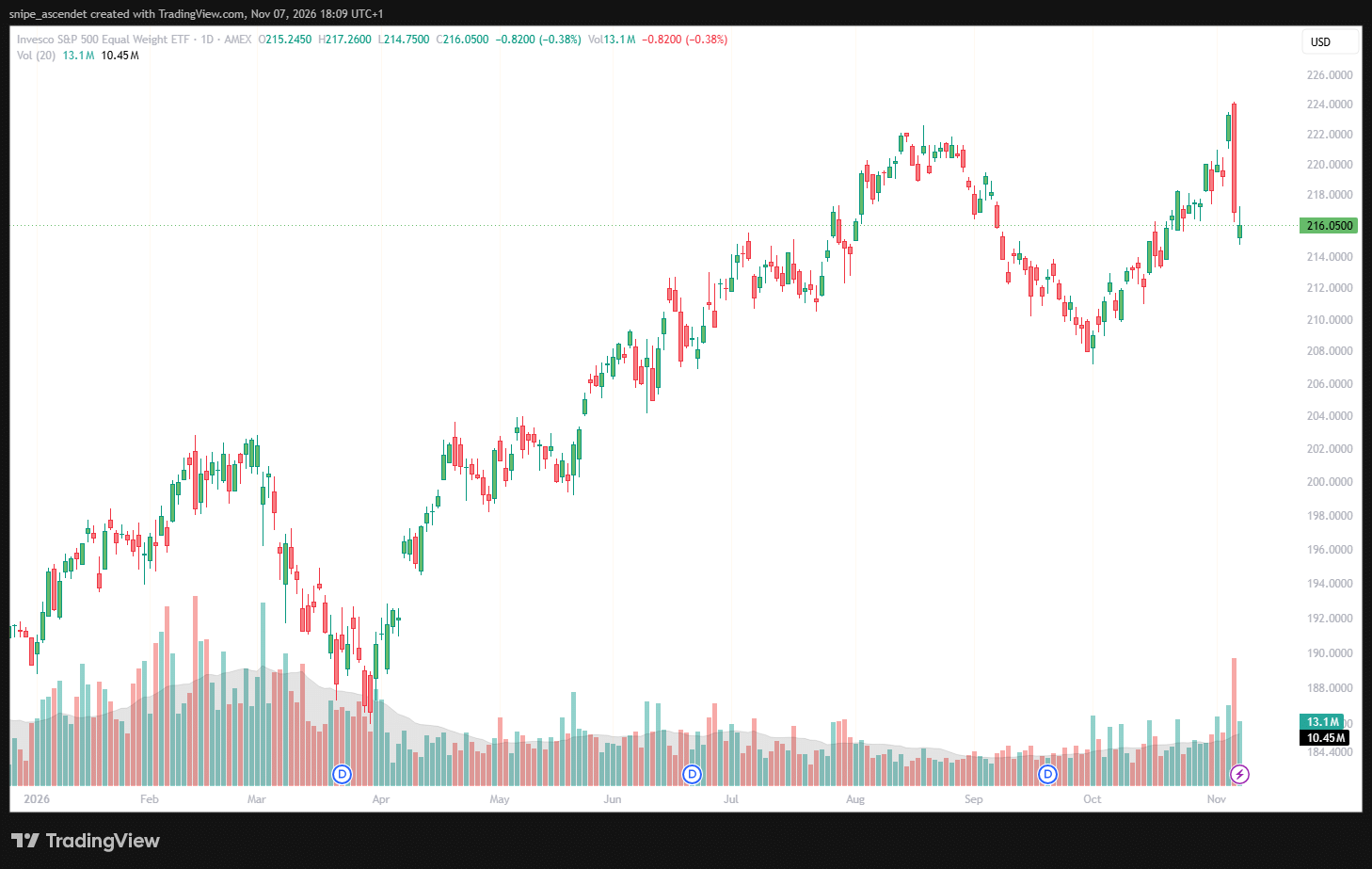
RSP gives approximately equal weight to the index’s constituent stocks at its scheduled rebalances, making it less dominated by mega-cap companies than the standard index. The one-day difference is a useful indication that the rebound was stronger in large weighted constituents than across the typical index holding. It is not a direct count of advancing and declining stocks, and it should be tested over more than one session.
For a lasting improvement, investors would want to see equal-weight performance stabilize, the Russell 2000 participate and sector gains extend beyond a few semiconductor names. Broad participation would reduce the market’s reliance on a small cluster of AI-related companies. Earlier DualFinances coverage of chip-led index rallies and Federal Reserve expectations provides context for why leadership and macro conditions have to be assessed together.
Jobs, Treasury Yields and the November 10 CPI Test
The Bureau of Labor Statistics reported 165,000 new nonfarm payroll jobs in October, with unemployment at 4.1%. Average hourly earnings rose 0.4% from September and 3.1% over the previous year. Revisions also lifted the combined August and September job estimates by 84,000. The stronger-than-expected labor data reduced the case for immediate monetary easing and reinforced market discussion of another Federal Reserve rate increase in December.
The US 10-year Treasury yield ended Friday around 4.86% on the market-price series. The Federal Reserve’s H.15 constant-maturity data showed 4.84% for November 6; the difference reflects distinct quote and measurement conventions. The market yield had retreated from levels above 5.3% in early October, but it remained high enough to matter for growth-stock valuation and the funding costs of capital-intensive AI businesses.
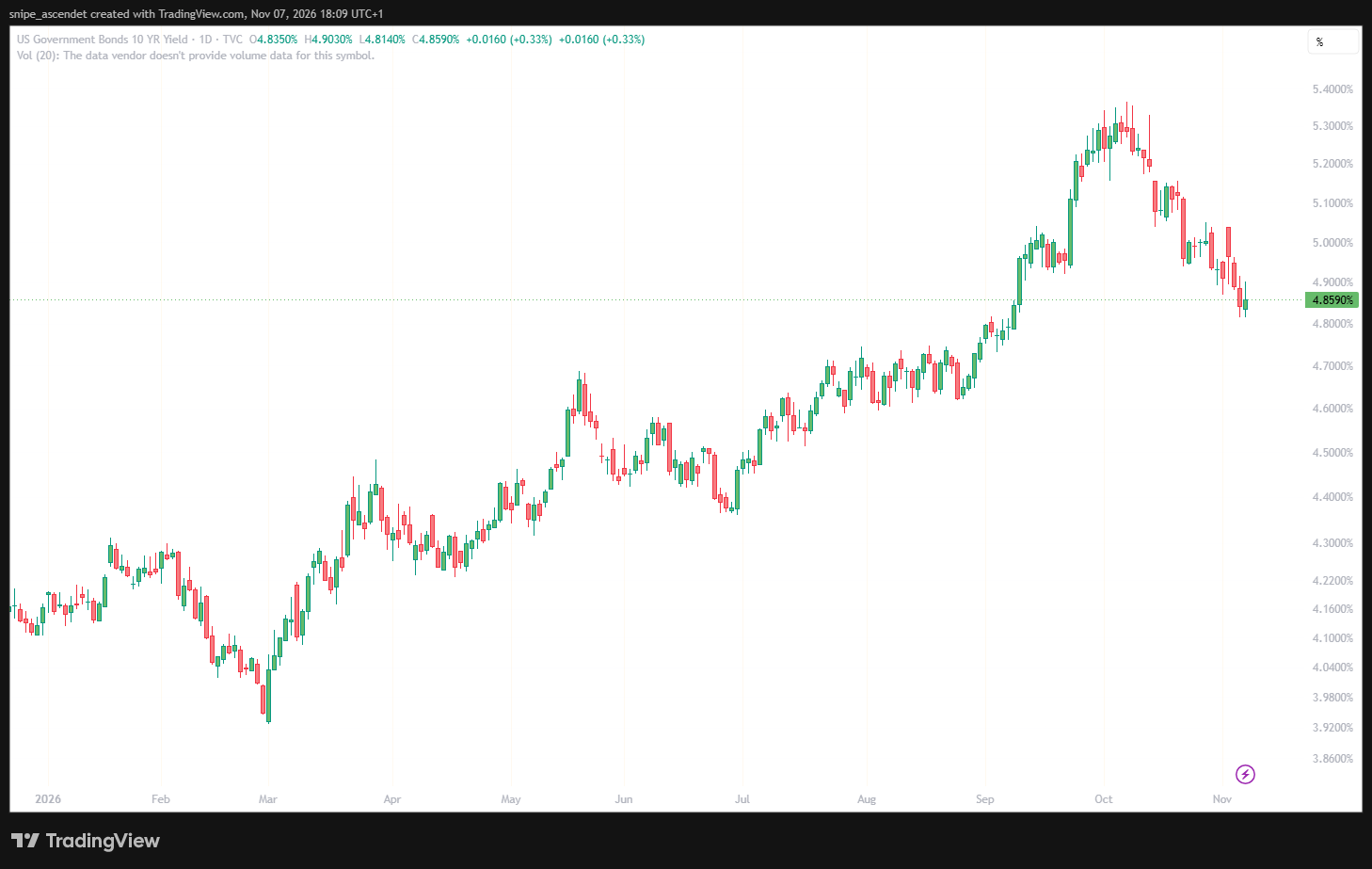
Higher discount rates reduce the present value of distant expected cash flows, a sensitivity that can weigh disproportionately on companies whose valuations depend on rapid growth many years ahead. For heavily financed infrastructure providers, the cost of debt adds a second direct pressure on project economics. DualFinances previously considered the relationship between AI capital investment, labor demand and prospective Federal Reserve policy.
The next catalyst is Tuesday, November 10, at 8:30 a.m. Eastern, when the BLS is scheduled to publish the October Consumer Price Index. The official release calendar confirms the timing. The outcome, particularly core inflation and the underlying monthly components, could reset interest-rate expectations ahead of the December Fed meeting.
Three Paths for Technology Stocks
Bullish scenario: inflation relief and broader buying
A softer-than-expected inflation report, stable or declining Treasury yields and constructive corporate guidance could encourage investors to rebuild exposure to technology. The strongest confirmation would be simultaneous gains in Nvidia, SOXX and the equal-weight S&P 500, with the Nasdaq regaining former trading levels on sustained participation. CoreWeave would need to demonstrate that its growth can be financed on acceptable terms.
Base scenario: a choppy, selective recovery
If inflation is mixed, yields remain elevated and earnings produce different outcomes across companies, markets may continue alternating between sharp rallies and selloffs. In that case, established cash-generating technology businesses could trade differently from debt-intensive data-center operators. A recovery in SOXX without better market breadth would remain vulnerable to reversals.
Bearish scenario: higher rates or weaker AI spending confidence
A hot inflation reading, stronger expectations of monetary tightening, project delays or disappointing forward guidance could trigger renewed selling. A Nasdaq break beneath Friday’s lower trading range, combined with weak equal-weight performance and fresh pressure on AI infrastructure names, would challenge the rebound thesis. None of these scenarios is a prediction; each identifies conditions investors can test against incoming data.
What Investors Should Watch Next
The November 10 CPI release and CoreWeave earnings are the first major tests. Results and outlooks from Applied Materials and Cisco, scheduled for the following week, can add evidence about chip-equipment demand and enterprise technology spending. Investors should monitor regular-session closes, not confuse after-hours quotations with them, and compare sector and index performance across identical periods.
Friday proved that buyers still exist in beaten-down AI stocks. It did not prove that a sustained technology rally has resumed. A durable recovery would require three forms of confirmation: resilient earnings and spending plans, a manageable rate environment and market participation that extends beyond a handful of large-cap winners. Until then, the rebound is credible as a trading move, but unconfirmed as a new uptrend.