

Semtech Corporation (NASDAQ: SMTC) reported record fiscal third-quarter 2027 revenue of $423.0 million on Monday, November 23, 2026, up 58.4% from a year earlier, alongside adjusted earnings of $1.17 per diluted share. Yet Semtech stock gave back part of a substantial regular-session rally after the release, making the durability of its AI networking growth and the quality of its fourth-quarter guidance the central questions for shareholders.
Why Did Semtech Stock Reverse After a Strong Earnings Report?
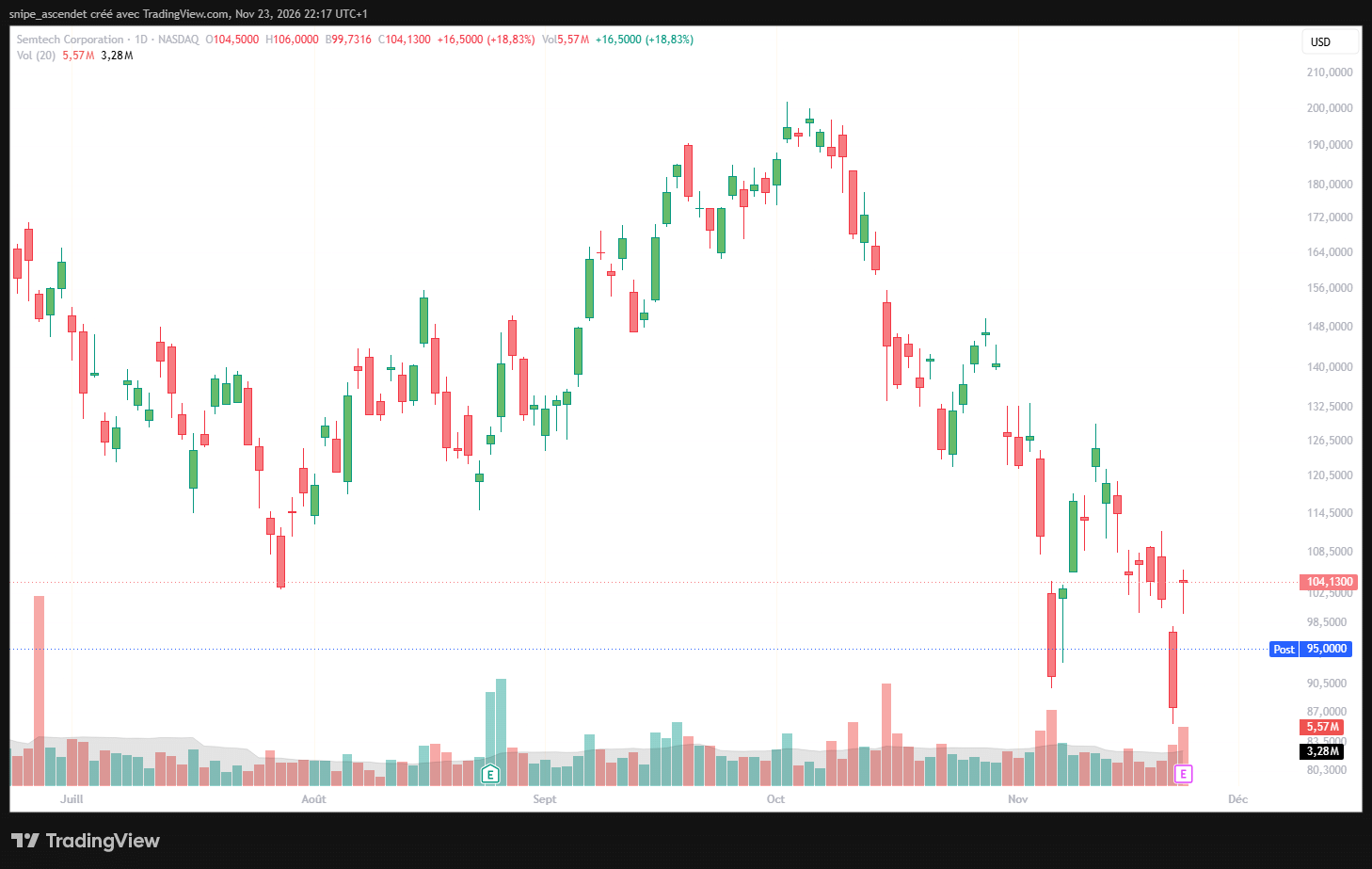
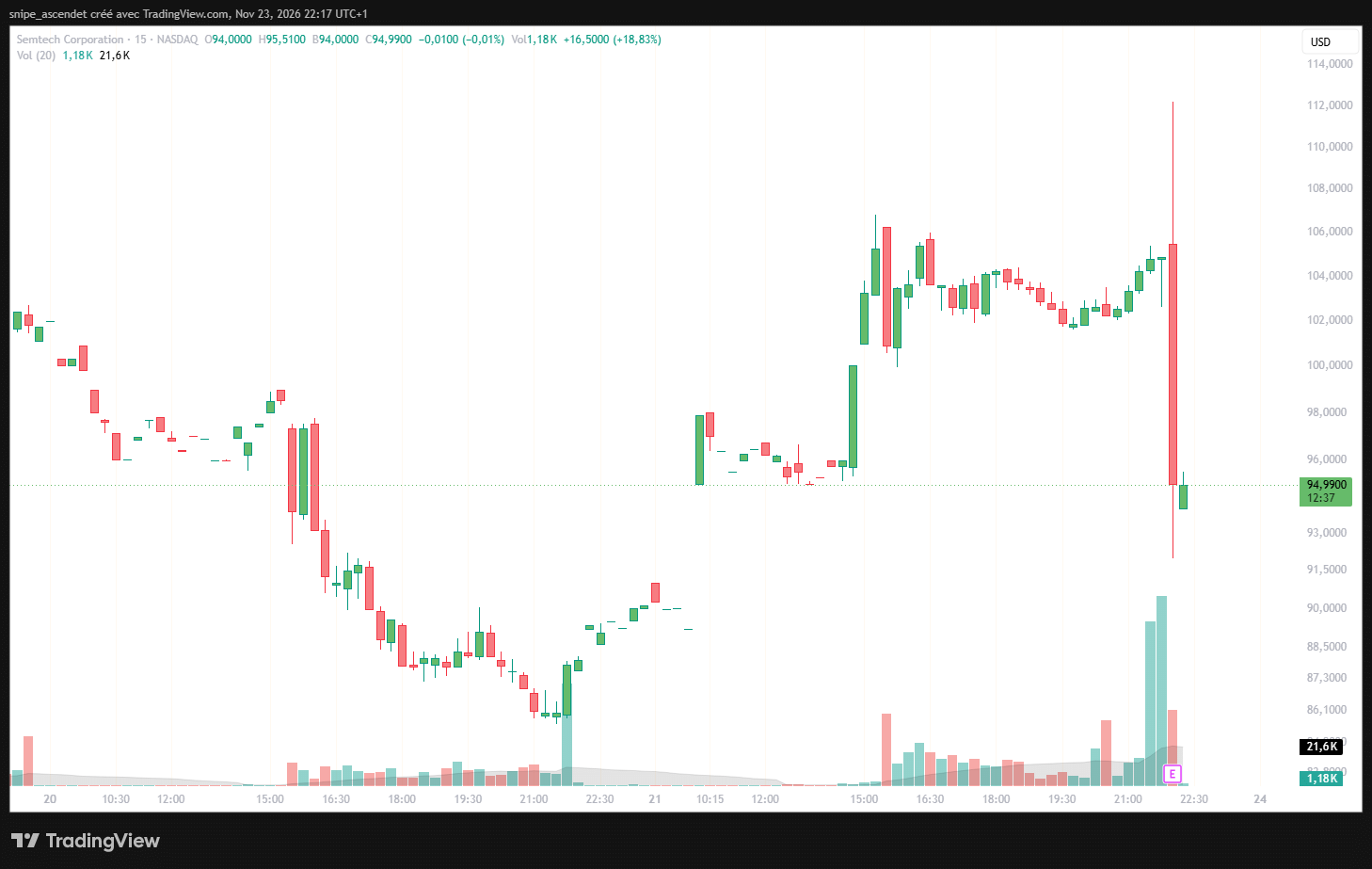
SMTC reached $106.00 during the November 23 regular session and stood at $104.13 at its close, a gain of $16.50, or 18.83%, from the November 20 close of $87.63. At approximately 4:17 p.m. ET on November 23, the shares were quoted at $94.99 in after-hours trading, about 8.78% below that session close. The late quote still represented a gain of approximately 8.40% over Friday’s close, showing how sharply the stock had moved in both directions.
The reversal followed a November 23 technology-stock rebound in which Nvidia also rose sharply. Semtech’s individual price action should be interpreted against that larger backdrop, rather than attributed to any single earnings metric without further evidence. The Nvidia-led semiconductor rally had already pushed expectations and share prices higher before Semtech’s release.
What Did Semtech Report for Fiscal Q3 2027?
Semtech’s fiscal third quarter ended October 25, 2026. Revenue increased from $267.0 million in the comparable prior-year period, while adjusted diluted EPS rose from $0.48. The prior-year comparisons appear in the company’s fiscal Q3 2026 results.
| Metric | Fiscal Q3 2027 | Fiscal Q3 2026 | Change |
|---|---|---|---|
| Revenue | $423.0 million | $267.0 million | +58.4% |
| Adjusted diluted EPS | $1.17 | $0.48 | +143.8% |
| Adjusted gross margin | 59.3% | 53.0% | +6.3 percentage points |
| Adjusted operating margin | 33.0% | 20.6% | +12.4 percentage points |
| Adjusted EBITDA | $145.8 million | $62.7 million | +132.5% |
| Free cash flow | $55.5 million | Not compared | 13.1% of revenue |
Sales also rose 23.7% from the $341.9 million posted in fiscal Q2 2027. Adjusted EPS advanced 64.8% sequentially from $0.71, indicating that the profit increase outpaced revenue growth. These EPS and margin figures are non-GAAP; they should not be treated as the company’s GAAP net income or earnings per share.
Importantly, Semtech had already raised its fiscal Q3 forecast at its October 15 analyst day to $417.5 million in revenue and $1.14 in adjusted EPS at the midpoints. The new figures exceeded those raised targets by $5.5 million and $0.03 per share, respectively, rather than delivering an entirely unexpected change in the business trajectory. The revised prior outlook is documented in Semtech’s October 15 SEC filing.
Where Is Semtech’s Growth Coming From?
Signal Integrity generated $182.4 million, or 43.1% of total revenue, with a reported segment gross margin of 69.8%. Analog Mixed Signal & Wireless produced $133.8 million, while IoT Systems & Connectivity contributed $106.7 million. The three figures total $422.9 million, with the $0.1 million difference from consolidated sales attributable to rounding.
| Business segment | Fiscal Q3 2027 sales | Share of total |
|---|---|---|
| Signal Integrity | $182.4 million | 43.1% |
| Analog Mixed Signal & Wireless | $133.8 million | 31.6% |
| IoT Systems & Connectivity | $106.7 million | 25.2% |
Management highlighted record backlog across FiberEdge, CopperEdge and photonics. These products support high-speed signal transmission within and between servers, optical modules and network equipment. Semtech’s October data-center strategy emphasized growing content per connection as AI systems demand higher bandwidth with tighter power budgets.
A large backlog can improve revenue visibility, but its conversion depends on customer schedules, design qualifications and product mix. Other optical and networking stocks have also faced abrupt valuation resets despite rapid growth, a pattern explored in the broader AI optical-networking sector analysis.
What Do Higher Margins and $55.5 Million in Free Cash Flow Mean?
The adjusted operating margin widened by 12.4 percentage points year over year to 33.0%, a significant improvement in operating leverage. Based on reported revenue, that margin implies roughly $139.6 million of adjusted operating profit. Adjusted EBITDA of $145.8 million equaled approximately 34.5% of sales, compared with 23.5% a year earlier.
Free cash flow of $55.5 million was equivalent to 13.1% of quarterly sales and about 38.1% of adjusted EBITDA. That is positive cash generation, but materially below the adjusted EBITDA figure. Investors should monitor whether collections, inventory investment, capital expenditure and other working-capital requirements allow a larger portion of future earnings to turn into cash.
Semtech also reported net leverage below 1.0 times, reducing the immediate balance-sheet pressure associated with financing its growth. At its October analyst day, the company outlined a fiscal 2030 financial framework targeting $3.2 billion of revenue, a 70% adjusted gross margin and free cash flow equal to 35% of sales. Those figures are long-term goals, not contractual commitments or quarterly guidance.
Is Semtech’s $480 Million Q4 Revenue Guidance as Strong as It Looks?
For fiscal Q4 2027, management projected $480 million in revenue, plus or minus $5 million, and adjusted EPS of $1.33, plus or minus $0.03. The sales midpoint is 13.5% above fiscal Q3, while the EPS midpoint implies a 13.7% sequential increase. The fourth quarter, however, contains 14 weeks rather than the more typical 13.
A simple illustration demonstrates the calendar distortion: multiplying the $480 million midpoint by 13/14 produces $445.7 million. That figure would be only 5.4% above third-quarter sales. It is not an official adjusted forecast, and it assumes identical sales in each week, but it shows why a headline 13.5% increase should not be mistaken for a like-for-like acceleration.
There is also a portfolio issue. Q4 guidance still includes the cellular module business, which Semtech agreed to sell to Compal Electronics for $62 million in cash, subject to adjustments. The August 13 transaction announcement anticipated closing during fiscal Q4 2027, subject to conditions. Subsequent quarters may therefore have a different reported revenue base and margin mix.
Management also indicated that adjusted gross margin excluding the held-for-sale operation was 64.0% in fiscal Q3, above the consolidated 59.3%. That difference is important: a smaller company after the sale could earn a higher gross margin, but reported sales could decline mechanically when the disposed business stops contributing.
Semtech scheduled its fiscal Q3 earnings conference call for Monday, November 23, 2026, at 4:30 p.m. ET, according to its investor notice. The highest-value questions are the backlog conversion timetable, the expected contribution from data-center products, the impact of the 14-week quarter, the divestiture timetable and the bridge from adjusted profits to free cash flow.
The November 23 after-hours price near $95 and regular-session price of $104.13 are useful reference points, not guaranteed support or resistance. With the stock still well below its early-October peak, even favorable earnings can trigger considerable volatility when investors reassess growth expectations and valuation.
Bottom line: Semtech delivered 58.4% year-over-year revenue growth, sharply stronger adjusted margins and positive free cash flow, but SMTC’s approximately 8.8% after-hours reversal showed that a strong quarter alone did not settle valuation concerns. The critical next test is whether higher-margin AI connectivity revenue and cash generation can sustain momentum after adjusting for the extra fourth-quarter week and the planned cellular module divestiture.
For informational purposes only; not investment advice.