

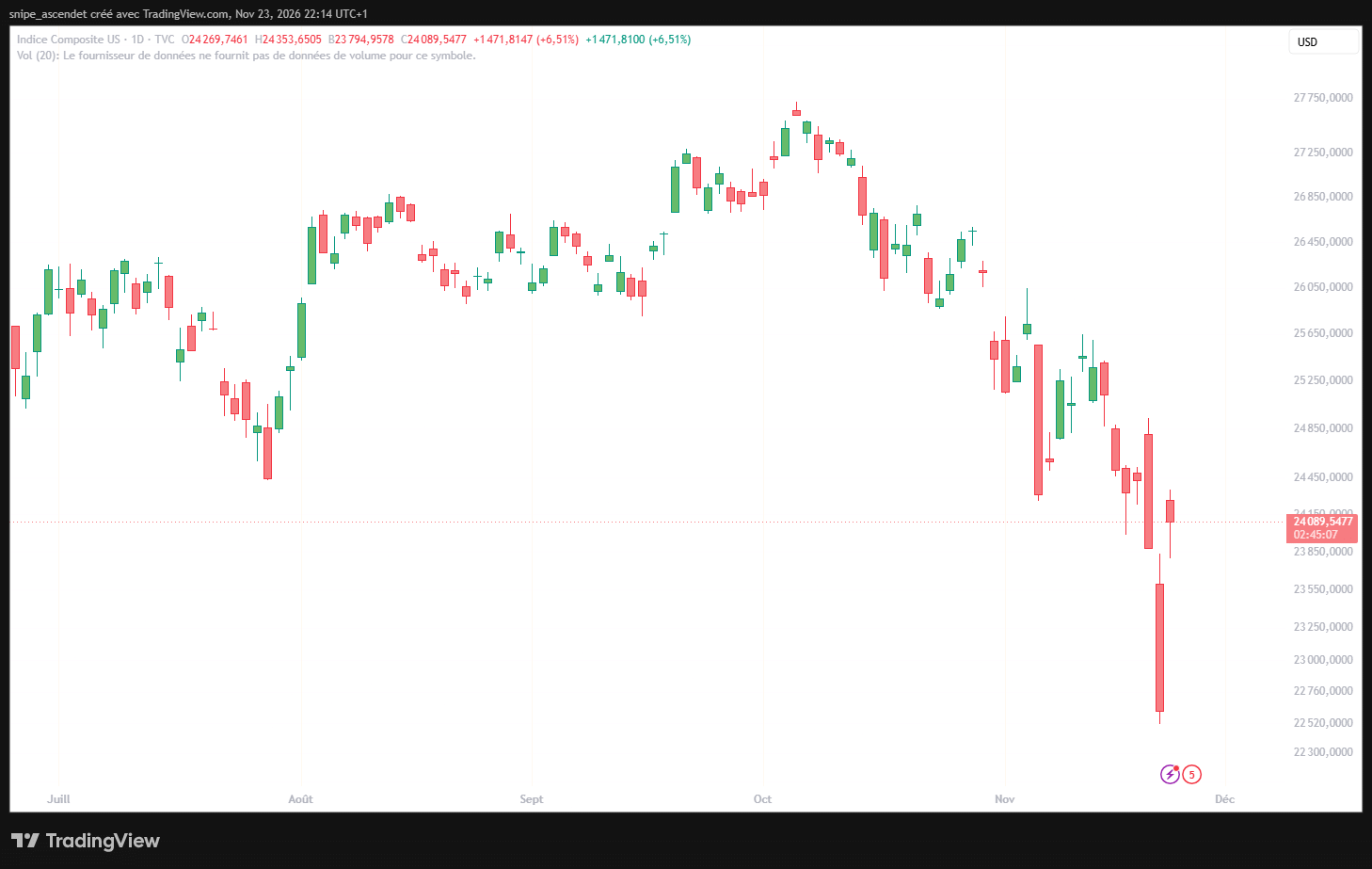
The Nasdaq rebound accelerated on Monday, November 23, 2026, when the Nasdaq Composite rose 6.51% to 24,089.55 and Nvidia (NASDAQ: NVDA) jumped 31.48% to $165.05 following Jensen Huang’s return as chief executive. The S&P 500 climbed 4.73% to 7,237.17, but remained below its 200-day moving average, leaving investors to judge whether the surge marked the start of a lasting recovery or a sharp reversal within a correction.
Nvidia’s board reinstated Huang on November 22, making its decision public on November 23. According to Reuters, the Nasdaq Composite and S&P 500 recorded their strongest daily percentage gains since the April 2025 rebound following a pause in U.S. tariffs.
How Big Was the November 23 Nasdaq Rebound?
The late-session readings below were recorded at approximately 4:15 p.m. ET on November 23. Each percentage is measured against the preceding regular-session close on Friday, November 20; the VIX is an index level, not a share price.
| Asset | Nov. 20 | Nov. 23 | Change |
|---|---|---|---|
| Nasdaq Composite | 22,617.73 | 24,089.55 | +6.51% |
| S&P 500 | 6,910.39 | 7,237.17 | +4.73% |
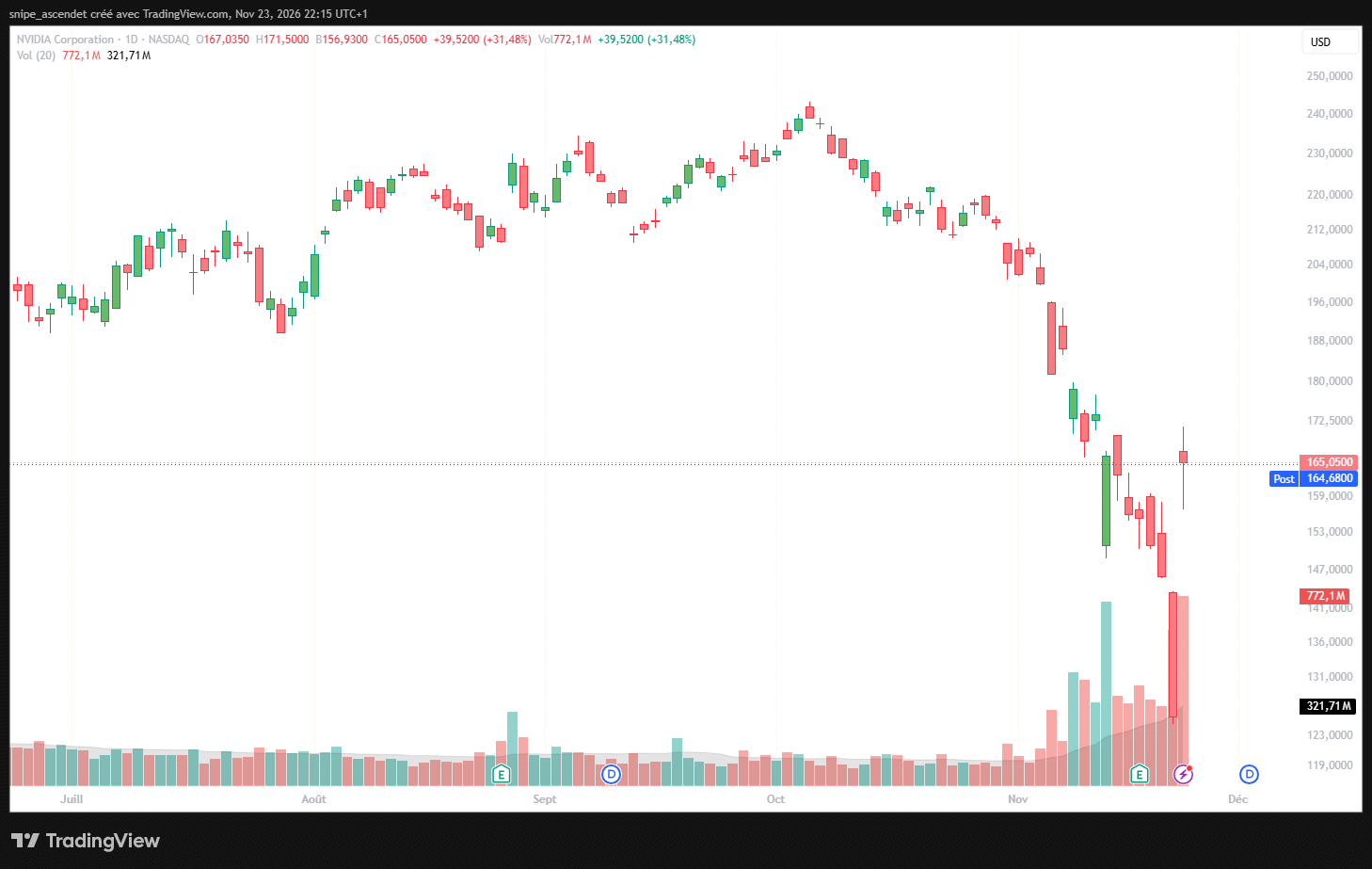
| Nvidia (NVDA) | $125.53 | $165.05 | +31.48% |
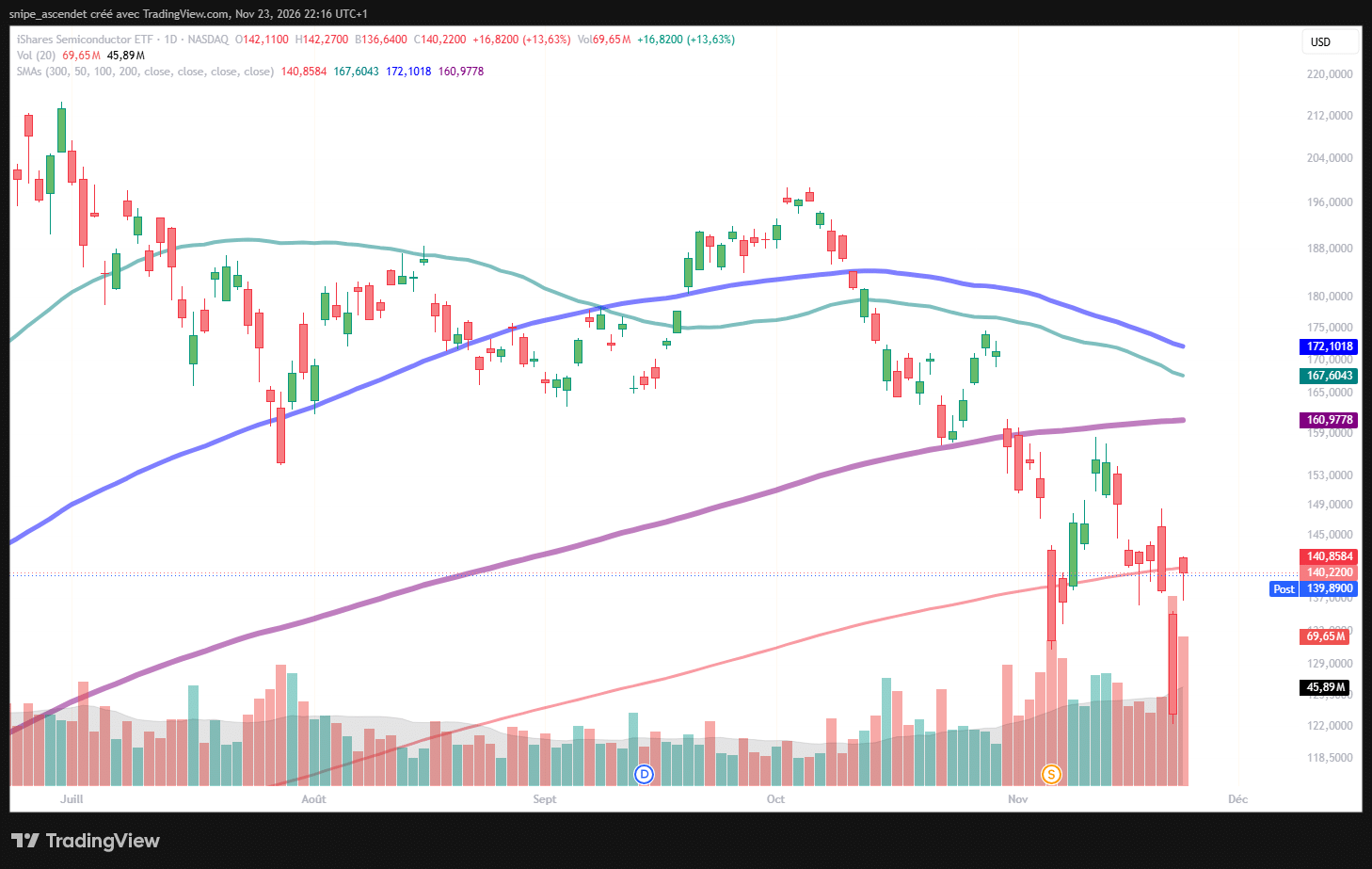
| iShares Semiconductor ETF (SOXX) | $123.40 | $140.22 | +13.63% |
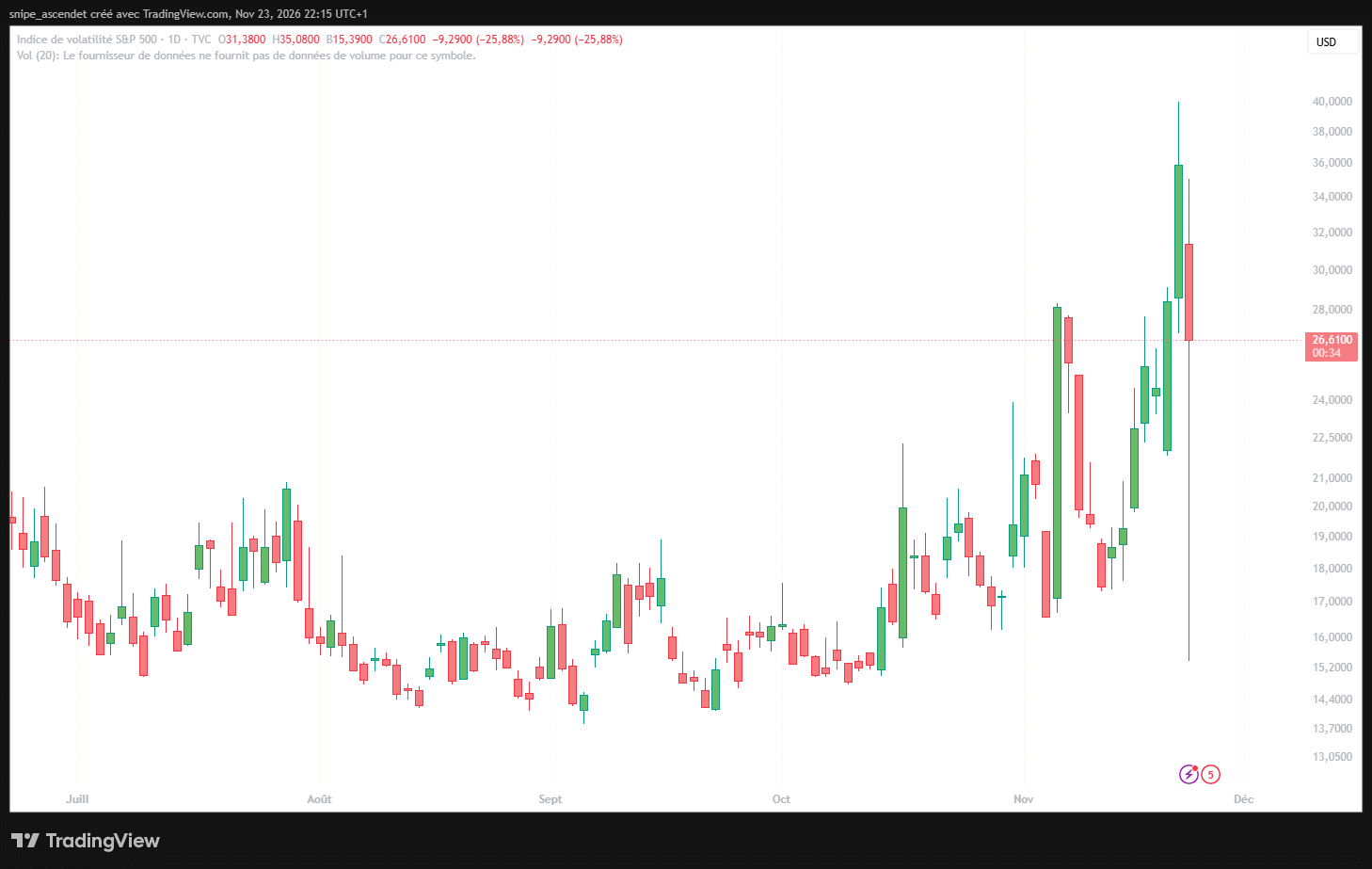
| Cboe VIX | 35.90 | 26.61 | -25.88% |
The Nasdaq reversed Friday’s 5.28% decline but could not erase the preceding week’s losses. The S&P 500 likewise recovered Friday’s points lost after the November 20 market selloff, while remaining below its October peak.
Why Did Jensen Huang’s Return Move Nvidia and the Entire Market?
Nvidia’s November 23 board announcement confirmed that directors voted unanimously to bring Huang back as president, CEO and director. Colette Kress continues as CFO after serving as interim CEO; the company said an independent investigation and a new national security and export-control oversight structure would continue. The decision removed an immediate leadership question for a company central to U.S. AI spending.
Nvidia gained $39.52 per share from its November 20 close of $125.53. Applying that change to approximately 24.1 billion shares outstanding, the figure reported in an SEC quarterly filing, implies roughly $952 billion in market value restored. At its November 23 session high of $171.50, Nvidia was up as much as 36.62%, equivalent to about $1.11 trillion on the same share-count assumption.
The stock’s 772.1 million-share session volume was about 2.40 times the displayed 20-day average of 321.71 million shares. For more detail on the change in leadership and the company-specific valuation impact, see DualFinances’ Nvidia CEO return analysis. The announcement did not include higher revenue guidance or new cash-flow projections.
Did the Semiconductor Rally Extend Beyond Nvidia?
Yes. The iShares Semiconductor ETF gained 13.63% to $140.22 as investors returned to shares exposed to AI accelerators, chip production and data-center infrastructure. Reuters also reported gains across major technology companies and cloud infrastructure stocks, indicating that the buying extended beyond a single ticker.
The recovery did not eliminate the issues that weighed on suppliers before November 23. Questions about returns on data-center spending, customer concentration and product-specific orders remain relevant. The reported Google TPU order reduction affecting Broadcom illustrates why a sectorwide rebound does not remove each company’s individual operating risk. SOXX still traded 12.90% below its 200-day average of $160.98.
What Does the VIX Drop to 26.61 Tell Investors?
The Cboe Volatility Index fell 25.88% from approximately 35.90 to 26.61 on November 23, reflecting a sharp retreat in expected near-term S&P 500 volatility. That followed Friday’s episode in which the index briefly moved above 40. A lower VIX suggests less demand for downside protection and calmer option pricing, although a reading above 20 still signals a more unsettled market than a low-volatility environment.
Why Is the S&P 500 Still Below Its 200-Day Moving Average?
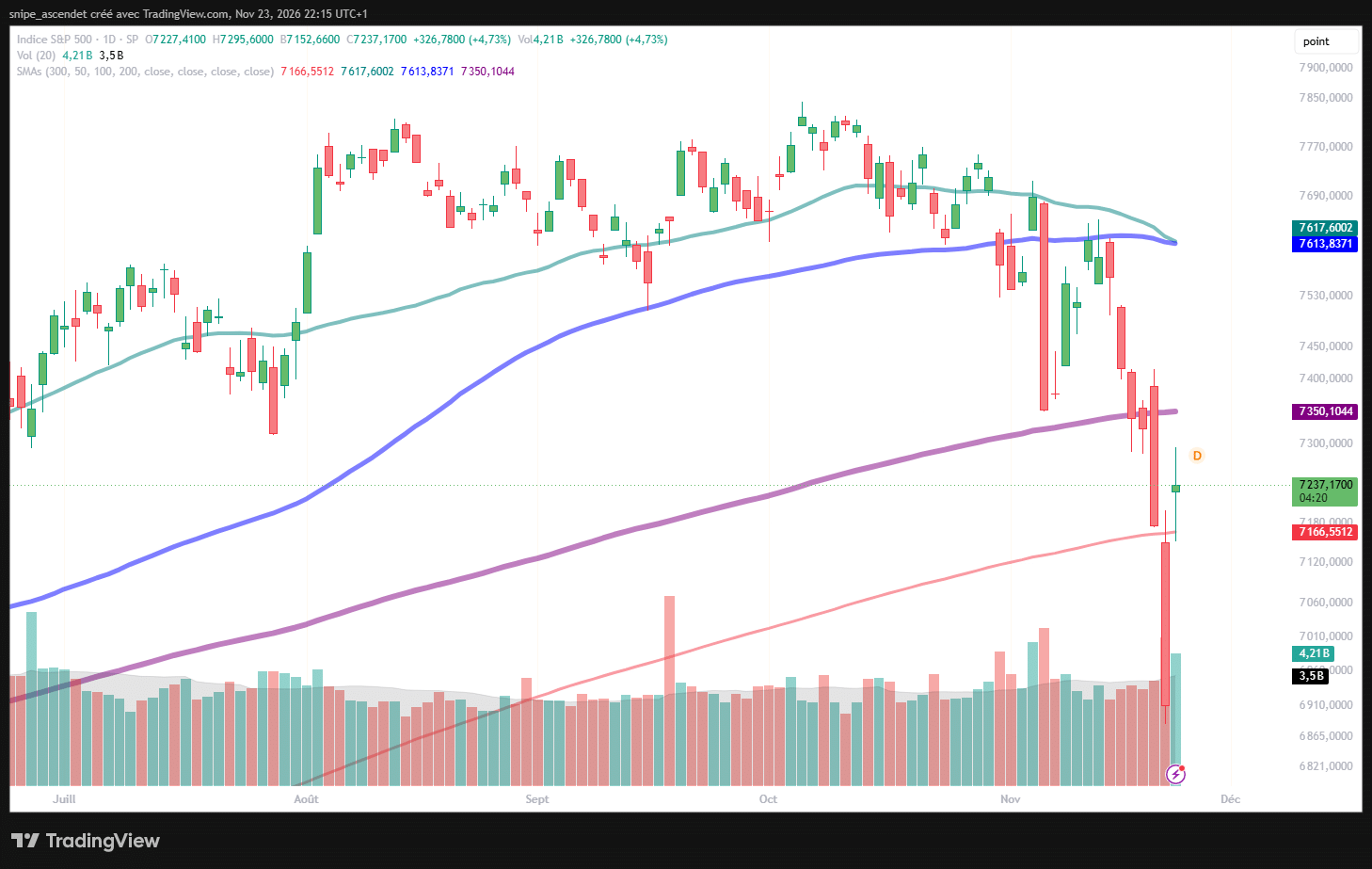
At 7,237.17, the S&P 500 remained 112.93 points, or 1.54%, below its 200-day average of 7,350.10. It moved back above its 300-day average of 7,166.55 by 70.62 points, or 0.99%. The 200-day threshold, previously broken during the mid-November market reversal, remains a key reference for whether longer-term price momentum has recovered.
A further 1.56% gain from the November 23 reading would be needed merely to reach the displayed 200-day line, assuming that moving average does not change. Holding the 300-day line, improving market breadth and stabilizing earnings expectations would provide stronger confirmation than a one-day percentage gain alone.
The Bureau of Economic Analysis schedules October personal income and outlays figures, including the PCE price index, for Wednesday, November 25 at 8:30 a.m. ET. That inflation reading will influence investors’ assessment of Treasury yields and the Federal Reserve’s next decision. The NYSE calendar confirms that U.S. stocks will be closed for Thanksgiving on Thursday, November 26, followed by an early 1:00 p.m. ET close on Friday, November 27.
Nvidia is also due to participate in the UBS Global Technology and AI Conference on Tuesday, December 1 at 9:35 a.m. ET, according to its investor-relations announcement. Management commentary and continued participation across chip stocks will test the rebound.
Bottom line: Nvidia’s return to familiar leadership coincided with a 31.48% stock rebound and a 6.51% Nasdaq rally on November 23, reversing Friday’s immediate panic. The broader test is whether the S&P 500 can reclaim its 200-day average while AI earnings, capital requirements and financial conditions support a sustained recovery.
For informational purposes only; not investment advice.