

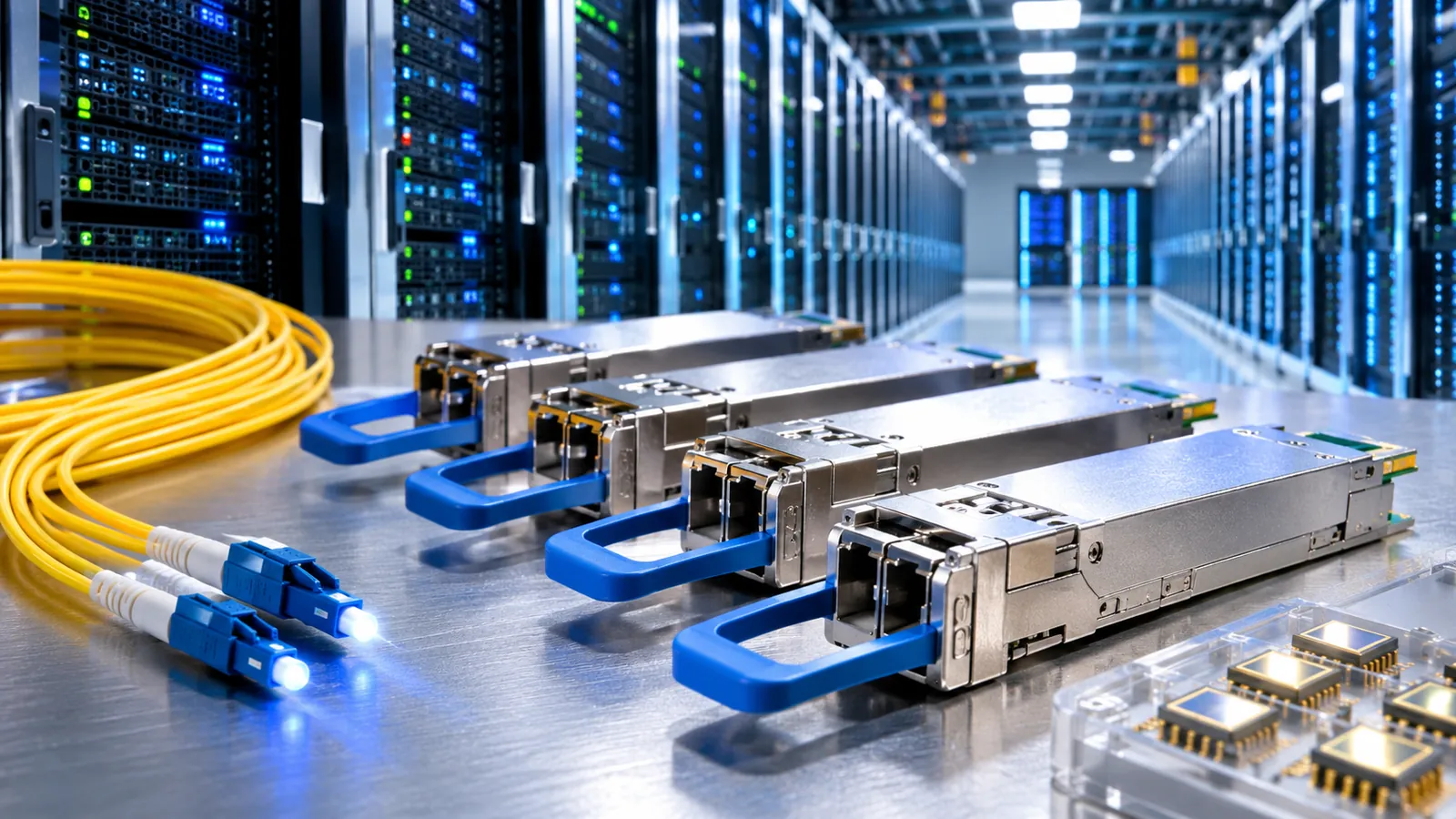
Applied Optoelectronics (NASDAQ: AAOI) announced a $2.2 billion minimum-purchase agreement with an existing hyperscale data center customer on November 24, 2026. The Applied Optoelectronics hyperscaler deal also comes with a customer demand forecast exceeding $10 billion through 2030, but that larger figure is not a firm order. The key shareholder test is production capacity and cash flow, as the company’s November 24 announcement makes clear.
What Does the Applied Optoelectronics Hyperscaler Deal Guarantee?
The four-year agreement runs from December 2026 through December 2030 and covers 800-gigabit-per-second optical transceivers and laser diodes. The existing Tier-1 customer was not named.
| Agreement component | Period | Amount | Status |
|---|---|---|---|
| 800G optical transceivers | 2027 | $1.5 billion | Minimum purchase commitment |
| Laser diodes | 2028–2029 | $700 million | Minimum purchase commitment |
| Combined commitments | 2027–2029 | $2.2 billion | Contractual minimums, subject to terms |
| Potential customer demand | December 2026–December 2030 | More than $10 billion | Nonbinding forecast |
The minimums comprise 68.2% transceivers and 31.8% lasers. The demand forecast implies more than $7.8 billion of potential additional business, which still requires firm orders and production capacity. Its customer agreement announcement also states that the customer made no capital commitment to fund the expansion.
Why Does the $10 Billion Forecast Matter for AAOI?
The customer’s projected demand exceeds 4.5 times the minimum purchases. That measures opportunity, not expected revenue.
The 2027 transceivers connect computing equipment in AI clusters. Beginning in 2028, AOI expects to supply laser diodes, some intended for co-packaged optics, which places optical links closer to switching chips. AOI plans to expand laser production in Texas. The announcement identifies both technologies as part of the agreement.
AOI also described the contract as its second long-term arrangement with a hyperscale customer. An earlier agreement involved conditional purchases of certain 1.6-terabit transceivers, according to its September 2026 Form 10-Q. The two deals have different structures.
Can AOI Manufacture Enough 800G Transceivers in 2027?
Manufacturing throughput is the central execution test. In its November 5 third-quarter results, AOI reported equipment capacity approaching 330,000 units per month. It targets installed capacity exceeding 500,000 monthly 800G and 1.6T units by December 2026 and 1 million by late 2027.
U.S. expansion has faced electrical-power and construction delays. Under the new agreement, AOI expects to begin shipping an agreed quantity of U.S.-manufactured products in the first quarter of 2027, then increase shipments during the year. A delayed production ramp could therefore limit how quickly the company converts contractual demand into sales.
See DualFinances’ analysis of AI optical-networking stocks. Yield, qualification, pricing and deliveries ultimately determine the result.
How Do the Commitments Compare With AAOI’s Financial Results?
AOI’s revenue rose sharply in the September 2026 quarter, but gross margin barely improved even as GAAP net earnings turned positive.
| Metric | Q3 2026 | Q3 2025 | Change |
|---|---|---|---|
| GAAP revenue | $269.9 million | $118.6 million | +127.6% YoY |
| GAAP gross margin | 28.2% | 28.0% | +0.2 percentage points |
| GAAP net income (loss) | $6.3 million | ($17.9 million) | +$24.2 million |
For the fourth quarter of 2026, management’s November 5 guidance called for $385 million to $420 million in revenue, a sequential increase of approximately 42.6% to 55.6% from third-quarter sales. Contracted future deliveries are not immediately recognizable revenue. The earnings release provides the GAAP results and the original fourth-quarter outlook.
The capacity expansion is capital intensive. For the nine months ended September 30, 2026, AOI used $76.7 million of cash in operations and spent $702.1 million on property, plant and equipment. Using operating cash flow minus those purchases, free cash flow was approximately negative $778.8 million. Its September 30 cash balance, including restricted cash, was $621.5 million. Its Form 10-Q documents those balances and spending.
AOI received approximately $1.59 billion in net proceeds from common-stock offerings during those nine months. On November 17 it signed a new at-the-market equity distribution agreement permitting up to $550 million in additional share sales. Those shares have not necessarily been issued; future sales could dilute shareholders.
Like the broader financing challenge facing AI data-center companies, sales commitments offer more value when customers pay promptly and growth generates cash after capital spending. AOI also bears a $2 million qualification expense under the deal.
- First quarter of 2027: Whether U.S.-made shipments start as the new contract requires.
- Throughout 2027: Production capacity, customer qualification and progress against the $1.5 billion transceiver minimum.
- 2028 and 2029: The planned $700 million laser-diode purchases and adoption of co-packaged optics.
- Every quarterly filing: Operating cash flow, capital expenditures, share count and any additional binding purchase commitments.
Bottom line: Applied Optoelectronics now has $2.2 billion in stated minimum customer purchases, a meaningful improvement in revenue visibility. The more-than-$10-billion demand forecast represents upside that remains conditional on new orders and a successful manufacturing ramp. For AAOI holders, cash conversion and dilution will determine how much of that opportunity reaches each share.
For informational purposes only; not investment advice.