

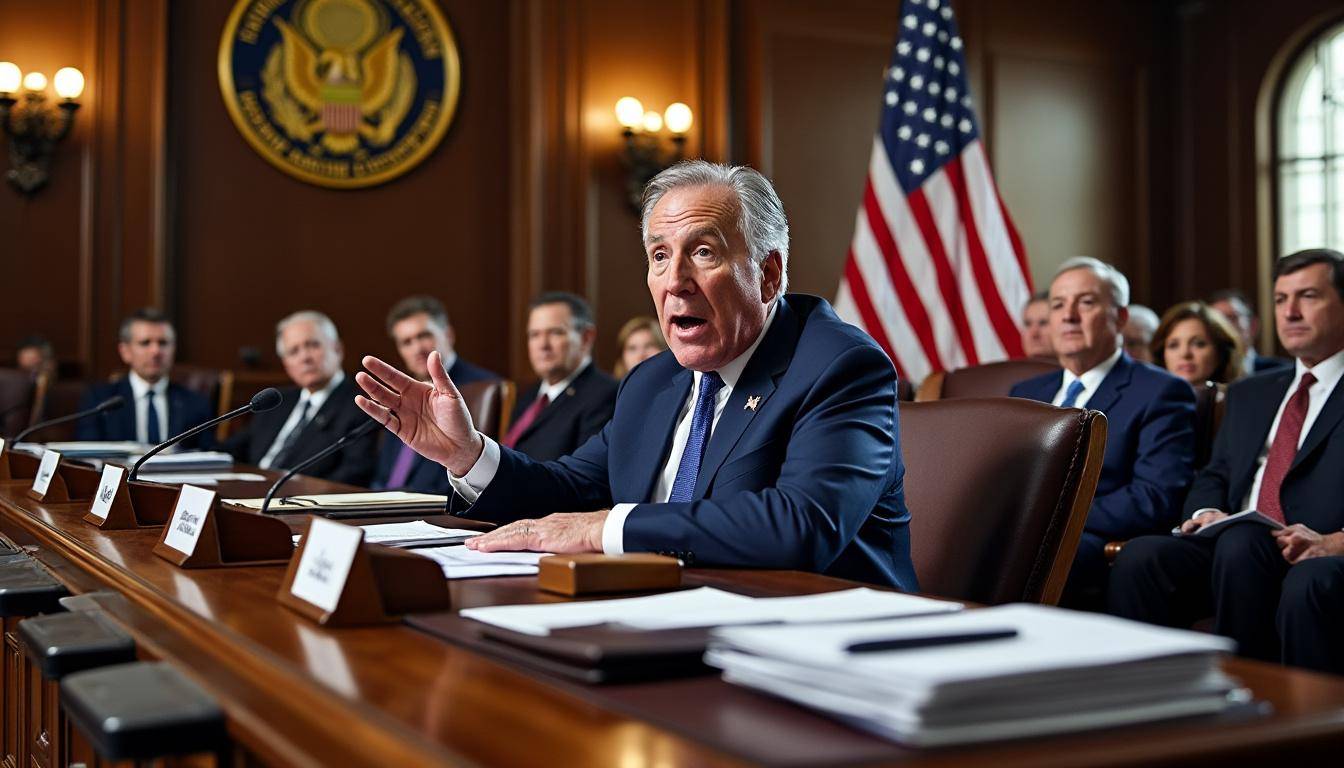
The State Capitol’s early movement on fiscal year 2027 framed a high-stakes contest between immediate tax relief and durable public services. Over the opening weeks of the 2026 legislative session, the Senate Finance Committee pushed forward a revised general revenue Budget that trims some of Governor Patrick Morrisey’s proposals while accelerating other priorities such as Medicaid funding and targeted pay increases for public safety and education staff. Lawmakers balanced competing forces: a drive for a near-term personal income tax cut, pressure to maintain or expand programmatic support, and the legal guardrails that traditionally tether long-term revenue changes to economic growth. This coverage follows a fictional but emblematic policy analyst, Maya Chen, who relocated to New York after several years in Charleston to track state-level fiscal reforms. Maya’s daily briefings to civic groups and financial readers highlight how the Senate’s substitute for Senate Bill 250 and the companion Senate Bill 392 reshape both short-term cash flows and structural fiscal policy.
Maya traces the mechanics behind key line items: how the Senate Finance Committee reduced the general revenue proposal to $5.381 billion, channeled surplus collections to one-time expenses like the Hope Scholarship voucher program, and increased standing general revenue for Medicaid to ensure front-loaded stability. The policy decisions are not abstractions. For teachers, law enforcement, and other classified employees, the interplay of budget language and separate statutory salary bills determines whether pay adjustments become law. Meanwhile, the proposed near-10% tax cut, partially retroactive and tied to new revenue offsets such as a restructured vape excise tax, underscores the political calculus driving the session. This story maps how procedural choices—committee substitutes, pre-funding, and sweep mechanisms—translate into concrete funding outcomes for residents while also exposing the long-term trade-offs lawmakers must weigh.
Senate Finance Committee Advances Budget Resolution for FY2027
The Senate Finance Committee moved quickly to recommend Senate Bill 250 to the full Senate, signaling an aggressive start to the FY2027 budgeting calendar. The committee’s action advanced a version of the state general revenue Budget that differs materially from the Governor’s initial proposal, both in scale and in composition. Where Governor Morrisey presented a $5.493 billion plan, the Senate pared that figure to $5.381 billion, reflecting a roughly 2% reduction realized through targeted cuts and re-prioritization.
For the committee, pacing mattered as much as numbers. Vice Chairman Ben Queen framed the debate as one between fiscal restraint and policy ambition, emphasizing that the committee arrived at decisions earlier than typical legislative timelines. The committee’s early passage recommendation allows additional time for negotiation and amendment before final votes, but it also invites pressure from stakeholders seeking programmatic restorations or expansions. Maya Chen, our policy analyst, notes that the compressed timeline functions like an early litmus test: the items that survive initial committee scrutiny often carry political momentum into subsequent rounds.
Process and Procedural Tools
The committee used several standard legislative tools: committee substitutes to rework bill text, surplus sections to establish discretionary end-of-year payments, and sweeps of special revenue to unlock one-time funding. These mechanisms let the Senate fund certain priorities—like part of the Hope Scholarship—without creating permanent recurring commitments out of general revenue lines. Procedurally, that choice preserves flexibility but raises governance questions about transparency and future obligations.
A notable procedural decision was to incorporate both the budget bill and a related income tax cut measure into the Senate’s early package. By doing so, the committee created a single negotiation theater where revenue changes and spending trade-offs can be resolved together. That bundling reflects a national trend of using reconciliation-like approaches at the state level to advance cohesive policy packages.
Practical Implications for Stakeholders
Schools, hospitals, and local governments track these movements closely. A reduced top-line Budget can force agencies to absorb 2% cuts or accept phased funding. The Senate’s choice to front-load Medicaid demonstrates a prioritization of health services continuity; for providers, increased general revenue funding mitigates the risk of mid-year payment disruptions. Yet stakeholders also recognize the fragility of surplus-funded programs—if the surplus is smaller than expected, the one-time funding can evaporate.
The committee’s early action also shapes lobbying strategies. Interest groups that would have preferred a larger package must decide whether to press for amendments or concede certain wins to preserve momentum on other priorities. Maya’s briefings highlight how advocacy coalitions reallocate resources in response to these procedural shifts, focusing on amendments most likely to secure votes in the narrow windows before final passage.
Final insight: early advancement by the Senate Finance Committee buys negotiation time but increases the importance of precise, transparent accounting for both recurring and one-time funding choices.
Revenue Adjustments, Medicaid Funding, and Voucher Financing
When finance professionals assess a budget, they parse both the totals and the composition. The Senate’s version of FY27 made deliberate changes to revenue allocation and program financing. Most notably, the committee increased general revenue support for Medicaid from the Governor’s proposed $139.3 million to $260.1 million—an adjustment funded partially through a sweep of special revenue accounts and a prefunding allocation from the current fiscal year. That move signals a prioritization of health program stability and reflects an intent to protect provider payments and beneficiary services against mid-year shortfalls.
How the Hope Scholarship Was Reworked
The Senate reduced the Hope Scholarship voucher program’s price tag from the Governor’s $338.3 million recommendation to $300 million. Instead of relying solely on general revenue, the Senate structured funding across several buckets: $100 million from supplemental appropriations comprised of available general revenue, Lottery funds, and Excess Lottery funds, and $200 million through a designated general revenue surplus section to be paid from end-of-year surplus collections. This hybrid approach preserves the program while avoiding immediate expansion of recurring general fund obligations.
From a fiscal management perspective, that design leverages one-time resources to accomplish a politically salient policy objective. The approach protects the state’s recurring fund stance but embeds an assumption about surplus realization that will need to be monitored through the fiscal year.
Comparative Funding Table
| Line Item | Governor Proposal (FY27) | Senate Recommendation (FY27) |
|---|---|---|
| Total General Revenue | $5.493 billion | $5.381 billion |
| Hope Scholarship | $338.3 million | $300 million |
| Medicaid General Revenue | $139.3 million | $260.1 million |
| Prefunding / Surplus Uses | $170 million (surplus) | $46.1 million prefunding + surplus allocations |
The table clarifies trade-offs: an overall smaller budget envelope but reoriented support for immediate health funding and a partially surplus-funded voucher program. Those choices will cascade into agency planning, especially for departments accustomed to multi-year appropriation trends.
For practitioners like Maya, the lesson is that structural shifts—moving costs from recurring lines to surplus or sweep mechanisms—can mask long-term fiscal exposure. While these adjustments maintain near-term flexibility, they also create potential cliffs where future legislatures must decide whether to replace one-time funding with permanent appropriations.
Final insight: reallocating funding across general revenue, prefunding, and surplus can ease near-term pressure but increases the need for disciplined forecasting and transparent contingency planning.
Tax Policy Maneuvers: The 10% Personal Income Tax Cut Debate
One of the most politically potent elements of the session is the proposed personal income tax reduction. The Senate included a committee substitute for Senate Bill 392 that would cut personal income tax rates by approximately 10%, retroactive to January 1, and return an estimated $250 million to taxpayers when fully implemented. Governor Morrisey championed a full 10% cut from the outset; his initial budget, however, only accounted for a 5% reduction. The Senate’s action opened a path to a deeper cut while simultaneously specifying offsets and revenue adjustments to preserve fiscal balance.
Funding Offsets and Excise Tax Restructuring
To avoid unmitigated recurring revenue loss, senators proposed several offsets. Departments and agencies were asked to trim FY27 budget requests by 2%, creating roughly $120 million in savings. Additionally, the committee suggested an excise tax restructuring on vape and e-cigarette products that could raise approximately $22 million. The current 7.5 cents per milliliter excise was proposed to shift into a tiered system: closed system vapes (cartridges/pods) taxed at $1.20 per cartridge and open system (refillable) devices taxed at $0.25 per milliliter.
Senator Robbie Morris framed the vaping tax change as the first tangible offset he had seen, while other lawmakers voiced concern about the broader fiscal trajectory. Some members, including Senator Jack Woodrum, warned of the risks inherent in cutting recurring revenue faster than the pace of economic growth, and urged adherence to statutory triggers embedded in State Code that phase rate reductions according to economic metrics.
Stakeholder Implications and Behavioral Effects
Tax cuts reverberate through the economy. For households, immediate tax relief increases disposable income, potentially supporting consumer spending or savings. For state services, however, recurring revenue declines can constrain long-term commitments. The retroactivity component complicates fiscal administration by requiring recalculations of withholdings and potential reconciliations by the Department of Revenue.
Maya models three scenarios to illustrate outcomes: a conservative growth case that preserves base revenues and requires no further cuts; a moderate case where the state absorbs the 10% cut but must curtail some non-mandatory programs over three years; and an optimistic growth case where economic expansion offsets the revenue loss and allows continued investment. Each scenario carries distributional consequences: higher-income filers often reap the largest nominal benefits from flat rate reductions, while lower-income households may benefit more from targeted credits.
- Offsets relied upon: departmental cuts, vaping excise changes, surplus sweeps.
- Short-term benefits: increased household cash flow, political goodwill.
- Long-term risks: structural imbalance, pressure on public services, trigger bypass concerns.
Policy design matters. A well-crafted tax cut paired with explicit, enforceable offsets and automatic stabilization features can mitigate risks. Absent those, the state may face difficult trade-offs in later years.
Final insight: the proposed 10% reduction illustrates the tension between immediate tax relief and long-term fiscal prudence; offsets are helpful but do not eliminate structural exposure.
Pay Raises, Workforce Impacts, and Political Dynamics
Parallel to revenue debates, the legislature moved on compensation for public employees. The House Finance Committee advanced House Bill 4765, which addresses pay raises for teachers, school service personnel, and State Police—categories whose salaries are codified separately from general executive branch adjustments. Governor Morrisey proposed an average 3% raise for these groups, a $78.4 million expense when aggregated. The Senate’s budget incorporates that 3% average increase, ensuring alignment between the separate compensation bill and the broader appropriation framework.
Operational and Recruitment Effects
Pay adjustments for educators and public safety personnel have immediate operational consequences. For school districts, even modest percentage increases affect salary grids and influence retention. The 3% raise helps preserve competitive positioning against neighboring states and private-sector alternatives. For State Police, the raise supports recruitment and retention in roles that demand specialized training and incur high opportunity costs.
The inclusion of these raises in the broader budget context avoids a piecemeal approach where some employee categories benefit while others do not. That coherence is administratively advantageous: payroll systems can be updated in a synchronized fashion, and human resources teams can plan merit processes with clearer fiscal baselines.
Political Trade-Offs and Interest Group Behavior
Support for raises crosses ideological lines—lawmakers who favor smaller government still recognize the practical necessity of maintaining workforce capacity. However, adding raises to a package also raises the political stakes in tax negotiations. Opponents of a large income tax reduction argued that shifting too much money back to taxpayers while public services face long-term pressures is untenable. Proponents counter that tax relief fuels private-sector growth and expands the tax base over time.
Maya’s interviews with district superintendents highlighted a pragmatic view: predictable, modest raises reduce turnover and lower long-term recruitment costs. Conversely, a finance director in a rural county emphasized that state-directed salary increases often come with unfunded mandates—new expectations without proportional local funding—which can strain smaller budgets.
Final insight: embedding the 3% raises into the Senate’s FY27 plan delivers near-term workforce stability but intensifies the need for robust revenue forecasting to sustain compensation commitments.
Long-Term Fiscal Risks, Policy Recommendations, and Modeling For 2026 And Beyond
Beyond immediate legislative moves, the session forces a reflection on structural fiscal policy. Reducing recurring revenue through a substantial personal income tax cut while funding high-priority programs with one-time surplus or sweeps introduces renewed volatility into the state’s budgetary path. Analysts like Maya run stress tests to evaluate outcomes under different economic cycles; the tests reveal that without explicit stabilization policies, the state could face pressure on core services during downturns.
Risk Factors and Mitigants
Key risk factors include slower-than-expected economic growth, underperformance of surplus collections, and adverse demographic trends that increase demand for Medicaid and education spending. To mitigate these risks, policymakers can:
- Establish automatic stabilization triggers that pause tax reductions if revenue growth lags.
- Build explicit rainy-day fund contributions tied to cyclical indicators.
- Phase in recurring spending increases only after multi-year revenue confirmations.
These mitigants share a common principle: policy changes should align with durable revenue patterns, not one-time windfalls. For lawmakers who prefer bolder tax relief, pairing rate reductions with targeted credits for low- and middle-income households helps balance distributional outcomes and political acceptability.
Practical Tools for Policymakers and Citizens
For citizens and municipal managers looking to adapt, the era demands better financial literacy and planning. Resources that translate budget choices into household and local-government impacts are essential. Practical tools include scenario budgeting templates, multi-year fiscal forecasts, and accessible explainers on how excise changes affect consumer prices.
On that front, readers interested in institutional innovation and personal finance can consult resources exploring how technology transforms financial services and wellness; for instance, AI financial services outlines how machine learning supports forecasting, and financial wellness strategies provides actionable household-level tactics that matter when tax policy shifts.
Maya’s final recommendation to legislative staff was practical: adopt a mixed approach that secures critical services through recurring funding where necessary, reserves one-time surplus for transitional investments, and ties any major tax change to clear, enforceable economic triggers. Her modeling showed that such a hybrid architecture preserves short-term responsiveness without surrendering long-term stability.
Final insight: sober fiscal design marries short-term responsiveness with structural safeguards—only through that balance can the state advance policy priorities without compromising future flexibility.