

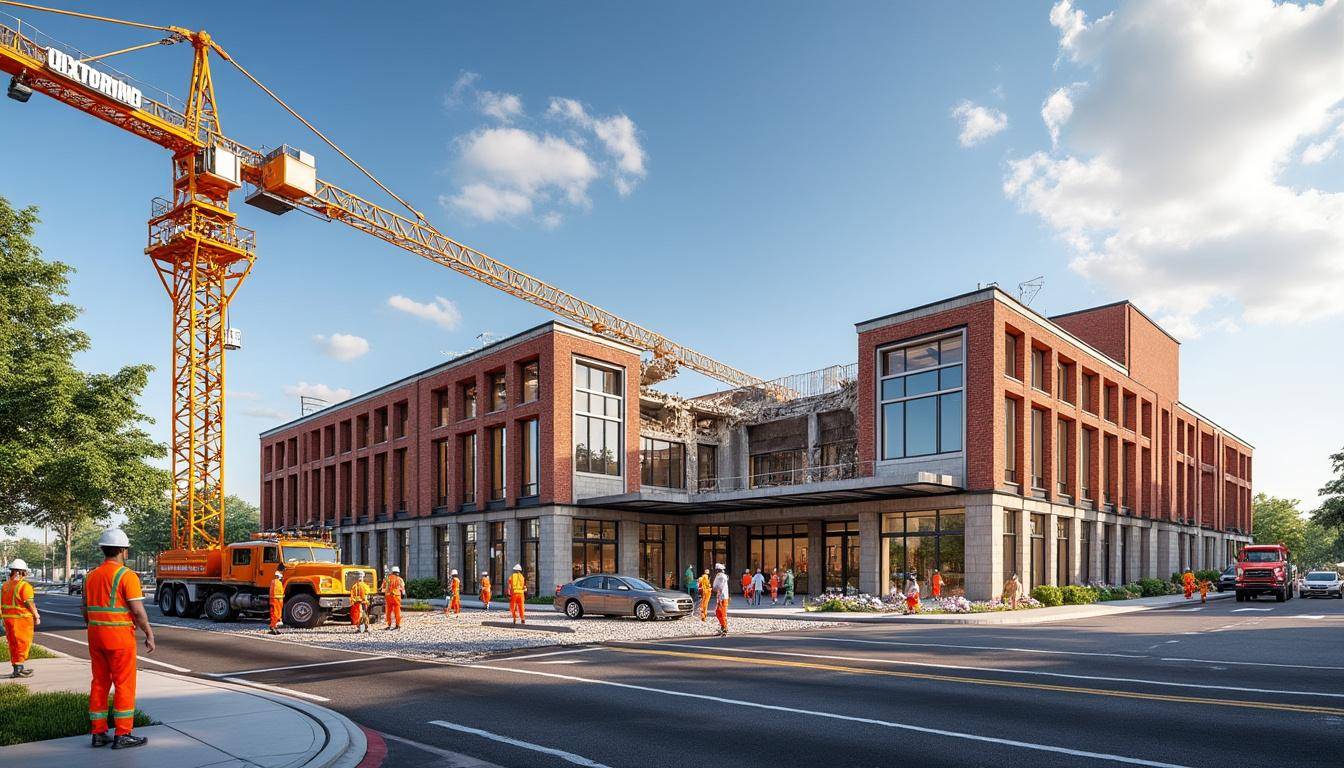
Dallas Midtown has finally shifted from renderings and debate to active construction, turning one of North Dallas’ most recognizable vacant properties into a live development story. At the long-idle former Valley View Center site, crews have started work on The Premier at Dallas Midtown, a six-story mixed-use building positioned near Preston Road and LBJ Freeway. For a property that spent years symbolizing delay, demolition, and unrealized ambition, that visible movement matters. In local real estate terms, it is more than a groundbreaking. It is the first physical proof that a long-promised urban district may now be taking shape.
The project’s timing also fits a bigger market narrative. Dallas continues to attract residents, employers, and capital, even as financing conditions remain selective and large mixed-use projects face intense scrutiny. That is why the start of this roughly $85 million first phase carries weight far beyond one apartment block. It tests whether an iconic site can finally become a walkable node of housing, retail, and long-term value creation. In a market where investors increasingly compare regional growth stories with broader labor and capital trends such as the recent U.S. economy job slowdown, Dallas Midtown stands out as a case study in patience, land strategy, and execution.
Dallas Midtown Construction Starts At The Former Valley View Site
Work is now underway on the first vertical phase of Dallas Midtown, ending more than a decade of starts, pauses, and shifting expectations around the old mall property. The initial project, The Premier at Dallas Midtown, is planned as a six-story mixed-use residential asset with nearly 300 apartments, street-level retail, and lifestyle amenities designed to support a more connected district. For years, the site was known mainly for what had been torn down. Now, for the first time, it is being defined by what is being built.
That distinction is important in North Dallas. The property sits in a strategic corridor framed by LBJ Freeway, Preston Road, and the Dallas North Tollway, making it one of the most valuable redevelopment locations in the city. In practical terms, this is the kind of site developers spend years assembling, entitling, and defending because location does so much of the long-term work. The dirt moving at Valley View is therefore not just symbolic. It signals that a major land play is beginning to convert into a visible, income-producing urban asset.
The Premier At Dallas Midtown Becomes The First Real Building In The Plan
The first phase carries an estimated cost of about $85 million and is being developed by Beck Ventures with Anthem Development and Prime Life Technologies America, a joint venture tied to Toyota Motor Corporation and Panasonic Holdings Corporation. That partnership matters because large mixed-use projects rarely move forward on vision alone. They require patient capital, technical coordination, and partners willing to take a long view on a site that needs infrastructure, timing, and careful sequencing.
For local observers, this is the breakthrough moment. Demolition of the old mall site was completed in 2023, but demolition by itself never guarantees a new chapter. Many former retail sites across the country have been cleared only to sit vacant again. Dallas Midtown is attempting something different: using a former enclosed mall parcel as the seed for a denser and more walkable district. The first building is not the whole story, but it is the piece that converts ambition into measurable progress.
That is also why analysts watching Sun Belt real estate development often compare projects like this with migration-led markets and suburban land repositioning, including trends highlighted in Florida suburban real estate. The shared question is straightforward: which projects can translate population growth into resilient mixed-use value? Dallas Midtown now has the chance to answer with concrete, steel, leases, and occupied units.
Why The Former Valley View Property Is So Important To Dallas Real Estate
The former Valley View site has sat at the center of redevelopment conversations for years because it combines scale, visibility, and access in a way few infill properties can. Beck Ventures acquired the property in 2012. The mall closed in 2015. Final demolition was completed in 2023. Those dates tell a familiar story in modern redevelopment: land control may happen quickly, but repositioning a legacy retail site into a viable mixed-use district often takes far longer than the public expects.
What makes this parcel especially compelling is not nostalgia alone, even though Valley View remains an iconic reference point for many Dallas residents. Its true importance lies in corridor economics. It sits in an area where traffic counts, employment nodes, established neighborhoods, and regional connectivity all intersect. If a project works here, it can influence land values, tenant demand, and planning decisions well beyond its own boundaries. That is why the site has also been discussed in wider conversations about the International District and even surfaced as one of the Dallas finalists considered for a potential future Mavericks arena location.
From Stalled Mall To Strategic Urban Corridor
Dallas laid key groundwork in 2015 when city leaders supported a broader vision for the Valley View-Galleria corridor through a tax increment financing district aimed at helping fund infrastructure and long-range investment. That move reflected a core truth of large-scale development: roads, utilities, drainage, access, and public realm improvements are often the hidden deal-makers. A glamorous rendering may win headlines, but infrastructure wins timelines.
City officials have framed the project as a catalyst for jobs, tax-base growth, and a more vibrant district. That framing is reasonable. A mixed-use project with homes, retail, dining, and future office potential can do more for a corridor than a single-use asset because it broadens activity across different hours of the day. Morning coffee traffic, lunchtime retail visits, evening dining, and residential occupancy all support a steadier pattern of place-making. The underlying lesson is simple: urban value compounds when uses reinforce one another.
For anyone tracking modern district creation, several factors explain why this site has remained a priority:
- Location strength near LBJ Freeway, Preston Road, and the Dallas North Tollway.
- Scale sufficient to support phased mixed-use growth rather than a one-off project.
- Public-private alignment through city-backed infrastructure planning.
- Market relevance in a metro still attracting households and businesses.
- Visibility that can help leasing, branding, and broader corridor repositioning.
That combination is rare, which is why Valley View has remained too important to ignore and too complex to rush.
What The First Dallas Midtown Development Phase Includes
The current phase centers on a six-story mixed-use building expected to deliver roughly 300 apartment units along with ground-floor retail and resident-focused amenities. In market terms, that is a sensible opening move. Housing creates daily foot traffic and provides immediate activation, while retail at street level helps establish a visible neighborhood pattern. Instead of waiting for a full district to appear all at once, the strategy allows the site to begin functioning in stages.
The completion timeline is expected to stretch beyond two years, with future phases dependent on financing conditions, infrastructure progress, and the broader market environment. That caveat deserves attention. In 2026, capital markets remain disciplined, and lenders generally favor phased execution over speculative overreach. Developers who can prove demand incrementally often have an advantage. Dallas Midtown appears to be following that logic by letting the first phase establish credibility before later components move ahead.
Dallas Midtown Phase One At A Glance
The first phase is significant not because it completes the master vision, but because it starts a measurable operating cycle. Once vertical construction begins, the conversation changes. Stakeholders stop asking whether the district is real and start asking how quickly it can lease, what rents it can command, and how subsequent phases should be timed. That is the moment when planning becomes real estate performance.
| Project Element | Current Details | Why It Matters |
|---|---|---|
| Name | The Premier at Dallas Midtown | Establishes the first branded vertical phase of the wider district |
| Location | Former Valley View site near Preston Road and LBJ Freeway | Places the project in one of Dallas’ most strategic corridors |
| Estimated Cost | About $85 million | Signals meaningful but disciplined first-phase capital deployment |
| Height | Six stories | Introduces density without requiring immediate high-rise execution |
| Residential Component | Roughly 300 apartments | Creates the daily population base needed for mixed-use activation |
| Retail Component | Ground-floor retail space | Supports walkability and early placemaking |
| Lead Partners | Beck Ventures, Anthem Development, Prime Life Technologies America | Adds development experience and institutional backing |
| Expected Delivery Window | More than two years | Reflects realistic construction and absorption pacing |
The practical insight is clear: the first phase does not need to do everything. It needs to perform well enough to unlock the next layer of the master plan.
How Dallas Midtown Could Reshape Urban Development In North Dallas
The long-term promise of Dallas Midtown lies in its potential to create a genuine mixed-use district rather than another isolated apartment project. City leaders originally backed a vision of a dense, walkable environment with housing, offices, shopping, entertainment, and open space. If that framework is executed with discipline, the site could become a model for how Dallas recycles aging retail land into higher-value urban neighborhoods.
There is also a broader capital-markets angle. Large district development is increasingly judged not only by design but by resilience: can it maintain demand through cycles, adapt to changing consumer habits, and attract a broad enough mix of tenants to remain relevant? Those questions are especially important after years in which office patterns shifted, retail formats changed, and investors became more selective. Even outside pure property circles, finance readers know that long-duration projects depend on confidence in employment, rates, and capital access, much like the themes explored in discussions around debt, wealth, and policy pressure. Dallas Midtown enters that environment with a valuable advantage: its land position is difficult to replicate.
What Investors, Residents, And The City Will Be Watching Next
Over the next several years, the most important signals will be visible and measurable. Are construction milestones being met? Does leasing interest emerge early? Can retail tenancy reflect the district’s walkable ambitions rather than defaulting to generic filler? And perhaps most importantly, will public infrastructure keep pace with private execution? Those are the variables that separate a successful district from a project that opens but never fully coheres.
Imagine a future resident moving into The Premier after years of driving past a fenced-off tract and half-remembered mall references. That resident will judge Dallas Midtown less by master-plan language and more by lived experience: sidewalk quality, access points, dining options, traffic flow, safety, and whether the area feels complete enough to support daily routines. This is where many major projects either validate the vision or expose its weak spots. Place-making is not a slogan. It is the sum of hundreds of decisions that become visible only after people arrive.
For now, one fact stands above the rest: construction has begun at an iconic former Valley View location that spent years trapped between memory and speculation. In Dallas, that shift alone is a meaningful milestone, and the market will now watch whether the broader Midtown development can build on it phase by phase.