

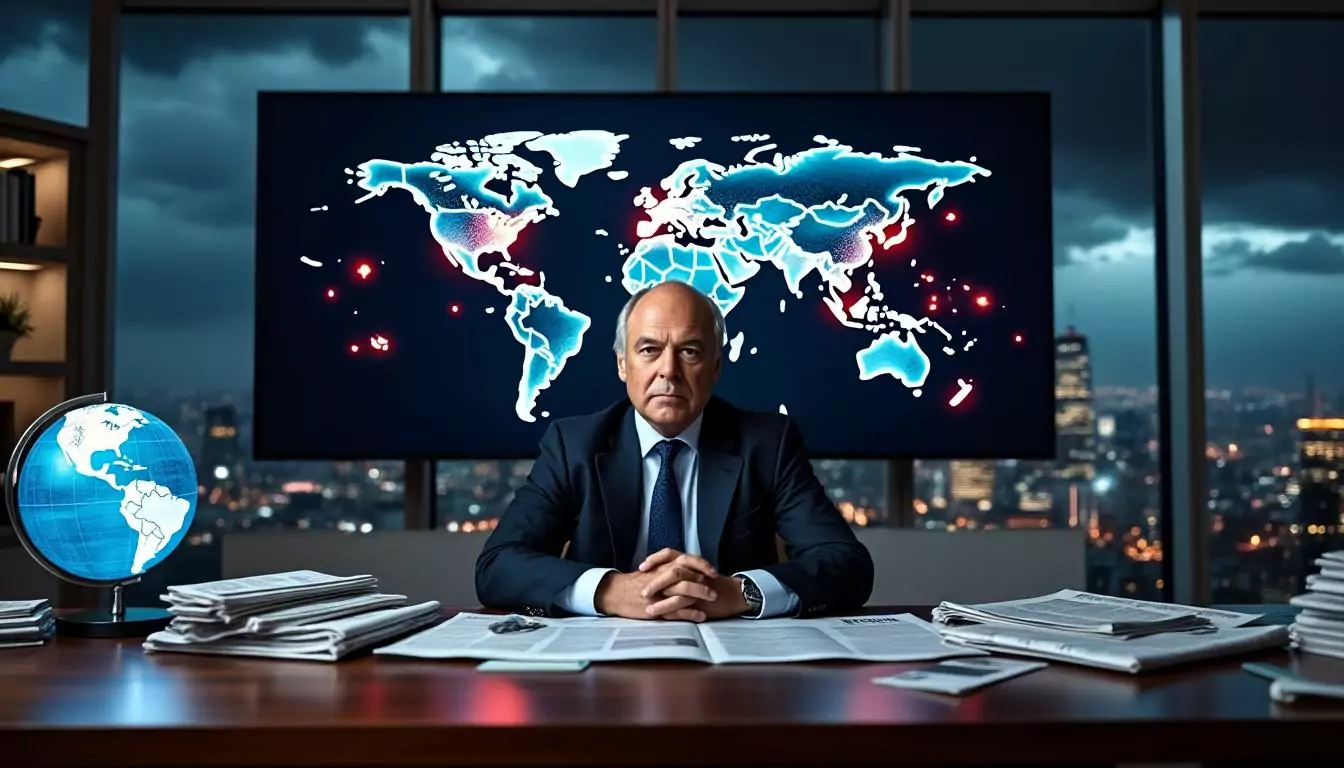
Ray Dalio is framing today’s turmoil through a much wider lens than the daily headlines. While many investors and readers are focused on ceasefires, missile exchanges, or shipping disruptions in the Middle East, the larger claim is more unsettling: isolated crises may no longer be isolated at all. They may be converging into a New World War-type environment defined not only by active battlefields, but also by sanctions, trade barriers, technology rivalry, energy leverage, and hardening alliances.
That perspective matters because markets still tend to price conflicts as temporary shocks followed by a return to normal. Yet the deeper issue is whether the global system itself is changing. In 2026, with supply chains still vulnerable, defense spending rising across multiple regions, and great-power competition shaping World Politics, the debate is no longer just about one war zone. It is about whether a prolonged era of Global Conflict, elevated Geopolitical Risks, and growing pressure on Global Security has already begun.
Ray Dalio’s New World War Warning And Why It Resonates In 2026
The core of the War Warning is simple: short-term events grab attention, but long-cycle forces drive history. A two-week ceasefire, a diplomatic statement, or a brief drop in oil prices can calm markets for a few sessions, yet those moves do not resolve the structural rivalries linking the United States, China, Russia, Iran, and their respective partners. That is why the argument feels less like a headline reaction and more like a macro framework.
Seen through that framework, today’s flashpoints are connected. The wars involving Russia and Ukraine, Israel and its regional adversaries, Iran and U.S.-aligned powers, and several overlapping conflicts across the Red Sea and surrounding regions all feed into the same map of strained International Relations. Add trade restrictions, capital controls, technology bans, cyber pressure, and competition over shipping lanes, and the picture begins to resemble the early phases of historic system-level confrontations.
Why investors keep underestimating long-cycle geopolitical risks
Investors are trained to discount future cash flows, not always to recognize civilizational turning points. When oil spikes on Middle East tension, the first instinct is to ask how quickly prices will mean-revert. But if the Strait of Hormuz, the South China Sea, and European security architecture are all part of one evolving strategic contest, then the right question is bigger: what if the baseline itself has shifted?
Consider a hypothetical portfolio manager in Manhattan, Elena, who built her 2026 playbook around falling inflation and stable rate expectations. She can hedge a short-lived energy shock. What she cannot easily hedge is a world where sanctions broaden, defense budgets surge, cross-border capital becomes more politicized, and supply chains are redesigned around security rather than efficiency. That is where Economic Crisis risk starts to intersect with military strategy.
The insight is clear: markets often normalize what history later defines as regime change.
That broader lens also affects careers, policy, and business strategy. Professionals tracking where finance and public-sector demand are heading may find it useful to review high-potential finance careers in 2026, especially as defense, infrastructure, energy, and risk analysis become more central to capital allocation.
Global Conflict Is Becoming Interconnected Across Regions And Systems
One reason this thesis has gained attention is that conflicts no longer stay in their original theater. A war in Eastern Europe affects gas flows, fertilizer prices, grain routes, and military procurement. A naval threat in the Gulf can hit insurance costs, tanker rates, inflation expectations, and central bank communication. A technology dispute between Washington and Beijing can reshape semiconductor investment from Arizona to Taiwan to the Netherlands. This is what modern Military Tensions look like: multi-layered, financialized, and global.
Historically, world wars were not always declared cleanly at the start. They often emerged through a chain of linked crises, alliance commitments, mobilization steps, and economic retaliation. That pattern is why analysts who focus only on official declarations risk missing the buildup. In practical terms, the front line today may include ports, payment rails, commodity exchanges, and chip foundries as much as it includes trenches or missile batteries.
Key signs that a fragmented world is behaving like a larger war system
Several indicators suggest today’s environment is more than a series of isolated disputes. They do not prove inevitability, but taken together they point to a world where escalation risks are embedded in the system.
- Alliance hardening through military pacts, diplomatic coordination, and more polarized U.N. voting.
- Economic weaponization via sanctions, tariffs, export controls, asset freezes, and shipping restrictions.
- Proxy conflict expansion in regions where major powers avoid direct confrontation but support local partners.
- Chokepoint vulnerability around strategic passages such as the Strait of Hormuz and other maritime routes.
- Defense-industrial mobilization including larger missile inventories, air defense orders, and munitions contracts.
- Financial pressure from deficits, debt issuance, and public spending tied to security commitments.
- Technology race centered on AI, cyber capability, semiconductors, drones, and space-linked systems.
When these elements appear together, the system begins to behave less like peacetime globalization and more like managed rivalry. That is the practical meaning of Global Conflict in this decade.
How Alliances Are Redrawing World Politics
The alignment of states matters because war risk does not depend only on who is fighting now. It depends on who supplies energy, intelligence, financing, weapons, diplomatic cover, and industrial capacity. Across recent years, a looser but increasingly visible bloc involving China, Russia, Iran, North Korea, and sympathetic partners has stood in sharper opposition to the U.S. and many of its treaty allies, including major European countries, Japan, Australia, Israel, and several Gulf partners.
This does not mean every country behaves as a rigid member of one camp. Many governments still hedge. India, Turkey, Gulf states, and several emerging powers often pursue strategic flexibility. Even so, the broad lines have become easier to trace through trade patterns, military exercises, sanctions compliance, and U.N. behavior. The language of nonalignment remains, but the mechanics of alignment are more visible than before.
Why China, Russia, and Iran matter so much in the current geopolitical map
Energy is one reason. China’s relationship with Iran and Russia helps reduce its vulnerability to selective supply disruption, especially when paired with domestic coal capacity, rapid renewable deployment, and strategic stockpiles. If one shipping route becomes contested, Beijing still has multiple fallback channels. That does not make China immune, but it does complicate assumptions that every Middle East disruption automatically hurts it more than others.
Russia gains from sustained fragmentation because conflict can keep commodity markets tight, preserve leverage over energy flows, and distract Western resources. Iran, despite sanctions pressure, retains strategic relevance because geography still matters. Control, disruption, or even uncertainty around critical routes can reverberate through gasoline prices, freight costs, inflation expectations, and voter sentiment in democracies far from the Gulf.
The larger point is that alliance structures shape resilience. They determine who absorbs shocks and who exploits them.
| Strategic factor | Why it matters in 2026 | Potential market impact |
|---|---|---|
| Energy partnerships | Oil and gas flows influence wartime endurance and diplomatic leverage | Volatility in crude, transport, refining margins |
| Military basing networks | Forward deployment supports deterrence but increases exposure | Higher defense spending, fiscal strain, regional risk premiums |
| Technology controls | Semiconductors, AI, and cyber tools define modern state power | Supply chain shifts, capital expenditure surges, export disruption |
| Shipping chokepoints | Narrow passages can be used as strategic pressure points | Insurance costs, inflation pressure, commodity spikes |
| Debt-financed security policy | Wars and deterrence are expensive for already stretched governments | Bond issuance growth, currency stress, financial repression risk |
For readers trying to understand how instability can reshape labor markets and corporate planning, the interaction between conflict and hiring is becoming more visible. A useful related angle appears in this analysis of how war conditions can alter employment trends, especially in technology, logistics, and defense-linked industries.
Historical Patterns Behind A New World War Scenario
History rarely repeats in exact form, but it often rhymes in structure. The classic sequence is familiar: a dominant power weakens relative to rising challengers, trade wars intensify, alliances harden, proxy wars multiply, and governments tighten control over finance and strategic industry. Eventually, military confrontation becomes more plausible because the economic and political groundwork has already been laid.
That historical lens is central to the present debate. The post-1945 order was built around American military reach, dollar centrality, open trade routes, and broad alliance credibility. If rivals begin to doubt the durability of that system, they may test it. If allies begin to doubt it, they may hedge. Either response can accelerate the transition.
Overextension, debt, and the limits of military reach
A major concern is overextension. The United States still maintains a vast global footprint, with hundreds of overseas military installations and security commitments across multiple theaters. Such reach offers influence, but it also creates cost, vulnerability, and difficult trade-offs. History shows that empires rarely fail because they lack ambition. They fail because commitments outgrow resources, public support, or political cohesion.
This is where the financial side becomes inseparable from the security side. Sustained military pressure tends to raise deficits, increase debt issuance, and divert industrial capacity. In a more extreme setting, it can lead to tighter capital management, heavier taxation, and forms of financial repression. For bond markets, that is not a side issue. It is central to the valuation of sovereign risk.
The lesson is uncomfortable but durable: no global power can be everywhere at full strength forever.
Military Tensions, Nuclear Signals, And The Risk To Global Security
Perhaps the most dangerous feature of the current environment is not any single battlefield. It is the possibility that governments are learning from each other’s vulnerabilities in real time. If leaders conclude that treaty promises are less reliable than they once seemed, they may respond by accelerating domestic weapons production, expanding missile defense, or reconsidering nuclear deterrence. That would deepen Global Security risk even without an immediate major-power clash.
There is a darker logic here. The more states believe the world has entered a harsher self-help era, the more they invest in capabilities that make crises harder to de-escalate. Precision missiles, drone swarms, cyber tools, satellite disruption, and dual-use AI systems all compress decision times. In such a setting, misunderstandings become more dangerous because response windows shrink.
Why chokepoints and secondary theaters may decide the next phase
Many observers focus on the most visible combat zone, yet secondary theaters can become decisive. A contested strait, a surprise cyberattack on logistics systems, or a standoff around a U.S.-allied base in Asia could reveal more about deterrence credibility than a thousand speeches. That is why policymakers from East Asia to Eastern Europe are watching Middle East outcomes so closely.
If a state close to a strategic waterway sees that pressure on maritime transit delivers leverage, others may study that precedent. If a country hosting U.S. forces sees hesitation in crisis response, its domestic debate may shift. This is how local wars reshape global expectations. The battlefield becomes a signal, and the signal becomes policy.
The crucial takeaway is that credibility is contagious. So is doubt.
Financial systems are also part of the adaptation process. As investors seek alternatives to traditional banking rails or hedge against currency fragmentation, interest in decentralized tools often grows, though not without substantial risk. Readers exploring that intersection can compare the practical side in real-world decentralized finance applications and the cautionary side in DeFi risks and rewards.
What Ray Dalio’s War Warning Means For Markets, Policy, And International Relations
If this reading of the world is even partly correct, then investors, executives, and policymakers should stop assuming a clean return to the old normal. The relevant shift is from a globalization-first model to a resilience-first model. That means higher defense spending, more state involvement in strategic sectors, more scrutiny of cross-border capital, and a premium on domestic energy, infrastructure, and industrial capability.
For markets, that can produce an unusual mix: structurally higher volatility, periodic commodity spikes, heavier fiscal issuance, and selective booms in areas tied to national security. Aerospace, cyber defense, grid resilience, logistics, rare earth processing, and energy infrastructure may all benefit, even while broader risk assets struggle with uncertainty. In other words, a period of elevated Geopolitical Risks does not affect every sector equally.
Practical questions leaders should be asking now
- How exposed are we to strategic chokepoints? Companies should map dependencies on routes, suppliers, and payment systems that could be disrupted.
- What happens if sanctions widen? Boards need scenario planning for restricted markets, frozen assets, and compliance burdens.
- Can financing remain stable during a security shock? Higher rates, wider spreads, and currency volatility may arrive together.
- Which assets gain value in a fragmented world? Domestic production, energy security, and critical technology may command premium valuations.
- Are political assumptions embedded in our forecasts? Many models still assume peace-driven efficiency rather than security-driven redundancy.
Those are not abstract questions anymore. They sit at the center of International Relations, corporate strategy, and public finance. And they explain why Ray Dalio’s message continues to travel far beyond investment circles.
The central market lesson from the New World War debate
The sharpest lesson is that modern war risk is not confined to soldiers and borders. It can move through energy invoices, insurance markets, sovereign debt auctions, semiconductor policy, and election cycles. A ceasefire may ease one pressure point, but it does not automatically reverse a structural change in the world order.
That is why the present debate matters. The question is not merely whether one regional war expands tomorrow. The deeper question is whether the architecture of global power has already entered a more adversarial era. If it has, then World Politics, asset prices, and the rules of globalization will continue to be rewritten in plain sight.