


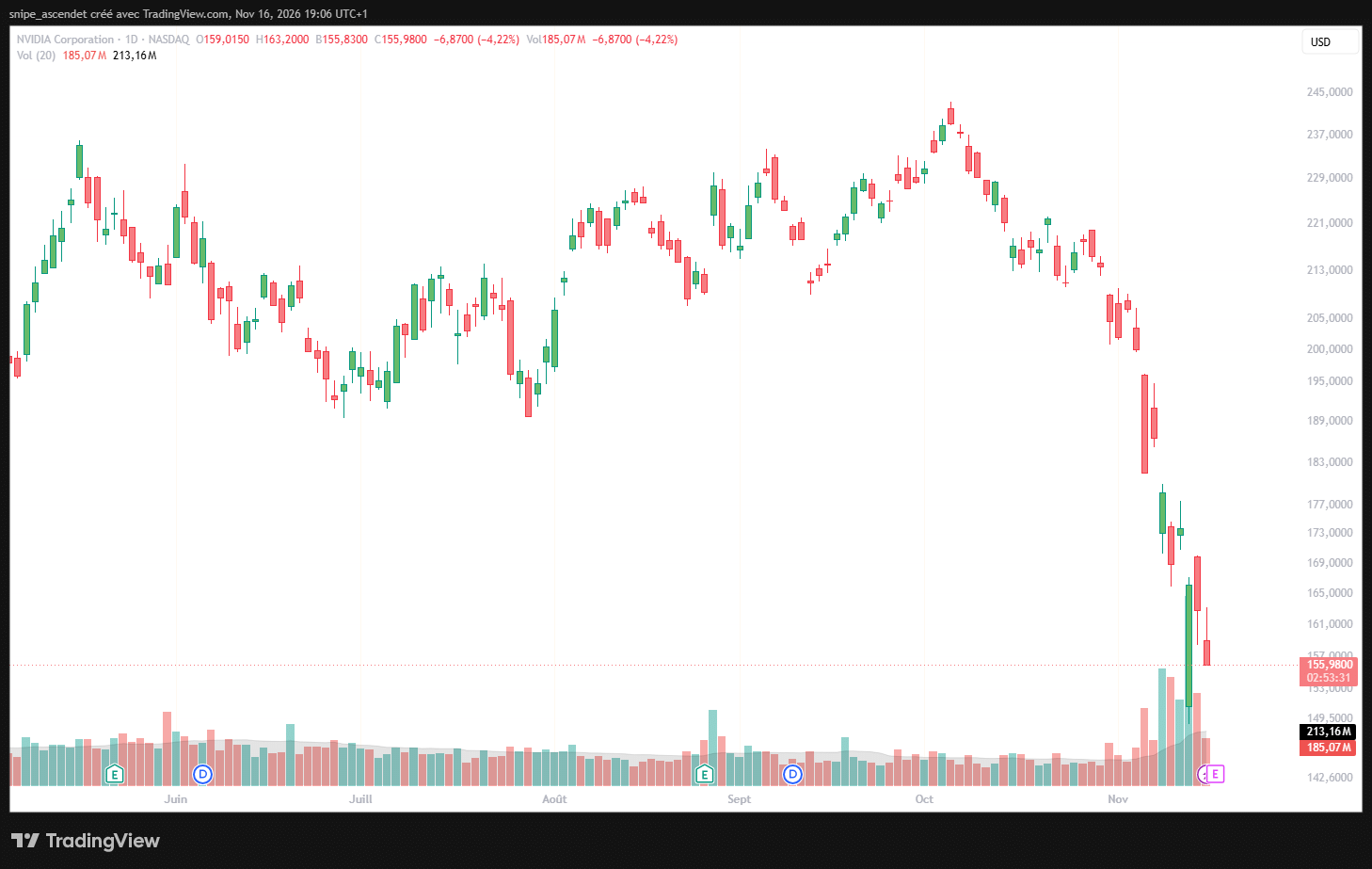
U.S. stocks fell on Monday, November 16, as technology and semiconductor shares led a broad pullback ahead of Nvidia’s earnings. At 1:06 p.m. ET, the Nasdaq-100-tracking QQQ ETF was down 2.32%, while Nvidia (NASDAQ: NVDA) had dropped 4.22% to $155.98, according to TradingView. For shareholders, the immediate test is whether Tuesday’s results can restore confidence in AI spending and the chipmaker’s operations after a sudden leadership change.
Tech stocks lead the November 16 market decline
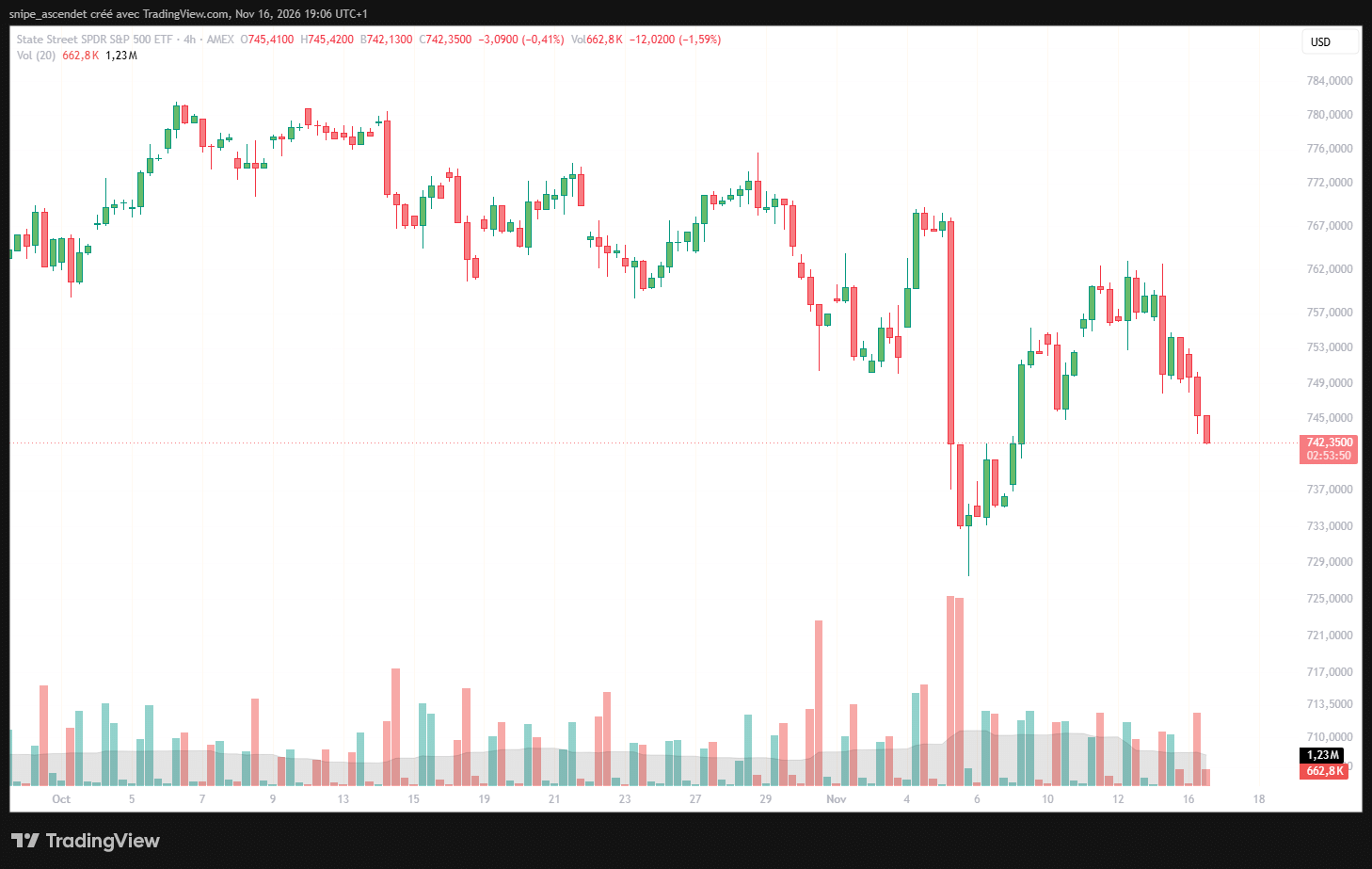
The Invesco QQQ Trust, which tracks the Nasdaq-100, traded at $664.10, down $15.79 from the previous close. The SPDR S&P 500 ETF Trust (SPY) fell to $742.35, a 1.59% decline. The gap between the two shows how a technology-heavy portfolio was taking a bigger hit than the broader U.S. equity market.
| Asset | Price at 1:06 p.m. ET | Change vs. prior close |
|---|---|---|
| Invesco QQQ Trust (QQQ) | $664.10 | -2.32% |
| SPDR S&P 500 ETF (SPY) | $742.35 | -1.59% |
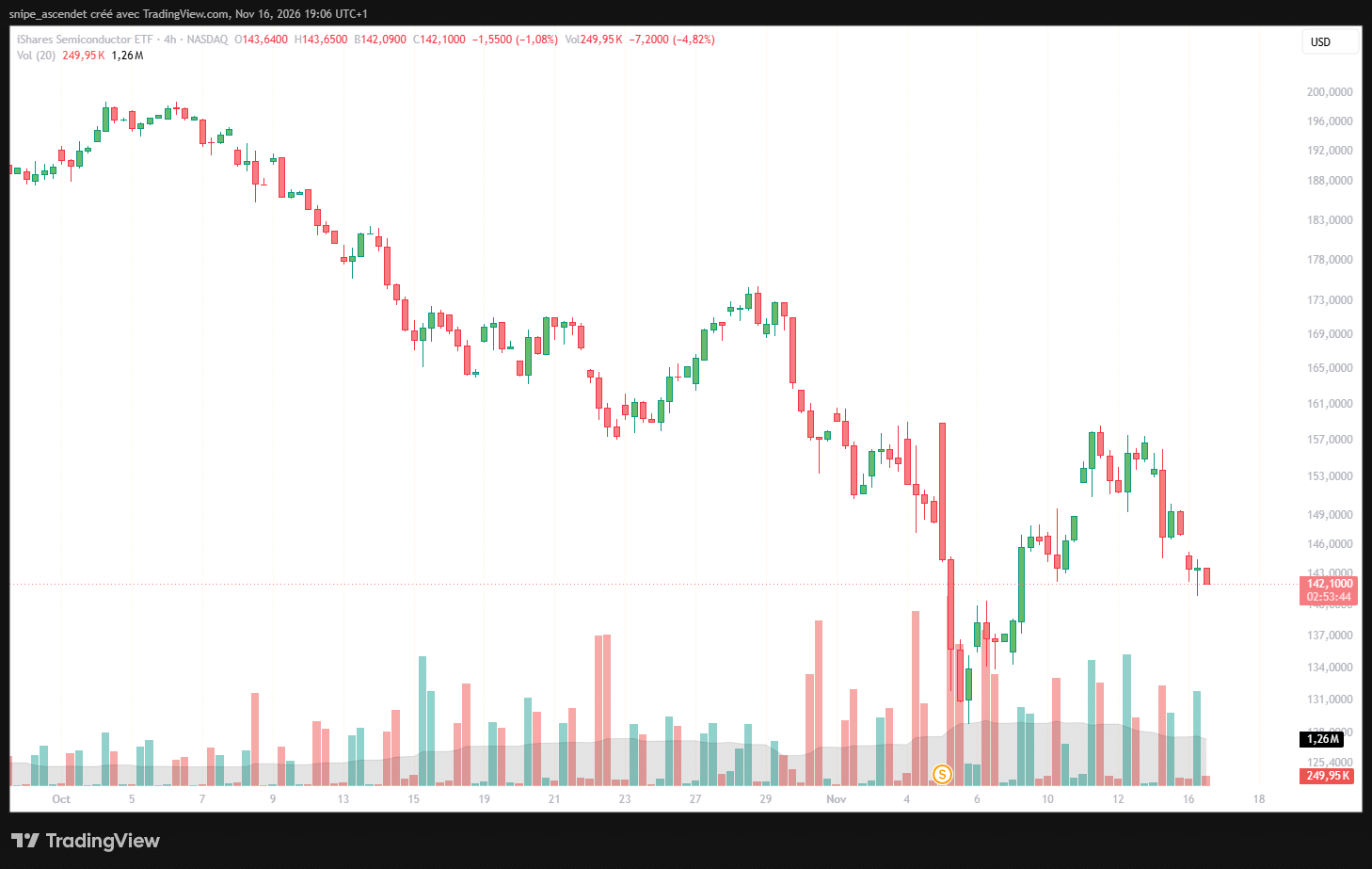
| iShares Semiconductor ETF (SOXX) | $142.10 | -4.82% |
| Nvidia (NVDA) | $155.98 | -4.22% |
These are intraday ETF and stock readings, not final closing prices or official index returns. Reuters reported earlier in the session that the Nasdaq Composite fell more than the S&P 500, with technology leading sector losses. The weakness followed a week in which major indexes gained despite volatility, as outlined in DualFinances’ November 13 market recap.
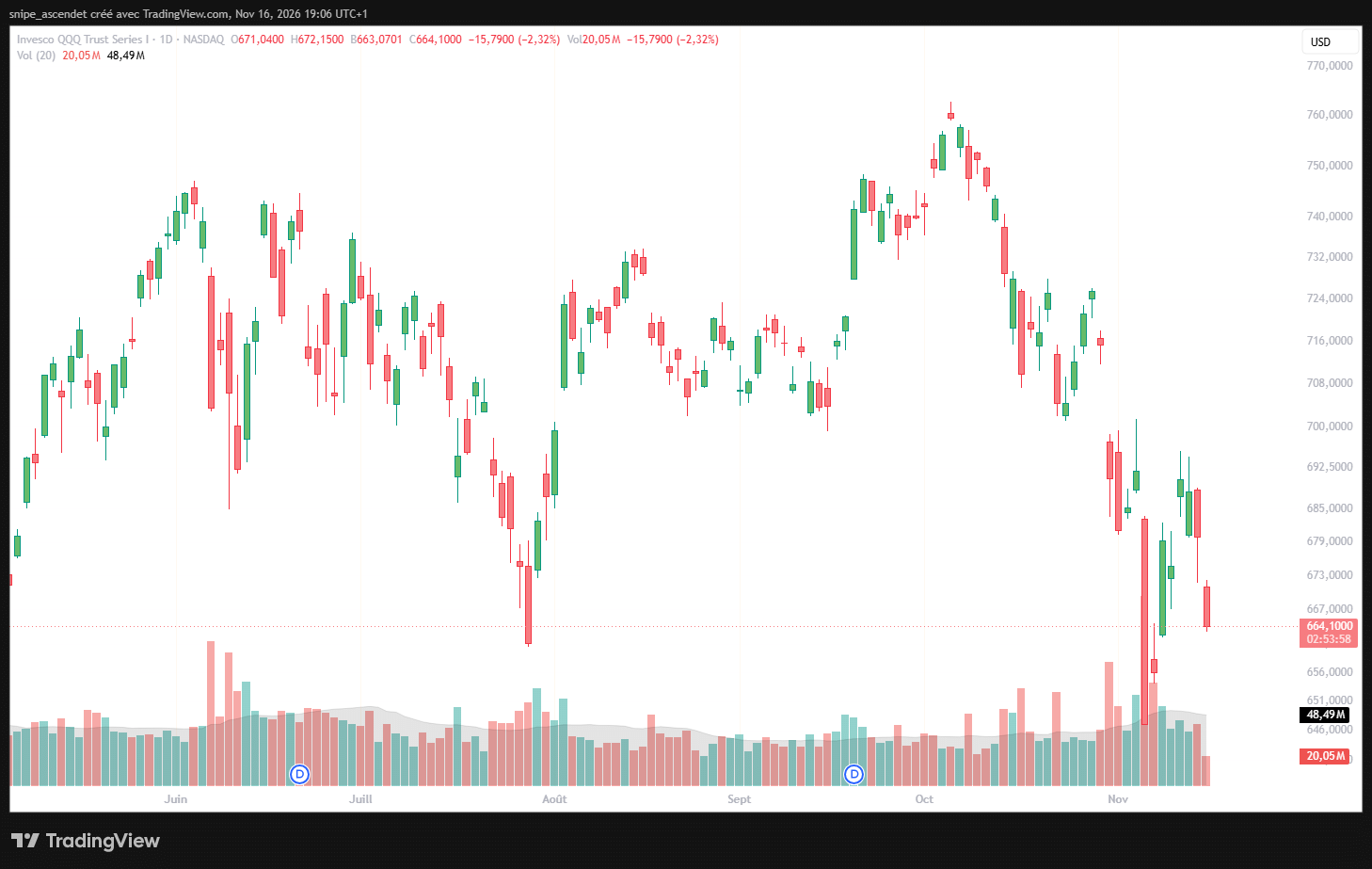
QQQ’s daily candles show that selling has extended beyond a single weak session. Its latest move follows a retreat from October’s highs, making Tuesday’s earnings a test of whether investors are prepared to support expensive AI-related growth stocks.
The iShares Semiconductor ETF (SOXX) dropped 4.82% to $142.10, more than double QQQ’s percentage decline. That divergence matters because chipmakers are the suppliers behind much of the AI infrastructure buildout. Weakness across the group indicates that investors are reducing exposure beyond Nvidia alone.
At 11:52 a.m. ET, Reuters reported declines of 6.4% for Intel and 5.8% for Micron, while the Philadelphia Semiconductor Index was down 3.7%. Those figures refer to the earlier reporting time and should not be confused with SOXX’s later reading.
Semiconductor investors also face a new policy variable. On November 15, the U.S. Commerce Department’s Bureau of Industry and Security announced a rule intended to prevent restricted foreign users from accessing advanced U.S. computing power through data centers in third countries. The potential effect on orders, licensing and end customers is another uncertainty for suppliers. The earlier Nvidia and Nebius selloff showed how market pressure can reach both chipmakers and AI infrastructure customers.
Nvidia falls before its first earnings report under interim leadership
Nvidia shares traded at $155.98, down $6.87 from their November 13 close of $162.85. The daily chart shows a renewed decline after a brief recovery, with the stock well below its October trading range.
The earnings announcement comes after a significant governance change. Nvidia’s Form 8-K states that its board accepted Jensen Huang’s resignation as chief executive and director on November 11. Chief Financial Officer Colette Kress became interim CEO while retaining her finance role. Tuesday’s presentation will therefore be assessed for operating continuity as well as financial performance.
The $108 billion guidance test for fiscal Q3 2027
Nvidia plans to report results for the quarter ended October 25, 2026, at approximately 4:20 p.m. ET on November 17, followed by a 5 p.m. ET conference call, according to its investor-relations announcement.
In its prior fiscal Q2 2027 earnings release, Nvidia recorded $96.221 billion in revenue, up 106% year over year, including $89.0 billion from its data-center business. The company guided fiscal Q3 revenue to $108.0 billion, plus or minus 2%, implying approximately 12.2% sequential growth at the midpoint. It forecast both GAAP and non-GAAP gross margins of 74.0%, plus or minus 0.5 percentage points, compared with 75.0% in fiscal Q2.
Meeting that earlier revenue forecast would show substantial demand, but the next quarter’s guidance may matter more for valuation. Investors will scrutinize orders for AI accelerators, gross-margin trends, the pace of Vera Rubin deployment, and whether large customers can continue funding capacity expansion. Cash generation and capital commitments deserve attention alongside headline sales.
Interest rates add pressure to technology valuations
The selloff is unfolding against restrictive financial conditions. Charles Schwab’s Monday opening update put the 10-year Treasury yield at 5.14% near the opening bell. Higher yields raise the discount rate applied to future corporate earnings and make financing data centers more expensive. DualFinances examined the same mechanism in its November 12 Treasury-yield and equity-market analysis.
There are two separate tests ahead: Nvidia must establish that its product demand and execution remain strong, while investors must decide what multiple to pay for that growth in a higher-rate environment. Results above prior guidance could support sentiment, but weaker forward margins, slower deliveries or financing concerns could keep the semiconductor group under pressure.
Bottom line
Monday’s decline is concentrated in technology, with SOXX falling faster than QQQ and SPY. Nvidia’s November 17 results will test the strength of AI demand, management continuity and profit expectations, but the response across Wall Street will also depend on bond yields and investor risk appetite.
Data as of 1:06 p.m. ET, November 16, 2026. For informational purposes only; not investment advice.