


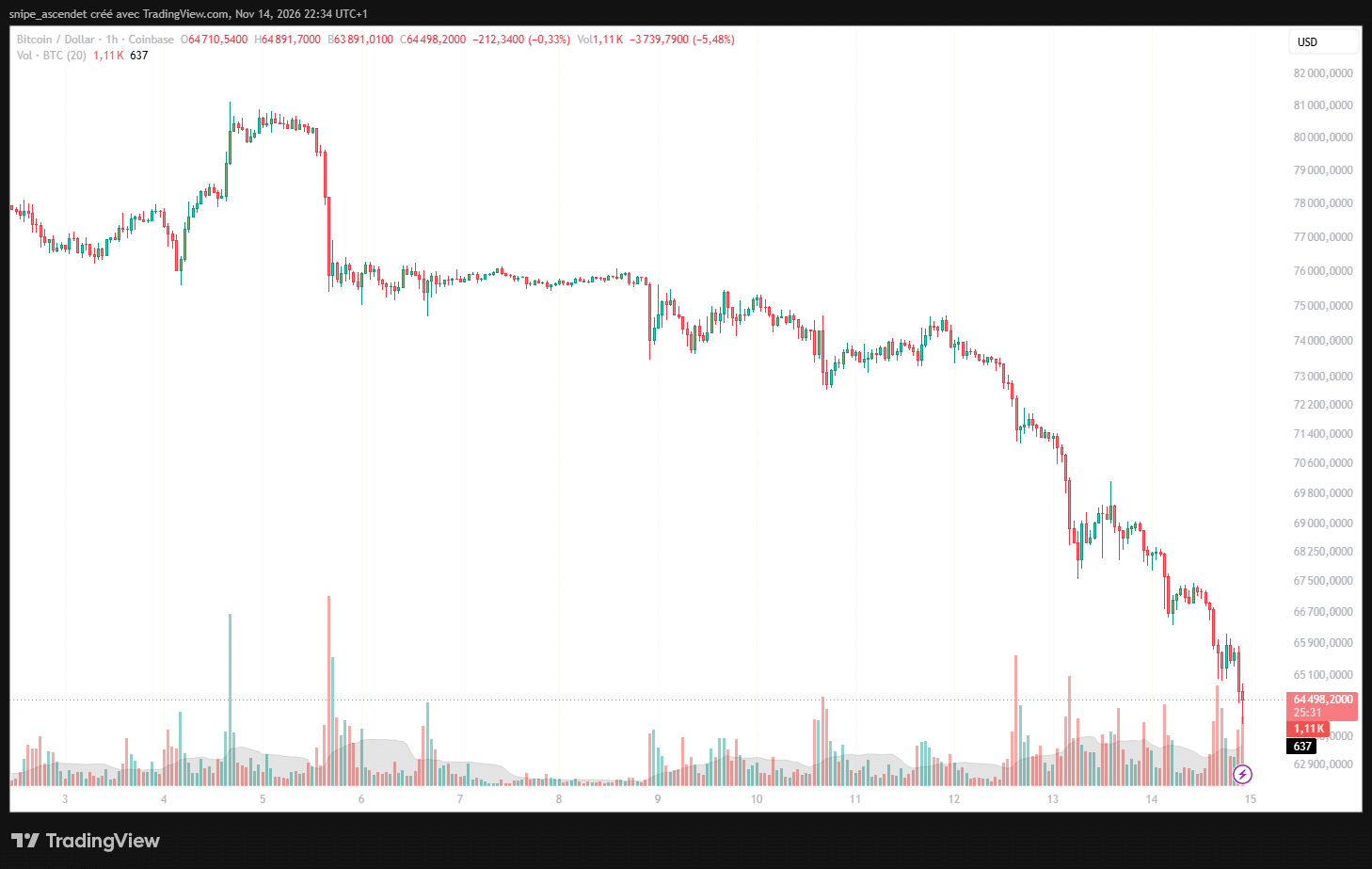
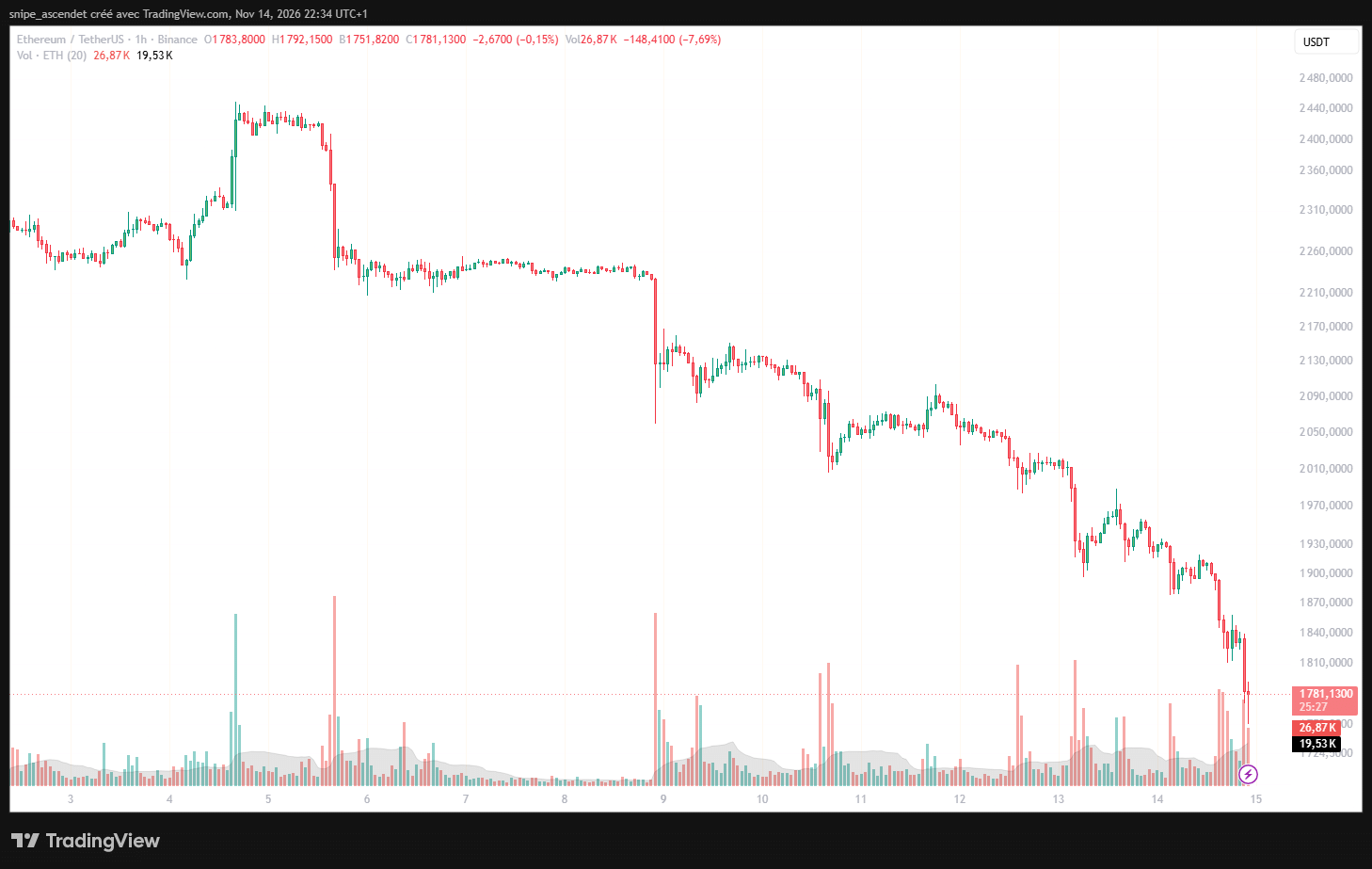
Bitcoin traded at $64,498.20 at 4:34 p.m. ET on Saturday, November 14, 2026, down 5.48% on Coinbase, while Ether fell 7.69% to 1,781.13 USDT on Binance. The weekend cryptocurrency selloff raises a pressing question for U.S. shareholders: will the weakness spread to the Nasdaq and S&P 500 when markets reopen Monday, November 16? The selloff raises the risk of a weak opening, but it does not establish that stocks will fall.
Bitcoin Breaks Below $65,000 as Crypto Selling Accelerates
Bitcoin’s decline is no longer limited to a single trading session. Its hourly trend shows successive lower highs and sharp declines from above $80,000 in early November, leaving the latest quote about 19% below the $80,000 reference level. The move through $70,000, then $65,000, has made downside momentum the immediate issue for traders.
Ether has weakened even faster. Binance’s ETH/USDT market stood at 1,781.13, down 7.69% on the displayed session, and its hourly chart shows repeated failed rebounds. That matters because weakness beyond Bitcoin points to a broader retreat from speculative cryptocurrency exposure rather than isolated pressure on the largest token.
Why Wall Street Was Already Vulnerable on Friday
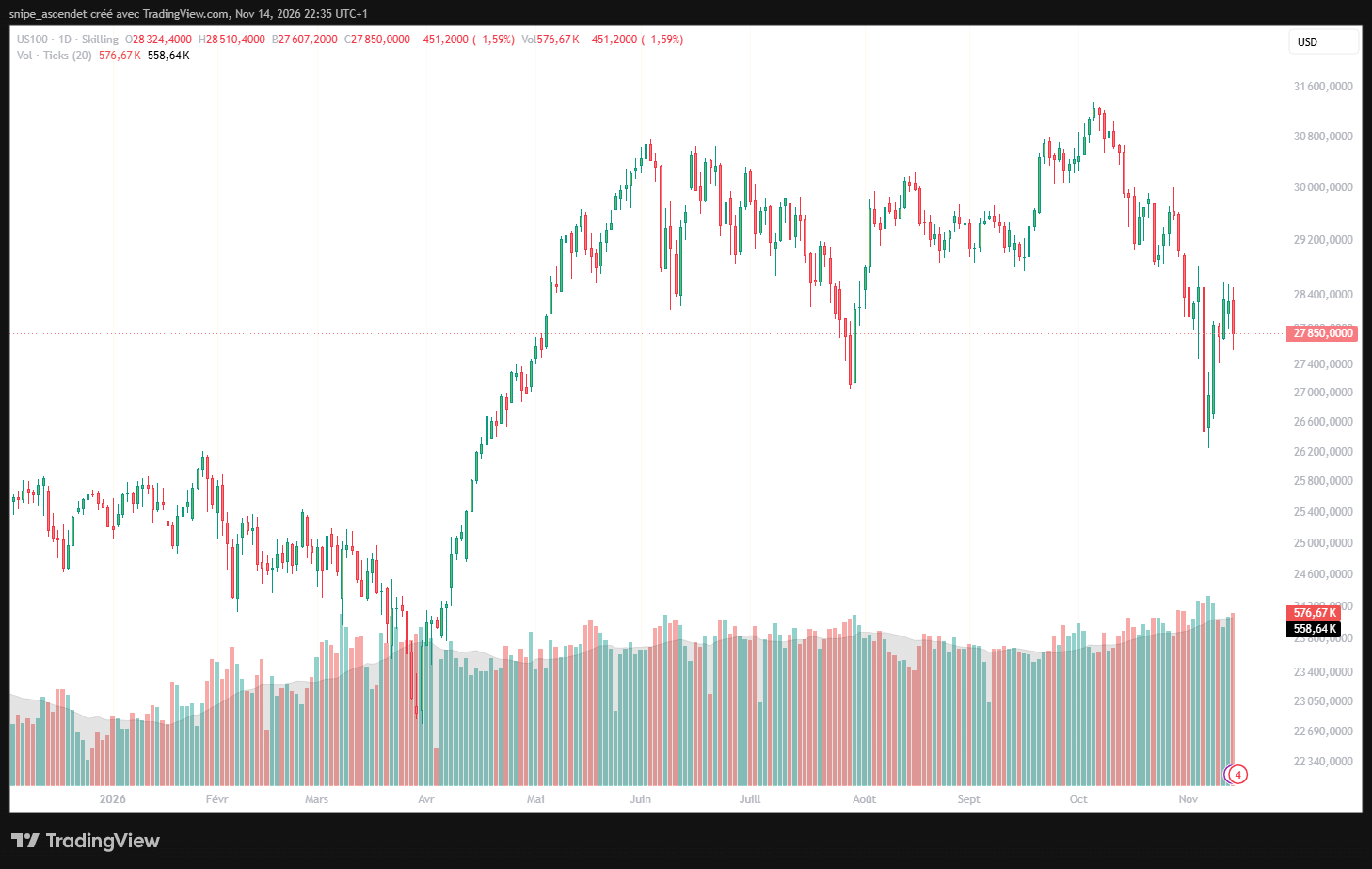
Stocks entered the weekend on uncertain footing. The S&P 500 fell 0.40% to 7,561.67 on Friday, November 13, while the Nasdaq Composite lost 0.91% to 25,136.27. The Dow Jones Industrial Average edged up 0.10% to 52,347.55, according to Associated Press closing figures.
| Benchmark | Friday close | Friday change |
|---|---|---|
| S&P 500 | 7,561.67 | -0.40% |
| Nasdaq Composite | 25,136.27 | -0.91% |
| Dow Jones Industrial Average | 52,347.55 | +0.10% |
There is an important counterweight to the bearish narrative: the S&P 500 gained 2.5% for the week, and the Nasdaq gained 2.3%. Cryptocurrency losses therefore coincided with a positive week for the major U.S. stock benchmarks. The relationship between the two markets is neither automatic nor fixed.
Technology shares nonetheless remained sensitive to the leadership disruption at Nvidia (NASDAQ: NVDA), higher bond yields and questions about AI-sector valuations. DualFinances examined those pressures in its November 12 Wall Street market analysis.
ETF Outflows and Inflation Are Adding to the Pressure
U.S. spot Bitcoin exchange-traded funds recorded $185.4 million in net outflows on Friday, led by $143.5 million from BlackRock’s IBIT and $41.9 million from Fidelity’s FBTC. Across November 9–13, withdrawals totaled $1.0653 billion; the seven-session outflow streak totaled $1.9074 billion, according to Farside Investors.
Inflation is a second problem. The Bureau of Labor Statistics reported that the October Producer Price Index rose 0.3% month over month and 6.5% year over year. Sticky inflation can reinforce expectations of tighter Federal Reserve policy, raising financing costs and putting pressure on the valuations of growth stocks and other risk-sensitive assets. For context, see DualFinances’ analysis of the U.S. inflation surprise and Treasury yields.
Does the S&P 500 Futures Chart Predict Monday’s Opening?
Not yet. The E-mini S&P 500 futures chart ended Friday near 7,561, after a volatile session. It shows the market’s positioning before the latest Saturday cryptocurrency losses, not a live weekend reaction by U.S. equity futures.
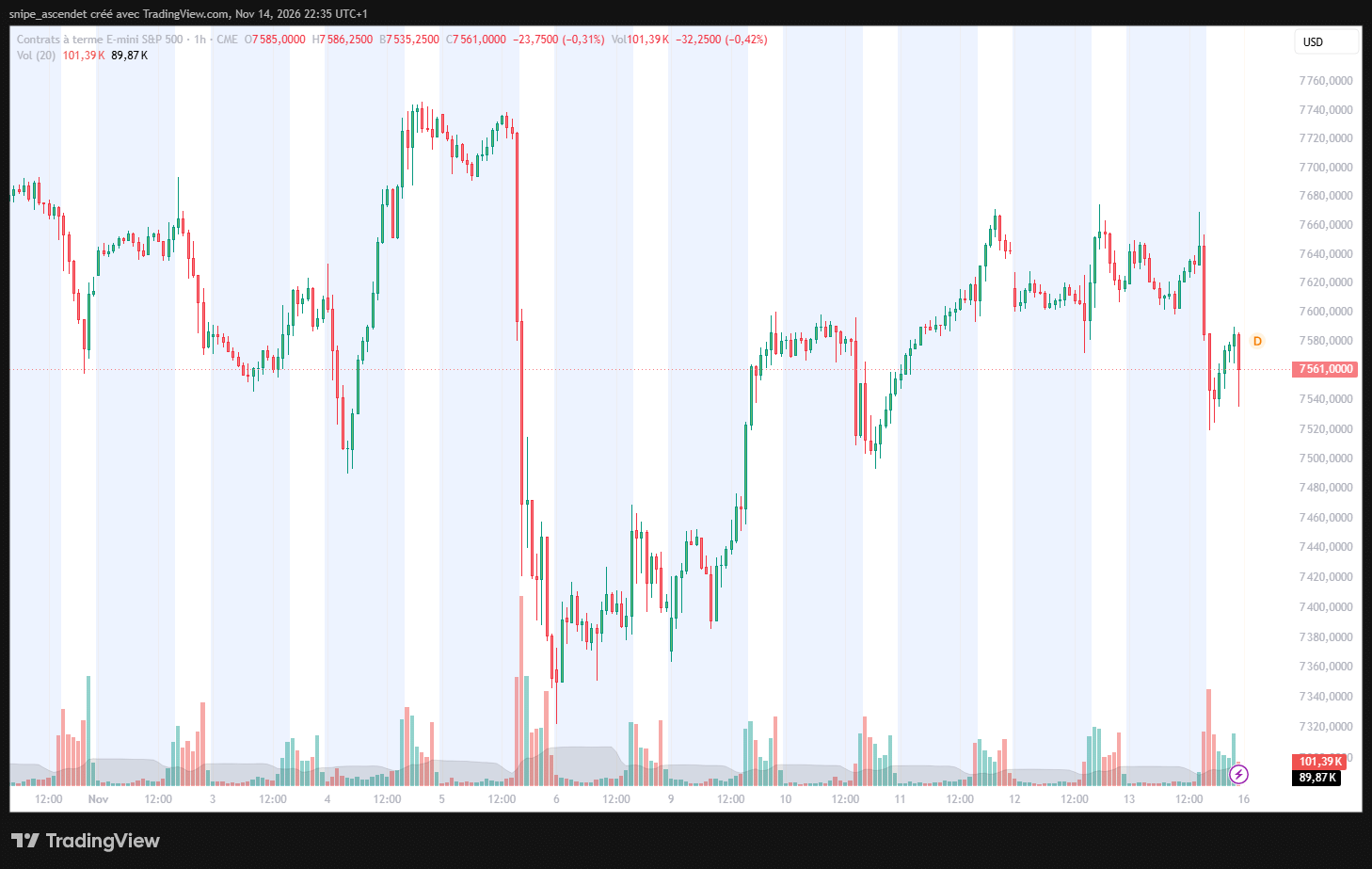
According to CME Group’s contract specifications, E-mini S&P 500 futures reopen on Sunday, November 15, at 6 p.m. ET. That session will offer a more direct test of whether cryptocurrency weakness is spilling into equity-index risk. Regular U.S. stock trading resumes Monday at 9:30 a.m. ET.
Three Scenarios for Wall Street on Monday, November 16
Bearish: The Crypto Selloff Spreads
If Bitcoin fails to regain $65,000 and slides below $64,000 while equity futures open lower, technology and crypto-linked shares could weaken. Coinbase (NASDAQ: COIN), Strategy (NASDAQ: MSTR) and semiconductor stocks would be worth monitoring. A weaker opening would not determine the full day.
Stabilization: Stocks Open Unevenly
If Bitcoin steadies between $64,000 and $65,000, the stock market could remain choppy without a broad liquidation. Investors may separate companies with resilient earnings and cash flow from speculative assets. This would be consistent with the selective trading described in DualFinances’ earlier review of the Nasdaq rebound.
Recovery: Buyers Return Before the Open
If Bitcoin recovers $65,000 and approaches $68,000 while equity futures turn positive, stocks may find support. Falling Treasury yields would strengthen that possibility. These levels are reference points, not guaranteed turning points.
Watch Bitcoin’s $64,000–$65,000 area, Treasury yields, Nasdaq performance and crypto-linked equities. Monday’s 9:30 a.m. ET cash-market opening will test the futures move. The Fed’s December 8–9 meeting remains part of the valuation backdrop.
Bottom line
Bitcoin below $65,000 is a warning sign for risk appetite, not a forecast of a Black Monday. U.S. stocks declined on Friday but still posted weekly gains, while ETF outflows and persistent inflation provide reasons for caution. Sunday’s futures reopening will determine whether the crypto selloff becomes a broader equity-market concern.
Data as of 4:35 p.m. ET, November 14, 2026. For informational purposes only; not investment advice.