


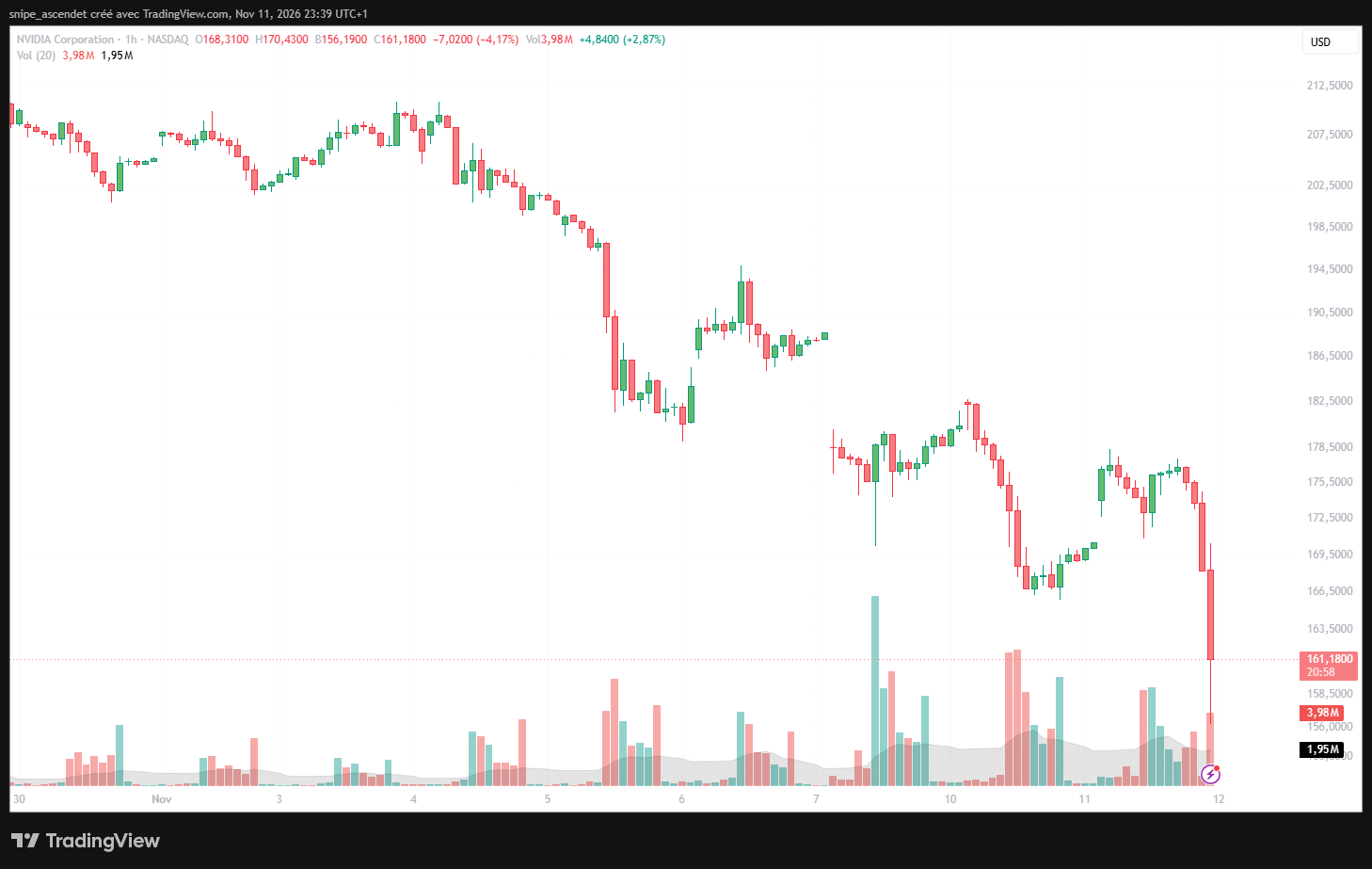
NVIDIA shares plunged more than 8% in after-hours trading on November 11, 2026, as a Wall Street Journal report said the chipmaker’s board was preparing to consider removing founder and CEO Jensen Huang. The latest supplied TradingView capture shows NVDA at $161.18 at 5:39 p.m. Eastern, down 7.22% from its $173.73 regular-session close, after the hourly chart recorded a $156.19 low, 10.10% below that close. The dramatic price reversal increases attention on the reported leadership deliberations, but Nvidia has not officially announced Huang’s removal, and a price chart alone cannot prove which headline or trades caused the move.
The reported move would represent a major leadership shock for the company at the center of the AI-chip market. It follows an investigation into allegations surrounding Huang’s personal relationships and a suspected foreign-intelligence effort. Nvidia’s independently appointed investigators have not publicly announced findings establishing that company technology or national-security information was compromised. Investors now face two different questions: what will the board decide, and how might the business perform if Huang leaves?
What the Wall Street Journal Actually Reported
The WSJ report states that Nvidia directors are preparing to oust Huang following reports of two extramarital relationships, one involving a woman described as a suspected Chinese spy. The newspaper said its account was based on people familiar with the matter and that the board could convene imminently. These details are attributed reporting, not a publicly disclosed board resolution, management appointment or regulatory finding.
On November 8, Nvidia’s board said it was beginning an independent investigation into reports that Huang had been the target of a foreign intelligence effort. Crucially, the board said at that time that it had no reason to believe Nvidia secrets or U.S. national security had been compromised, and it expressed confidence in Huang’s leadership. On November 10, independent directors retained former acting U.S. Attorney Joon H. Kim and Wachtell, Lipton, Rosen & Katz to conduct the inquiry. The new WSJ reporting says directors may be weighing a materially different leadership outcome, but the earlier statement should not be confused with the outcome of the ongoing investigation.
The personal-conduct allegations do not by themselves prove criminal misconduct, espionage or violations of export controls. That distinction matters when reporting on a named executive and when assigning risk to a public company’s shares.
NVIDIA Sinks More Than 8% After Hours: The Numbers Behind the Selloff
Nvidia ended the regular trading session at $173.73, up $4.84 or 2.87%. The new TradingView image captured at 11:39 p.m. Paris time (5:39 p.m. ET) shows its extended-hours price at $161.18. Relative to the $173.73 regular close, that is a $12.55 decline, or 7.22%. The latest hourly bar also shows a low of $156.19, which is 10.10% below the regular close. Thus a headline describing a plunge of more than 8% is supported by the chart’s observed intrahour low, not by the final displayed quote.
What does the 8% claim mean? The latest price of $161.18 reflects a 7.22% after-hours decline, while the bar’s intrahour low implies a 10.10% drawdown. The displayed −4.17% beside the hourly candle measures that candle’s movement, not the decline from the regular-session close. TradingView captures document price and volume, but do not by themselves establish the precise causal impact of the WSJ report. After-hours prices may change quickly as liquidity thins.
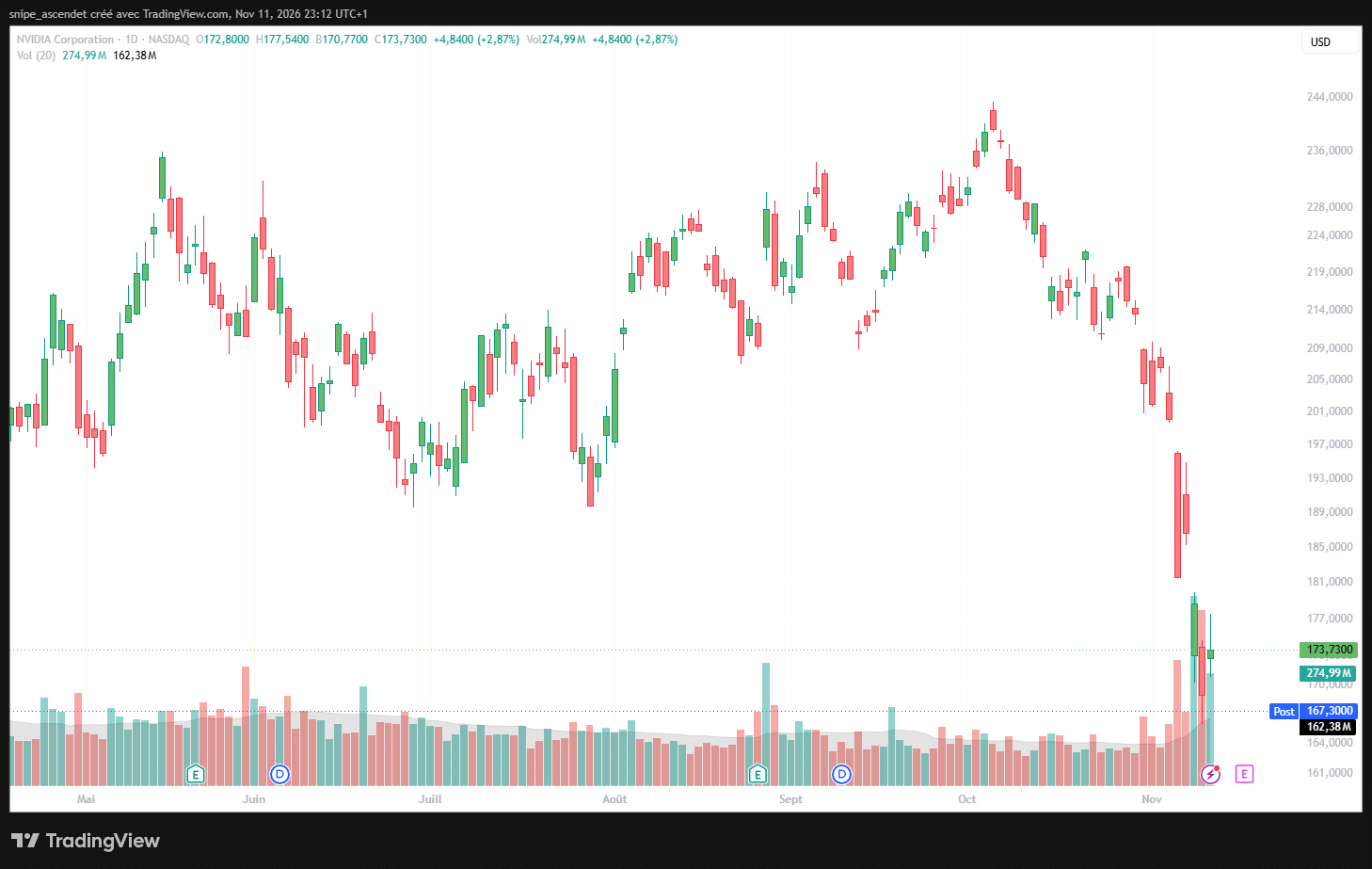
The daily Nvidia chart shows why shareholders were already sensitive to governance news. The shares had suffered a substantial retreat from their October peak before recovering during Wednesday’s regular session. TradingView showed approximately 287.66 million shares traded on November 11 in the regular-session daily panel versus a 20-day reference near 163.01 million. The volume increase demonstrates substantial turnover, but neither high volume nor a single green daily candle establishes a lasting reversal. Likewise, sharp extended-hours moves can be amplified by thinner liquidity and wider spreads.
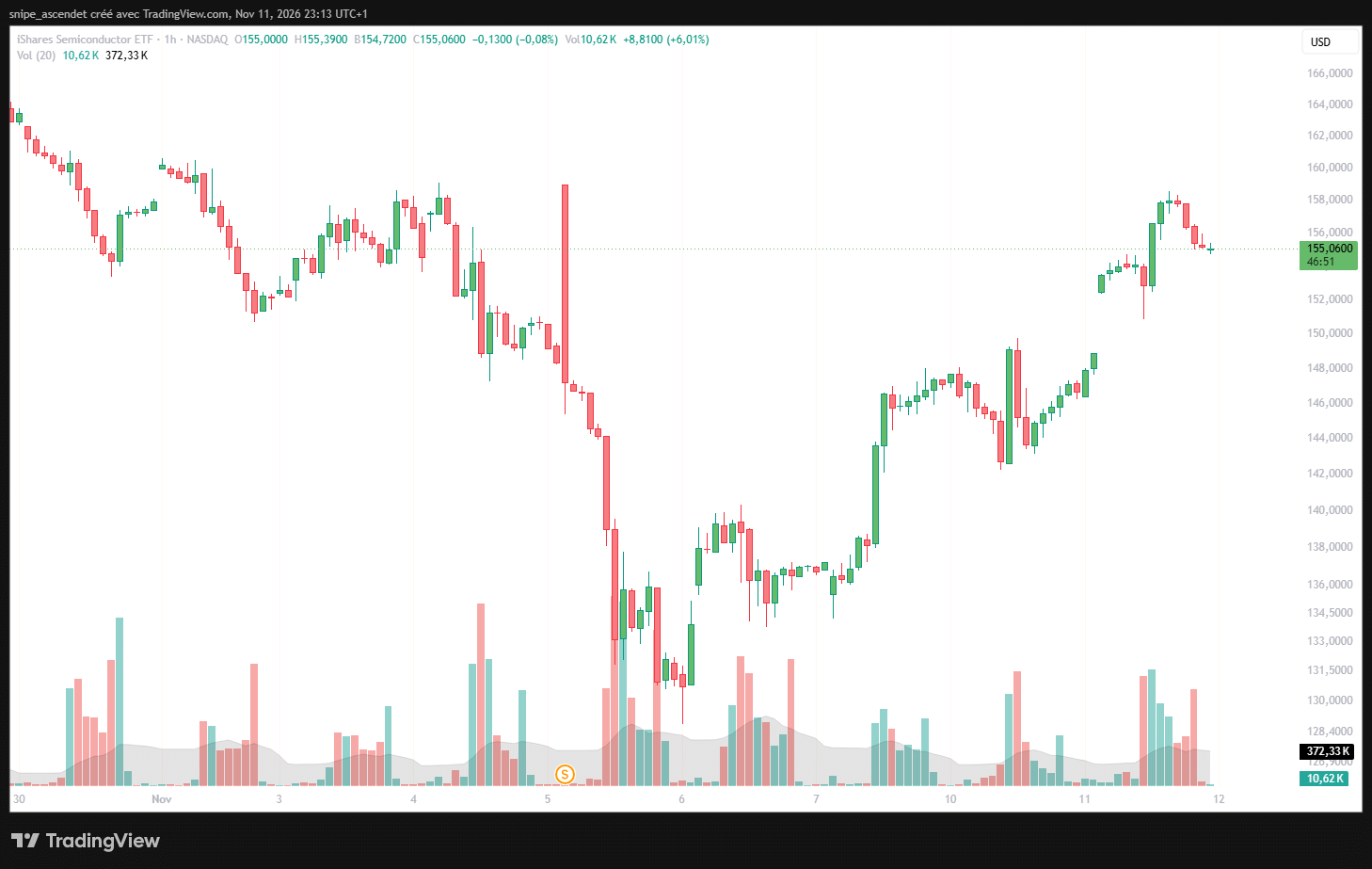
For context, the SOXX hourly chart showed the semiconductor ETF around $155.06 late in the session, after a strong regular trading day. That comparison is useful because leadership-specific news can cause NVDA to diverge from chip-sector performance even when the sector’s demand outlook is unchanged. But it cannot prove that a single headline caused a particular price change.
Why Removing Jensen Huang Would Be a Major Corporate Event
Huang co-founded Nvidia in 1993 and has directed its transformation from a graphics-chip supplier into a leading provider of AI computing systems. He is closely identified with the company’s technology roadmap, software ecosystem, customer relationships and public strategy. A leadership change could therefore create key-person risk: uncertainty about whether the company can preserve the same execution and commercial relationships without the founder who shaped them.
That risk should not be confused with an automatic decline in demand for Nvidia products. Orders from data-center customers, software adoption, manufacturing partnerships and competition from alternative accelerators do not immediately disappear with a CEO change. The practical question is whether a transition would disrupt decisions, delay product execution, weaken customer confidence or produce tighter operational controls that affect sales and costs.
Independent directors also have duties to oversee risk and succession. A well-executed transition could stabilize governance and reassure customers and regulators, while a rushed departure without a credible replacement could intensify uncertainty. Both outcomes remain possible until the board communicates its decision and management plan.
Is There an Obvious Successor?
Nvidia has not announced a replacement in the statements reviewed for this article. Associated Press and other reporting have highlighted the difficulty of replacing a founder who has led the company for more than three decades and whose responsibilities span technology, strategy and major commercial relationships.
Possible approaches include appointing an interim executive from the existing leadership team, recruiting an external CEO with experience managing global technology and regulatory exposure, or separating some responsibilities while a search proceeds. These are illustrative governance alternatives, not reported board decisions. Naming an individual as the chosen successor before an announcement would be premature.
A successor’s first tasks would likely include reaffirming Nvidia’s product roadmap, communicating with major customers and suppliers, explaining management continuity to employees, and clarifying how the board will oversee export-control and national-security risks. Each of those areas can affect investor confidence even when quarterly revenue remains resilient.
Wall Street Analysts Were Already Reassessing Leadership Risk
Earlier on November 11, Reuters reported that Baird downgraded Nvidia to neutral and reduced its price target to $200, citing a combination of leadership uncertainty, the outlook for 2027 data-center demand and limits to near-term visibility. Morgan Stanley also removed Nvidia from its top-pick list. Those actions preceded the newly reported board deliberations; they should not be portrayed as reactions to a decision that had not yet been announced.
These analyst decisions illustrate why governance can become part of valuation. Markets discount expected future earnings and cash flows, but they also reflect uncertainty about who will deliver those results and which legal or regulatory risks the business may face. A higher risk premium can compress valuation multiples even without an immediate change in reported earnings. For more context on Nvidia-specific compliance and regulatory exposure, see our analysis of Nvidia China chip allegations and the NVDA selloff.
What Matters for Nvidia’s Earnings and AI Business
Nvidia has scheduled its fiscal third-quarter 2027 earnings conference call for November 17, 2026, covering the quarter ended October 25. The company said it would release results before the 5 p.m. ET call. Those financial disclosures are an independent checkpoint for the investment case and should not be replaced by speculation about the board.
Investors should evaluate revenue growth, gross margin, operating expenses, cash generation and management’s next-quarter outlook. Large AI infrastructure customers are making multi-year capital-spending decisions; the rate of spending and Nvidia’s competitive position may matter more to long-term cash flows than a volatile after-hours quote. For a related demand signal from the AI infrastructure industry, read our CoreWeave Q3 earnings analysis covering growth, debt and cash flow.
Macro conditions matter as well. Nvidia is a high-profile growth stock, and changes in interest-rate expectations can influence valuation multiples independently of governance developments. For a previous market reaction to the leadership inquiry, see our November 9 coverage of Nvidia and the broader Wall Street rally.
Four Scenarios Investors Should Separate
| Scenario | What would establish it | Main financial issue |
|---|---|---|
| Huang stays CEO | Official board or company statement confirming continuity | Restoration of confidence and oversight credibility |
| Huang takes leave or transfers duties | Formal interim-leadership disclosure | Execution during a temporary transition |
| Huang is removed and an interim CEO is appointed | Board action and named interim management | Succession, customer retention and operational continuity |
| Permanent successor is announced | Company appointment disclosure | Strategy, incentive alignment and long-term capital allocation |
These are conditional scenarios rather than probability estimates. The WSJ report supports the conclusion that a possible removal was under consideration, but it does not establish which of these outcomes will occur.
What to Monitor After the 8% Nvidia Selloff
The highest-value updates will come from Nvidia’s investor-relations releases, regulatory filings and any official account of the board meeting. Investors should also watch whether the $161.18 observed after-hours quote changes, the next regular-session opening price, and relative performance versus SOXX and the wider Nasdaq. The $156.19 after-hours low is an observed historical print in the supplied chart, not an analyst-defined support level. In the absence of a verified company decision, precise claims about a departure date, replacement candidate or confirmed stock-price reaction would be premature.
Bottom Line
The after-hours plunge of more than 8% and the November 11 WSJ report mark a significant escalation in Nvidia’s leadership crisis: the board is reportedly preparing to oust Jensen Huang, but removal has not been officially confirmed in the statements reviewed. Nvidia’s earlier independent inquiry, its previous statement of confidence in Huang and Wall Street’s growing succession concerns are documented facts. The updated hourly chart documents a sharp after-hours plunge, including a low more than 8% beneath the regular close, but the precise causal contribution of the WSJ headline cannot be isolated from the chart alone.
For investors, the central issue is no longer only the controversy itself. It is whether Nvidia can preserve its AI computing position, customer confidence and long-term cash generation under whichever leadership structure ultimately emerges.
Prepared November 11, 2026. Financial education only; not individualized investment advice. Market prices and reporting may change rapidly.