


Nvidia (NASDAQ: NVDA) faces renewed scrutiny after S&P Global Ratings placed its AA credit rating on CreditWatch Negative on November 25, 2026. Nvidia shares closed at $149.38, down 3.86%, as concerns about corporate governance persisted despite Jensen Huang’s reinstatement as chief executive.
The rating action introduces a new dimension to Nvidia’s leadership crisis. Investors must now assess the company’s financial strength alongside its governance, regulatory exposure and dependence on its co-founder.
Why Is Nvidia’s Credit Rating Under Review?
S&P cited management and governance risks, including questions surrounding board independence, executive oversight and dependence on key personnel. Nvidia’s board reinstated Huang on November 22 and publicly announced the decision on November 23. While his return reduced immediate leadership uncertainty, the rating agency remains concerned about the effectiveness of corporate oversight.
A potential one-notch downgrade could move Nvidia from AA to AA-. Both ratings remain investment grade and indicate a strong capacity to meet financial obligations. CreditWatch Negative is not a downgrade, but it signals a meaningful possibility of a reduction as S&P evaluates the company’s response.
Nvidia Stock Gives Back Part of Its November 23 Rally
Nvidia’s November 25 trading session continued the reversal that followed its historic rebound on November 23. The stock closed at $149.38, after reaching an intraday low of $141.17. Daily volume reached 317.19 million shares. At 4:08 p.m. ET on November 25, its after-hours price stood at $148.83.
| Trading date | Nvidia share price |
|---|---|
| November 20, 2026 close | $125.53 |
| November 23, 2026 close | $165.05 |
| November 24, 2026 reference close | $155.38 |
| November 25, 2026 close | $149.38 |
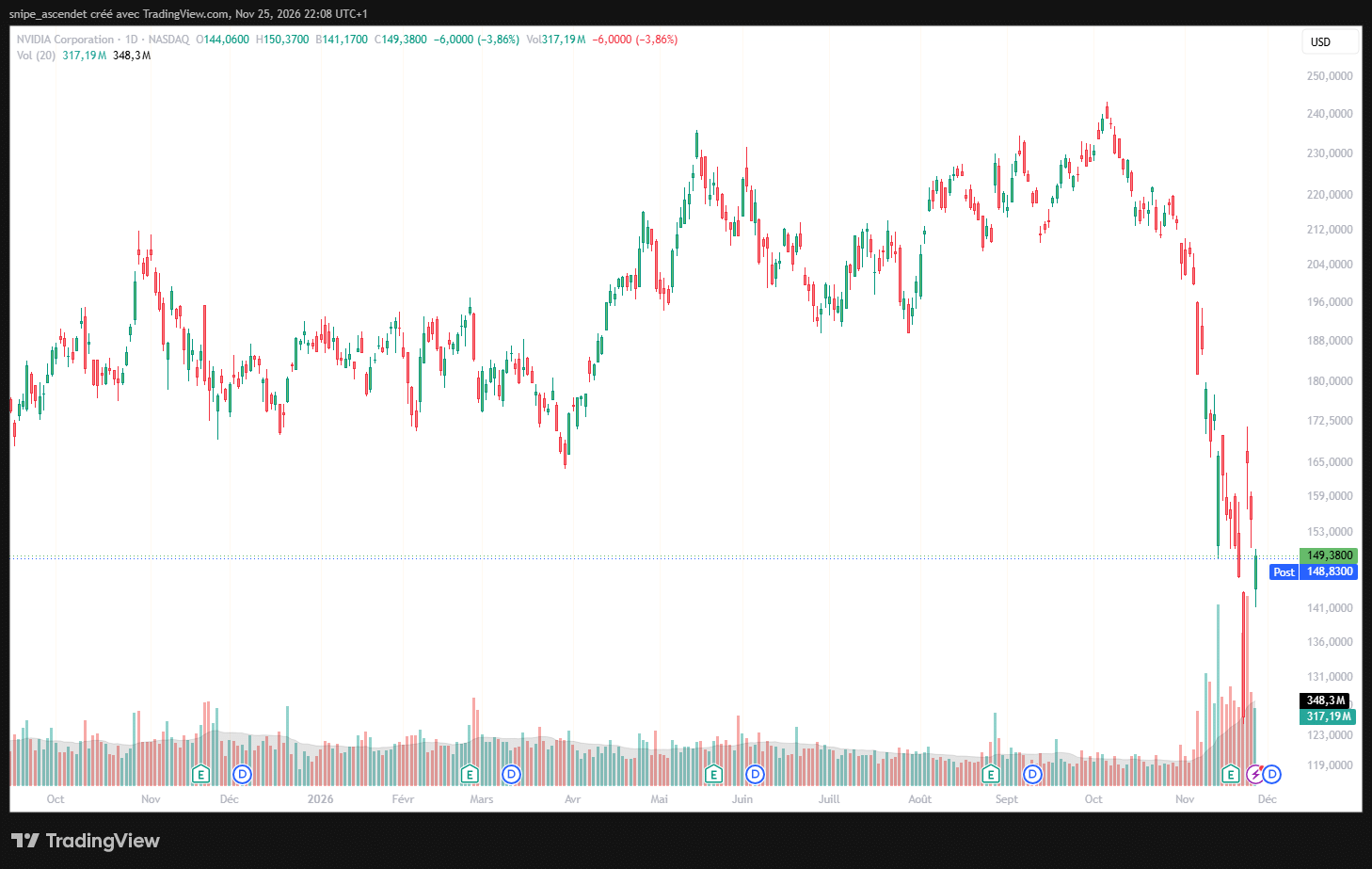
The November 25 closing price was 9.49% below Nvidia’s November 23 closing level of $165.05. The company remained approximately 19% above its November 20 close of $125.53. However, Nvidia had surrendered approximately 40% of the dollar-per-share gain generated during its November 23 Wall Street rebound.
The reversal follows the broader semiconductor selloff on November 24 and highlights the difficulty of sustaining a recovery based primarily on leadership developments.
Nvidia’s Financial Position Remains Strong
The credit review comes despite exceptional revenue growth and substantial cash generation. Nvidia’s third-quarter fiscal 2027 results, covering the period ended October 25, 2026, illustrate the difference between its operating performance and governance risks.
| Financial indicator | Latest figure |
|---|---|
| Quarterly revenue | $115.84 billion |
| Revenue growth YoY | 103% |
| Quarterly free cash flow | $43.78 billion |
| Cash and cash equivalents | $29.09 billion |
| Marketable debt securities | $24.42 billion |
| Long-term debt | $32.37 billion |
| Cash and marketable debt securities less reported debt | $21.14 billion |
Nvidia generated free cash flow equivalent to approximately 37.8% of quarterly revenue. Its cash and marketable debt securities exceeded reported financial debt, although this comparison excludes other liabilities and contractual commitments. These figures provide a substantial financial buffer. They also explain why the immediate concern is corporate oversight rather than an apparent inability to repay creditors.
A downgrade could increase borrowing costs when Nvidia issues new debt. It would not automatically increase the interest rate on all existing fixed-rate bonds. For example, a hypothetical 50-basis-point increase in borrowing costs on $10 billion of newly issued debt would represent $50 million in additional annual interest expense.
That amount would be relatively modest compared with Nvidia’s cash generation. The more significant risk for equity investors may be a reduction in the valuation premium they are willing to assign to the company. Governance uncertainty can increase required investment returns even when near-term earnings remain strong.
Nvidia’s Exposure to the AI Financing Cycle
Nvidia also depends on customers continuing to finance substantial purchases of AI accelerators, networking systems and data center equipment. Higher financing costs for cloud infrastructure providers could eventually affect the timing and size of future hardware orders. This is particularly relevant as Nvidia expands its Vera Rubin platform alongside existing Blackwell deployments.
The company’s exposure is therefore twofold: its own governance review and the financial sustainability of its customers’ infrastructure spending.
What Investors Should Watch Next
Shareholders should monitor S&P’s review, Nvidia’s board oversight measures, regulatory developments and evidence that management can maintain operational continuity. The next quarterly results will also provide an opportunity to evaluate cash generation, strategic commitments and customer demand for Vera Rubin.
Bottom line: Nvidia’s AA credit rating remains intact, and its balance sheet provides significant financial protection. However, Huang’s return has not resolved all governance concerns, leaving shareholders exposed to a potential increase in the company’s risk premium.
For informational purposes only; not investment advice.