

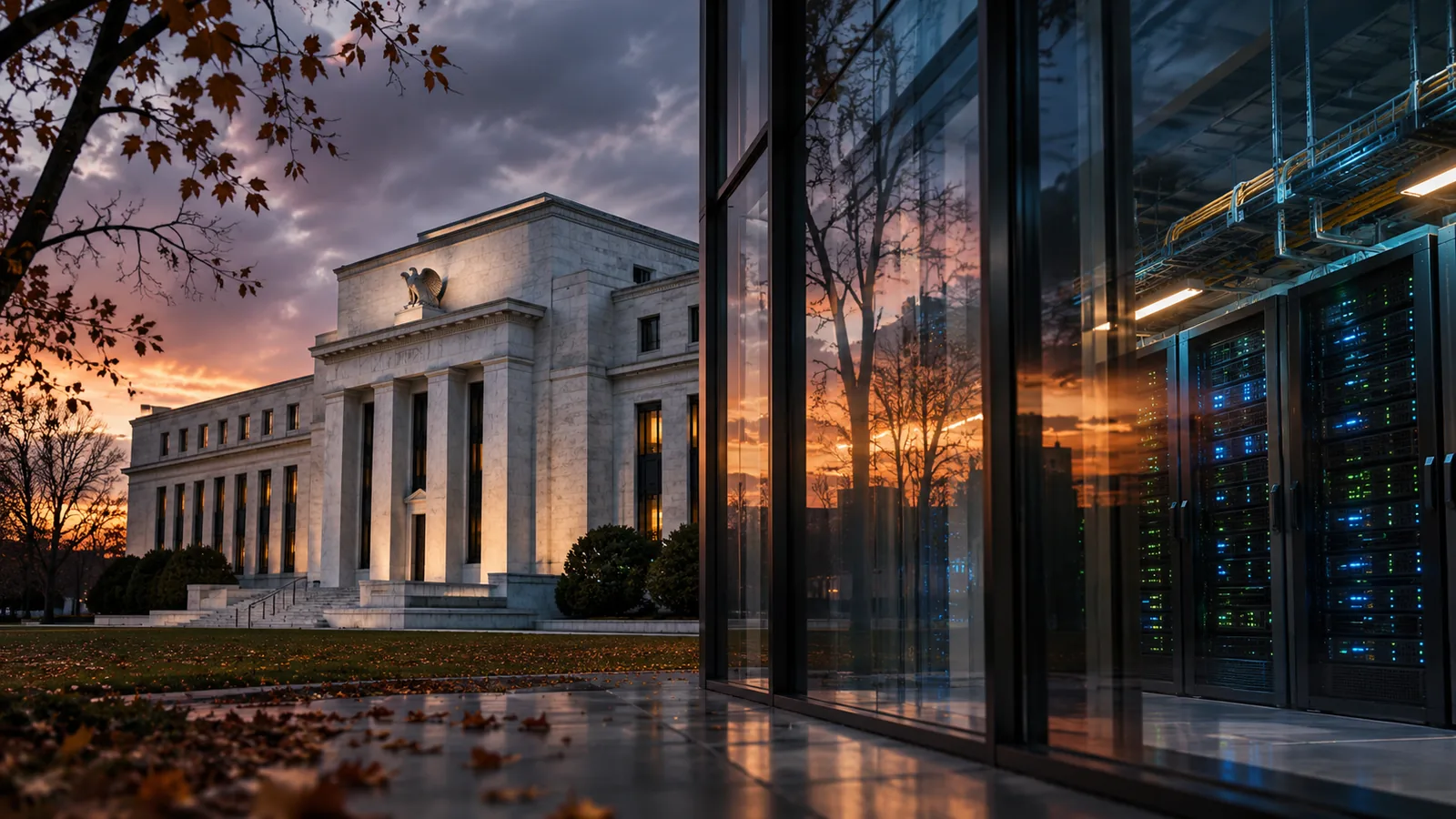
The Federal Reserve’s November 13, 2026, Financial Stability Report puts artificial intelligence at the center of a growing debate about U.S. market risk. AI was cited by 87% of the 23 market contacts surveyed, up from 50% in the spring, while advanced-computing debt issuance exceeded $680 billion through October. For shareholders, the question is whether AI revenue and cash flow can support the scale of borrowing, leases, and guarantees behind the buildout. Source: Federal Reserve Financial Stability Report.
Why 87% of Market Contacts Now Cite AI as a Risk
AI topped the New York Fed’s latest survey of risks over the next 12 to 18 months. The survey gathered opinions from 23 professionals at banks, broker-dealers, investment funds, and advisory firms in September and October. The spring sample included 20 contacts.
- Artificial intelligence: 87% in fall 2026, versus 50% in spring, a rise of 37 percentage points.
- Risk-asset correction: 52%, versus 35%.
- Higher long-term interest rates: 48%, versus 20%.
- Cyberattacks: 43%, versus 20%.
- Fiscal debt sustainability: 43%, versus 30%.
The survey reflects respondents’ views, not a Fed Board vote or a forecast of an AI crash. Separately, the report examines how valuations, leverage, and financing links could amplify a correction. The survey appears in Box 5.1.
AI Debt Issuance Has Passed $680 Billion in 2026
The Fed estimates that more than $680 billion of advanced-computing-related debt was issued by October 2026, compared with $130 billion during all of 2023. Using the stated thresholds, that is more than 5.2 times the 2023 total. This debt accounted for about 31% of nonfinancial investment-grade corporate debt issuance in 2026, up from less than 6% in 2023. See Box 2.2, Leverage in the Data Center Buildout.
New debt issuance is not the same as debt outstanding. Issuance measures financing raised over a period; outstanding debt measures balances still owed. The Fed separately estimates more than $1.1 trillion of outstanding publicly tracked advanced-computing debt as of October. Adding $680 billion to $1.1 trillion would double-count some financing.
Financing spans corporate bonds, project loans, and structured credit. Developers often use long-term technology-company contracts to secure loans.
The Bigger Exposure May Be the $3 Trillion in Other Obligations
For a group including Amazon, Alphabet, Broadcom, Meta Platforms, Microsoft, Nvidia, and Oracle, the Fed reports more than $1 trillion in undiscounted leases that have not yet begun, plus more than $2 trillion in contract commitments and guarantees. These include take-or-pay agreements and residual-value guarantees. The report’s Figure C details the categories.
These are not $3 trillion of immediately payable debt. Some guarantees trigger only after defaults, and undiscounted contracts are not directly comparable with on-balance-sheet debt.
A developer may borrow against a cloud provider’s future lease. If demand disappoints, the developer bears occupancy risk while the cloud provider may still owe payments.
Similar dynamics affect GPU deals. Nvidia (NASDAQ: NVDA) has disclosed substantial commitments and guarantees; our analysis of Nvidia’s $530.5 billion commitment package separates scheduled spending from maximum gross exposure. These exposures can overlap the Fed’s sector totals.
Why the Fed Is Comparing AI With the 1990s Telecom Boom
The Fed compared investment by five hyperscalers, Amazon, Alphabet, Meta, Microsoft, and Oracle, with telecom infrastructure investment beginning in 1995. Measured relative to GDP, their cumulative capital expenditure has followed a similar path, and the recent acceleration suggests AI spending could soon move ahead of the historical comparison. Unlike the telecom operators, hyperscalers have generally supported more investment with substantial operating cash flows, although borrowing has recently increased.
This comparison is not a forecast of another dot-com bust. In a November 16 speech, Fed Governor Michael Barr said even a technology that eventually lifts productivity could disappoint investors if financial returns arrive later than expected. A successful technology may still disappoint shareholders.
The valuation question extends beyond chipmakers. Recent weakness in AI optical-networking stocks shows why rapid sales growth may not justify high valuations.
Hedge Fund Leverage Adds Another Potential Shock Amplifier
The report also finds hedge fund leverage at its highest level since comprehensive data collection began in 2013. A correction may force leveraged investors to sell assets across markets. The Fed still describes U.S. banks as sound and well-capitalized.
Higher Treasury yields raise funding costs and discount future earnings. Our recent U.S. inflation and stock-market recap covers the equity-market backdrop. The Fed report generally cuts off on October 28 and excludes subsequent market moves.
Watch whether AI revenue covers depreciation, power, and interest costs; whether free cash flow remains positive after capital spending; and whether leases and guarantees outpace operating cash generation.
For chipmakers and smaller cloud operators, monitor customer concentration, collateral values, and counterparties. Strong revenue guidance paired with worsening cash conversion is a valuation warning. Respondents also identified AI-enabled cyberattacks on critical financial infrastructure.
Bottom line: The Fed is identifying a financing vulnerability, not announcing that an AI crash is imminent. The immediate shareholder risk is a mismatch between what companies have committed to spend and the cash their AI investments can generate, especially if higher rates and market leverage make refinancing more expensive.
Data as of 1:00 p.m. ET, November 16, 2026. For informational purposes only; not investment advice.