

Dell Technologies (NYSE: DELL) reported record Q3 fiscal 2027 earnings on November 24, 2026, with revenue rising 103% year over year to $54.9 billion and adjusted earnings per share increasing 265% to $9.45. The company raised its annual revenue forecast to $202 billion as its artificial intelligence order backlog reached $132.3 billion.
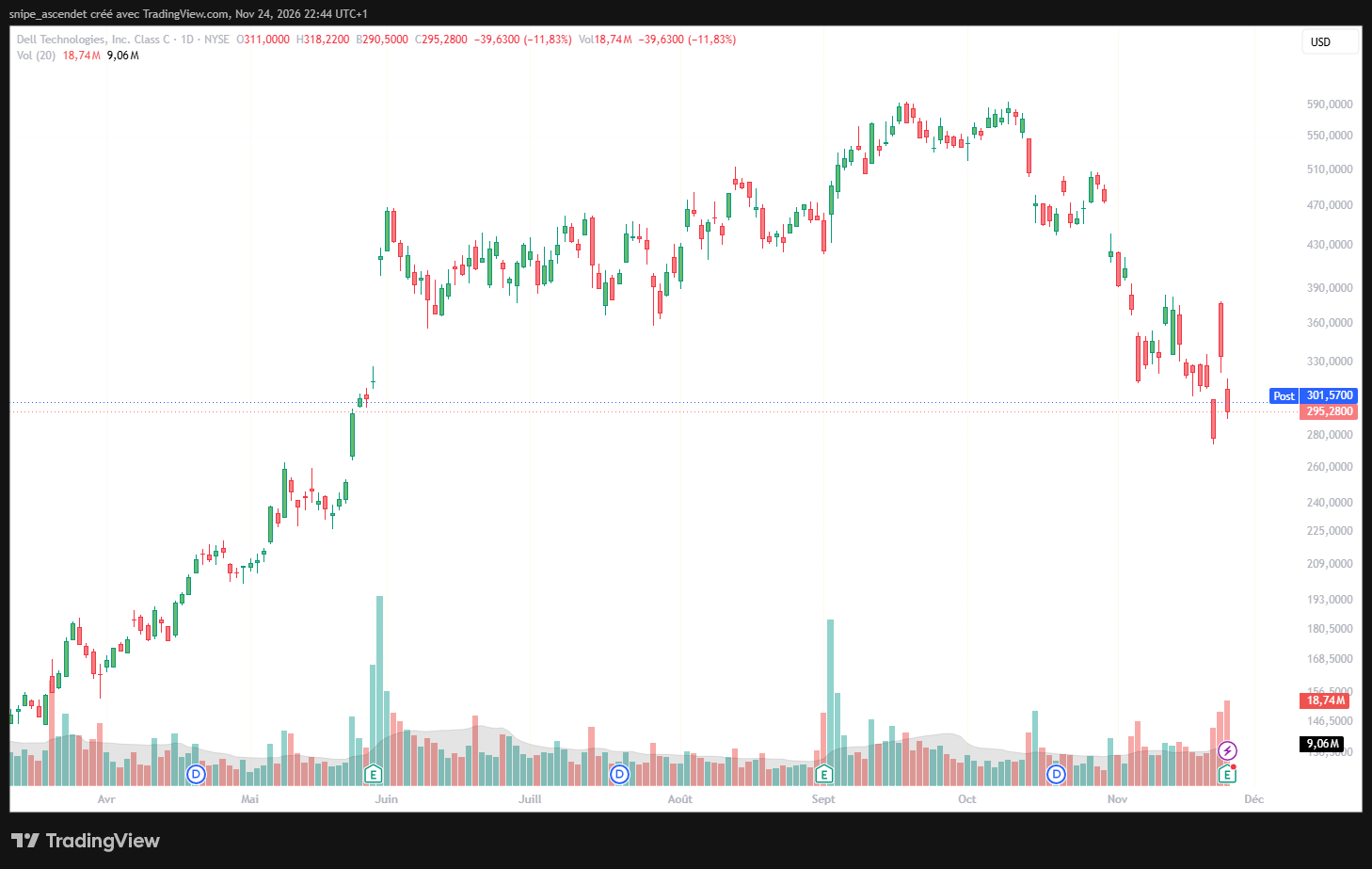
Dell stock closed down 11.83% at $295.28 on November 24 before the earnings announcement. Shares subsequently recovered 2.16% to $301.66 at 4:44 p.m. ET, according to TradingView, as investors assessed the company’s stronger earnings, improving margins and increased capital returns.
Dell Q3 2027 Earnings: Revenue and Profit Exceed Expectations
Dell significantly exceeded Wall Street expectations for the fiscal quarter ended October 30, 2026. Revenue came in 11.4% above consensus, while adjusted earnings exceeded expectations by 43.4%, based on LSEG estimates reported by Reuters.
| Financial metric | Q3 FY2027 | Q3 FY2026 | YoY change |
|---|---|---|---|
| Revenue | $54.94B | $27.01B | +103% |
| GAAP EPS | $8.82 | $2.28 | +287% |
| Adjusted EPS | $9.45 | $2.59 | +265% |
| GAAP operating income | $7.44B | $2.12B | +251% |
| GAAP operating margin | 13.5% | 7.8% | +5.7 pts |
| Operating cash flow | $4.46B | $1.17B | +280% |
| Free cash flow | $3.47B | $506M | +587% |
| Adjusted free cash flow | $4.29B | $1.67B | +157% |
Source: Dell Technologies, fiscal Q3 2027 financial results.
The most important development is that profitability is growing considerably faster than revenue. Dell is benefiting from operating leverage as infrastructure sales increase without a proportional rise in operating expenses.
Non-GAAP operating expenses declined from 11.8% to 7.0% of revenue, while adjusted gross margin remained relatively stable at 21.2%. Dell is therefore retaining a larger proportion of its incremental revenue as operating profit.
Dell’s $132.3 Billion AI Backlog Signals Continued Infrastructure Demand
Dell recorded $60.2 billion in new AI orders during the third quarter and ended the period with a $132.3 billion backlog.
That represents a 39.3% increase from the $95 billion backlog reported at the end of the preceding quarter. New AI orders were approximately 2.7 times quarterly AI server revenue.
Dell also reported more than 7,500 customers deploying its AI Factory solutions, which combine computing, networking, storage and software.
Management said it evaluates customers’ access to financing, land and electricity when accepting AI orders. These requirements matter because data center development increasingly depends on infrastructure availability rather than demand for computing capacity alone.
The backlog provides substantial revenue visibility, but converting those orders into recognized sales and cash remains essential. Delayed construction, financing difficulties or power shortages could disrupt delivery schedules.
This issue is particularly relevant given the financing and debt challenges facing AI cloud providers such as CoreWeave.
AI Servers Are Transforming Dell’s Business Model
Dell’s Infrastructure Solutions Group (ISG) has become the dominant contributor to company revenue and profitability.
| Business segment | Q3 FY2027 revenue | YoY growth |
|---|---|---|
| AI-optimized servers | $22.0B | +291% |
| Traditional servers and networking | $15.0B | +235% |
| Storage | $4.9B | +24% |
| Total ISG | $42.0B | +198% |
| Client Solutions Group | $12.9B | +3% |
Infrastructure accounted for approximately 76.4% of consolidated quarterly revenue and 91% of reportable segment operating income.
ISG operating profit increased 308% to $7.12 billion, with its operating margin expanding from 12.4% to 17.0%. Meanwhile, the traditional PC-oriented Client Solutions Group recorded a 6% decline in operating profit.
Dell’s earnings increasingly depend on enterprise computing, AI deployment and data center spending rather than consumer PC replacement cycles.
The company’s performance also reinforces the importance of networking and optical connectivity across the AI supply chain, following Applied Optoelectronics’ $2.2 billion hyperscaler supply agreement.
Dell Raises Fiscal 2027 Revenue Guidance to $202 Billion
Dell increased its full-year revenue and earnings forecasts for the fiscal year ending January 29, 2027.
| FY2027 guidance | Previous | Updated | Increase |
|---|---|---|---|
| Revenue | $192B | $202B | +5.2% |
| AI server revenue | $74B | $78B | +5.4% |
| GAAP EPS | $24.37 | $28.24 | +15.9% |
| Adjusted EPS | $25.50 | $29.68 | +16.4% |
Source: Dell Technologies, November 24, 2026.
The updated outlook implies annual revenue growth of 78% and adjusted EPS growth of 188%.
Dell expects AI-optimized servers to generate approximately 38.6% of total fiscal 2027 revenue.
For the fourth quarter, management forecasts:
- Revenue of $56.3 billion, up 69% year over year.
- GAAP EPS of $7.90, up 134%.
- Adjusted EPS of $8.40, up 116%.
Although fourth-quarter revenue is expected to increase sequentially, adjusted EPS guidance implies an 11.1% decline from the third quarter. Investors should therefore examine whether product mix, component costs or other factors could limit near-term margin expansion.
Free Cash Flow, Debt and the Additional $25 Billion Buyback
Dell’s earnings growth is increasingly translating into cash generation.
Quarterly free cash flow reached $3.47 billion, equivalent to approximately 6.3% of revenue. Operating cash flow exceeded capital expenditures and capitalized software costs by a substantial margin.
The board also approved an additional $25 billion in share repurchase authorization, following $4.9 billion returned to shareholders during the quarter.
However, quarterly shareholder distributions exceeded free cash flow by approximately $1.4 billion. The growing balance sheet deserves attention alongside the buyback announcement.
| Balance sheet metric | Jan. 30, 2026 | Oct. 30, 2026 |
|---|---|---|
| Cash and equivalents | $11.53B | $13.55B |
| Total debt | $31.50B | $37.70B |
| Accounts receivable | $17.59B | $28.95B |
| Inventory | $10.44B | $29.44B |
| Accounts payable | $33.63B | $57.80B |
Source: Dell Technologies consolidated financial statements.
Inventory increased approximately 182% from the beginning of the fiscal year. The expansion reflects the scale of Dell’s operations but also increases its exposure to working capital requirements, component pricing and customer payment schedules.
The additional repurchase authorization gives management flexibility, rather than committing Dell to an immediate $25 billion expenditure.
Dell Stock Rebounds After Hours Following an 11.83% Selloff
Dell shares experienced significant volatility on November 24, 2026, following the previous session’s broad technology market recovery.
| DELL trading data | Price |
|---|---|
| November 23 close | $334.91 |
| November 24 open | $311.00 |
| November 24 regular-session high | $318.22 |
| November 24 regular-session low | $290.50 |
| November 24 close | $295.28 |
| November 24, 4:44 p.m. ET | $301.66 |
Source: TradingView.
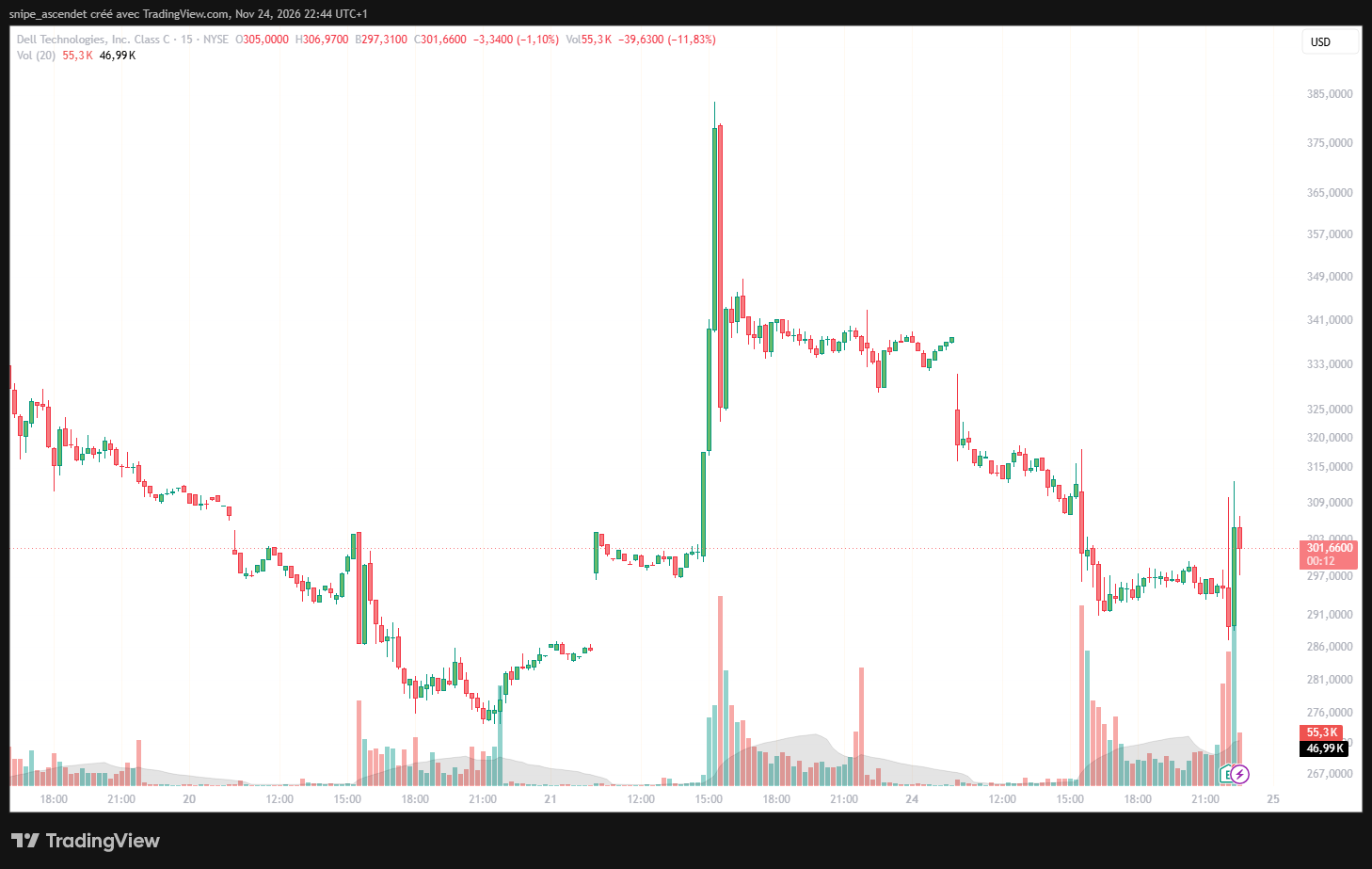
Approximately 18.74 million shares traded during the November 24 session, around 2.1 times the 20-day average of 9.06 million shares.
The after-hours recovery followed a volatile period for technology equities, including the historic Nasdaq rebound following Jensen Huang’s return to Nvidia.
Dell’s earnings demonstrate that strong AI infrastructure demand can coexist with substantial stock market volatility. Investors are reassessing not only growth expectations but also the sustainability of AI capital expenditures and corporate valuations.
Is Dell Stock Undervalued After Its Recent Decline?
Based on the November 24 closing price of $295.28 and Dell’s updated fiscal 2027 earnings guidance, the stock trades at approximately:
| Valuation metric | Multiple |
|---|---|
| FY2027 adjusted P/E | 9.95x |
| FY2027 GAAP P/E | 10.46x |
The relatively low earnings multiple is notable given Dell’s projected profit growth. However, investors must consider whether current earnings reflect sustainable profitability or an unusually strong infrastructure investment cycle.
Competitive pressure from other server manufacturers, dependence on semiconductor suppliers, customer financing risks and potential reductions in AI spending could affect future earnings.
The next scheduled investor event is Dell’s appearance at the Barclays Global Technology Conference on December 9, 2026, according to its investor relations calendar. Fiscal 2027 ends on January 29, 2027.
Bottom line: Dell’s fiscal third-quarter results show that AI infrastructure demand is generating substantial revenue, operating profit and free cash flow. With a $132.3 billion AI backlog and an increased $29.68 annual adjusted EPS forecast, the investment question is increasingly whether Dell can sustain these margins and convert its growing order book into cash.
For informational purposes only; not investment advice.