


Zeta Global (NYSE: ZETA) reported $492.7 million in third-quarter 2026 revenue, up 46% year over year, and raised its full-year revenue outlook to $1.855 billion. Adjusted earnings of $0.38 per share exceeded the $0.28 Zacks consensus estimate, while quarterly free cash flow climbed 73% to $81.5 million. The company also achieved $38.3 million in GAAP net income, marking another step toward sustainable profitability. See Zeta’s November 9 earnings release and the pre-earnings consensus.
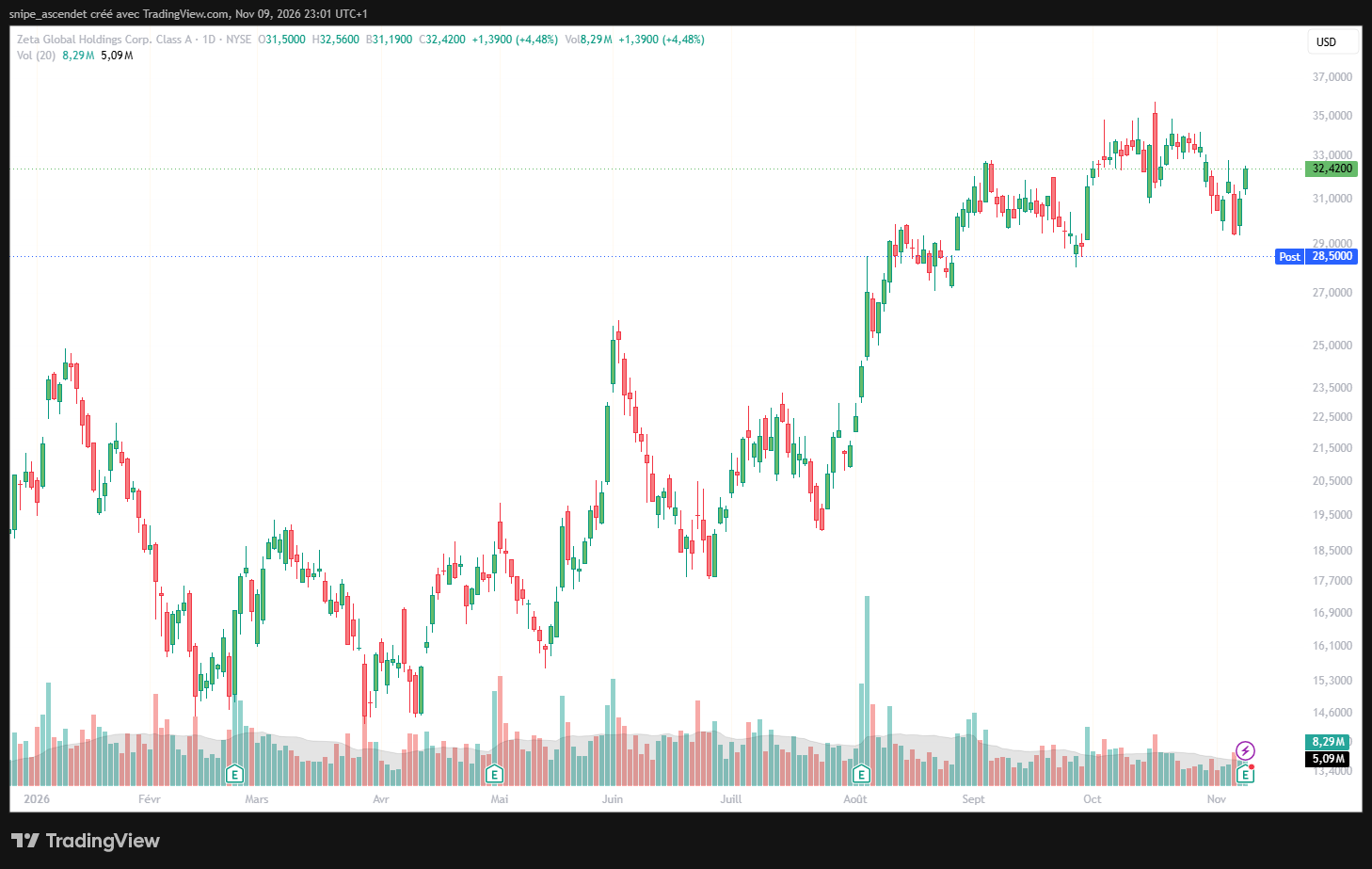
Yet the initial stock-market reaction was negative. ZETA finished the November 9 regular session at $32.42, up 4.48%, before falling toward $28.50 in after-hours trading, approximately 12% below the official close. These are distinct trading sessions, and the after-hours quotation is a snapshot rather than a confirmed closing price.
The divergence raises a central question for investors: if Zeta is accelerating its AI-driven growth, improving margins and generating more cash, how much of that progress is already reflected in its valuation?
ZETA Q3 2026 Earnings: Reported vs. Expected
| Metric | Reported | Expected | Difference |
|---|---|---|---|
| Revenue | $492.66 million | $470.48 million | +$22.18 million (+4.7%) |
| Non-GAAP diluted EPS | $0.38 | $0.28 | +$0.10 (+35.7%) |
| GAAP net income | $38.27 million | Not verified | N/A |
| Adjusted EBITDA | $121.04 million | No verified consensus | N/A |
| Free cash flow | $81.52 million | No verified consensus | N/A |
Results cover the quarter ended September 30, 2026. The expected figures come from Zacks estimates published November 5; the actuals are drawn from Zeta’s SEC-filed earnings exhibit. Non-GAAP EPS is not the same as the company’s $0.14 diluted GAAP EPS.
Revenue Growth Is Strong, but the 30% Underlying Measure Matters
Headline revenue increased from $337.2 million a year earlier to $492.7 million. That 46% expansion is substantial, but it includes revenue from the acquired Marigold enterprise business and some political-candidate activity. Zeta separately disclosed 30% year-over-year growth excluding Marigold and political-candidate revenue, accelerating from a comparable 28% figure in the previous quarter.
The distinction matters for valuation. A business expanding 30% without those contributions can still justify a premium to slower-growing software companies, but the trajectory is different from assuming 46% can recur indefinitely without acquisitions. The adjusted growth measure is company-defined and should not be presented as an independently audited organic-growth rate.
Zeta reported 212 “super-scaled” customers, up 18% from the year-earlier period, with average revenue per customer in that group reaching $2.0 million, up 22%. Larger account spending and new customers both matter, but neither isolates AI-product revenue.
Athena and AthenaOS: AI Adoption Is Real, Monetization Is Less Transparent
Management attributed accelerating demand to increased adoption and usage of Athena. Zeta combines its customer-data infrastructure with prediction and marketing-execution tools, aiming to help enterprise clients decide whom to reach, when to engage and which campaigns to prioritize. The company’s October 8 AthenaOS announcement outlined a broader enterprise-intelligence product that could extend its reach beyond conventional marketing workflows.
AthenaOS was in limited internal beta when announced, with a public beta expected later in 2026 and general availability targeted for the first quarter of 2027. These are planned milestones, not proof of material subscription revenue. Zeta also outlined work on specialized inference models and early-stage chip initiatives with partners. Its capital-light approach remains a strategy, not a measured return.
Investors should look for disaggregated Athena-related revenue, paid adoption cohorts, retention, usage and gross-margin contribution. Without a standalone AI revenue line, the current results establish stronger overall economics and management’s assertion of AI demand, not a verified AI-only growth rate.
Margins, GAAP Earnings and Free Cash Flow Improve
Adjusted EBITDA rose to $121.0 million from $78.1 million a year earlier, lifting the margin to 24.6% from 23.2%. Management highlighted a “Rule of 71,” calculated by adding the 46% reported revenue growth rate to the 24.6% adjusted EBITDA margin, with rounding. It is a company-selected performance measure, not a generally accepted accounting standard and not equivalent to the conventional Rule of 40 measured with a consistent profitability definition.
More consequential was the move to $38.3 million of GAAP net income, against a $3.6 million loss in the prior-year quarter. Operating income reached $45.9 million, versus $8.8 million a year earlier. Zeta generated $91.3 million of cash from operations and reported $81.5 million in free cash flow after capital spending and capitalized development costs, with the company’s stated foreign-exchange adjustment. The free-cash-flow margin reached 16.5%, compared with 14.0% a year earlier.
These figures suggest that sales growth is translating into operating leverage. Shareholder costs remain. Stock-based compensation totaled $50.0 million in the quarter, around 10.1% of revenue, and $155.1 million for the first nine months. The charge is noncash in the reporting period, but equity awards can dilute existing owners. Zeta also spent $85.5 million repurchasing shares during the first nine months, making net share-count trends important alongside reported free cash flow.
For perspective, DualFinances’ comparison of Cloudflare and Akamai examines another segment of the AI software market where adjusted profitability, GAAP results and capital requirements give very different pictures of investment quality.
Balance Sheet and Raised 2026 Guidance
Zeta held $340.1 million of cash and cash equivalents as of September 30, against $243.9 million in long-term borrowings. It also reported acquisition-related liabilities of approximately $53.2 million across current and long-term categories. This does not erase acquisition or other obligations.
| 2026 guidance metric | Updated range | Midpoint |
|---|---|---|
| Full-year revenue | $1.853B–$1.857B | $1.855B |
| Full-year adjusted EBITDA | $414.1M–$415.2M | $414.65M |
| Full-year free cash flow | $270.6M–$271.6M | $271.1M |
| Full-year GAAP EPS | $0.22–$0.24 | $0.23 |
| Q4 revenue | $521M–$525M | $523M |
The full-year revenue midpoint increased by $37 million from $1.818 billion, and the company now forecasts approximately 42% reported revenue growth for 2026. Fourth-quarter revenue guidance implies 32% to 33% year-over-year reported growth, or 22% to 24% excluding acquisitions and political-candidate revenue. The implied deceleration deserves attention, though comparisons are affected by prior-year acquisition timing and mix. These figures are company forecasts, not completed results.
Why ZETA Dropped After a Beat-and-Raise Quarter
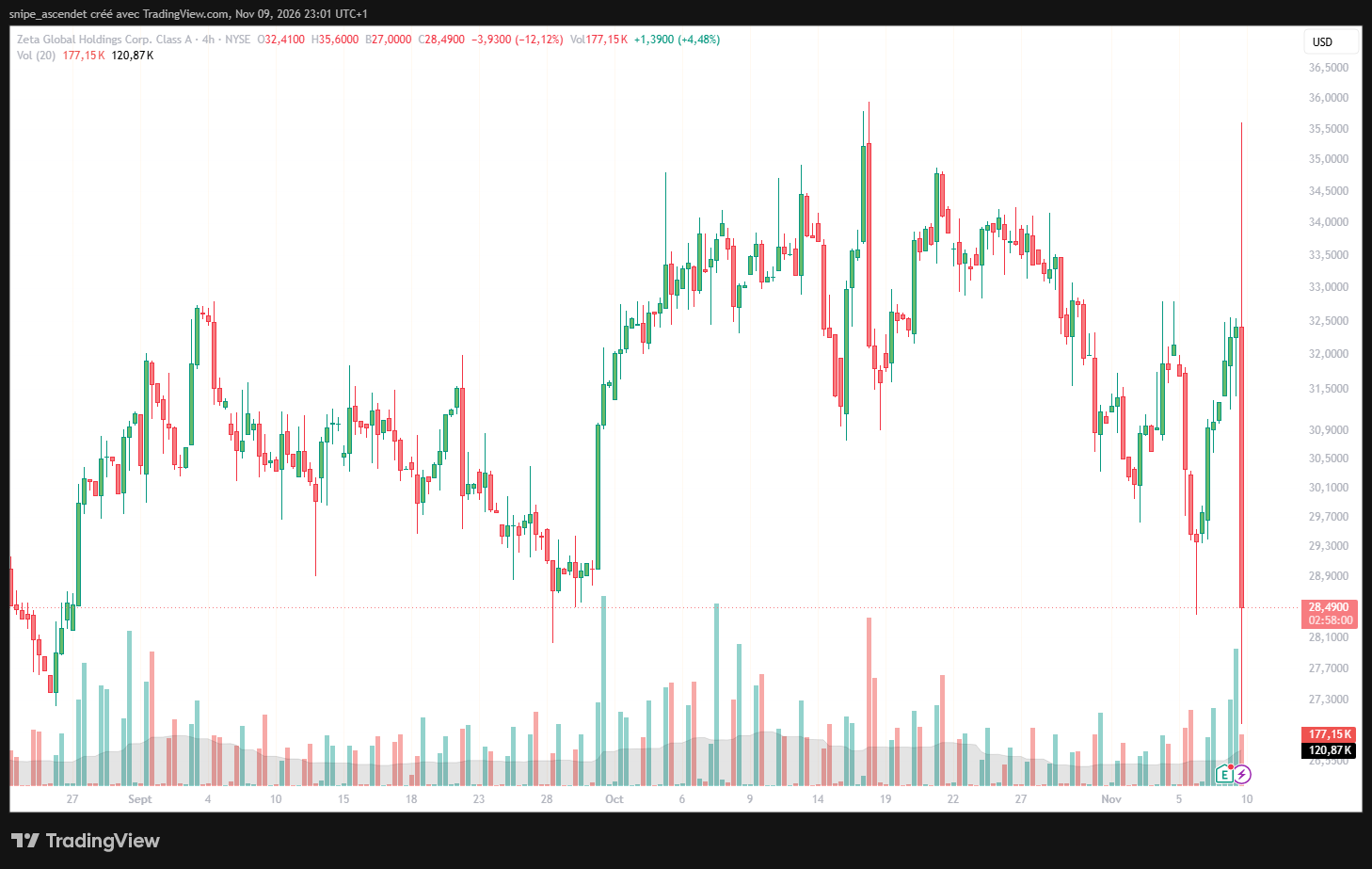
The regular-session gain and subsequent after-hours decline represent different pieces of information. In the supplied daily chart, ZETA closed November 9 at $32.42 on approximately 8.29 million shares, above its displayed 20-session average of 5.09 million. In the four-hour chart captured around 5:01 p.m. Eastern, the price was near $28.50. Relative to the regular close, that is a drop of roughly 12.1%.
One snapshot cannot establish why traders sold. Potential explanations include elevated expectations, investors taking profits after a sharp prior rally, positioning into earnings, concerns about the outlook’s composition or broader software risk appetite. None is confirmed as the cause of this particular move. After-hours prices can also reverse before the next regular session.
ZETA Valuation: What the Market Is Paying for Growth
There is no reliable, time-matched fully diluted market-capitalization figure in the earnings exhibit. An illustrative calculation can nevertheless frame the question. Zeta reported 251.0 million common shares outstanding on July 29, 2026 in its second-quarter Form 10-Q. Multiplying that dated share count by the November 9 regular close of $32.42 produces approximately $8.14 billion of equity value, equal to 4.4 times the updated 2026 revenue midpoint. At the provisional after-hours quote of $28.50, the same calculation yields about $7.15 billion, or 3.9 times sales.
Using the company’s $271.1 million full-year free-cash-flow forecast, those illustrative equity values represent approximately 30 and 26 times projected free cash flow, respectively. These are price-to-company-defined-FCF ratios, not trailing multiples or enterprise-value multiples. They depend on share count, dilution, repurchases and the actual trading price. Investors should refresh the denominator with the latest reported actual shares before treating the results as actionable valuation estimates.
The bull argument is that 30% adjusted growth, expanding GAAP profit and double-digit free-cash-flow margins support a growth-software valuation. The counterargument is that a multiple near four times annual revenue still assumes sustained execution and improving earnings quality. Stock compensation, acquisition integration and future AI competition could reduce the return accruing to each share even as reported revenue increases.
Comparing ZETA With Klaviyo, HubSpot and the Software Sector
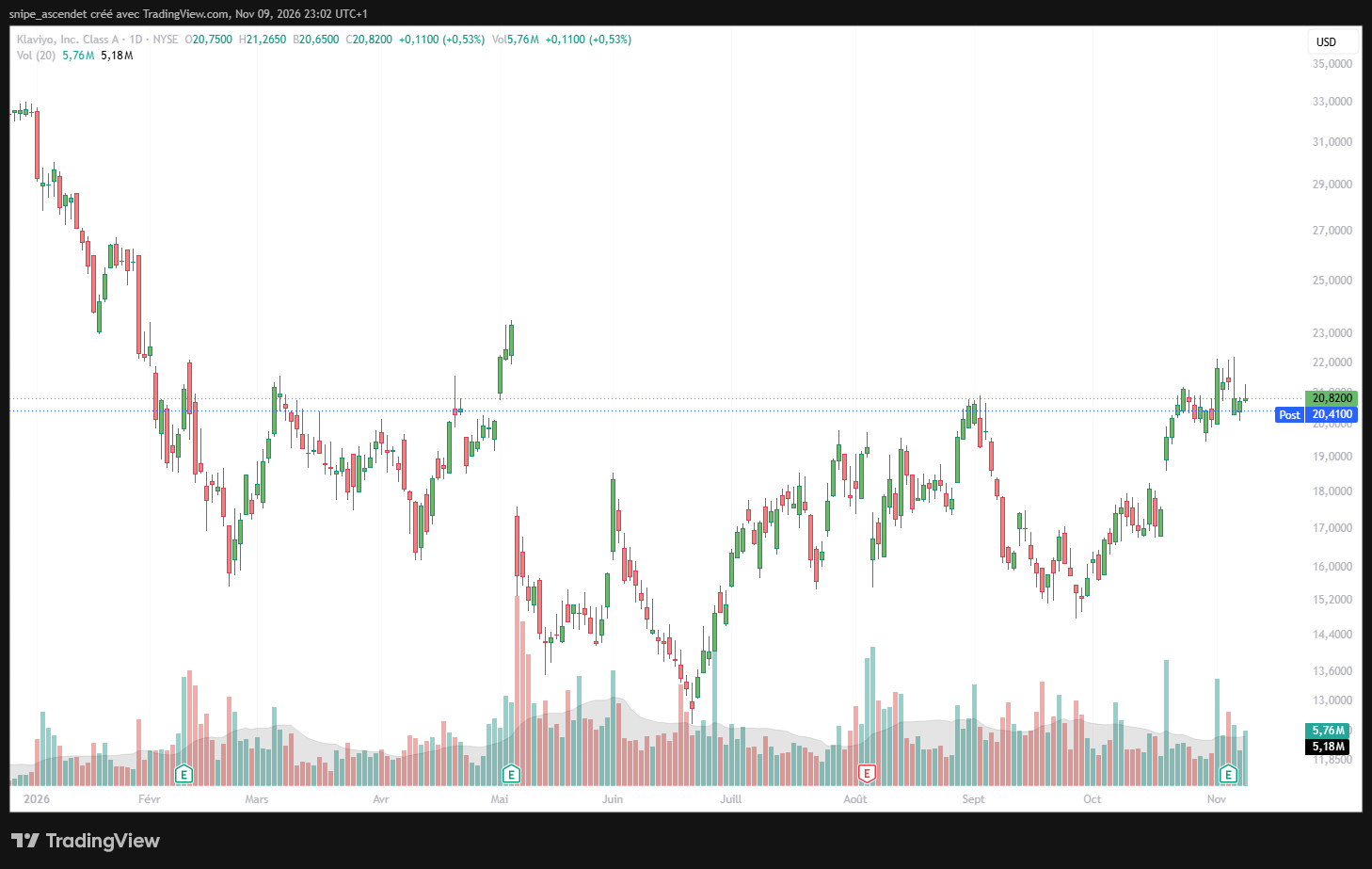
Klaviyo (NYSE: KVYO) offers a useful business-model comparison because it focuses on customer data, automated marketing and customer engagement. Its supplied November 9 daily chart shows a $20.82 close, up 0.53% for the session. Zeta and Klaviyo address overlapping budgets, but their revenue composition, customers and profitability profiles differ; share prices alone say nothing about which business is cheaper.
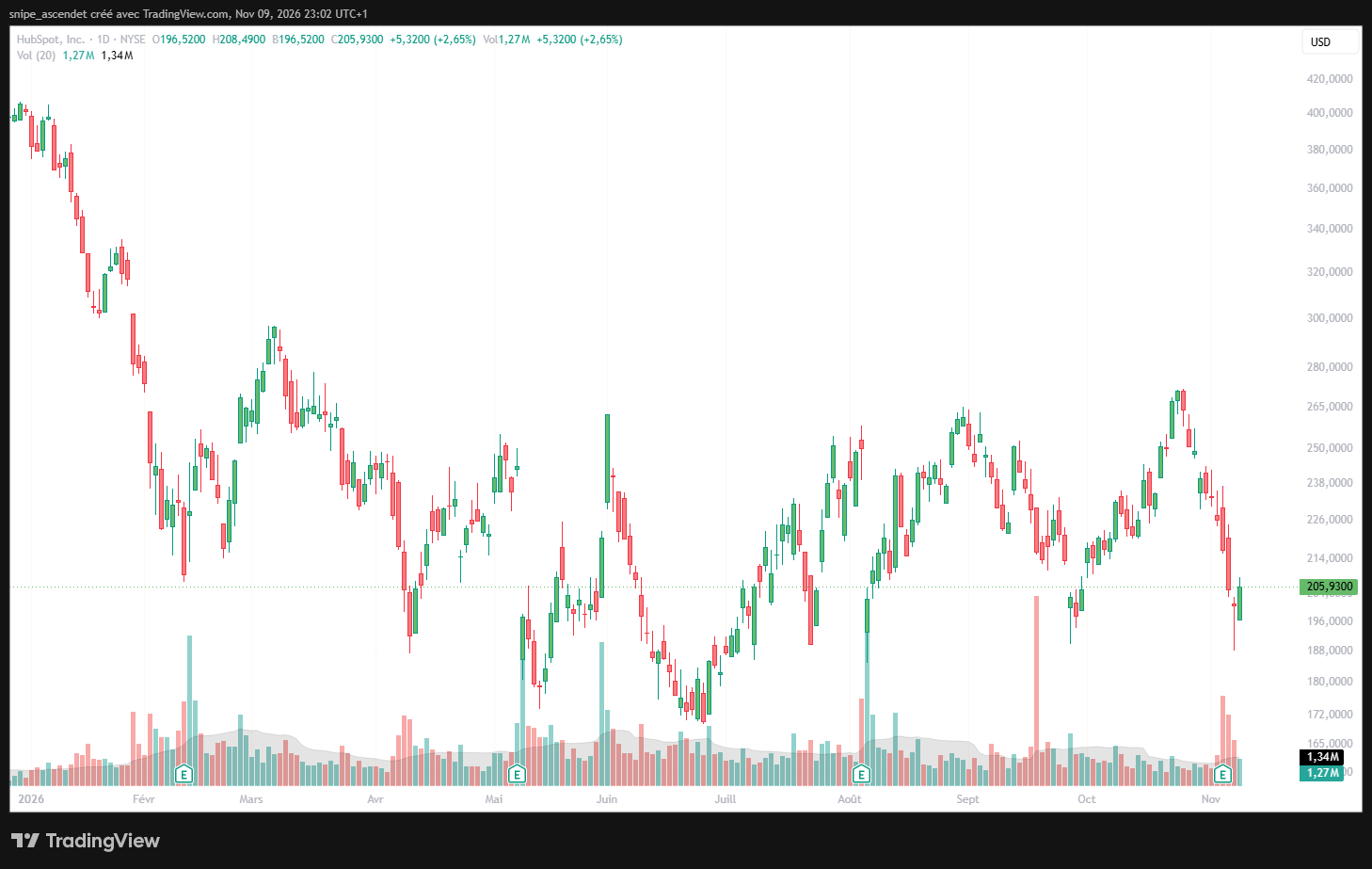
HubSpot (NYSE: HUBS), a broader CRM and marketing-software platform, closed at $205.93, up 2.65% that day. Its model is a reminder that AI features can help retention and product expansion while also increasing product-development costs and competitive pressure. A proper cross-company valuation comparison requires matched dates, share counts, cash, debt, growth and GAAP or consistently defined cash-flow measures, not a comparison of nominal share prices.
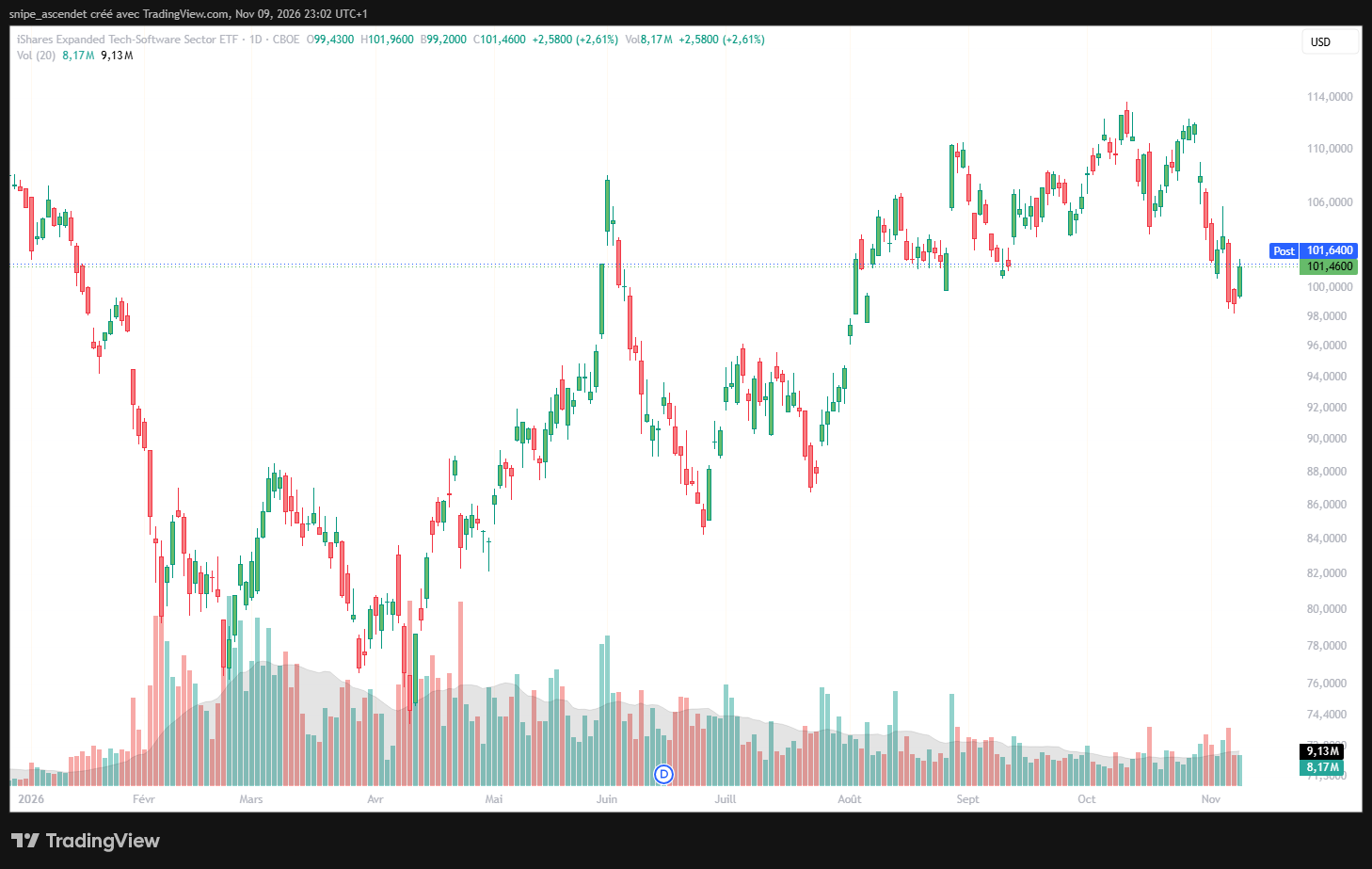
The iShares Expanded Tech-Software Sector ETF (IGV) closed at $101.46, gaining 2.61% in the same regular session. The juxtaposition shows that ZETA’s +4.48% regular-session advance was stronger than the ETF’s move on November 9, while the later ZETA selloff was an issuer-specific after-hours development. The charts do not support exact multimonth return comparisons.
The competitive setting is also changing. Salesforce announced an agreement to acquire Braze in October 2026 for approximately $5.66 billion in enterprise value, subject to completion. Such consolidation could sharpen demand for integrated data and engagement platforms, but it may also strengthen rivals. Zeta’s AI positioning is not a guarantee of share gains.
Three Scenarios for ZETA Stock in 2027
Bull case: AI adoption compounds with cash flow
Zeta sustains strong growth excluding acquisitions, moves AthenaOS into broader commercial availability, expands large-customer spending and produces more free cash flow per share. Margin expansion combined with restrained dilution would provide the strongest evidence that the current valuation is warranted.
Base case: Healthy growth, but lower multiples
Revenue continues to grow at a solid pace, although the mix normalizes after acquisitions and election-related contributions. Profitability improves more gradually than investors expect, while the software sector assigns lower valuation multiples to long-duration growth. The business could execute reasonably well without a corresponding rise in its stock price.
AI monetization proves slower than expected, integration costs persist, customer spending weakens or stock compensation outpaces free-cash-flow improvement per share. Competitors bundle AI features more aggressively, reducing pricing power. A weaker growth trajectory alongside multiple compression could produce substantial downside.
The essential checkpoints are Q4 revenue near the new $521 million to $525 million range, adjusted growth excluding acquisitions, AthenaOS commercialization, super-scaled customer growth, GAAP operating income, stock-based compensation and the conversion of reported earnings into cash. Unlike the heavily financed data-center businesses discussed in DualFinances’ AI infrastructure debt analysis, Zeta currently has a comparatively asset-light model; that distinction makes net cash generation and shareholder dilution especially informative.
Bottom line: Zeta’s third-quarter numbers support the case that it is becoming a faster-growing and more profitable software business. They do not prove that the AI products alone account for the acceleration or that every valuation premium is justified. The after-hours decline highlights the difference between reporting better financial results and exceeding what investors had already priced in.
Disclosure: This article is informational, not personalized investment advice. Quotes from TradingView reflect screenshots captured November 9, 2026; after-hours indications are not official regular-session closes.