

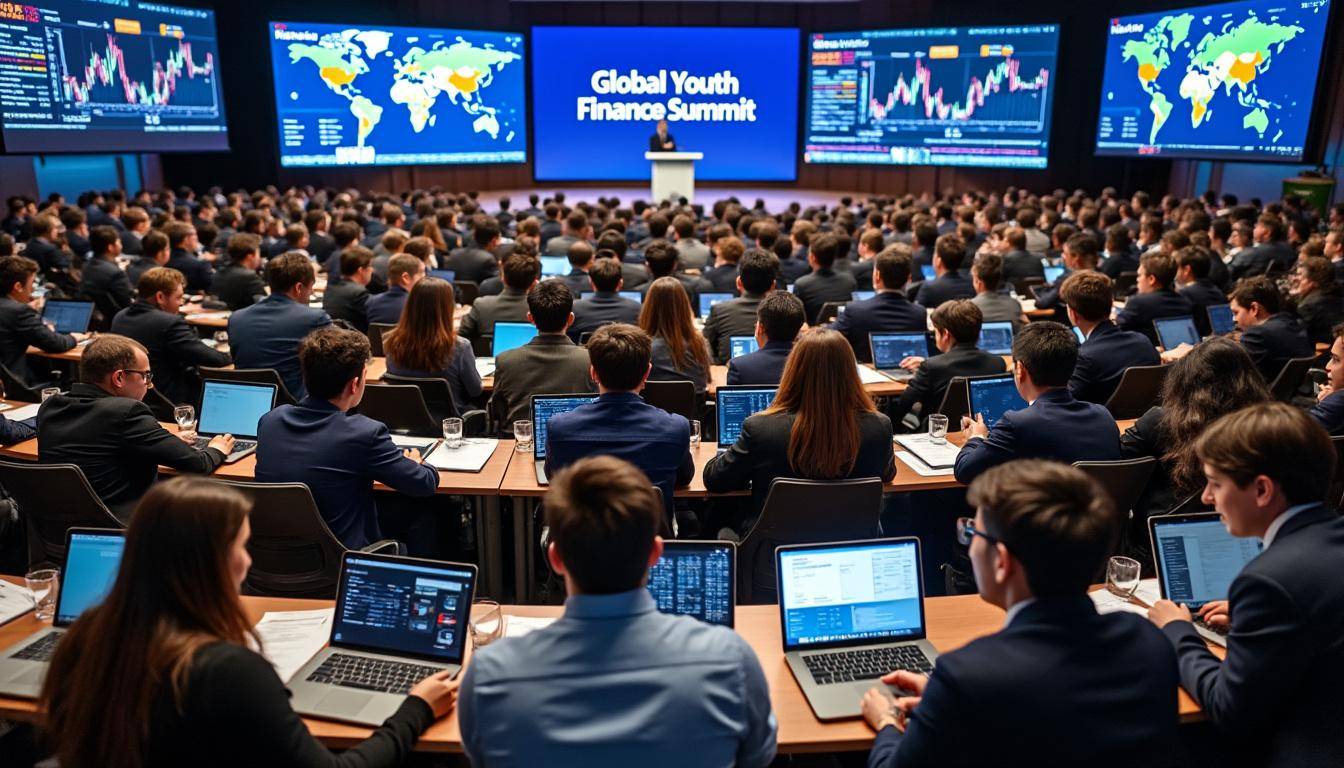
The 2025–2026 edition of the International Youth Leadership Finance Summit in Shanghai drew remarkable energy from a diverse cohort of students determined to interrogate the commercial path for artificial intelligence. Over the weekend, more than 100 students representing top universities worldwide converged to examine real corporate cases, debate investment priorities, and practice the cross-disciplinary teamwork modern finance demands. Organizers from the Master of Finance Program at the Shanghai Advanced Institute of Finance designed a schedule that balanced technical primers, business case clinics, and investor-style deliberations—creating an environment equal parts classroom, lab, and market simulation.
Participants left with improved frameworks for evaluating AI products, sharper practical skills in financial modelling and commercial due diligence, and a clearer sense of how to translate technical breakthroughs into scalable business models. Networking moments—both formal and informal—amplified the educational impact, turning theoretical conversations into concrete mentorship and potential collaboration. This article examines the Summit through multiple lenses: purpose and outcomes, curriculum and workshops, student experience and engagement, industry perspectives on AI commercialization, and the practical lessons attendees can carry into careers in finance and technology.
International Youth Leadership Finance Summit: Purpose And Strategic Goals
The Summit’s central ambition was to identify the next wave of AI leadership by combining rigorous financial analysis with product and engineering insight. Organizers framed the event around a clear thematic objective: hunt the next AI unicorn. That phrase signaled a pragmatic shift from academic curiosity to market-oriented evaluation.
From an educational standpoint, the Summit had three main goals. First, to teach students how to assess AI products beyond hype—reading technical claims for commercial viability. Second, to sharpen investment judgment by juxtaposing engineering trade-offs with business metrics. Third, to promote cross-border dialogue among future leaders in finance. These goals reflect broader trends in 2026 finance: employers increasingly value hybrid profiles that pair quantitative skills with domain expertise in AI and product strategy.
Why The Emphasis On Cross-Disciplinary Skillsets Matters
Experts at the Summit emphasized that AI has moved from proof-of-concept breakthroughs into engineering rigor and commercial validation. That transition changes hiring and investment criteria. Employers now prize candidates who combine systems thinking, product intuition, and capital-allocation discipline. For students like our guide, Maya Chen, this meant learning to read model performance metrics in light of production constraints and revenue models.
The Summit’s exercises—for example, mock diligence on AI startups—forced participants to reconcile three viewpoints: the engineer’s view on feasibility, the product manager’s view on user adoption, and the investor’s view on scalability and exit potential. Each perspective yields different priorities. The engineer may value model accuracy; the product manager, adoption velocity; the investor, unit economics and defensibility. The ability to translate between those perspectives is now a core competence in finance careers that touch technology.
Insight: Mastering the interplay of technical and financial lenses equips students to identify which AI ventures are likely to scale commercially.
Students, Workshops, And The Practical Curriculum At The Summit
Curriculum design at the Summit balanced theory, hands-on practice, and peer learning. Courses ranged from AI fundamentals for non-engineers to investor workshops that simulated term-sheet negotiations. The pedagogical intent was clear: provide participants with practical toolkits that they could immediately apply in internships or early career roles.
Sample Workshop Topics And Learning Objectives
A typical track included sessions on: AI fundamentals, product-market fit analysis for AI products, financial modelling for AI startups, and case clinics featuring actual company data. In a session modeled on real-world diligence, a student team led by Maya Chen evaluated a speech-recognition startup. Their task: determine whether the company’s model accuracy improvements justified a capital raise focused on sales expansion. The team considered market size, ARR projections, gross margins, and the cost of moving from research to production.
Such exercises taught a pragmatic method: start with unit economics, layer in adoption assumptions, and stress-test technical dependencies that could alter burn rates. Faculty and industry mentors provided immediate feedback, demonstrating how small shifts in assumptions translate into large valuation swings. That kind of hands-on learning is what distinguishes summit-based education from classroom theory.
List of core competencies developed during the Summit:
- Technical literacy: reading model metrics and deployment constraints.
- Commercial analysis: assessing TAM, go-to-market, and revenue models.
- Investment judgement: constructing cap tables and term-sheet priorities.
- Collaboration: cross-functional teamwork and stakeholder communication.
- Networking: building mentor and peer relationships for career growth.
Insight: A tactical, workshop-centered curriculum accelerates student readiness for roles at the intersection of AI and finance.
Engagement, Networking, And Student Outcomes
Participant engagement was multidimensional. During case sessions, student teams worked under time pressure to deliver concise investment memos. During networking hours, conversations pivoted to internships, joint research projects, and startup ideas. The Summit intentionally created structured networking opportunities—mentor tables, company booths, and moderated panels—to convert conversation into practical opportunity.
Measuring Impact: From Participation To Empowerment
Outcomes were tangible. Several participants received follow-up interviews for internship roles, and one multidisciplinary team formed a continuing collaboration to develop an AI product prototype aimed at healthcare diagnostics. These outcomes highlighted how the Summit serves as a launchpad: it accelerates pathways from education and engagement to actual career steps.
To capture event highlights numerically, the Summit published an outcomes table. The table below synthesizes participation metrics and common post-Summit outcomes that illustrate the Summit’s role in student development.
| Metric | Value | Typical Outcome |
|---|---|---|
| Participants | More than 100 | Peer networks and team formation |
| Universities Represented | Top global institutions | Cross-border collaboration |
| Company Cases | Over a dozen | Real-world due diligence practice |
| Follow-up Opportunities | Internship interviews, startup pilots | Career advancement |
Insight: Networking structured around substantive technical and commercial work yields stronger, more actionable professional ties than casual meet-and-greets.
Industry Perspectives: From Engineering Breakthroughs To Commercial Validation
Industry and academic experts at the Summit emphasized a major shift: AI progress now centers on engineering robustness and business validation rather than only algorithmic novelty. That shift alters the evaluation framework for investors and asset managers. Investors increasingly ask whether improvements in model metrics translate into sustainable competitive advantage and margin expansion.
How Investors Are Re-Framing AI Opportunity
Panelists described a multi-step approach to AI investing. First, verify the technical claims with reproducible metrics. Second, map product deployment risks—data acquisition, latency, and integration complexity. Third, build financial scenarios that reflect different commercialization paths. The Summit’s case studies helped students practice this approach, often revealing trade-offs that separate promising ventures from overhyped projects.
One industry anecdote shared during a luncheon resonated with students. A mid-stage AI firm once prioritized accuracy improvements that added marginal user value but required disproportionate engineering costs. Investors advised pivoting to integration ease—packaging the model into developer-friendly APIs—which produced faster enterprise adoption and healthier margins. That story illustrated how commercial judgment can outperform pure technical optimization.
Insight: Sustainable AI businesses arise when engineering improvements are aligned with scalable go-to-market strategies.
Practical Lessons For Students And The Path Ahead
Students left the Summit with actionable frameworks they can apply immediately. For example, a simple four-step diligence checklist proved popular: validate technical claims, estimate unit economics, assess market adoption levers, and model capital needs. That checklist helps early-career analysts generate investment memos that are both technically grounded and commercially relevant.
Applying Summit Lessons In Real Careers
Maya Chen returned to her university with a clear plan: refine her financial modelling skills, pursue internships that expose her to product teams, and continue collaborating with peers on a prototype project targeting healthcare. Her trajectory mirrors what many attendees planned—deploying Summit experiences into portfolio internships and cross-disciplinary research.
For educators and program directors, the Summit offers a blueprint: combine technical primers with case-based investor training and structured networking. For students, the message is straightforward: cultivate hybrid skill sets, seek mentorship actively, and translate learning into tangible projects.
Insight: The most compelling proof of the Summit’s value is not the sessions themselves but the career and collaborative opportunities that follow—true measures of empowerment and long-term impact.