

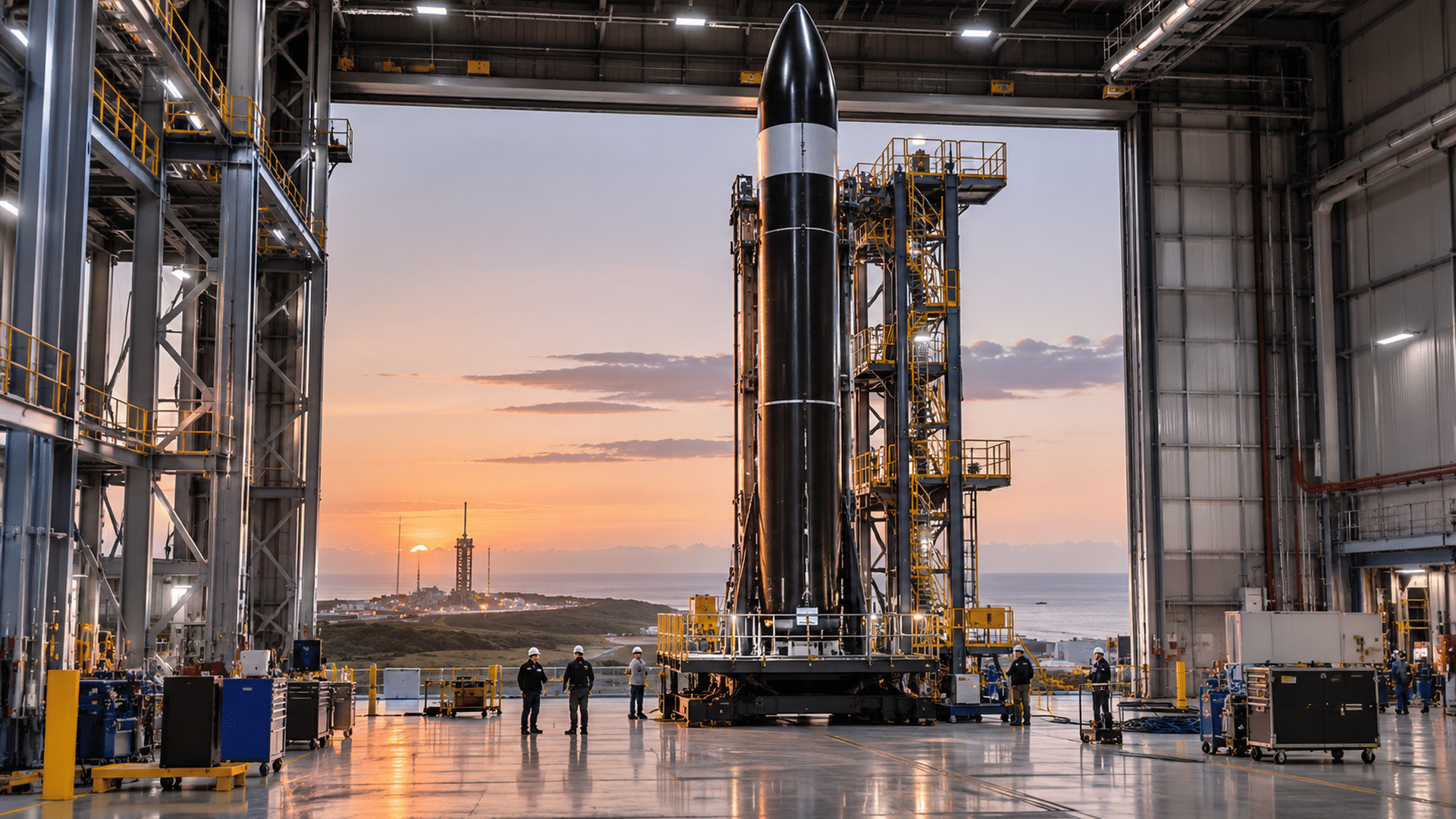
Rocket Lab reported $267.8 million in third-quarter 2026 revenue, up 72.7% year over year, and a record $3.57 billion order backlog, a 52% increase from the preceding quarter. The November 9 results offered investors a striking combination: accelerating demand for launches and satellites, positive quarterly operating cash flow, and a larger pipeline of contracted work. They also revealed the central investment challenge. Rocket Lab still lost $79.7 million under GAAP during the quarter, while its next-generation Neutron rocket is not expected to make its first flight before 2027.
The distinction is consequential. A $3.57 billion backlog is not $3.57 billion in cash or immediately recognizable revenue. It represents work that must be delivered, potentially over several years, at costs that can change before the corresponding revenue is recognized. For RKLB shareholders, the question after this earnings report is not whether customers are ordering more. It is whether execution can turn the orders into stronger margins and sustainable cash generation. The figures come from Rocket Lab’s November 9 earnings release.
RKLB Stock Rallied Before Earnings, Then Retreated After Hours
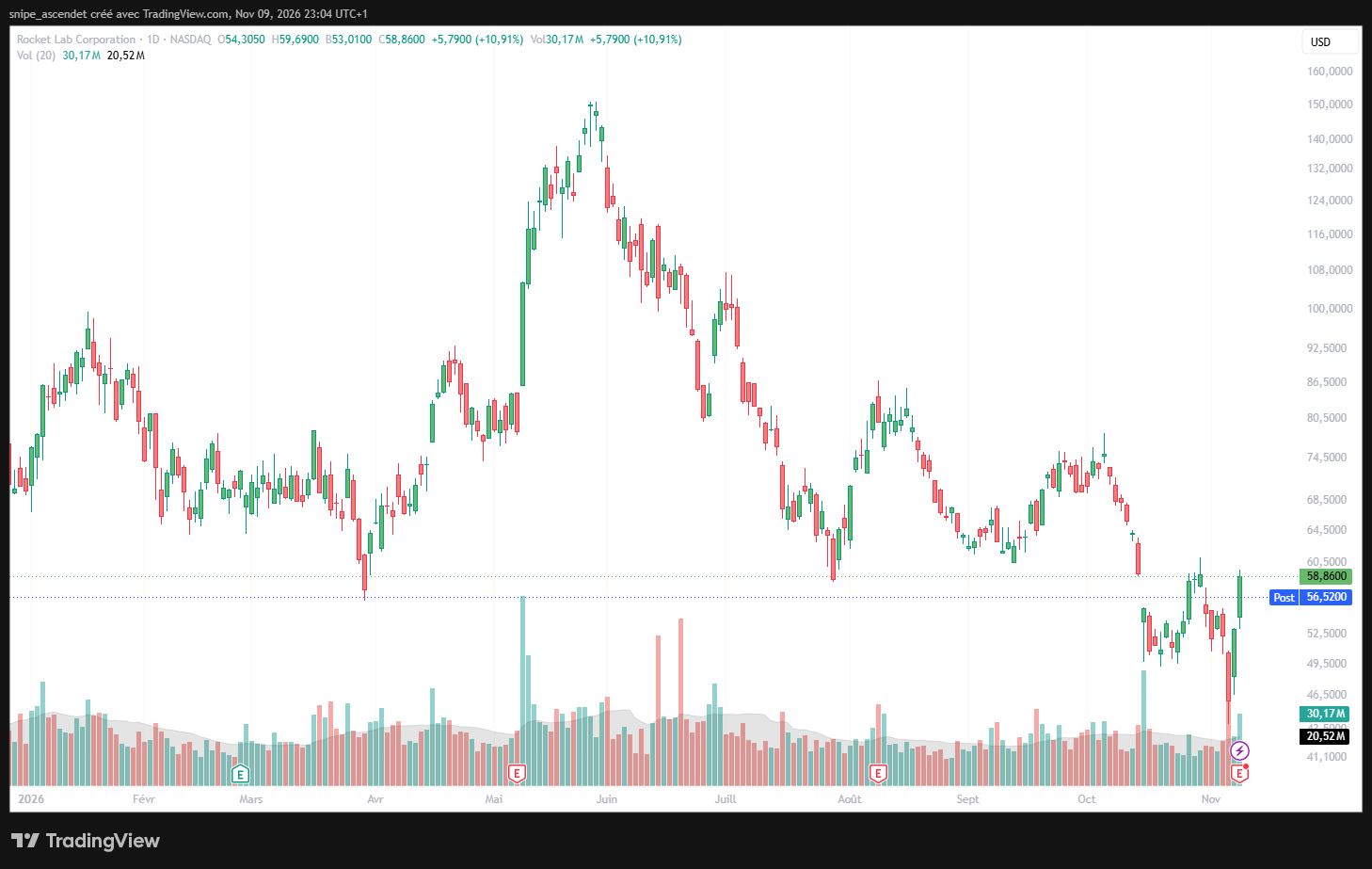
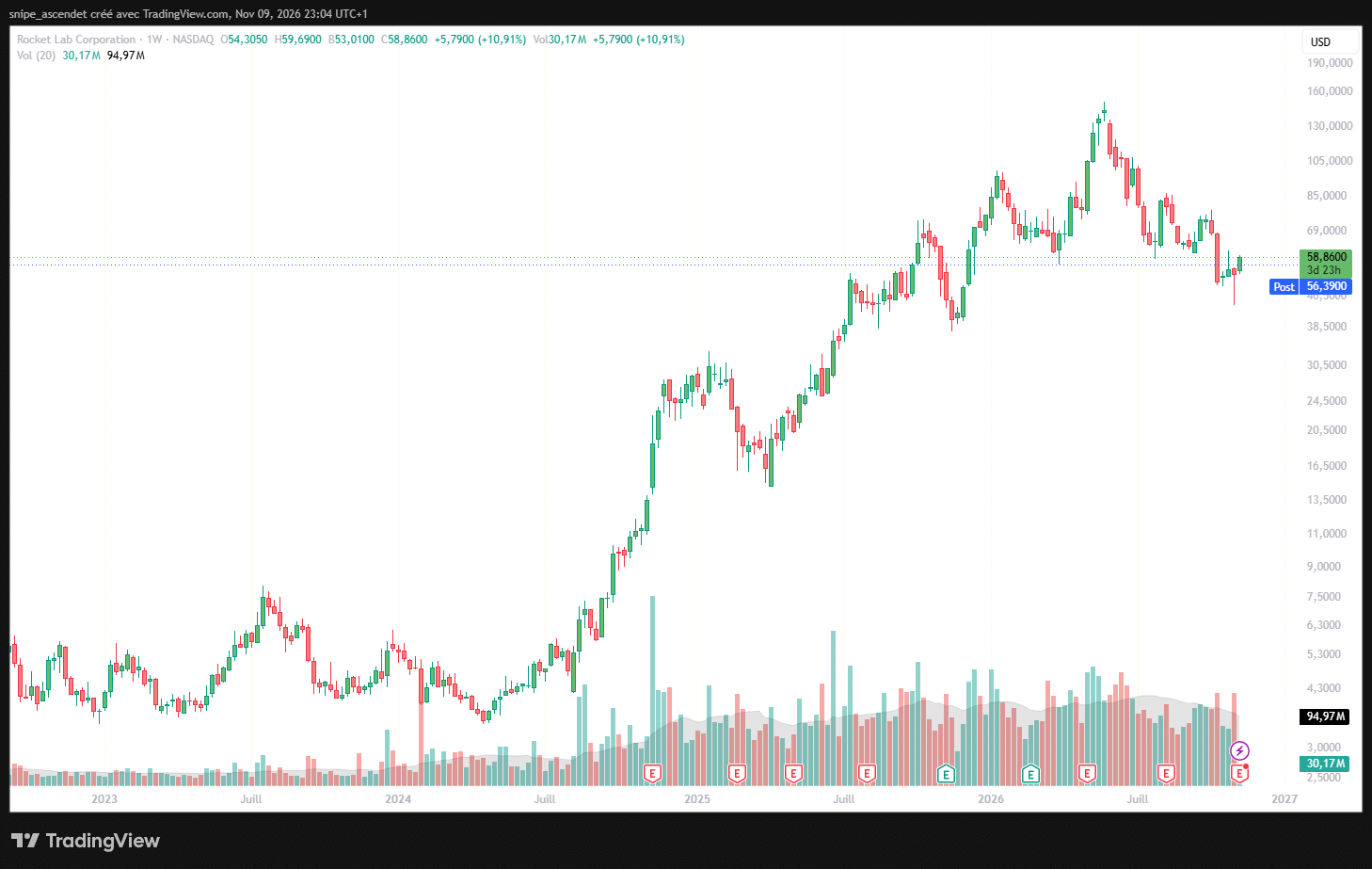
RKLB finished the November 9 regular Nasdaq session at $58.86, up $5.79 or 10.91%, with approximately 30.17 million shares traded, according to the supplied TradingView daily chart. But the report was released after the market closed. At approximately 5:04 p.m. Eastern, the four-hour TradingView snapshot showed $56.52 in extended-hours trading, about 4.0% below the official session close. That later quote was not a second official closing price and could change as after-hours trading continued.
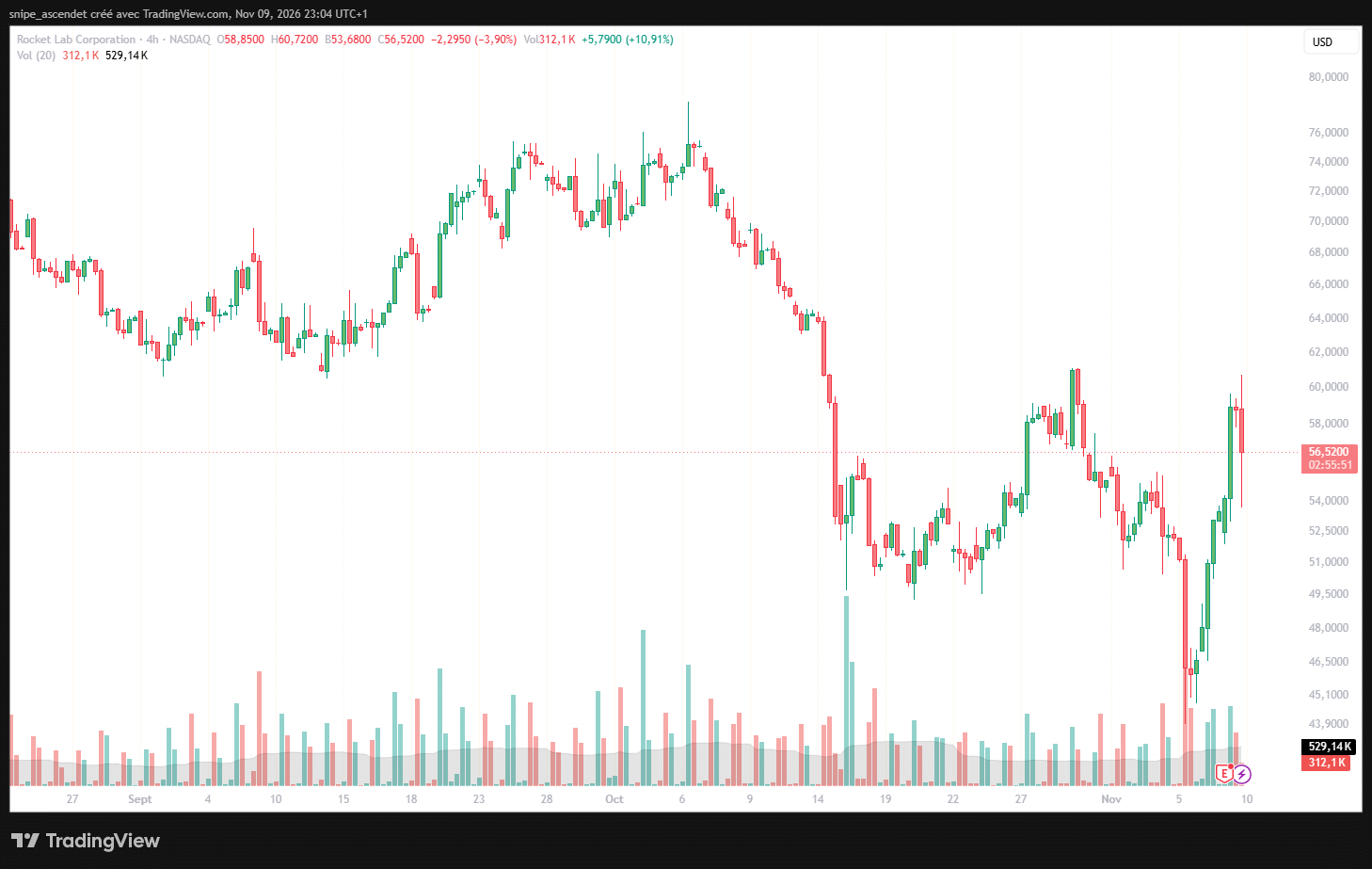
A positive regular-session move followed by a weaker post-report quote is not evidence that investors rejected the backlog. The market was also weighing Neutron’s development timetable, losses, share issuance and the pending Iridium transaction. No single cause for the initial extended-hours decline can be established from the price chart alone. The contrast fits a broader pattern of volatile growth-stock trading discussed in our analysis of Wall Street’s fragile technology-stock rebound.
Rocket Lab Q3 Earnings: Revenue Beat Expectations, but Losses Persist
The quarterly results show both operating progress and mounting costs. Rocket Lab generated $90.1 million of GAAP gross profit on $267.8 million of revenue, equivalent to a 33.6% gross margin. That compares with roughly 37.0% a year earlier. Research and development expense rose to $98.4 million and selling, general and administrative costs reached $70.9 million, leaving a $79.2 million GAAP operating loss.
The following estimates are pre-report snapshots from MarketBeat’s Q3 consensus listing and Finviz’s GAAP EPS estimate. They are not company guidance, and EPS comparisons can vary by provider and accounting basis.
| Metric | Reported Q3 2026 | Expected | Difference |
|---|---|---|---|
| Revenue | $267.83 million | $257.21 million | +$10.62 million, about +4.1% |
| GAAP earnings per share | -$0.12 | About -$0.07 (Finviz GAAP estimate) | $0.05 larger loss per share |
| GAAP gross margin | 33.6% | Not reliably established | Not calculated |
| GAAP operating loss | -$79.19 million | Not reliably established | Not calculated |
Revenue grew from $155.1 million in the third quarter of 2025. Product revenue reached $197.5 million and service revenue $70.3 million. These are financial-statement classifications and should not be treated as a precise breakdown of Rocket Lab’s Space Systems and Launch business lines. The GAAP net loss widened to $79.7 million from $18.3 million a year earlier, although the comparison also reflects differences in tax benefits and other nonoperating items. On a non-GAAP basis, the adjusted EBITDA loss narrowed to $18.0 million, from $26.3 million in the year-earlier quarter. The company’s reported financial statements provide the underlying reconciliations.
The positive cash-flow headline also requires precision. Rocket Lab reported $7.2 million of GAAP operating cash flow in Q3. Over the first nine months of 2026, however, operating activities still used $127.3 million of cash and purchases of property, equipment and software consumed $84.2 million. Subtracting those capital expenditures from operating cash flow gives approximately negative $211.4 million of nine-month free cash flow using a simple, explicitly calculated definition. One positive quarter does not yet establish a self-funding business.
What the $3.57 Billion Backlog Actually Tells Investors
Rocket Lab said its backlog increased by approximately $1.2 billion sequentially, reaching $3.57 billion. During Q3, the company signed close to $1 billion in launch contracts across Electron, HASTE and Neutron and reported about $470 million of Space Systems contracts. Its launch backlog reached 117 missions. Those new commitments suggest customer demand is reaching beyond the established Electron small-launch business.
But the headline backlog figure has limitations. The release does not provide a full quarter-by-quarter schedule showing exactly when the $3.57 billion is expected to become revenue, nor does it establish the profitability of each contract. Some work involves manufacturing, testing and missions that will be delivered long after an order is signed. Backlog also is not identical to cash received: milestone payments, working-capital requirements and final customer acceptance can all affect timing.
A useful investor test is therefore backlog conversion, not backlog accumulation alone. If revenue and cash collections rise as contracted projects progress, the expanding order book gains economic credibility. If working capital and development spending increase faster than collections, growth can remain capital intensive even with record commitments.
Neutron Is the Biggest Execution Test for 2027
The new medium-lift Neutron rocket sits at the intersection of Rocket Lab’s opportunity and its risk. The company said it secured more than $515 million in Neutron launch contracts during the third quarter, bringing the pre-debut book to 16 missions. Several contracts carry a $70 million base launch price, according to Rocket Lab. That helps explain how the company’s future launch mix might move beyond Electron’s smaller missions.
Yet Neutron had not flown as of the earnings release. Rocket Lab now targets its first flight no earlier than 2027 and says work continues on flight-hardware integration, testing and delivery to Launch Complex 3. That timetable is a development target, not a commitment that commercial flights or contract revenue will begin at a particular pace. Rocket qualification, launch reliability, reusability economics and production capacity remain questions that cannot be settled by the value of signed contracts.
The bull case is that Neutron opens a much larger addressable launch market and supplies a second revenue engine alongside space hardware. The bear case is that a longer development cycle absorbs cash and pushes high-value contracted missions further into the future. The backlog creates potential revenue visibility, but it does not remove engineering risk.
Space Systems Gives Rocket Lab a Business Beyond Launches
Rocket Lab’s strategy is wider than selling launches. During the quarter, 12 Rocket Lab-built spacecraft reached orbit and entered operation, including eight satellite platforms for Globalstar, two NASA Mars-science spacecraft and missions involving U.S. defense and commercial customers. Management also reported more than 55 spacecraft in development or construction. Those projects matter because satellite manufacturing and components can generate commercial activity even while Neutron remains in development.
The industrial challenge is to scale complex aerospace production without allowing component sourcing, specialized labor and acceptance milestones to erode gross profit. The third quarter’s 33.6% GAAP gross margin, below the year-earlier level, shows why revenue growth and margin growth must be assessed separately. More manufacturing revenue is valuable only if its contribution improves as the business expands.
The Iridium Acquisition Adds Scale and Financing Risk
Rocket Lab’s proposed purchase of Iridium Communications (NASDAQ: IRDM) would add a satellite communications network and recurring services to a company best known for launches and spacecraft production. The June 29 acquisition announcement specified a notional $54 per Iridium share in cash and stock, comprising $27 in cash plus a Rocket Lab share component determined by a collar. The companies put the implied enterprise value at about $8 billion and targeted closing in mid-2027, subject to remaining conditions.
By November 9, Rocket Lab said Iridium shareholders had approved the deal and its financing had been arranged; this was not a completed acquisition. A September financing update described the completion of a $1.944 billion at-the-market equity offering, the continuation of an Iridium $1.775 billion credit facility following lender consent, and the termination of a proposed bridge facility. Those steps reduce one source of funding uncertainty but do not eliminate integration or shareholder dilution risk.
On Rocket Lab’s nine-month cash-flow statement, gross proceeds from at-the-market stock offerings totaled $3.91 billion. Its cash and cash equivalents stood at $4.45 billion at September 30, compared with $829 million at December 31, 2025. Common shares outstanding also rose from approximately 543.6 million to 639.2 million over that period, an increase of roughly 17.6%. The entire share-count change should not be attributed to a single offering, but investors must consider a larger equity base when evaluating future earnings per share. These figures illustrate a funding-versus-dilution trade-off similar to that described in our examination of debt and financing pressures at AI infrastructure companies.
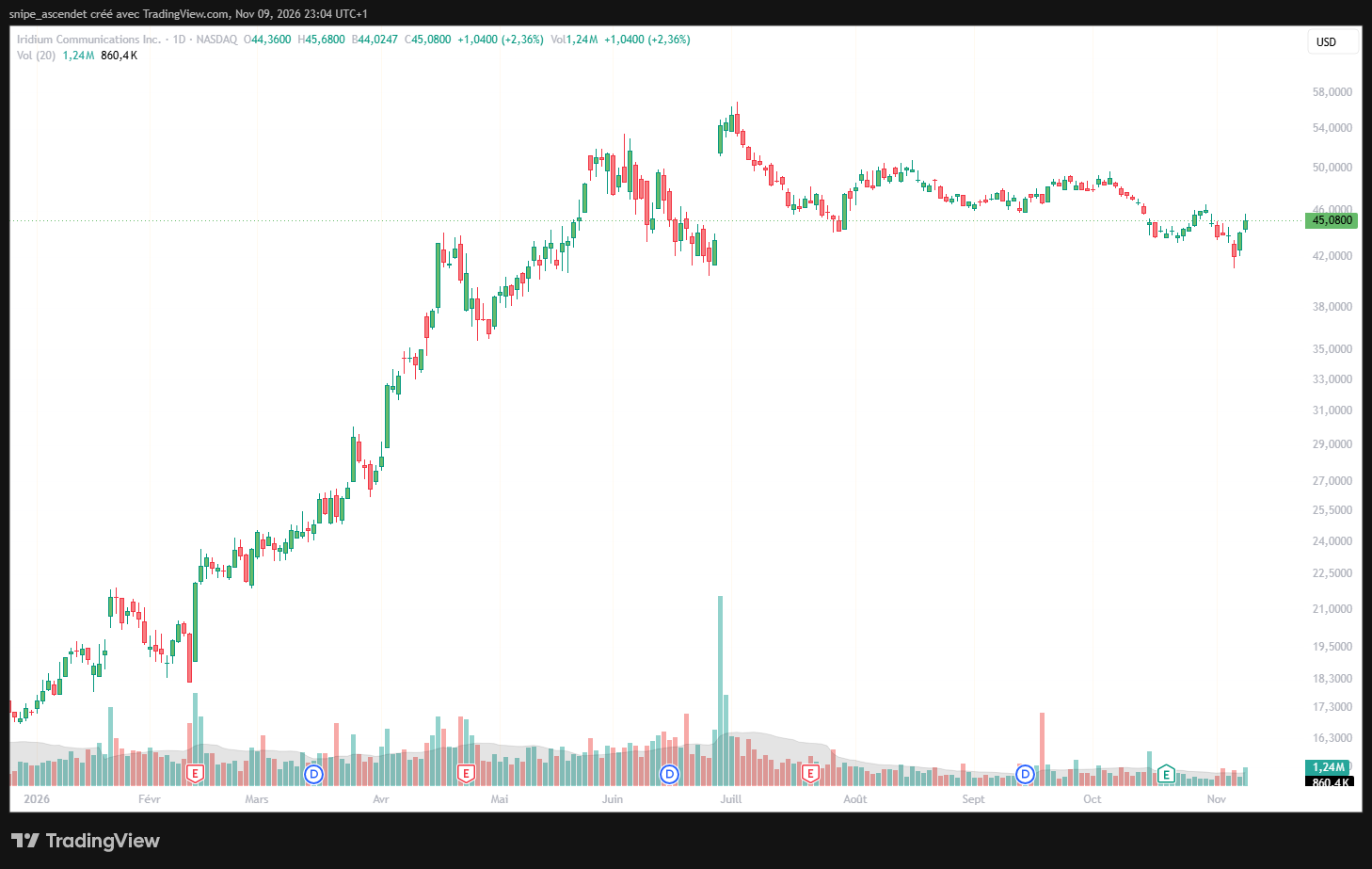
Iridium’s regular-session close of $45.08 on November 9 was below the deal’s $54 notional reference value, but the value of the stock portion can change under the agreed exchange mechanism. It would be misleading to call the difference a simple fixed cash takeover spread.
RKLB vs. ASTS: Space Stocks Are Not One Investment Thesis
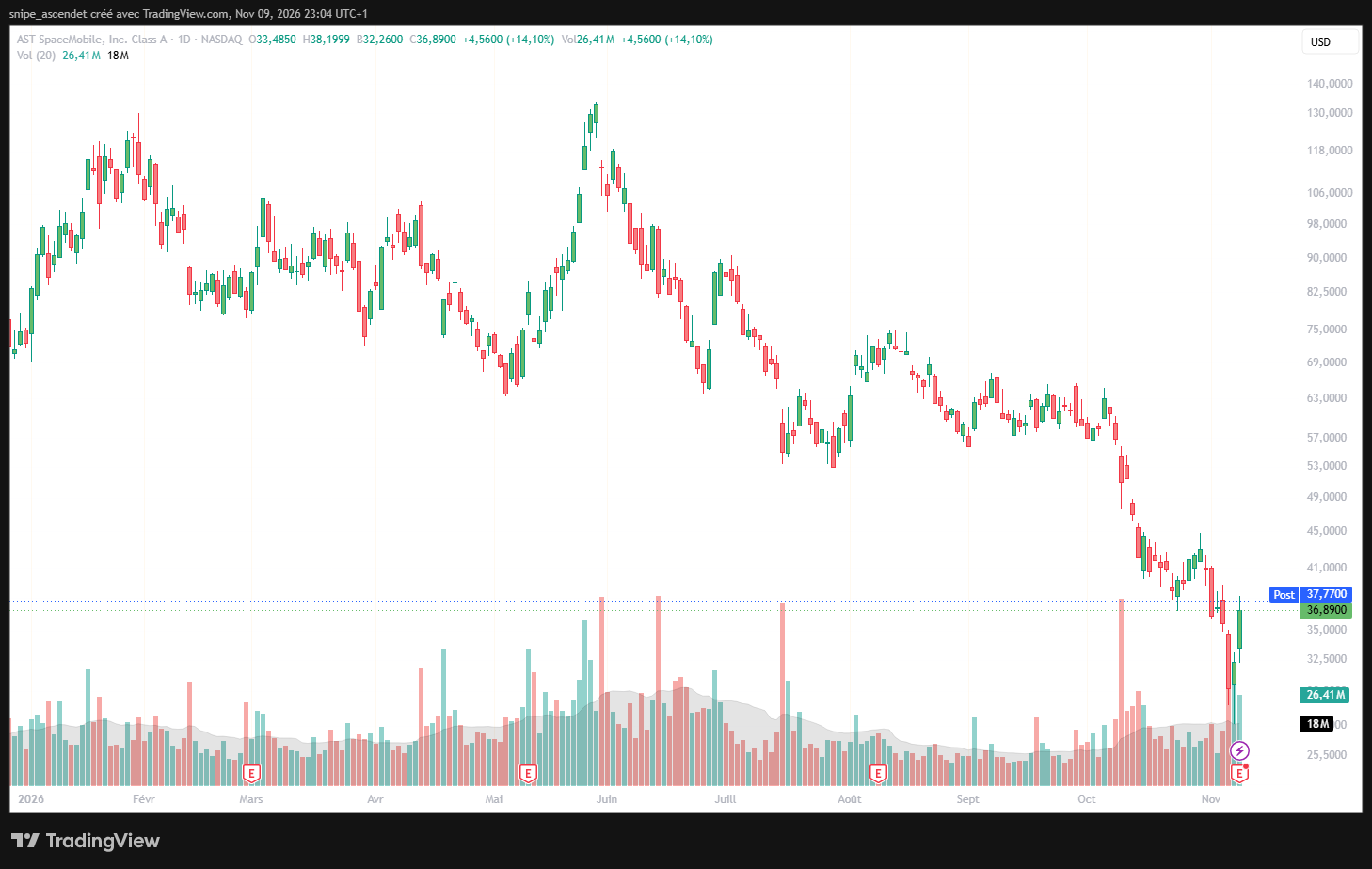
AST SpaceMobile (NASDAQ: ASTS) gained 14.10% to $36.89 during the November 9 regular session, compared with Rocket Lab’s 10.91% rise and Iridium’s 2.36% gain. These are same-day share-price moves, not comparable measures of operational progress. AST SpaceMobile is focused on direct-to-device satellite connectivity, Iridium operates an established satellite communications network, and Rocket Lab combines launch services with manufacturing while attempting to broaden into satellite operations through Iridium.
Investors looking at the wider space sector should distinguish between an operating network, an early-stage network buildout and a launch-and-manufacturing platform. Each faces different revenue recognition, capital spending and execution risks. A single strong trading day does not rank their underlying business models.
Q4 Guidance and the Milestones That Could Change the RKLB Thesis
Rocket Lab expects fourth-quarter 2026 revenue between $270 million and $290 million, with GAAP gross margin of 34% to 36%. The $280 million revenue midpoint implies roughly 4.5% sequential growth from Q3, while the gross-margin range suggests management expects some improvement from the third quarter’s 33.6%. The company also guided to a $14 million to $20 million adjusted EBITDA loss. These are company forecasts, not guaranteed results.
The next meaningful tests are straightforward: whether fourth-quarter sales and margins land within guidance; whether Space Systems delivers revenue and collects cash as the backlog is executed; whether Neutron completes its announced milestones without another major schedule setback; and whether the Iridium transaction secures remaining approvals and closes on acceptable economic terms. Investors should also watch changes in the diluted share count and in cash from operations, rather than looking at the cash balance in isolation.
Rocket Lab has demonstrated demand. Its order book and growing spacecraft activity support a credible commercial expansion story. What has not been demonstrated is that this backlog will translate into sustained GAAP profitability and positive free cash flow on the required timetable. That is the decisive gap between the bullish operating narrative and the investment risk surrounding RKLB.
Financial information is as of November 9, 2026. Stock prices are U.S.-dollar TradingView snapshots; extended-hours quotes are not official closing prices. This article is for information only, not personalized investment advice.