


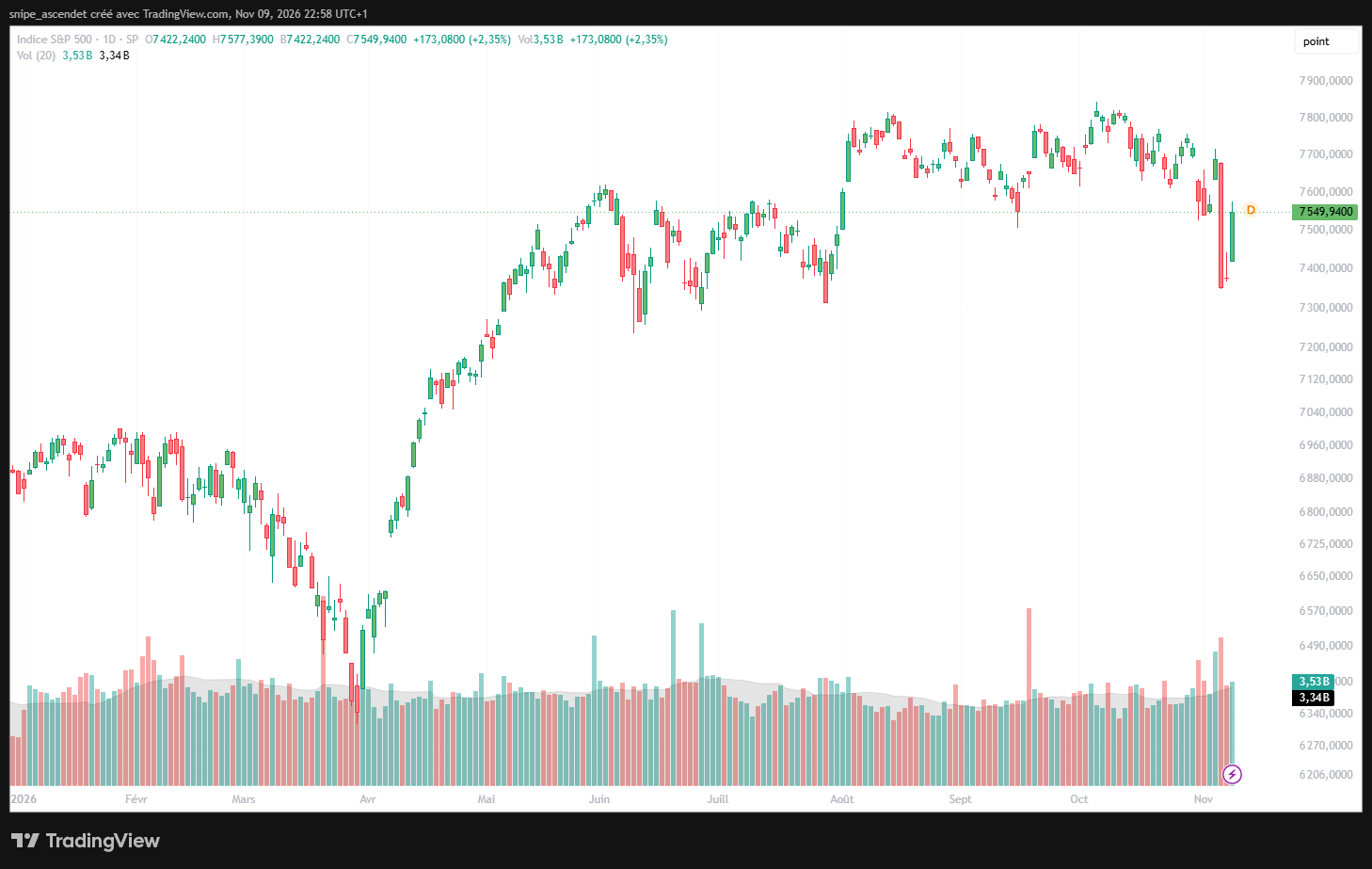
Wall Street delivered a broad rebound on Monday, November 9, 2026, while Nvidia remained the standout loser. The S&P 500 advanced 2.35% to 7,549.94, the Nasdaq Composite climbed 2.74% to 25,253.14, and the Dow Jones Industrial Average gained 2.15%. Nvidia fell 4.27% to $178.67 after its board opened an independent inquiry into reports that CEO Jensen Huang had been targeted by a foreign intelligence effort. Meanwhile, a steep oil-price decline supported risk appetite as Washington signaled a lower near-term likelihood of renewed military strikes on Iran.
The divergence is consequential. Investors bought semiconductors and economically sensitive stocks despite an abrupt loss of confidence in one of the AI industry’s most important leaders. The key question is whether the rally reflects a lasting improvement in inflation and geopolitical risk, or merely a rebound from the previous week’s sharp selloff. For context, DualFinances’ analysis of the fragile November 6 tech rebound identified market breadth and policy uncertainty as obstacles to a sustained recovery.
Wall Street’s November 9 Rally Was Broad, Not Just a Big Tech Bounce
The Reuters closing market report confirmed gains in all 11 S&P 500 sectors, with industrials and consumer discretionary shares each advancing more than 3%. The small-cap Russell 2000 outperformed the large-cap benchmarks, rising 3.15% to 2,840.81. That pattern matters because a rally led only by a handful of dominant technology companies would offer weaker evidence of improving investor confidence.
| US benchmark | November 9 close | Daily change |
|---|---|---|
| S&P 500 | 7,549.94 | +2.35% |
| Nasdaq Composite | 25,253.14 | +2.74% |
| Dow Jones Industrial Average | 52,389.75 | +2.15% |
| Russell 2000 | 2,840.81 | +3.15% |
The S&P 500’s 173.08-point rise was its largest daily percentage gain since April 8, according to Reuters. Trading activity supported the breadth of the rebound: advancing issues outnumbered declining issues by approximately 4.06 to one on the NYSE and 3.34 to one on the Nasdaq. Those figures are more persuasive evidence of broad participation than the index gains alone, although they describe only a single trading session.
Iran Peace Hopes Send Oil Lower and Ease One Inflation Risk
The immediate macroeconomic catalyst was the prospect of less military escalation around Iran. President Donald Trump said further US strikes were highly unlikely as long as negotiations continued to progress. That was a statement about the likelihood of renewed attacks, not an announcement that a peace agreement had been signed. Reports of shipping incidents near the Strait of Hormuz and competing demands in the negotiations underscored how fragile the situation remained.
Oil traders nonetheless repriced part of the geopolitical risk premium. Reuters reported that benchmark Brent crude futures settled at $92.57 per barrel, down 5.85%, while US West Texas Intermediate futures ended at $86.85, down 4.38%. Both benchmarks continued to move after their settlement times, demonstrating the importance of comparing the same contract and observation period.
Lower crude prices can relieve pressure on transportation costs and energy-intensive businesses, and they may eventually moderate headline inflation if the decline persists. That possibility helped equities on Monday. It does not prove that inflation will fall: gasoline and other consumer prices respond with lags, while wages, services and shelter costs follow different dynamics. Oil also remained exposed to disruption risks, so a rapid reversal was possible if diplomacy failed.
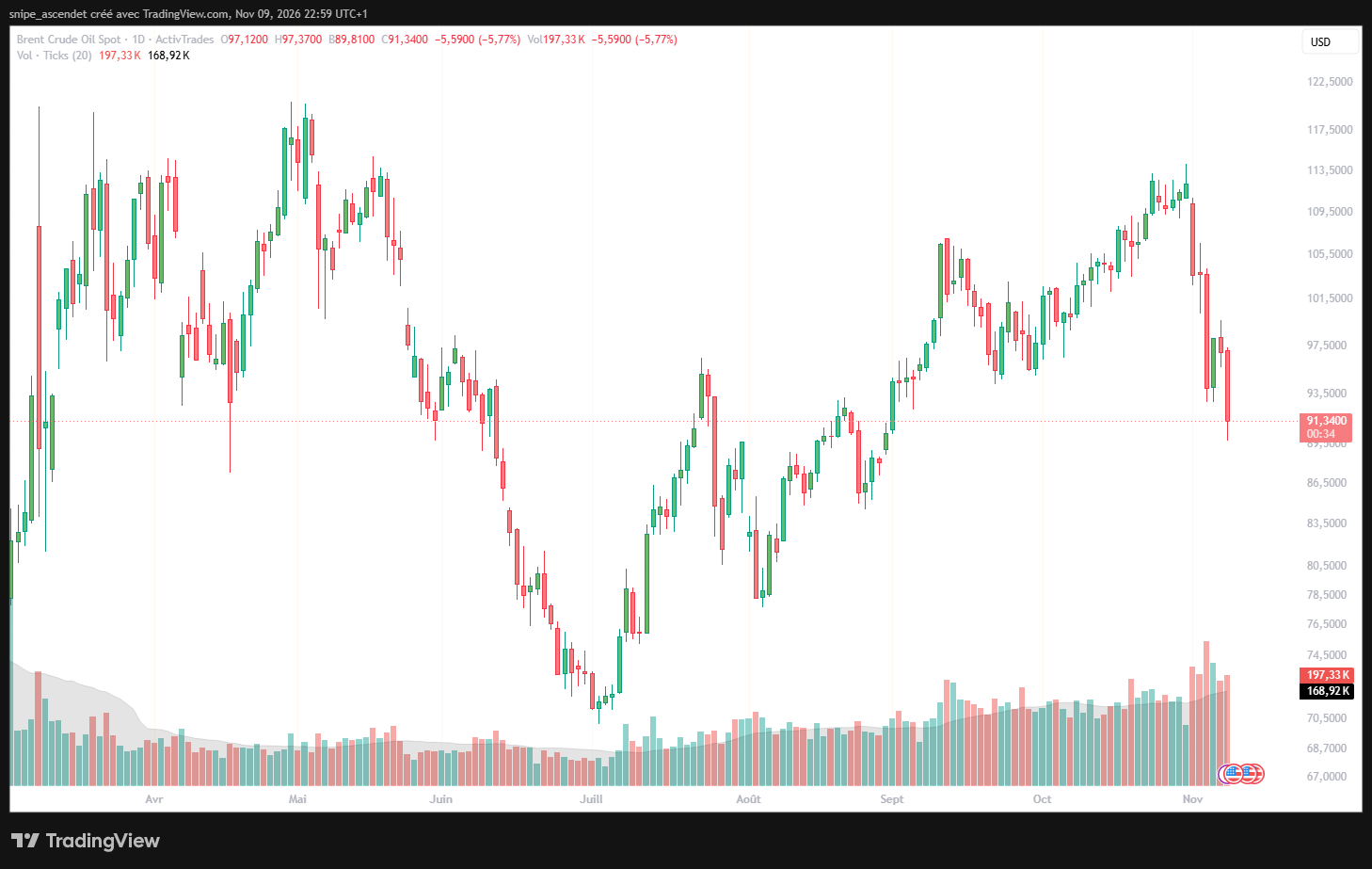
An ActivTrades Brent spot feed showed $91.34, whereas the ICE Brent futures settlement was $92.57. These are distinct market references and should not be treated as inconsistent prices for the same instrument.
Why Nvidia Fell While Other AI Chip Stocks Surged
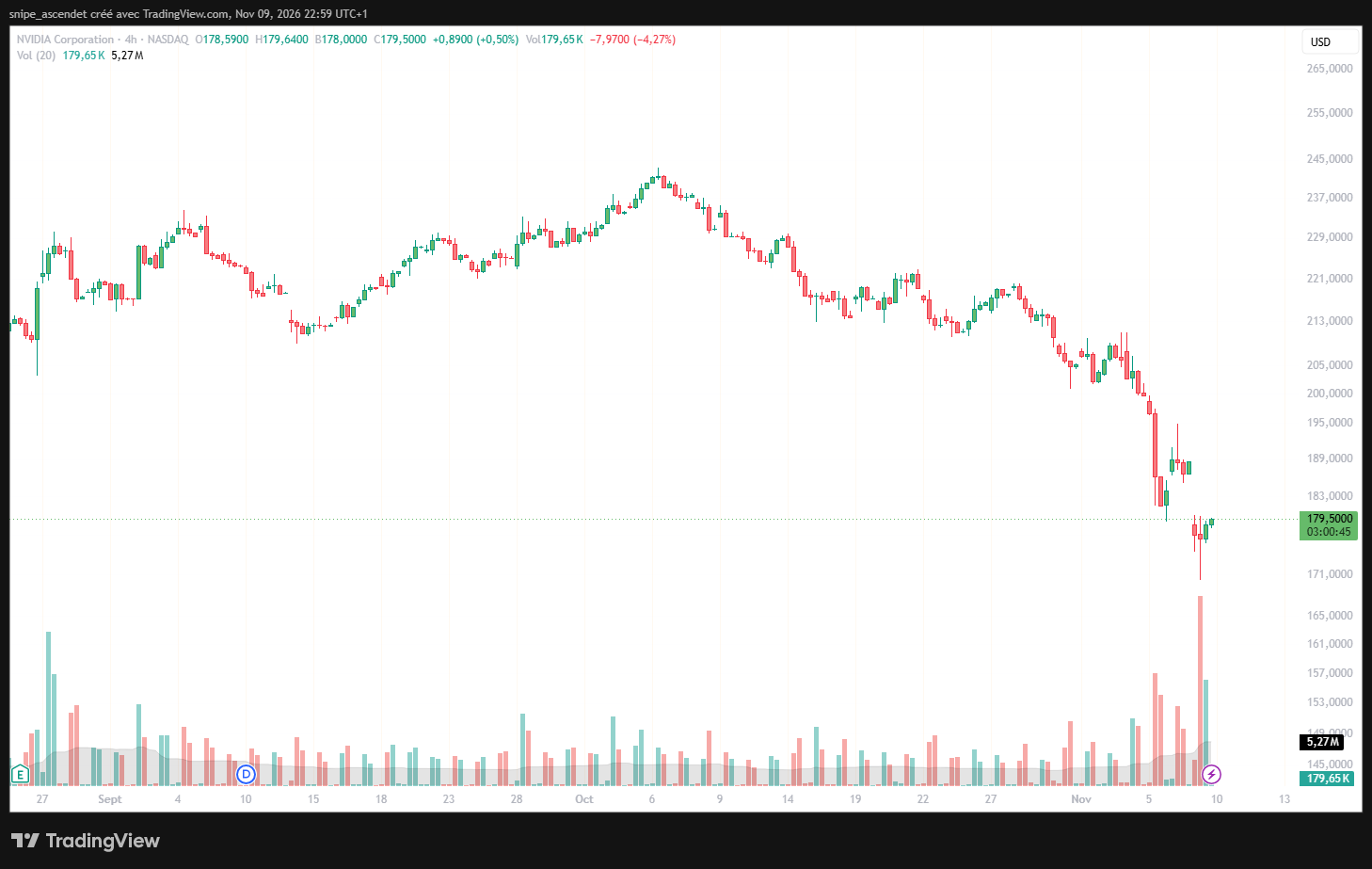
Nvidia was the exceptional semiconductor loser. Shares ended the regular US session at $178.67, down 4.27%, even as the Philadelphia Semiconductor Index jumped about 6.9%, according to Reuters and reported closing-price data. The stock’s weakness was not presented by Nvidia as a revision to GPU demand, earnings or guidance. The immediate issue was corporate governance and uncertainty around the company’s founder and chief executive.
On November 8, Nvidia’s board announced an independent investigation following reports that Huang had been a target of a foreign intelligence effort. Independent directors and outside counsel are overseeing the process. The board said it had no reason to believe that national security or Nvidia’s proprietary information had been compromised, while committing to review the available evidence. It also affirmed confidence in Huang and his management team.
Reuters reported allegations involving a woman described in previous media coverage as a suspected Chinese intelligence asset. Those allegations have not been established by the Nvidia investigation, and the Chinese foreign ministry rejected the characterization. Investors should distinguish reporting about a possible intelligence operation from any proven transfer of company secrets or finding of wrongdoing by Huang.
The Financial Risk Is Dependence on a Key Executive
Huang’s role extends beyond conventional chief executive duties. He is closely associated with Nvidia’s engineering direction, its CUDA software ecosystem and its relationships with cloud customers, suppliers and governments. Even without evidence of a breach, a lengthy investigation could distract management, complicate strategic conversations or create questions about succession. Those are potential risks, not outcomes that have already occurred.
By the same token, a governance controversy does not mechanically reduce orders for AI accelerators. Investors need evidence of customer delays, weakened pricing, higher costs or changed guidance before translating this episode into lower earnings expectations. Nvidia’s next operational disclosures will be more informative about that part of the investment case than speculation about its leadership.
AMD’s 13% Gain Shows Investors Have Not Abandoned AI Hardware
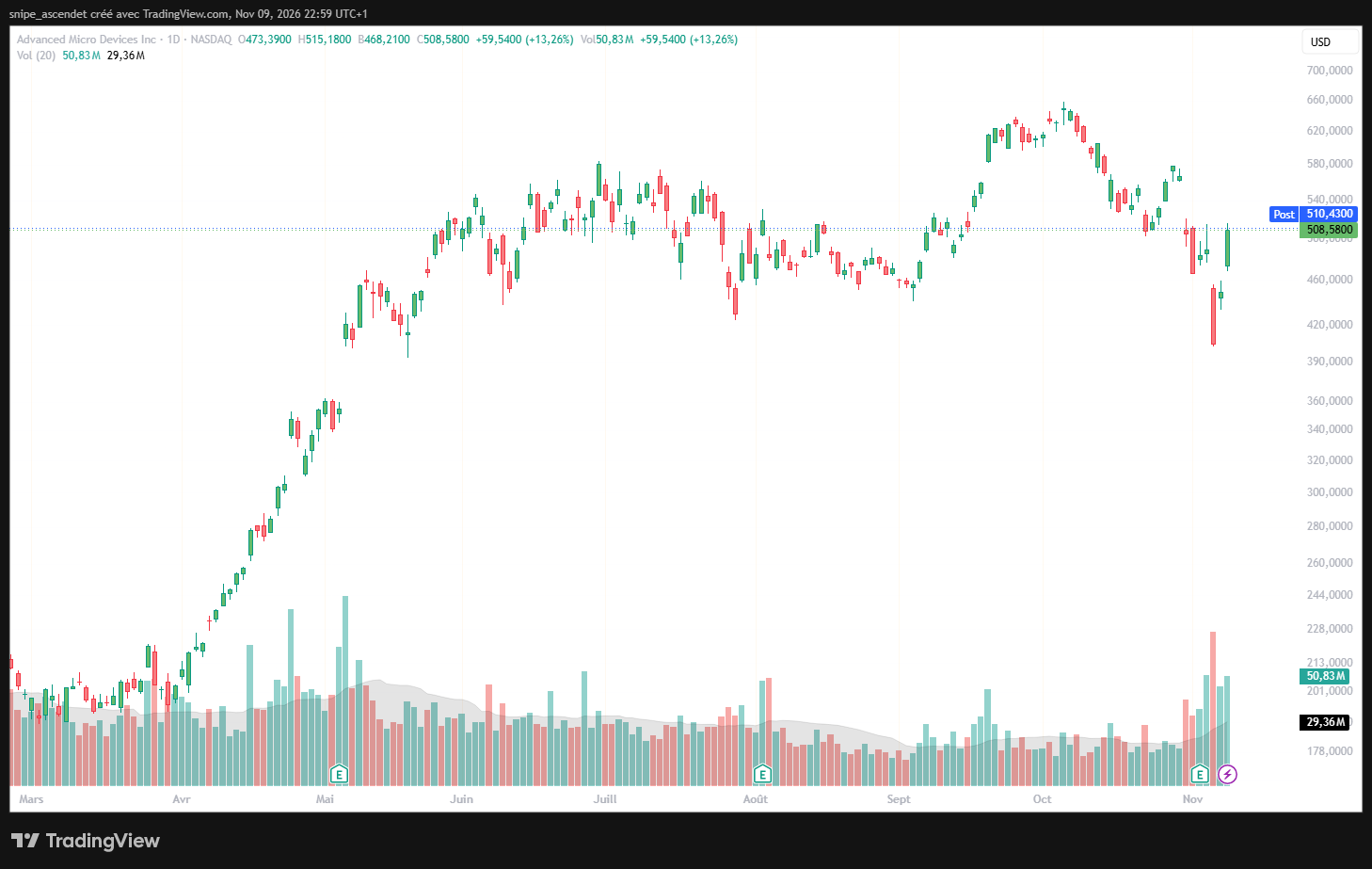
Advanced Micro Devices was a striking counterpoint. Its shares rose 13.26% to $508.58 on November 9, while Broadcom gained approximately 8.8%, according to Reuters. Relative to Nvidia’s 4.27% decline, AMD outperformed by roughly 17.5 percentage points in a single session. That is a notable market-price divergence, but it should not be mistaken for an equally large change in either company’s underlying business.
There are several plausible interpretations. Investors may be rebuilding semiconductor exposure after the previous week’s selloff while excluding Nvidia-specific governance risk. They may also be reconsidering the competitive value of alternative GPU suppliers. Neither interpretation establishes that Nvidia customers have switched orders to AMD. Procurement decisions depend on product performance, software integration, supply, networking and long-term customer road maps.
The competitive fundamentals deserve a separate test. Our AMD-versus-Nvidia revenue comparison examines the enormous difference in their data-center revenue bases. A one-day relative gain for AMD does not close that gap, but it underscores how differently the market can price company-specific risk even within the same AI spending cycle.
QQQ and Equal-Weight Stocks Confirm a Wider Recovery
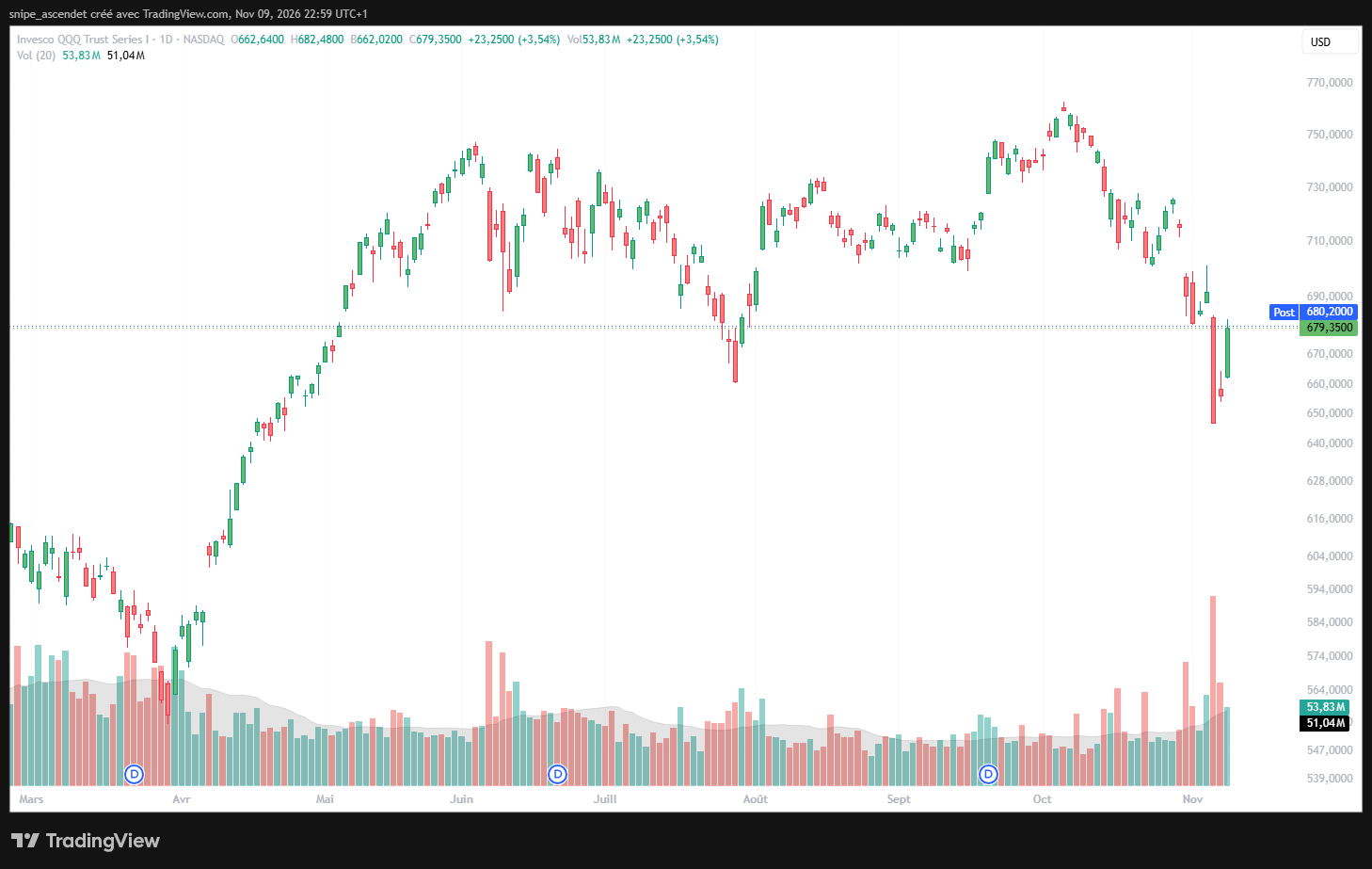
The Invesco QQQ Trust, which tracks the Nasdaq-100 rather than the Nasdaq Composite, gained 3.54% to $679.35 in the November 9 session. That advance reinforces the evidence of a forceful rebound in large growth stocks, even with Nvidia under pressure. QQQ’s performance must not be described as the return of the Nasdaq Composite: they are different instruments with different constituents and weightings.
More importantly, the Invesco S&P 500 Equal Weight ETF (RSP) advanced 2.27% to $220.95. Its gain was only 0.08 percentage points below the standard capitalization-weighted S&P 500’s 2.35% increase. Because RSP distributes exposure more evenly among S&P 500 constituents at its scheduled rebalances, its participation provides an additional check on whether the session was dominated by mega-cap stocks.
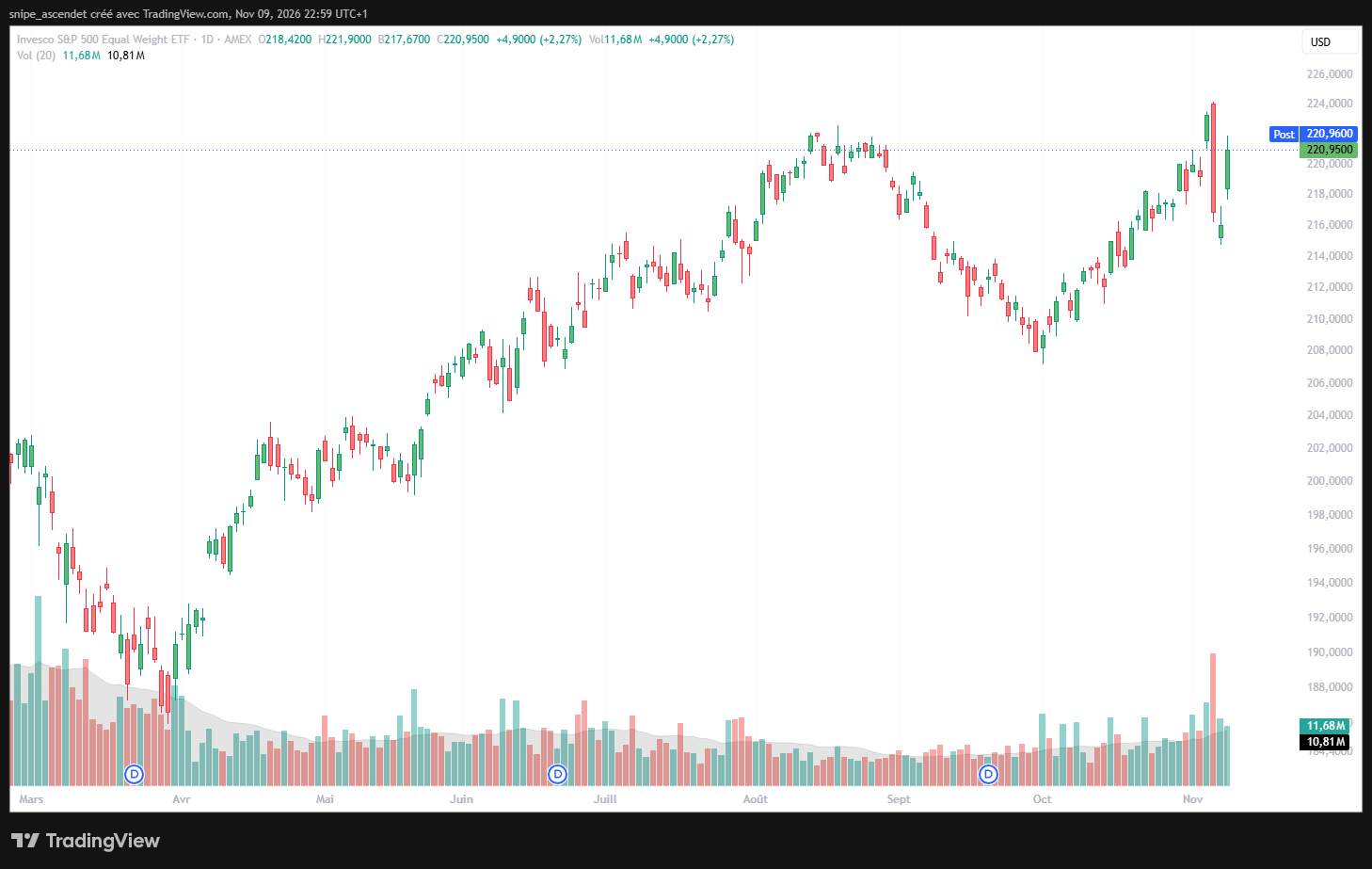
The combined evidence is constructive: small caps outperformed, every major S&P 500 sector advanced, and equal-weight equities participated. Still, one positive session does not erase the steep technology losses recorded the previous week. The market would need further broad-based gains, stable credit conditions and earnings support to establish that investors have moved beyond a short-covering or relief rally.
The Next Test Is Inflation, Interest Rates and AI Spending
The October US Consumer Price Index report is scheduled for Tuesday, November 10, at 8:30 a.m. Eastern, according to the Bureau of Labor Statistics release calendar. The data could redirect the market’s attention from the day’s geopolitical relief to the Federal Reserve’s next policy decision.
Lower oil prices help the inflation story at the margin, but core inflation, services prices and recent labor-market resilience also matter. A stronger-than-expected CPI reading could push bond yields and expectations for tighter policy higher, making elevated valuations harder to defend. Softer inflation might support the opposite reaction. Neither path is assured before the data are published.
AI companies face an additional question independent of short-term sentiment: how profitably customers can convert infrastructure spending into revenue. The debt and cash-flow issues identified in DualFinances’ examination of leveraged AI data-center operators remain relevant even when semiconductor shares recover. Strong hardware demand does not remove construction, financing, energy or contract-execution risk.
Three Scenarios for the Next Trading Sessions
Bullish: Diplomacy Improves and Inflation Cooperates
If negotiations reduce the risk of renewed strikes, crude prices stabilize at less inflationary levels and CPI comes in softer than expected, the rally could broaden further. Confirmation would come from sustained gains in the equal-weight S&P 500, continued small-cap participation and resilient earnings expectations. Nvidia would also need to reassure investors that its governance review is not disrupting operations.
Base Case: A Selective, Volatile Recovery
The more mixed outcome is that oil remains volatile, inflation fails to deliver a decisive surprise and corporate news drives larger gaps between stocks. In that environment, AMD and other chipmakers could trade on demand expectations while Nvidia continues to carry a separate governance discount. Sharp daily moves would not, by themselves, establish a new sector trend.
Bearish: Geopolitical Risk Returns or Rates Rise
Fresh military escalation, disruption around the Strait of Hormuz, a hot CPI report or signs of delays in AI capital spending could reverse some of Monday’s gains. The most important warning would be renewed weakness extending beyond Nvidia into equal-weight equities, smaller companies and credit-sensitive businesses. This scenario identifies risks to monitor, not a prediction that they will materialize.
What Investors Should Watch After November 9
Monday’s rally was real, but its durability remains unproven. The S&P 500 recovered 2.35%, the Russell 2000 gained 3.15%, and RSP participated almost as strongly as the capitalization-weighted benchmark. At the same time, Nvidia’s 4.27% decline illustrated how quickly leadership and governance uncertainty can overwhelm sector-wide optimism.
The next checkpoints are developments in US-Iran diplomacy, the November 10 inflation report, Nvidia’s independent review and the pace of customer spending on AI infrastructure. Investors should evaluate those separately rather than assigning all market movements to a single headline. Monday showed that a broad risk-on session can coexist with a severe company-specific selloff; it did not settle which trend will dominate next.