

US stocks recovered much of their early losses on Wednesday, November 25, 2026, but Wall Street entered Thanksgiving with little evidence that the AI selloff had ended. The Nasdaq Composite fell 0.65% after losing more than 4% intraday, while new tariff proposals, 3.8% PCE inflation and mounting pressure on AI-related corporate debt complicated the outlook for technology investors.
Wall Street Recovers From a Sharp Selloff Before Thanksgiving
According to Reuters’ preliminary closing figures, the Dow finished higher, while the S&P 500 and Nasdaq Composite remained negative. The recovery followed the November 23 rally following Jensen Huang’s return to Nvidia and the November 24 semiconductor selloff.
| Index or asset | November 25, 2026 level | Daily change |
|---|---|---|
| Dow Jones Industrial Average | 50,173.90 | +0.31% |
| S&P 500 | 7,183.08 | -0.25% |
| Nasdaq Composite | 23,579.44 | -0.65% |
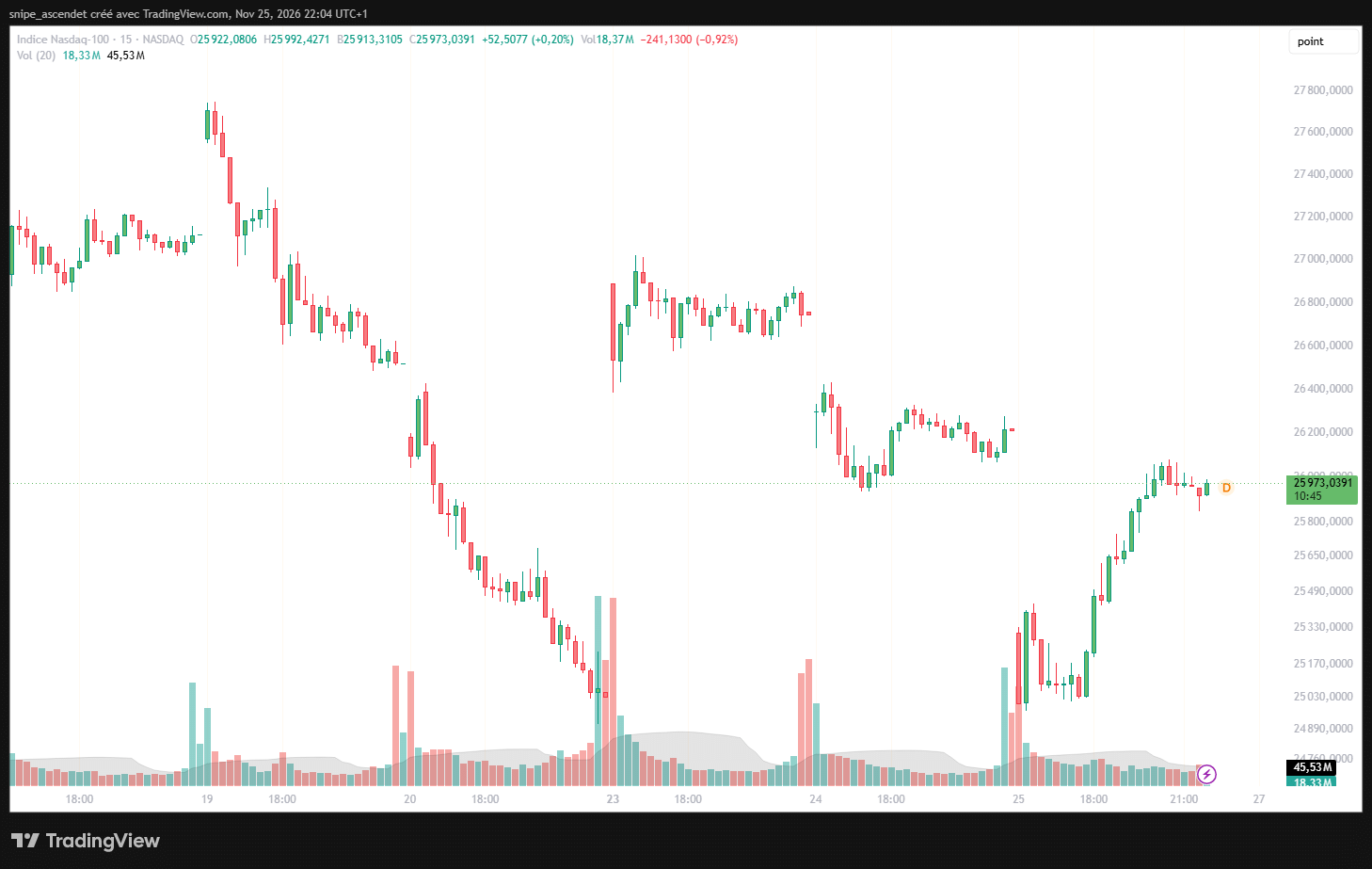
| Nasdaq-100 | 25,973.04 | -0.92% |
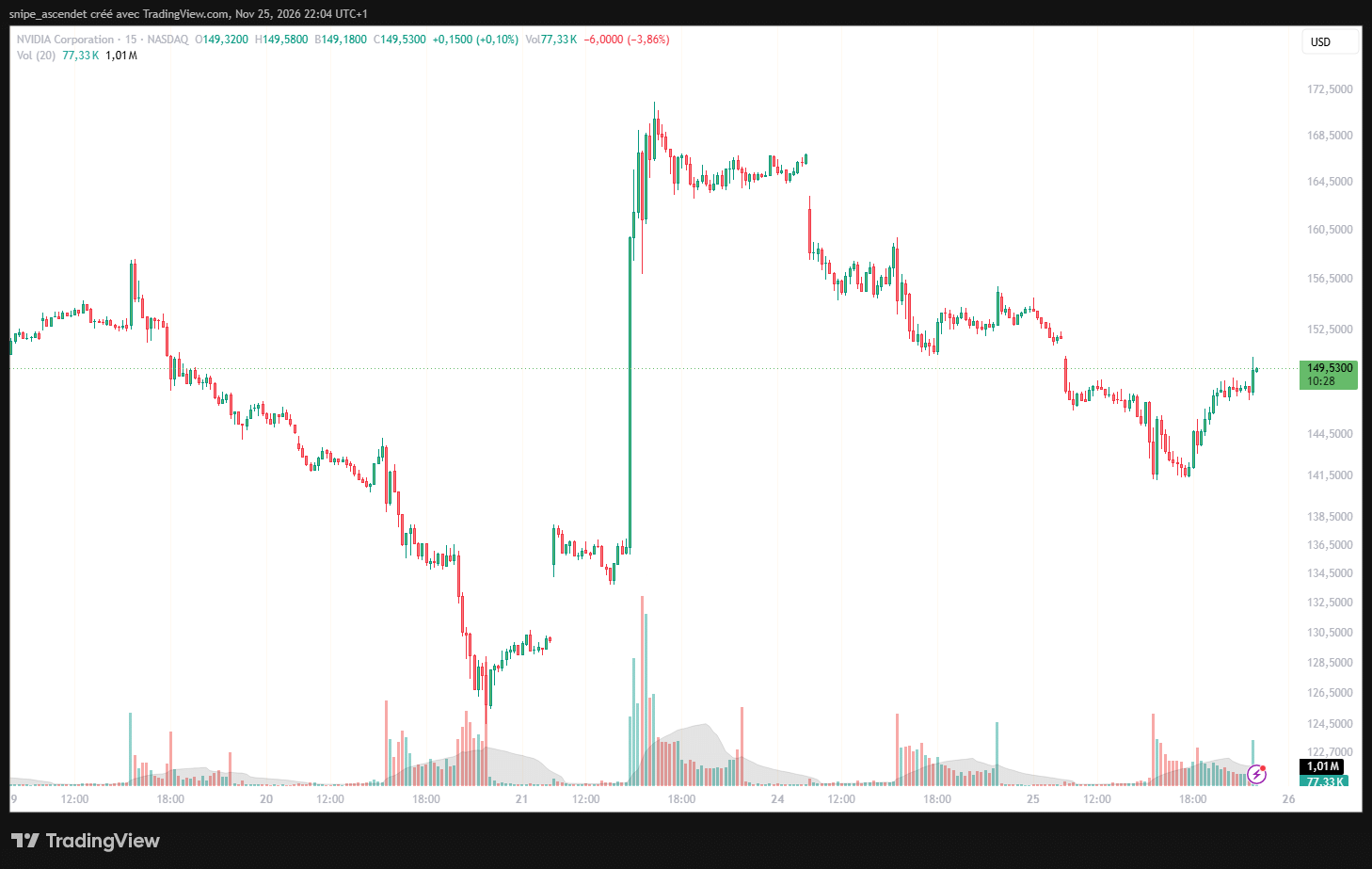
| Nvidia (NASDAQ: NVDA) | $149.53 | -3.85% |
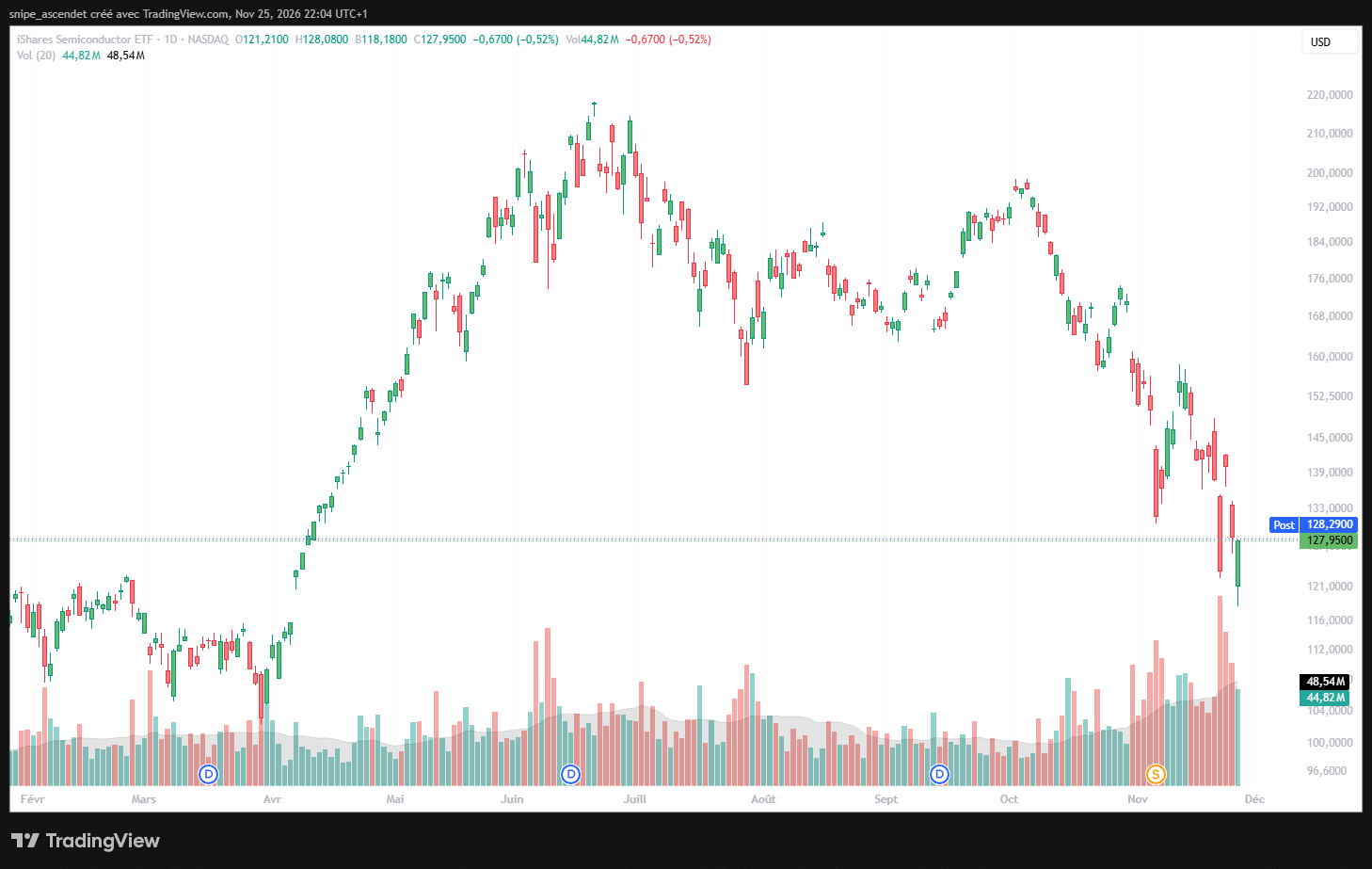
| iShares Semiconductor ETF (NASDAQ: SOXX) | $127.95 | -0.52% |
The first three entries are preliminary regular-session closes from Reuters. The Nasdaq-100, Nvidia and SOXX readings are from TradingView at approximately 4:04 p.m. ET on November 25, 2026; Nvidia’s change is measured against its November 24 closing price of $155.51.
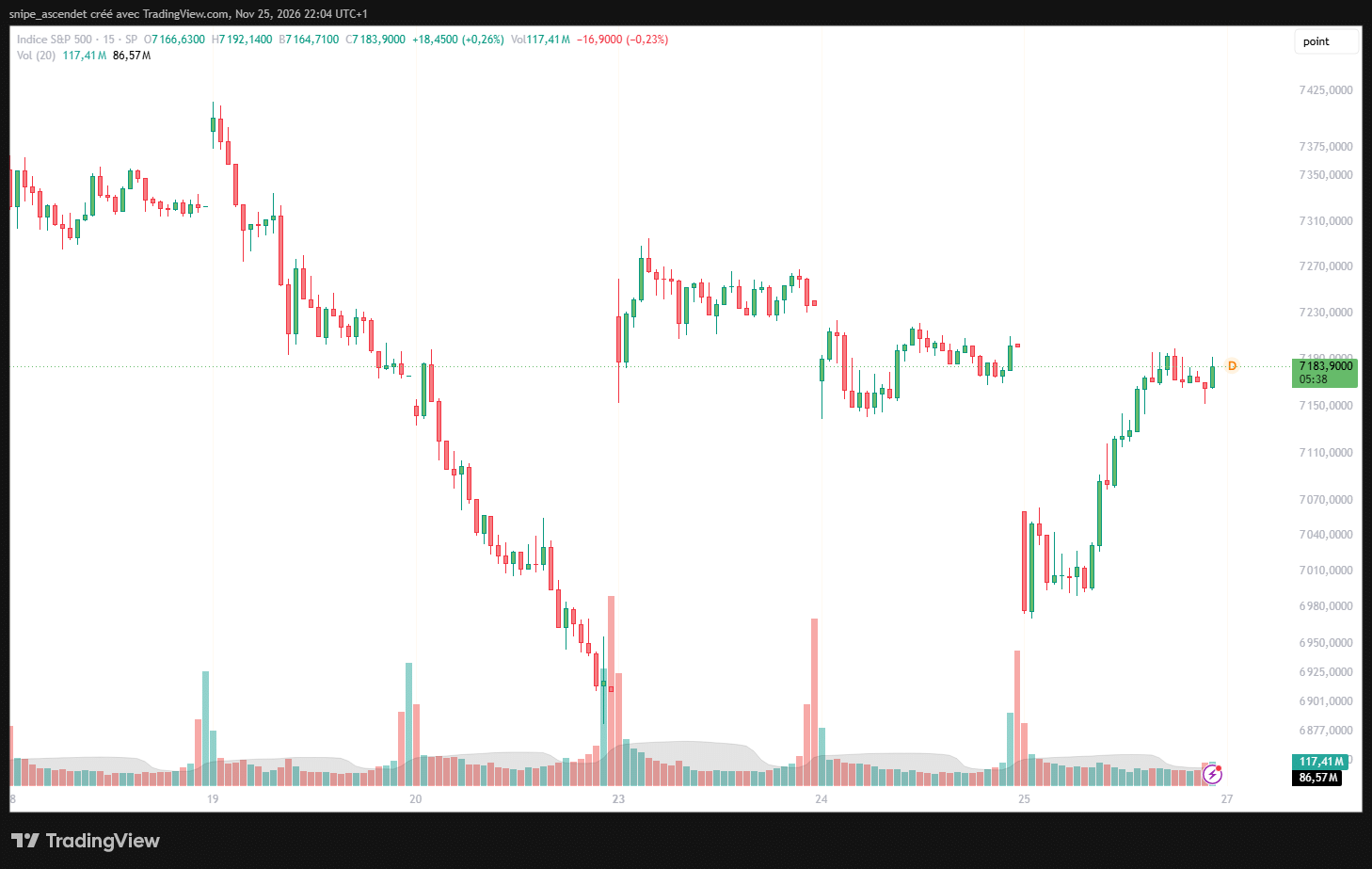
Buying during the afternoon helped reduce the losses, and the Dow’s positive finish indicates that the weakness was not uniform. However, a recovery from an intraday low is different from a sustained market reversal, especially when financing costs and earnings expectations are under pressure.
Nasdaq-100 Briefly Reaches Bear-Market Territory
The Nasdaq-100 briefly traded 20% below its record closing high on November 25, according to Reuters. It subsequently recovered above that threshold. A temporary intraday breach is not the same as a closing confirmation of a bear market.
Semiconductors remain especially exposed to changes in expected AI investment. SOXX traded around $215 at its June 2026 peak and reached $127.95 on November 25, a decline of approximately 40% from that approximate peak. Its November 25 rebound from a daily low of $118.18 amounted to 8.27%, even though the ETF remained lower on the day.
Nvidia’s AA Credit Rating Faces a Potential Downgrade
On November 25, Reuters reported that S&P Global Ratings placed Nvidia on CreditWatch with negative implications. Its AA rating remains in place, but a one-notch downgrade is possible as the agency evaluates management and governance concerns.
The distinction matters. Nvidia retains a high investment-grade rating, and the credit review is not a finding of financial distress. It does, however, highlight questions about board independence, executive oversight and succession planning that Huang’s reinstatement has not resolved.
Nvidia traded at $149.53 at approximately 4:04 p.m. ET on November 25, down 9.40% from its November 23 close of $165.05. It remained 19.12% above its November 20 close of $125.53, meaning that the two subsequent declines had only partially reversed Monday’s gain.
CoreWeave Bonds Expose the Financing Risk Behind AI
The stress in corporate debt is potentially more consequential than the afternoon equity rebound. Reuters reported on November 25 that CoreWeave’s (NASDAQ: CRWV) 2030 bonds reached a record low, with yields on its 2031 bonds approaching 18%.
CoreWeave’s 9.625% senior notes due July 15, 2032, had already traded as low as 74.9 cents per dollar of face value on November 24, according to reported TRACE transactions. An indicative November 25 quotation near 73 cents would imply a discount of approximately 27% to par, although that specific quotation has not been independently confirmed.
CoreWeave’s September 30 quarterly filing shows $47.505 billion of future debt principal payments, including $10.974 billion scheduled for 2027. The latter represents approximately 23.1% of the total.
A falling bond price does not change the fixed coupon on existing debt. But if comparable yields persist when CoreWeave needs new financing, future projects could become more expensive, reducing the cash available to shareholders and limiting expansion.
SpaceX GPU Rental Prices Raise Questions About AI Returns
A November 25 Wccftech report citing SemiAnalysis institutional research suggests SpaceX reduced small-cluster Blackwell spot rates from $15-$15.50 to $10-$12 per GPU-hour. Neither a company price sheet nor confirmation of the reported change was identified.
Using the midpoint of both reported ranges, the reduction would be 27.87%. At unchanged utilization, a fleet of 10,000 GPUs running at 80% utilization would generate the following illustrative annual rental revenue:
| Hourly GPU rate | Annual gross rental revenue |
|---|---|
| $15.25 | $1.069 billion |
| $12.00 | $840.96 million |
| $11.00 | $770.88 million |
| $10.00 | $700.80 million |
The midpoint scenario reduces annual gross revenue by $297.84 million before electricity, operating costs, depreciation and interest. It is a sensitivity calculation, not a forecast for SpaceX. Long-term contract prices may behave differently from spot prices.
Anthropic’s Reported H200 Contract Risk Adds to Supply Concerns
The same report suggests Anthropic might not renew capacity covering approximately 50,000 H200 GPUs, with SpaceX potentially marketing the capacity to other customers at around $5 per GPU-hour for early 2027. Elon Musk has previously expressed a contrary view about Anthropic’s future compute needs, and no confirmed nonrenewal was identified.
If older accelerators return to the rental market while new Blackwell and Vera Rubin capacity expands, providers may need to cut prices or accept lower utilization. That would be particularly important for operators servicing debt incurred when GPU capacity commanded higher prices.
Lower compute prices can also stimulate demand, making AI applications more economical. The investment question is whether the increase in usage offsets the reduction in revenue per GPU-hour and the capital required to expand.
New US Tariff Proposals Add to Corporate Margin Risks
The US Trade Representative announced Section 301 proposals on November 25 covering 14 trading partners. The proposed rates vary by country, product exclusions and existing agreements.
| Trading partners | Initial proposed rate or ceiling | Conditional alternative |
|---|---|---|
| China | Up to 20% | Up to 40% |
| Vietnam | Up to 35% | 20% |
| India | Up to 25% | 17% |
| Taiwan, South Korea | Up to 15% | Up to 25% |
| Indonesia, Malaysia, Thailand, Cambodia | Up to 18% | Up to 25% |
| European Union, Japan, Switzerland | Up to 15% | Up to 20% |
| Singapore | Up to 20% | 10% |
| Bangladesh | Up to 18% | Up to 20% |
These are proposals, not newly effective duties. The alternative rates and exemptions also matter: many semiconductor products already subject to Section 232 tariffs are excluded under the non-China notices. Exposure depends on the product, origin and existing duty treatment, rather than the headline country rate alone.
Higher Inflation Limits the Fed’s Room to Support Markets
The Bureau of Economic Analysis reported on November 25 that October PCE inflation reached 3.8% year over year, with core inflation at 3.3%. Both measures increased 0.3% month over month. Real consumer spending was essentially flat.
Separately, the BEA revised third-quarter GDP growth to a 4.3% annualized rate. Resilient growth and persistent inflation reinforce expectations for tighter monetary policy, extending the pressures discussed in our analysis of rising two-year Treasury yields.
Higher discount rates reduce the present value of future earnings, while borrowing costs can increase. AI infrastructure businesses with significant upfront investment face both effects at once.
Gold, Silver and Bitcoin Also Come Under Pressure
Reuters reported spot gold at $3,547.29 per ounce at 2:19 p.m. ET on November 25 after it briefly fell below $3,500. Silver also reached its lowest level since August 2025 during the session.
Bitcoin fell to approximately $58,128 at 9:30 a.m. ET on November 25, according to Corgano’s morning market readings. These are intraday observations, not closing prices. Simultaneous weakness across metals and crypto highlights how higher rate expectations can affect assets with very different investment characteristics.
What Investors Should Watch After Thanksgiving
US stock markets are closed on Thursday, November 26, and reopen on Friday, November 27, with an early 1 p.m. ET close. Reduced holiday liquidity may amplify price swings.
The next major monetary policy catalyst is the December 8-9 Federal Reserve meeting. Written tariff comments are due January 5, 2027, with hearings scheduled to begin January 25. Investors should also monitor AI bond yields, GPU rental rates, customer renewals and the pace of new data center commitments.
Bottom line: The November 25 recovery reduced immediate equity losses but left the fundamental risks unresolved. Investors assessing AI stocks should focus on cash generation, utilization and refinancing capacity alongside revenue growth, particularly if compute prices decline and borrowing costs remain high.
For informational purposes only; not investment advice.