

Nvidia shares were down 6.06% at $167.85 in Tuesday afternoon trading on November 10, 2026, as fresh reporting raised questions about how advanced artificial-intelligence chips reached Chinese customers through intermediaries. At approximately 1:16 p.m. Eastern, the company’s stock was falling much faster than the iShares Semiconductor ETF, down 1.51%, and the Nasdaq-100-tracking Invesco QQQ Trust, down 1.42%. AMD shares were up 0.18% at the same snapshot. These are intraday TradingView quotations, not official closing prices.
The immediate catalyst was an investigation by The Information alleging that a business network connected to Alice Huang helped arrange at least $7.5 billion in Nvidia-chip shipments to Chinese firms. Separately, Bloomberg reported a roughly 50,000-chip discrepancy between trade records and an inventory accounting Nvidia had supplied to US officials concerning Singapore-based Megaspeed. The allegations have not established that Nvidia knowingly violated export rules. But they create a more difficult question for shareholders: whether Nvidia can demonstrate effective oversight of its distributors while preserving a fast-growing AI business. Reuters reported that the company was on course for a roughly $470 billion two-session market-value decline earlier Tuesday.
What the $7.5 billion China chip allegation actually says
According to The Information’s November 10 reporting, Alice Huang and associates operated or used companies in China and Singapore to source Nvidia hardware. One company identified in the account, Shanghai Century Litong, gained preferred cloud partner status in 2023, allegedly improving its access to chips. The report put the total at roughly 240,000 H100, H200 and some A100 chips and named Chinese technology groups and AI laboratories among users of the computing capacity. Reuters summarized the allegations but explicitly said it could not independently verify the report.
That distinction matters financially and legally. A reported $7.5 billion in shipments is not proof that Nvidia recognized $7.5 billion of additional revenue, that every shipment broke US law, or that its executives authorized illegal transfers. The products, shipment dates, end users, licensing status and roles of different intermediaries would all have to be established. Renting access to computers outside China also presents different compliance questions from physically transferring controlled chips across borders.
A separate part of the controversy concerns Nvidia CEO Jensen Huang’s relationship with Alice Huang. Reuters reported that Huang had acknowledged marital infidelity, while the allegations that Alice Huang acted for Chinese intelligence remain disputed and unverified independently by Reuters. Nvidia’s November 8 board statement announced an investigation led by independent directors and outside counsel. The board said it had no reason at that point to believe US national security or Nvidia trade secrets had been compromised and reaffirmed confidence in its CEO. Its investigation had not issued a public final finding as of this article’s November 10 cutoff.
Bloomberg’s 50,000-chip inventory gap raises a separate control question
The Megaspeed story should not be conflated with The Information’s 240,000-chip shipment estimate. Bloomberg’s November 9 investigation, also carried in greater detail by The Business Times, compared commercial records for chips sold to Megaspeed via hardware partners with the inventory totals Nvidia had presented to US authorities. The reported difference was about 50,000 units, valued at billions of dollars. That was an accounting or reconciliation gap, not a verified count of stolen or smuggled hardware.
After questions were raised, Nvidia told Bloomberg it had inspected additional Megaspeed warehouses containing the hardware. The company did not disclose an exact updated count or the documentation required to reconcile the full difference publicly. Megaspeed has denied allegations of chip diversion and said an investigation by Singapore authorities concluded without adverse action against it. Those company statements do not, by themselves, establish the outcome of any separate US investigation.
Bloomberg also reported that Nvidia general counsel Tim Teter contacted a senior Commerce Department official in 2025 to ask about Singapore’s detention of Alice Huang. Contact with a regulator is not inherently improper, and the report did not establish that Nvidia caused an investigation to stall. For investors, the material issue is whether the company can provide a consistent, independently checkable chain of custody for controlled hardware moving through distributors, cloud providers and data centers.
NVDA drops 6% as selling volume rises
Nvidia’s November 10 daily TradingView candle showed $173.97 at the open, $174.69 at the intraday high, $166.24 at the intraday low and $167.85 at the capture time. The approximately 275.03 million shares traded by 1:16 p.m. ET exceeded the chart’s 20-day average daily volume of about 146.83 million. Because the session was unfinished, the final daily high, low, close and volume could still change. The roughly 1.87-times ratio compares incomplete current-day turnover with a full-day historical average; it highlights unusually active trading, not a final daily-volume multiple.
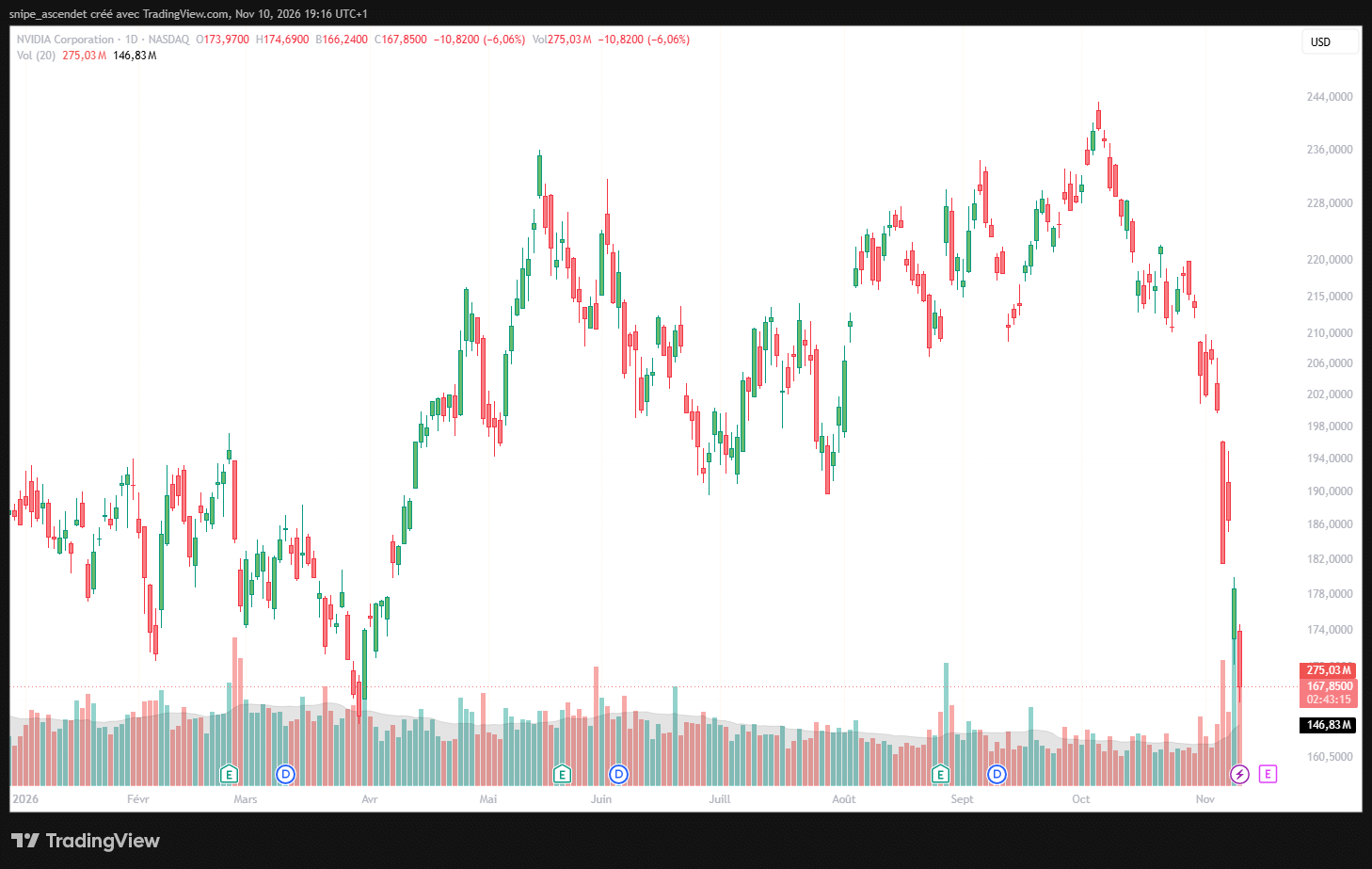
The four-hour chart adds detail: the decline accelerated during the first half of November, with rallies repeatedly failing to reverse the downward sequence. A small upward move in the currently forming four-hour candle did not alter the daily decline. Chart structure can describe market behavior; it cannot establish how much selling was caused by any single allegation.
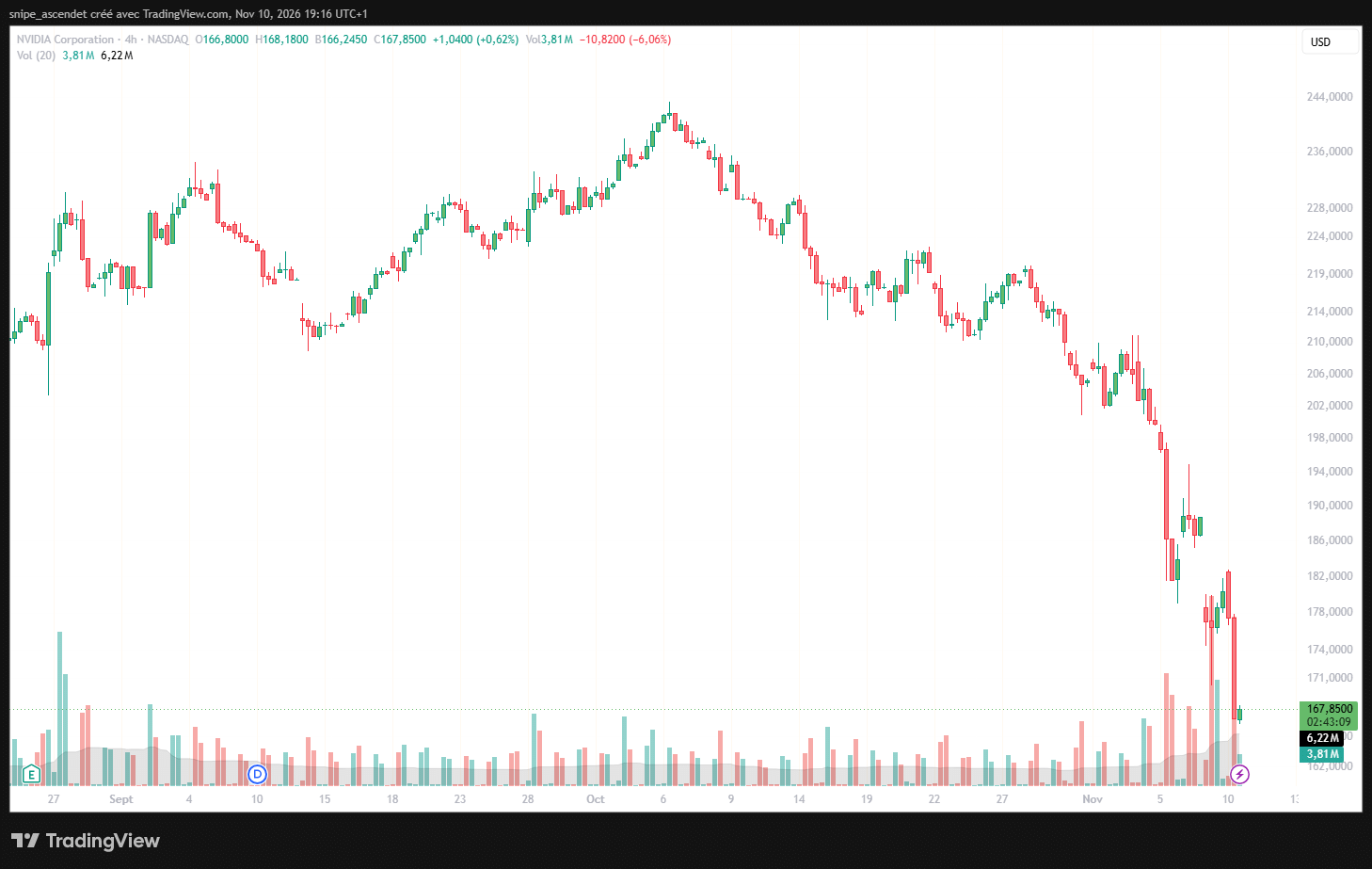
Monday’s official Nvidia closing price was $178.67, following a 4.27% decline, according to the previous session’s market data. Tuesday’s $167.85 quote was $10.82 lower, or 6.06%, but was still provisional. Our report on the November 9 Wall Street rally and Nvidia’s initial divergence examines why the first selloff occurred even as much of the market rebounded.
AMD, SOXX and QQQ separate company risk from a wider selloff
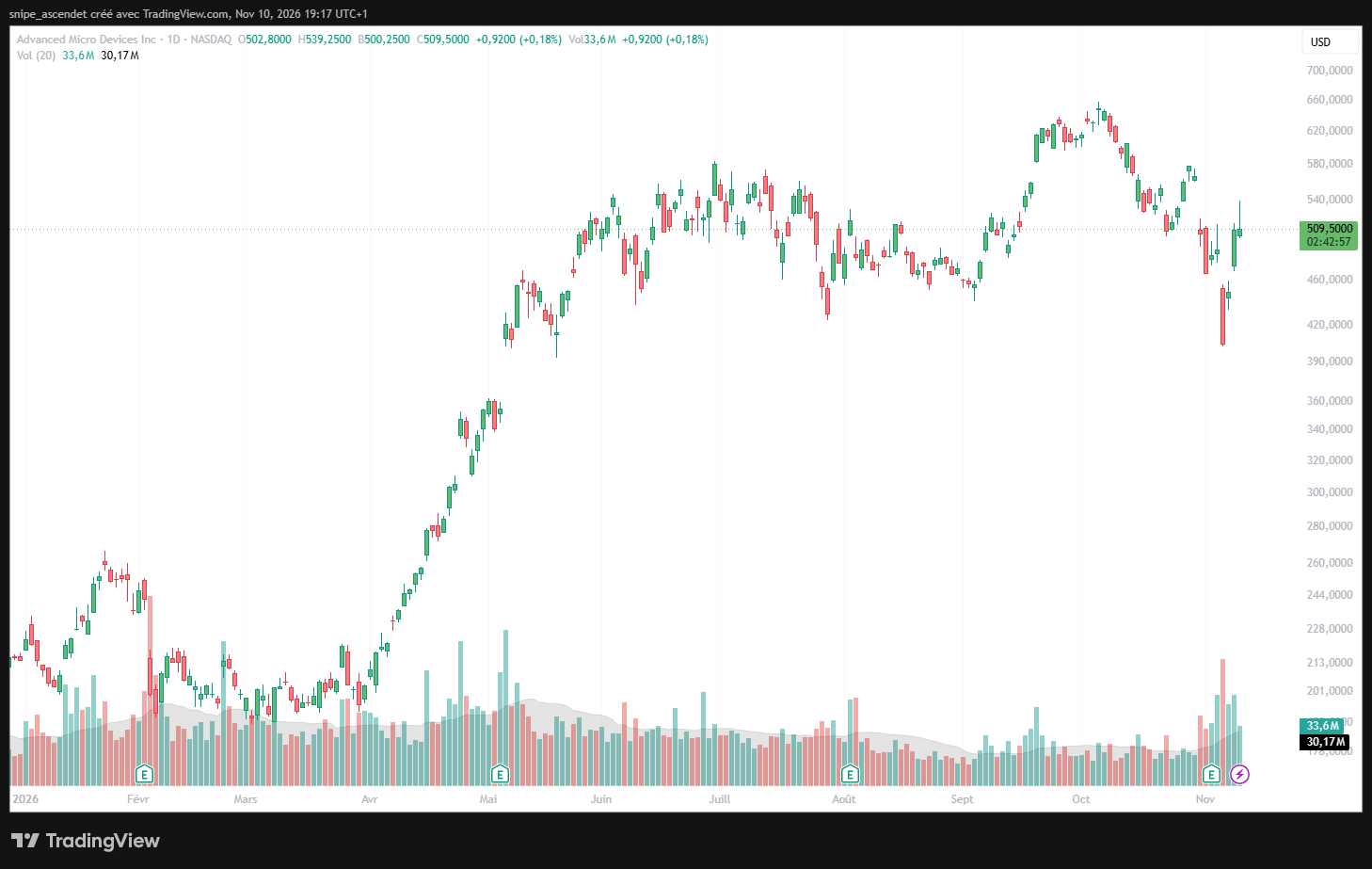
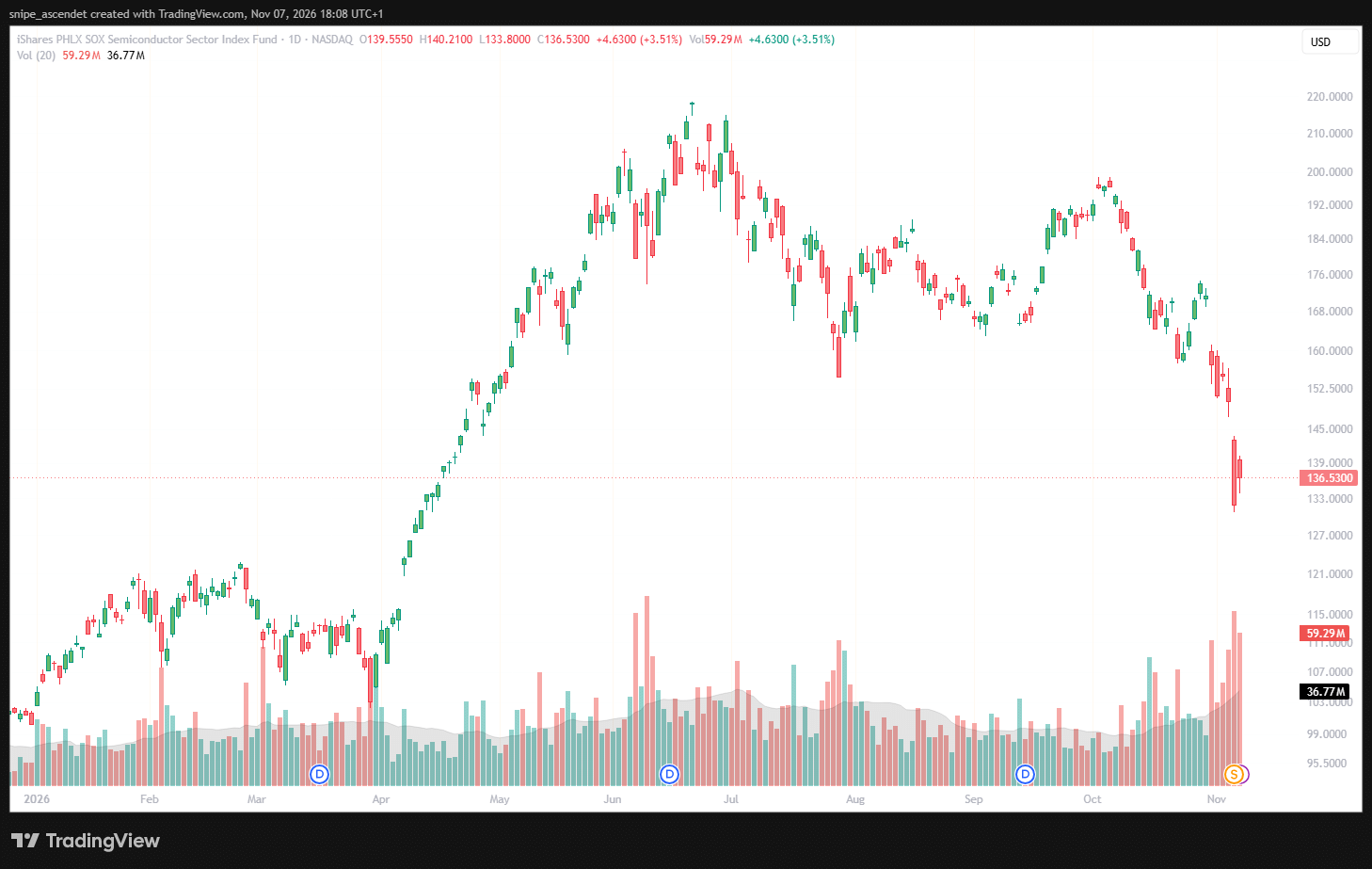
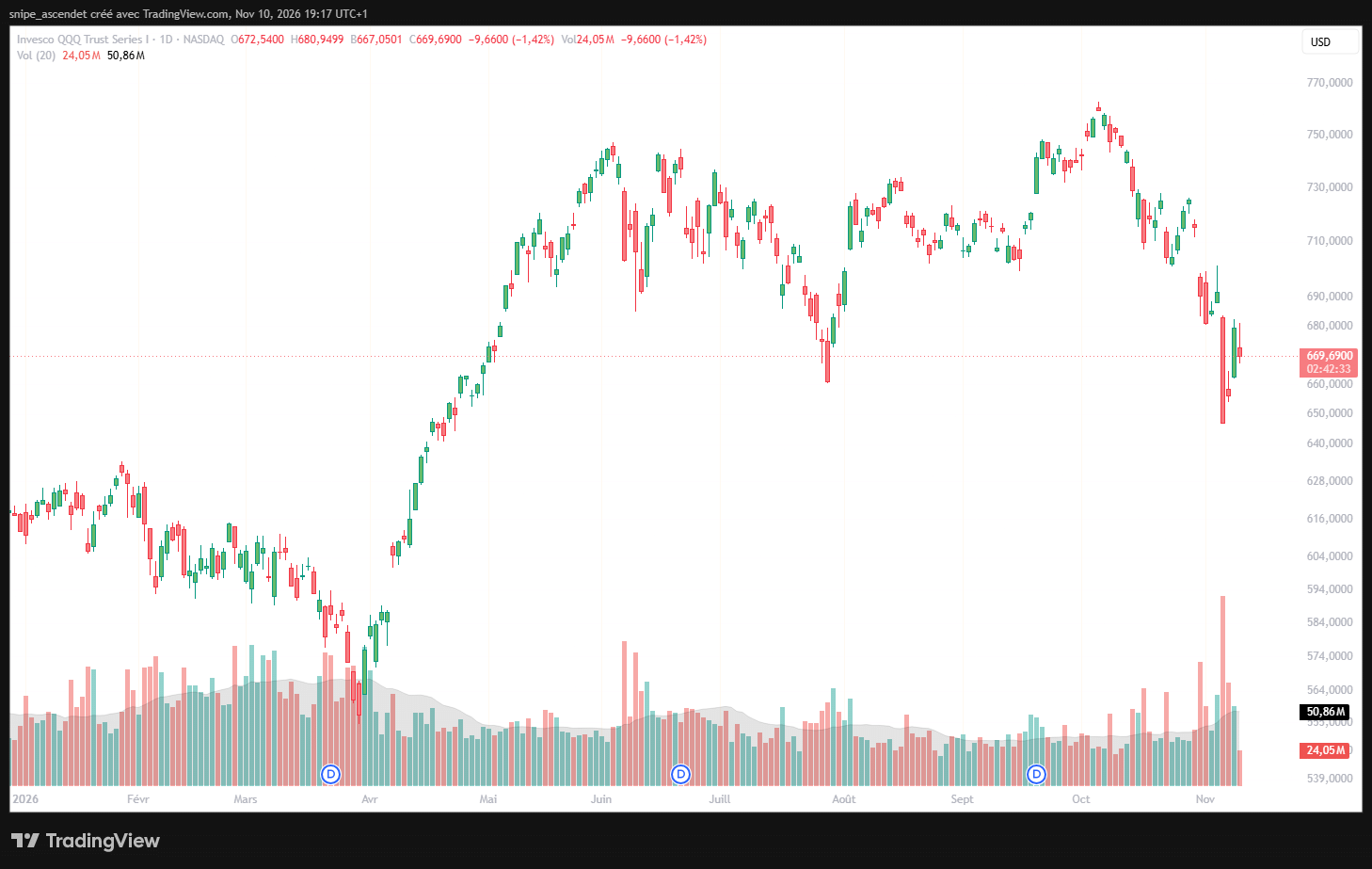
At identical intraday capture times on November 10, Nvidia underperformed AMD by approximately 6.24 percentage points, SOXX by 4.55 points and QQQ by 4.64 points. Relative performance is more informative than comparing the dollar prices of different shares. It indicates that Nvidia-specific news contributed to a distinctly weaker trading pattern, while not proving a precise causal breakdown between governance concerns, export-control headlines, technology valuations and broader market risk.
| Instrument | Intraday quote | Daily move | Analytical role |
|---|---|---|---|
| NVDA | $167.85 | −6.06% | Company-specific exposure |
| AMD | $509.50 | +0.18% | GPU competitor |
| SOXX | $144.54 | −1.51% | Semiconductor basket |
| QQQ | $669.69 | −1.42% | Nasdaq-100 exposure |
AMD’s relative resilience does not mean customers are transferring orders from Nvidia or that AMD has erased Nvidia’s scale advantage. The companies’ latest earnings cover different fiscal periods, and their Data Center segments are not identical measures of accelerator sales. Our AMD-versus-Nvidia revenue analysis details the gap between Nvidia’s $89.0 billion quarterly Data Center business and AMD’s more recent $8.55 billion segment revenue.
SOXX shows that the rest of the semiconductor group was also under pressure. The ETF’s historical series is split-adjusted, so investors should not mistake historical changes in displayed per-share prices for an unexplained trading collapse. The broad correction provides context, but the ETF’s smaller intraday decline helps isolate Nvidia’s relative underperformance.
QQQ fell 1.42%, confirming broader weakness in large-cap growth exposure. QQQ tracks the Nasdaq-100 and must not be described as the Nasdaq Composite index. For context on the preceding week’s fragility, see DualFinances’ Nasdaq rebound analysis. French readers seeking background on index funds and direct US stock ownership can consult DualFinances.fr’s guide to US market investing (in French).
Export controls are not a blanket ban on every China sale
Nvidia’s Form 10-Q for the quarter ended July 26, 2026 makes clear why the distinction between authorized and unauthorized sales is essential. US restrictions vary by chip specifications, buyer, end user, destination and licensing conditions. The company said it had received licenses from February 2026 to ship limited quantities of H200 products to specified China-based customers, while Chinese government restrictions prevented the full authorized volume from being sold. Nvidia said H200 shipments under that program represented less than 1% of its most recent quarterly Data Center revenue.
The same filing says Nvidia faced a 25% tariff linked to an inspection requirement on licensed H200 shipments and had taken a $400 million charge in the first half of fiscal 2027 related to excess H200 inventory and purchase obligations. These details show that the China opportunity was already constrained before the present controversy. A determination of wrongdoing would require evidence about specific shipments and applicable rules, not the mere presence of Nvidia chips at a Chinese customer.
In its August 26 earnings release, Nvidia said its outlook for third-quarter fiscal 2027 revenue was approximately $108 billion, plus or minus 2%, and specifically assumed no Data Center compute revenue from China. That does not make supply-chain controls irrelevant: regulatory disruption, customer vetting, reputational damage or changes in access to cloud capacity could still affect partnerships and future sales channels beyond directly forecast China revenue.
Nvidia’s underlying earnings remain formidable, but uncertainty affects valuation
Nvidia’s fiscal second-quarter revenue reached $96.22 billion, up 106% year over year; Data Center revenue was approximately $89.02 billion, up 117%. GAAP gross margin was 75.0% and GAAP operating income was $63.73 billion. These are reported results, not estimates. Nvidia also disclosed approximately $21.34 billion in free cash flow under its company-specific definition for the quarter. Investors should distinguish these disclosed fundamentals from the unquantified potential financial impact of the investigations. FinanceToTheTop.com’s explanation of free cash flow provides context on why different cash-flow definitions require care.
That financial strength means an abrupt change in equity valuation should not automatically be interpreted as a comparable change in expected chip demand. Shares are valued on a discounted stream of future profits and cash flows, with an additional risk premium when uncertainty rises. Governance investigations, more stringent compliance costs, weaker pricing power or a reduced addressable market could each change that calculation even if current customer demand remains strong.
Conversely, investors should not assume that a lower share price is necessarily a bargain. A credible valuation needs forward earnings, margins, capital spending, the share count and an appropriate discount rate, rather than a comparison to the October peak alone. For a methodological overview, see FinanceToTheTop.fr’s introduction to DCF and comparable-company valuation (in French). A useful historical companion is Bourse24.tv’s French-language report on the initial Jensen Huang investigation, which predates the latest shipment allegations.
Three scenarios investors can monitor through November 17
Bullish: the company can reconcile shipments and preserve trust
An independent, documented reconciliation of inventories, no established export-control violations and a clear board update could reduce the uncertainty priced into NVDA. Strong demand and resilient guidance would reinforce the idea that the stock’s decline reflected elevated perceived risk rather than a sudden earnings collapse. This scenario requires new evidence and is not the current established outcome.
Base case: investigations continue while earnings remain strong
Additional disclosures may emerge gradually, leaving a persistent governance discount even if customer orders and revenue expectations hold up. Market performance could then depend on the credibility of Nvidia’s compliance reforms, regulatory developments and broader AI valuations. The wide gap between NVDA and AMD would not necessarily persist each day.
Bearish: documented violations or distribution restrictions
If authorities establish unauthorized transfers, require substantial changes to Nvidia’s partner network, or impose penalties, investors could reassess future revenue opportunities, costs and management oversight. Such outcomes remain contingent, not confirmed. Another risk is simply that the AI sector’s valuation contracts further, which could amplify NVDA volatility regardless of the investigations’ ultimate findings.
The next scheduled financial catalyst is November 17, 2026, when Nvidia will release fiscal third-quarter results and hold a 5 p.m. ET conference call, according to its official investor-relations calendar. Investors should watch actual revenue against management’s $108 billion outlook, Data Center sales, gross margin, cash conversion and any factual updates on governance or export compliance. The central question is no longer just how quickly Nvidia can sell more AI compute; it is how convincingly it can account for the chips distributed through its global ecosystem.