

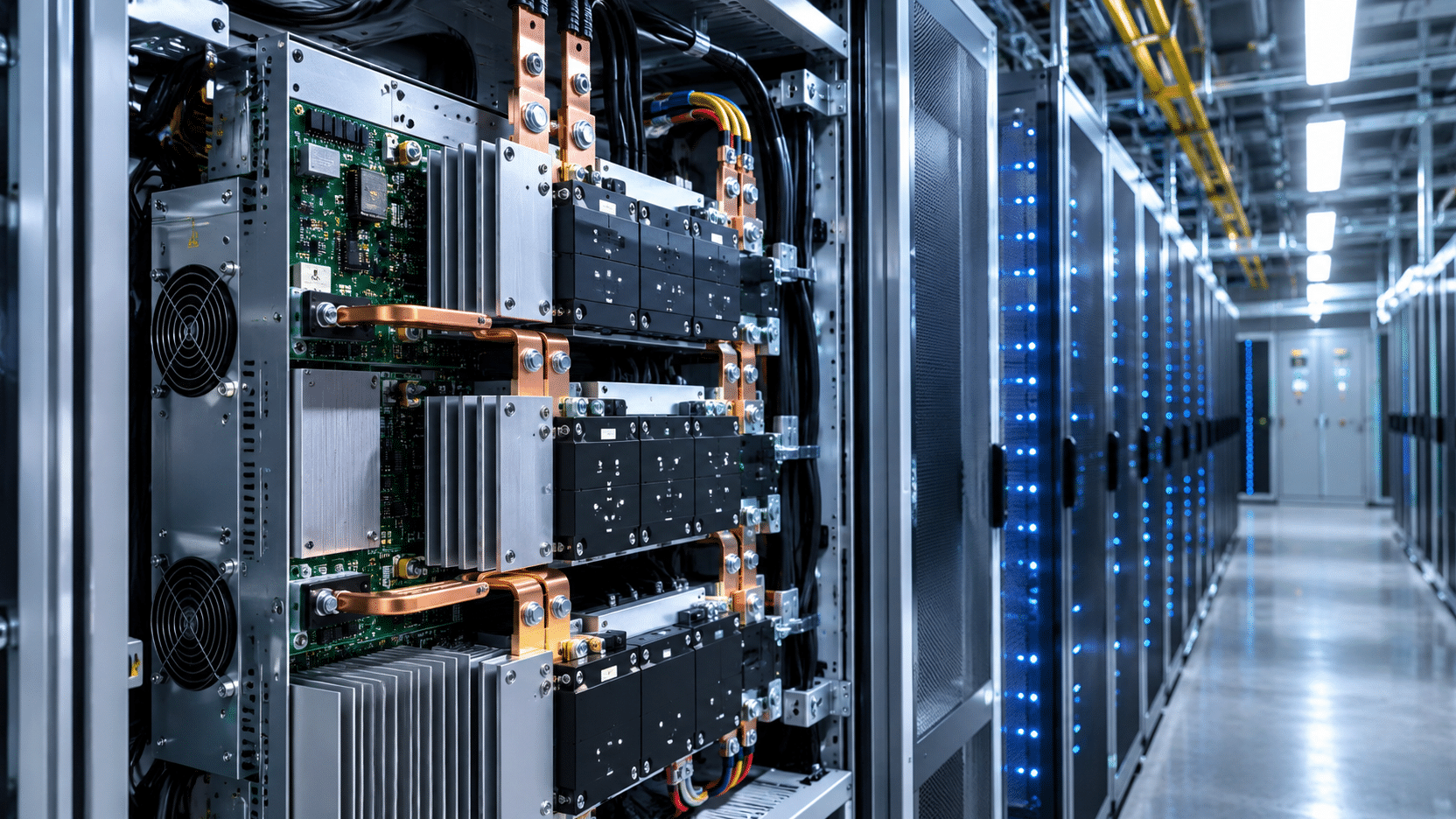
Infineon Technologies expects fiscal 2027 revenue to reach approximately €20 billion, up more than 20% from the €16.353 billion recorded in fiscal 2026, as demand for data center power supplies accelerates. The German semiconductor company said on November 10 that revenue from those supplies could approach €4 billion in the year ending September 2027. Yet the stock’s reaction and the gap between cash flow guidance and analyst expectations show why stronger AI demand alone does not settle the investment case. Infineon’s official earnings announcement sets out both the growth targets and the substantial spending needed to achieve them.
Infineon is not competing with Nvidia primarily as a supplier of AI accelerators. It makes the power semiconductors, conversion systems and control components that help move electricity through data centers and into computing equipment. That distinction matters: a wave of accelerator investment can raise demand for power infrastructure, but it does not guarantee Infineon will earn an attractive return on every additional factory investment.
Infineon’s 2027 Outlook: Growth Above 20%, Margins in the Mid-20s
Infineon reported fiscal 2026 revenue of €16.353 billion, a 12% increase from the previous year. Its segment result reached €3.223 billion, corresponding to a 19.7% segment result margin. Management now expects roughly €20 billion in fiscal 2027 revenue, which represents an implied 22.3% increase from the reported base. The company projects a segment result margin in the mid-20% range, about five percentage points higher than in fiscal 2026. These are management forecasts, not realized results.
| Metric | FY 2026 reported | FY 2027 outlook |
|---|---|---|
| Revenue | €16.353 billion | Approximately €20 billion |
| Revenue growth | 12% | More than 20% |
| Segment result margin | 19.7% | Mid-20% range |
| Data center power-supply revenue | Approximately €2.2 billion, per management’s November commentary | Close to €4 billion |
| Free cash flow | €993 million | Approximately €1.8 billion |
| Adjusted free cash flow | €1.925 billion | Approximately €2.2 billion |
| Investments | Not compared here | €3.0 billion–€3.5 billion |
The €4 billion figure covers power supplies for AI and conventional data centers, rather than AI-specific chips alone. Management described an increase from roughly €2.2 billion in fiscal 2026, a potentially substantial step up, during its earnings commentary reported by Investing.com. At €20 billion of companywide revenue, the targeted business would represent nearly one-fifth of total sales. However, that share is an approximation based on guidance, not an audited segment disclosure.
The company also expects mid-teens percentage revenue growth in Automotive and low-teens growth in Edge Systems, while Power Systems should expand considerably faster than the group. Infineon reorganized into these three reporting segments in July 2026, so investors should use its restated segment data when comparing historical trends. The guidance assumes an EUR/USD exchange rate of 1.15, making currency changes another source of risk.
Quarterly Earnings: Strong Operating Momentum, Uneven Bottom Line
The fourth quarter, ended September 30, produced €4.706 billion in revenue, up 13% sequentially from €4.172 billion in the third quarter. Segment result climbed to €1.119 billion from €797 million, and the segment result margin improved to 23.8% from 19.1%. The company also reported €532 million in period profit and €0.40 in diluted earnings per share from continuing operations. Its €0.60 adjusted diluted EPS is a different measure and should not be substituted for IFRS diluted EPS.
| Fourth-quarter metric | Reported | Analyst expectation | Difference |
|---|---|---|---|
| Revenue | €4.706 billion | €4.71 billion | -€4 million |
| Segment result | €1.119 billion | €1.10 billion | +€19 million |
| Diluted EPS, continuing operations | €0.40 | €0.52 | -€0.12 |
| Period profit | €532 million | €677 million | -€145 million |
Consensus figures above were reported by Investing.com on November 10; estimates are not Infineon guidance. The figures combine metrics with different accounting definitions and should be read line by line.
The quarter therefore delivered stronger segment profitability without an equivalent earnings-per-share beat. Infineon’s next quarter also bears watching: management projects approximately €4.6 billion in revenue and a segment result margin near 23% for the first quarter of fiscal 2027, implying slightly lower revenue than in the just-reported quarter. Its longer-term optimism should not be mistaken for uninterrupted sequential growth.
The €4 Billion Data Center Opportunity: Power, Not GPUs
AI training and inference clusters require large amounts of electricity to reach increasingly dense arrays of accelerators. Power must be converted, regulated, protected and delivered efficiently, from grid connections to server racks and processors. Infineon’s data center technology overview describes silicon, silicon carbide and gallium nitride devices across that chain. More complex power architecture can increase the semiconductor content per system even when the company does not manufacture the GPU itself.
Its relationship with Nvidia provides a concrete example. On October 21, Infineon announced an expanded collaboration on gallium nitride conversion for 800-volt direct-current data center systems. That is evidence of technical participation in next-generation power designs, not proof of a guaranteed revenue amount or exclusive supplier position.
Management said cumulative revenue associated with multi-year data center delivery and capacity-reservation arrangements, including both signed contracts and agreements still under negotiation, exceeded €10 billion. The distinction is essential: a combined signed-and-negotiated total is not equivalent to a firm order backlog. The company must still secure customer commitments, expand output, ship products and collect cash. Its quarterly reporting also points to energy infrastructure, electric mobility and software-defined vehicles as additional growth drivers.
Infineon Stock: An Early Jump Fades to a Modest Gain
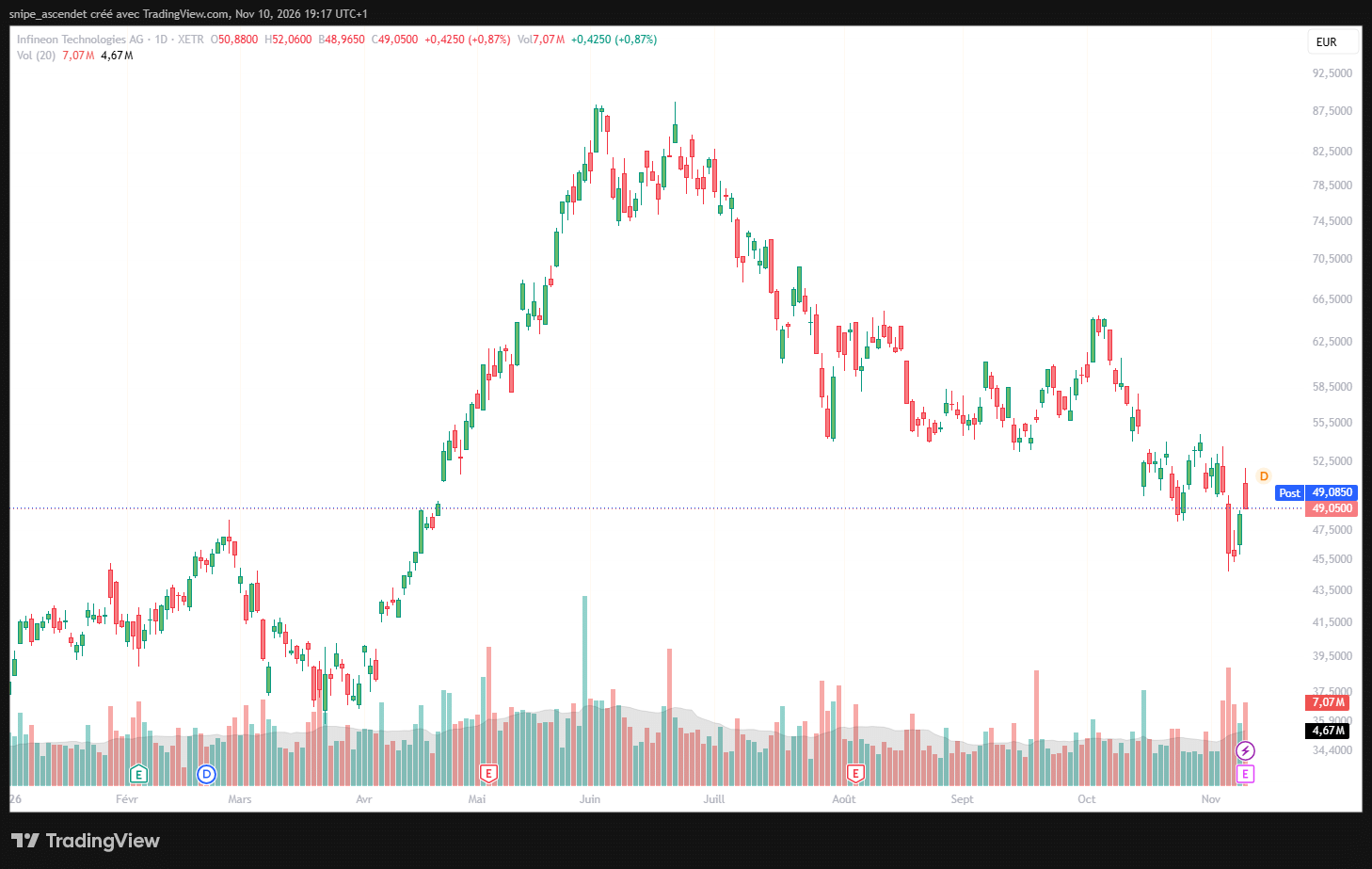
Infineon’s Xetra shares closed November 10 at €49.05, up 0.87%, according to the supplied TradingView daily screenshot and Xetra market data. The daily chart shows an opening price around €50.88 and a session high of €52.06 before the price retreated. Trading volume was about 7.07 million shares, compared with a 20-session average near 4.67 million in the screenshot. The result was a positive close, but not an unqualified endorsement of the outlook.
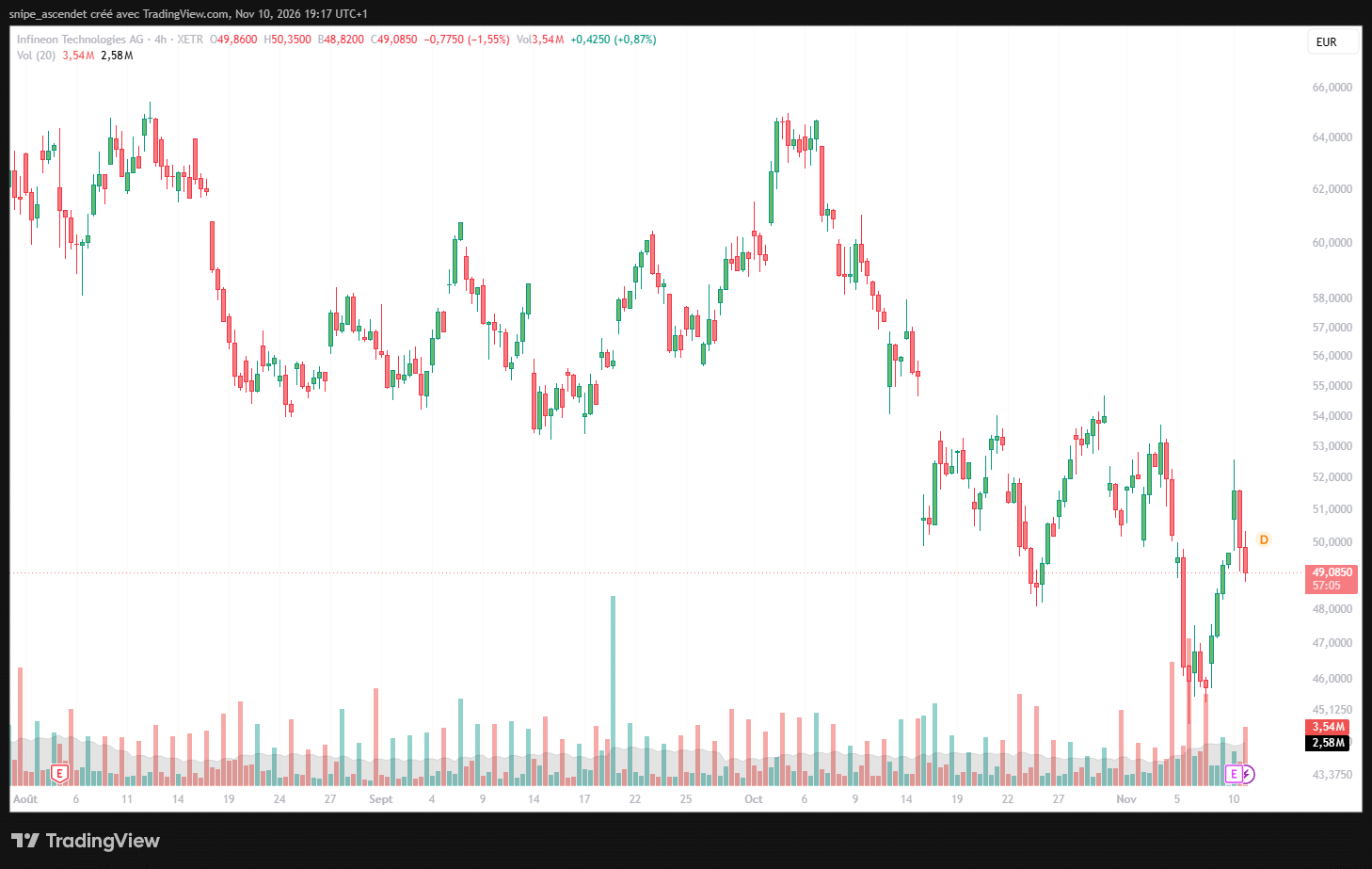
The four-hour view helps explain the mixed response. Infineon recovered from a sharp early-November decline before its earnings announcement, but the latest four-hour candle fell as prices pulled back from the session’s initial strength. It would be misleading to describe that red four-hour candle as a negative full-day return: the daily Xetra session finished higher. As always, chart patterns describe price behavior, not a verified cause for individual trades.
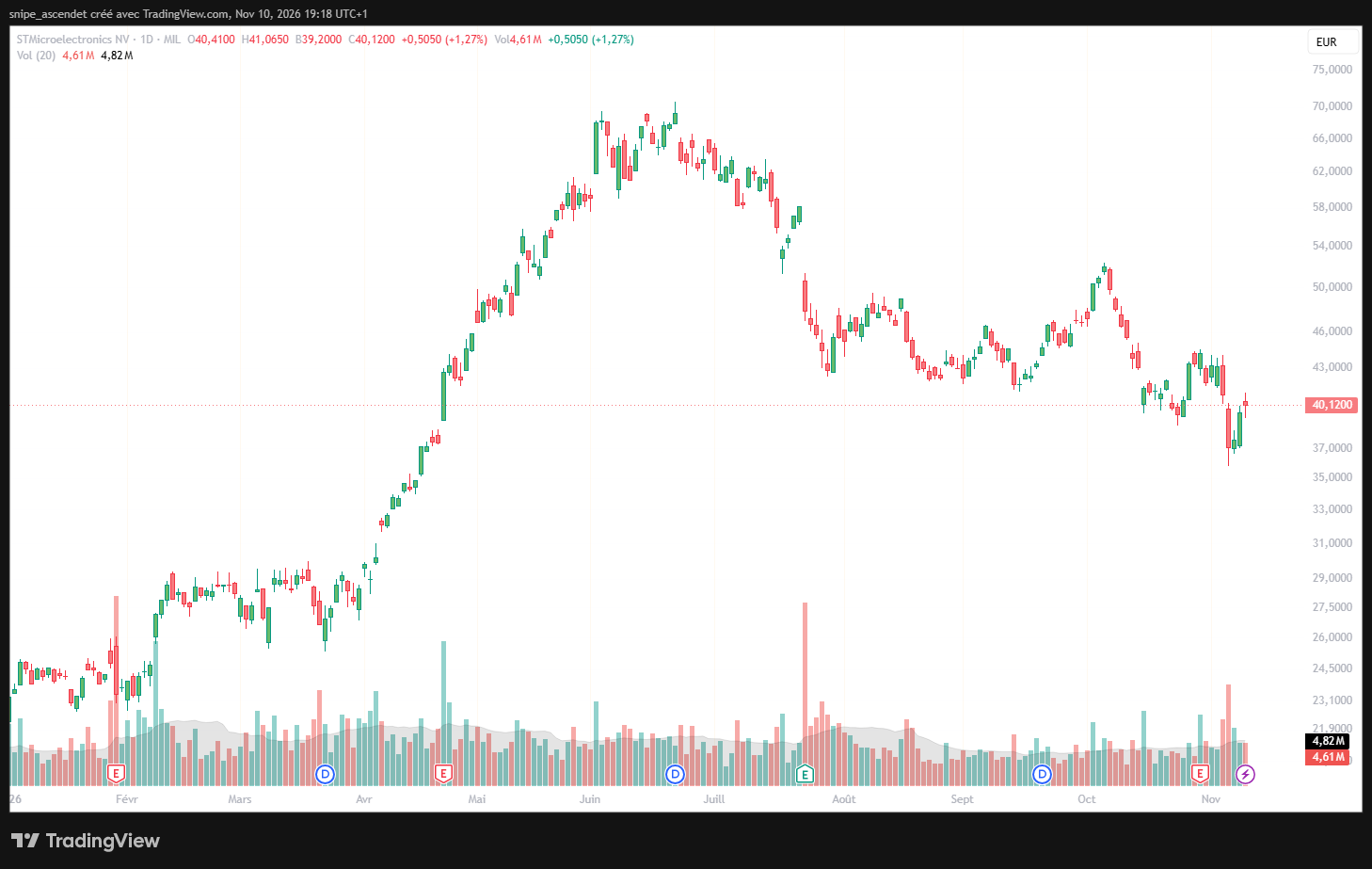
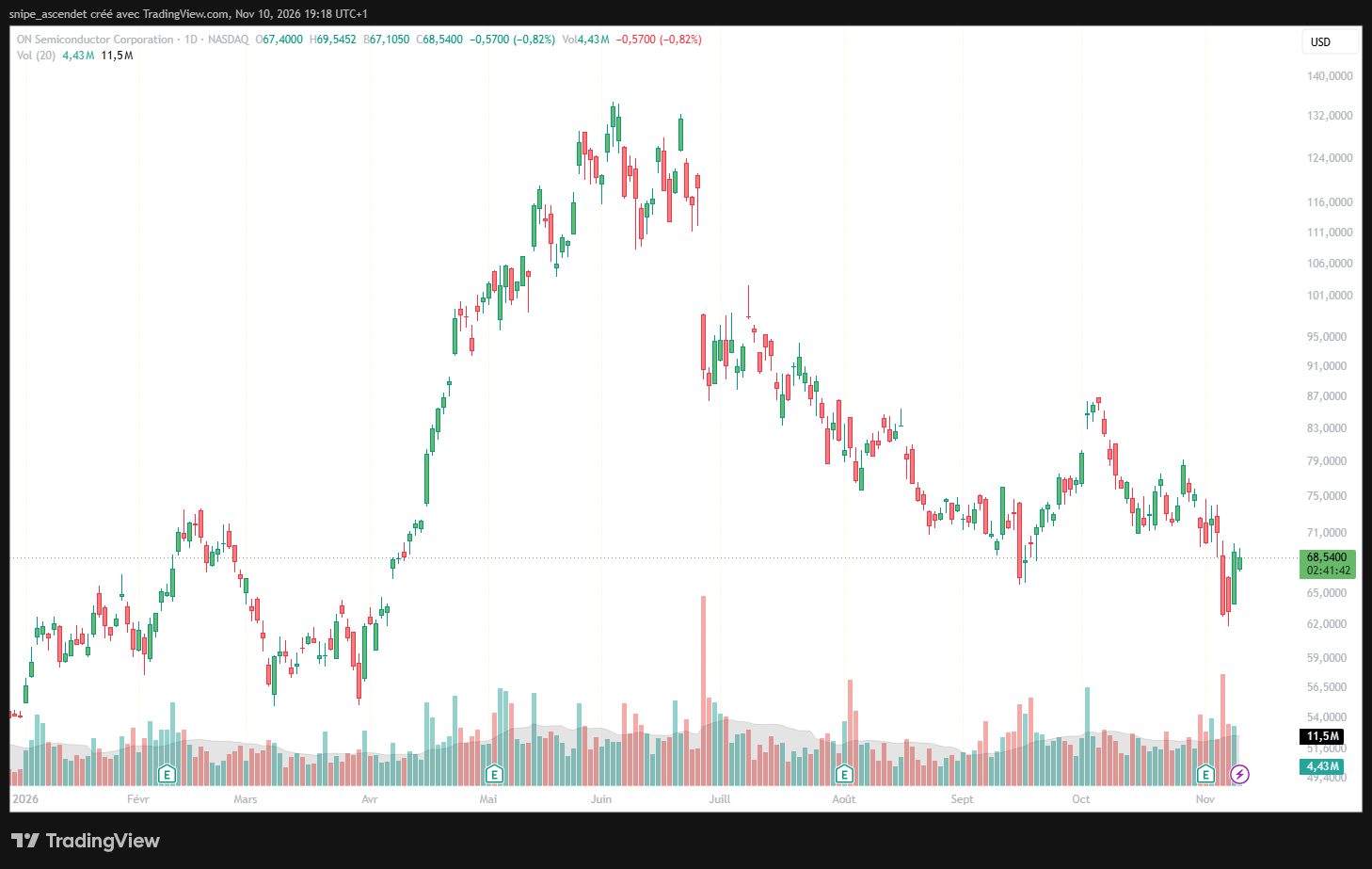
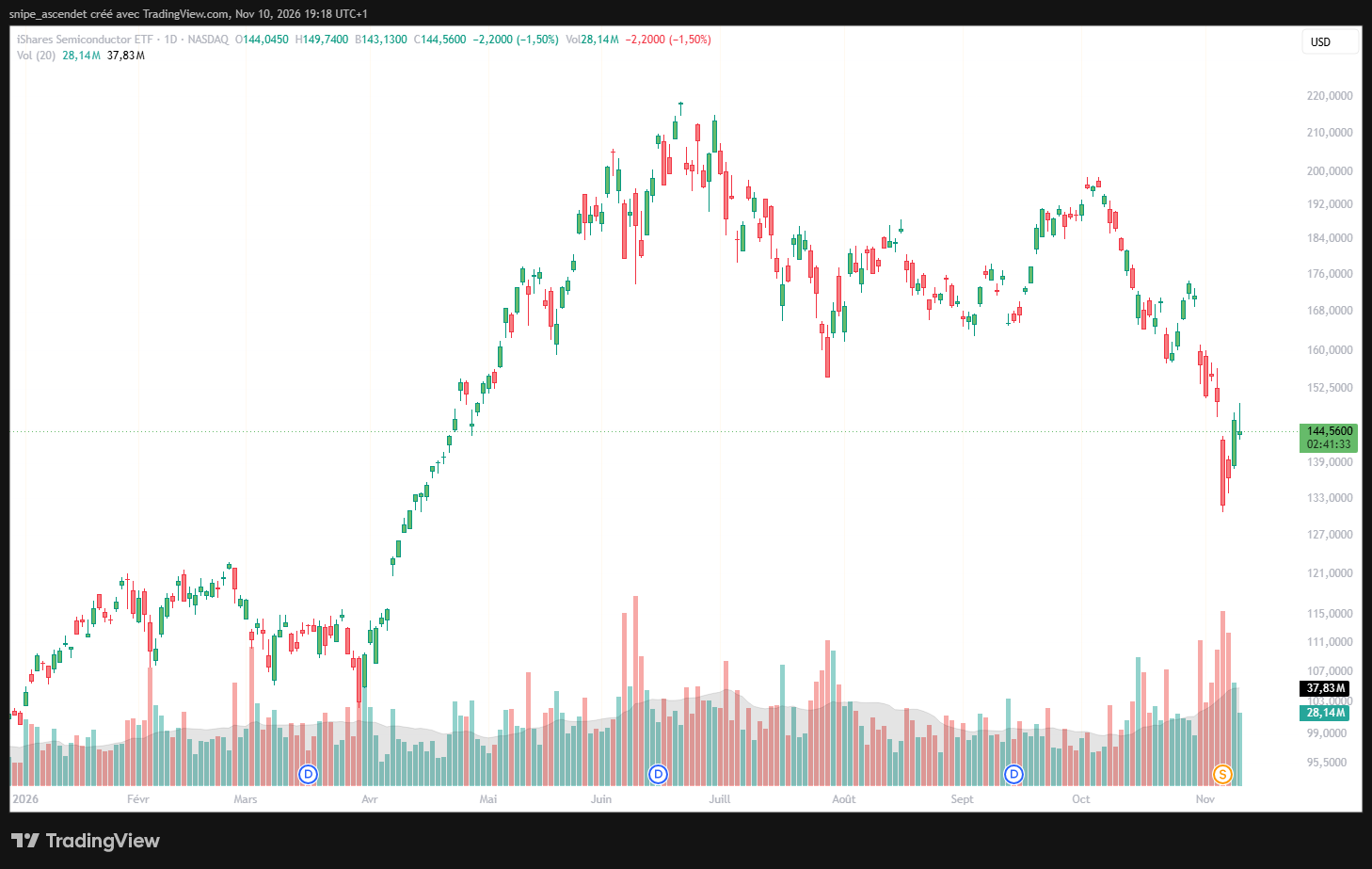
The comparison with broader semiconductor trading reinforces the need for care. At the chart-capture time around 1:18 p.m. Eastern on November 10, onsemi traded near $68.54, down 0.82%, and the iShares Semiconductor ETF (SOXX) near $144.56, down 1.50%. Those were intraday US indications, not official US closes. STMicroelectronics’ Milan listing (STMMI) finished near €40.12, up 1.27%, based on its supplied daily chart. The charts reflect different exchanges and currencies, so a same-day percentage change is not proof that Infineon outperformed a like-for-like business basket.
Why the Cash Flow Forecast Is the Real Test
Infineon expects €1.8 billion in fiscal 2027 free cash flow, below the €2.26 billion analyst estimate reported by Investing.com. Its approximately €2.2 billion adjusted free cash flow forecast likewise trails the €2.74 billion cited consensus. Revenue guidance, by contrast, narrowly exceeds the €19.81 billion reported expectation. That combination suggests the market must evaluate both growth and the near-term cost of supplying it.
| FY 2027 measure | Company outlook | Reported consensus | Outlook minus consensus |
|---|---|---|---|
| Revenue | €20.00 billion | €19.81 billion | +€190 million |
| Free cash flow | €1.80 billion | €2.26 billion | -€460 million |
| Adjusted free cash flow | €2.20 billion | €2.74 billion | -€540 million |
Importantly, the company’s adjusted free cash flow excludes certain major investments in front-end factory buildings. It is not simply a second interchangeable name for free cash flow. The distinction matters when comparing manufacturers with very different expansion programs. For a broader explanation, FinanceToTheTop.com examines how free cash flow is calculated, including the consequences of capital expenditure and differing company definitions.
Management plans €3 billion to €3.5 billion in investments in fiscal 2027, including a Dresden production ramp, silicon carbide capacity in Kulim, Malaysia, and gallium nitride manufacturing in Villach, Austria. These commitments could support higher-value products and future margins, but they also expose the company to utilization risk if customer orders or the AI infrastructure cycle slow.
Infineon ended September 2026 with €2.137 billion of gross cash and €6.850 billion of financial debt, implying €4.713 billion of net debt on the company’s definition. Free cash flow in fiscal 2026 was €993 million, versus adjusted free cash flow of €1.925 billion. In other words, the business enters its next phase with an established revenue base and genuine cash generation, but also substantial capital needs. For investors assessing the quality of an earnings release, FinanceToTheTop.com’s guide to financial reporting red flags provides a useful framework.
There is one further accounting nuance. The fiscal 2027 free cash flow outlook excludes the proposed sale of Infineon’s NOR Flash and F-RAM memory business to Winbond. If regulatory approvals and closing occur, the company says pretax proceeds could increase reported fiscal-year free cash flow by up to €1 billion. This would be a transaction-related cash inflow, not evidence that recurring chip operations generated another €1 billion.
STMicroelectronics and onsemi: Similar End Markets, Different Exposure
Infineon is not alone in supplying power electronics. STMicroelectronics has significant silicon carbide manufacturing investments as well as automotive and industrial exposure. Its latest SEC-filed update describes further spending on selected growth programs. The supplied Euronext Milan STMMI chart shows the stock’s large midyear advance followed by a substantial correction, underscoring how cyclical expectations affect valuations.
US-listed onsemi is another relevant comparator. On November 10 the company introduced its EliteSiC M4 platform, describing prospective applications in electric vehicles, AI data centers and industrial power. Technical claims from company product announcements are not direct comparisons of realized revenue or profitability. The onsemi chart also shows that semiconductor equity weakness extended beyond any one European issuer.
For sector context, SOXX tracks US semiconductor shares across different business models. It fell in the November 10 intraday snapshot despite Infineon’s positive Xetra close. SOXX completed a three-for-one share split effective November 5, 2026, as confirmed by an iShares SEC filing. The chart is split-adjusted; earlier nominal prices must not be compared against the new share price without the same adjustment. Our analysis of semiconductor infrastructure stocks under pressure gives context for the recent valuation reset.
The broader supply chain extends into electricity production, networking and the accelerators themselves. DualFinances has separately examined AMD’s AI revenue gap with Nvidia and the question of whether AI power companies can convert demand into cash. A related Bourse24.tv report on the semiconductor selloff provides additional market context in French. These comparisons illustrate a central investment risk: infrastructure demand may be broad while returns to shareholders remain highly company-specific.
Bull and Bear Cases for Infineon in 2027
Bull case: AI data center orders convert into delivered products, the Dresden and other capacity expansions reach profitable utilization, and the more favorable product mix supports the anticipated increase in segment margin. Improving automotive and industrial demand adds another driver. Stronger recurring free cash flow would make the higher capital spending easier to justify.
Bear case: hyperscaler deployment schedules stretch out, new power architectures ramp more slowly than expected, or competition pressures pricing. Manufacturing investments then arrive before the corresponding revenue. Currency movements, weaker automotive orders or operating delays could further compress margin. Investors could mark the shares down even if revenue still rises because the implied future cash returns weaken.
What to monitor next: quarterly Power Systems growth under the new segment structure, the gap between adjusted and unadjusted free cash flow, customer commitment conversion, capacity utilization, and whether the next fiscal quarter meets the company’s approximately €4.6 billion revenue and 23% margin outlook. These are observable catalysts; no unsupported stock-price target is necessary.
Infineon’s €20 billion revenue goal is an important statement about the demand for electrical infrastructure behind AI. The company is aiming to capture more of the power content inside data centers, not to replace GPU designers. For shareholders, however, the decisive issue is whether the expected increase in revenue and segment profitability produces a durable rise in cash flow after the spending required to deliver it.