
Anthropic began marketing an initial public offering on November 10, 2026, proposing to sell 825 million shares at $70 to $78 apiece. At the top of that range, the public offering would total $64.35 billion before any underwriters’ option. A separate $26 billion placement with seven technology suppliers could bring the initial transaction to about $90.35 billion, and the full over-allotment option could push gross sales above $100 billion. But the bigger issue for Wall Street is not the IPO’s record-setting scale. It is whether Anthropic can turn explosive demand for Claude into enough enduring cash flow to support approximately $900.9 billion of disclosed computing and infrastructure commitments. The terms are set out in Anthropic’s November 10 announcement and its amended SEC prospectus.
Anthropic’s IPO Terms: What the $100 Billion Headline Includes
Anthropic plans to sell 801,351,354 newly issued Class A shares, while existing stockholders will offer another 23,648,646 shares. The company receives no proceeds from the stockholder sales. Underwriters may buy up to 123,750,000 additional new shares during a 30-day option period. Anthropic has applied to trade on the Nasdaq Global Select Market under ANT, but the shares had not begun trading as of November 10. The registration statement was not yet effective when the company announced its roadshow.
| Transaction component | At $78 per share | How to interpret it |
|---|---|---|
| 825 million public shares | $64.35 billion | Includes both new shares and existing-holder sales |
| Separate private placement | $26.00 billion | Contingent supplier investment in Class N shares |
| Combined offering and placement | $90.35 billion | Gross amount, not the cash Anthropic keeps after expenses |
| 123.75 million-share underwriters’ option | $9.65 billion | Only if exercised in full at the top of the price range |
| Potential total including option | About $100.00 billion | Conditional maximum, not a completed raise |
The prospectus estimates $84.6 billion in net company proceeds at the $74 midpoint from the issuer’s IPO shares and private placement, after estimated fees and expenses, or $93.7 billion if the option is fully exercised. Those estimates are not interchangeable with the gross maximum calculated at $78. The timetable remains subject to final pricing, regulatory effectiveness and market conditions. Reuters reported that preliminary offering terms circulated earlier had been larger before the formal amended filing.
$1 Trillion or $1.4 Trillion? The Valuation Gap Explained
The difference between the two widely quoted valuation figures is primarily a share-count question. Anthropic expects approximately 13.087 billion Class A, N, T, E and F shares outstanding after the public offering and placement, excluding exercise of the over-allotment option. At $78 per share, multiplying that count by the proposed price gives approximately $1.02 trillion of market capitalization on the disclosed outstanding-share basis. Reuters also cited a valuation of about $1.4 trillion on a broader fully diluted basis that includes equity-linked securities such as options and restricted stock.
The figures are not two separate offers or a $400 billion cash payment. Fully diluted valuation anticipates additional potential shares and depends on precisely which awards, reserves and convertible instruments are counted. That distinction matters when comparing Anthropic with established listed technology companies, whose headline market capitalizations generally use shares currently outstanding. At the top of the range, $1.02 trillion is roughly 12.6 times Anthropic’s October annualized revenue run rate, while a $1.4 trillion fully diluted valuation is roughly 17.3 times that same measure. Neither calculation is a conventional trailing-12-month sales multiple.
The valuation has also reset from discussions of much higher prices earlier in the fall. For context, DualFinances previously covered Anthropic’s proposed November listing before the price range was public, while Bourse24 examined the earlier valuation debate in French. The amended S-1 provides firmer deal terms than those prior market discussions.
Claude Revenue Is Accelerating, but GAAP Profitability Is Not Consistent
The company’s 2025 revenue was $4.585 billion. In the nine months ending September 30, 2026, revenue reached $33.242 billion, up from $2.545 billion in the comparable prior-year period. Quarterly revenue rose from $11.555 billion in Q2 2026 to $16.956 billion in Q3, an increase of approximately 46.7%. Anthropic reported an annualized revenue run rate of about $81 billion as of October 31, up $10 billion from a month earlier. That run rate annualizes a more recent activity level: it is not realized annual sales or an assurance that future quarterly revenues will match it.
| Performance measure | Period | Reported |
|---|---|---|
| Revenue | 2025 full year | $4.585 billion |
| Revenue | First nine months of 2026 | $33.242 billion |
| GAAP operating result | First nine months of 2026 | -$1.260 billion |
| Adjusted operating result | First nine months of 2026 | +$4.081 billion |
| Revenue | Q3 2026 | $16.956 billion |
| GAAP operating result | Q3 2026 | -$567 million |
| Annualized revenue run rate | October 31, 2026 | About $81 billion |
The gap between GAAP and adjusted earnings deserves attention. Adjustments in the prospectus include stock-based compensation and certain noncash charitable contributions, which do not erase the economic significance of dilution. The GAAP operating result swung from a $974 million profit in Q2 to a $567 million loss in Q3, even as sales advanced. The lesson for IPO investors is that strong product demand does not guarantee a straight-line path toward higher margins when the company must continually add costly computing capacity.
The $26 Billion Supplier Placement Creates a Two-Sided AI Trade
The private placement is backed by companies that sell Anthropic the chips, cloud services and infrastructure used to build and serve Claude. The amended filing identifies $10 billion from Google and $10 billion from Nvidia, followed by $2.5 billion from AMD, $1 billion each from Broadcom, Micron and Microsoft, and $500 million from TSMC Partners. Importantly, Google’s participation funds part of an investment obligation under a pre-existing 2026 arrangement. That means not every dollar in the $26 billion should automatically be described as wholly new strategic support.
| Strategic investor | Placement commitment | Relevant commercial exposure |
|---|---|---|
| $10.0 billion | Cloud and TPU infrastructure | |
| Nvidia | $10.0 billion | GPU accelerators |
| AMD | $2.5 billion | GPU accelerators |
| Broadcom | $1.0 billion | Custom silicon and connectivity |
| Micron | $1.0 billion | Memory |
| Microsoft | $1.0 billion | Cloud infrastructure |
| TSMC Partners | $0.5 billion | Semiconductor manufacturing ecosystem |
This structure gives suppliers potential equity upside while preserving a commercial relationship with one of their major AI customers. Yet it also raises an analytical question: how much of the sector’s apparent investment demand comes from independent end customers, and how much is reinforced by suppliers financing customers that buy their products? The placement is not evidence of wrongdoing or proof that chip orders lack demand. It does, however, make cash conversion and related-party dependencies especially important to evaluate.
Nvidia: A $10 Billion Commitment Does Not Eliminate Market Risk
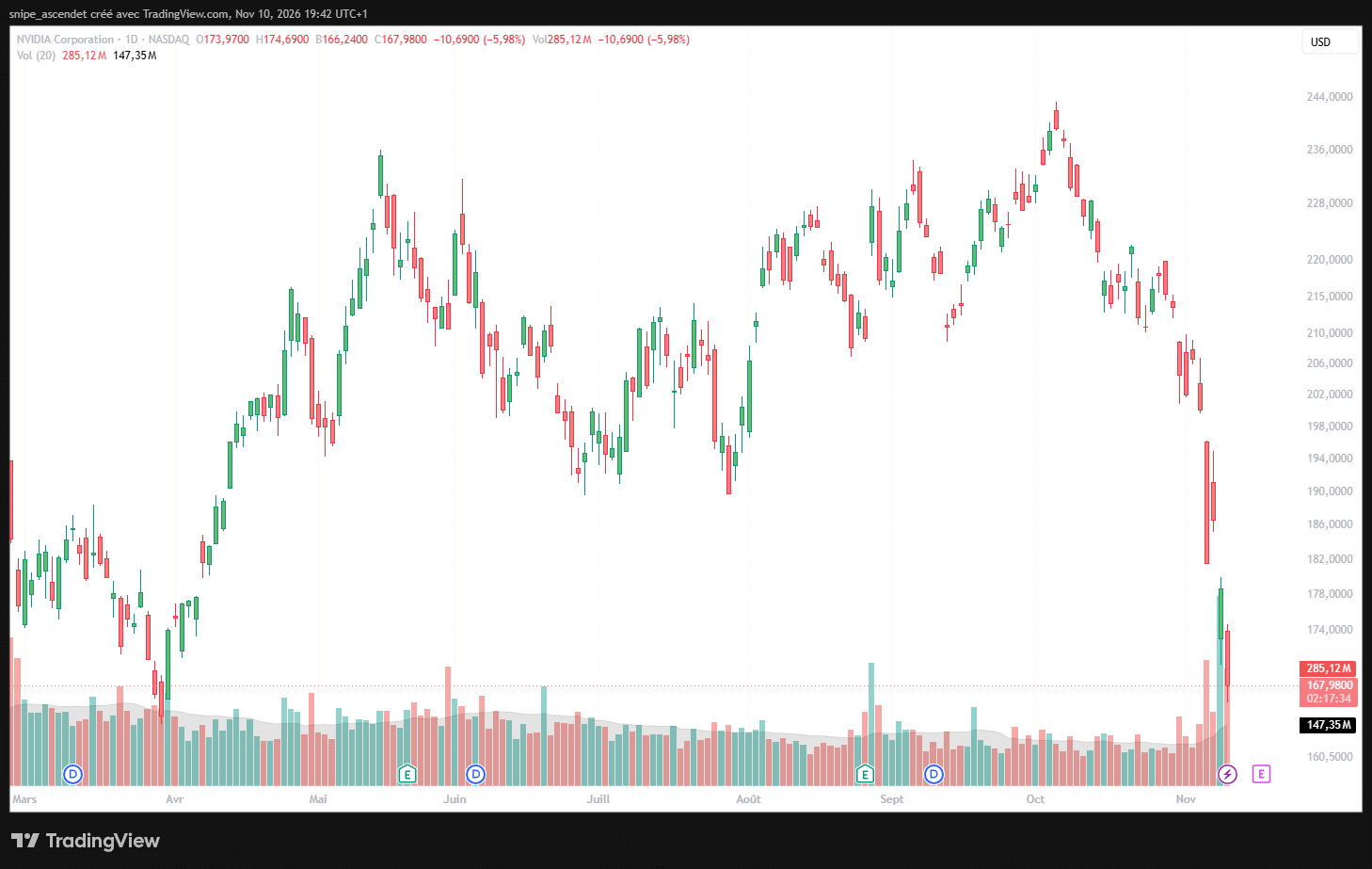
Nvidia’s daily TradingView screenshot captured around 1:42 p.m. Eastern on November 10 showed NVDA at $167.98, down 5.98% intraday, with approximately 285.12 million shares traded at that point. The chart’s 20-session volume reference was about 147.35 million shares. Both volume and the daily percentage were still changing during the U.S. session. The move should not be attributed solely to Anthropic’s IPO: Nvidia faced other company-specific headlines and broader AI-sector pressure. A committed equity check can deepen a customer relationship without insuring the supplier’s market valuation.
Alphabet: Equity Exposure and Cloud Revenue Are Different Returns
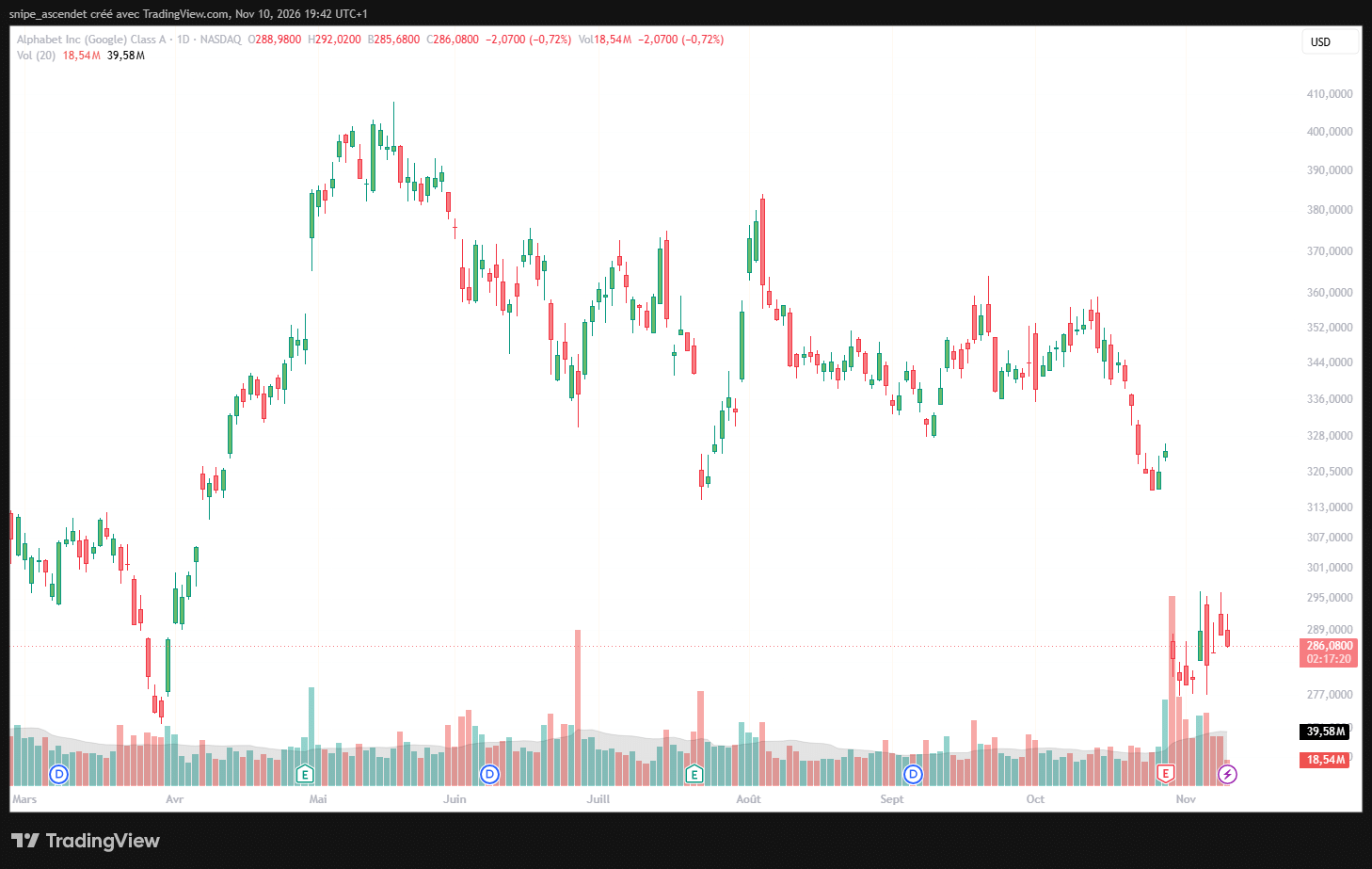
Alphabet’s GOOGL screenshot showed $286.08, down 0.72% intraday at 1:42 p.m. Eastern. Anthropic already relies on Google TPUs and cloud services, making the IPO relevant to both Alphabet’s investments and its cloud capacity. However, any future Anthropic equity gain is distinct from the margin Google might earn selling infrastructure. Costs associated with supporting large AI workloads also need to be measured against the sales they generate.
Amazon: An Existing Strategic Partner, Not a Buyer in This Placement
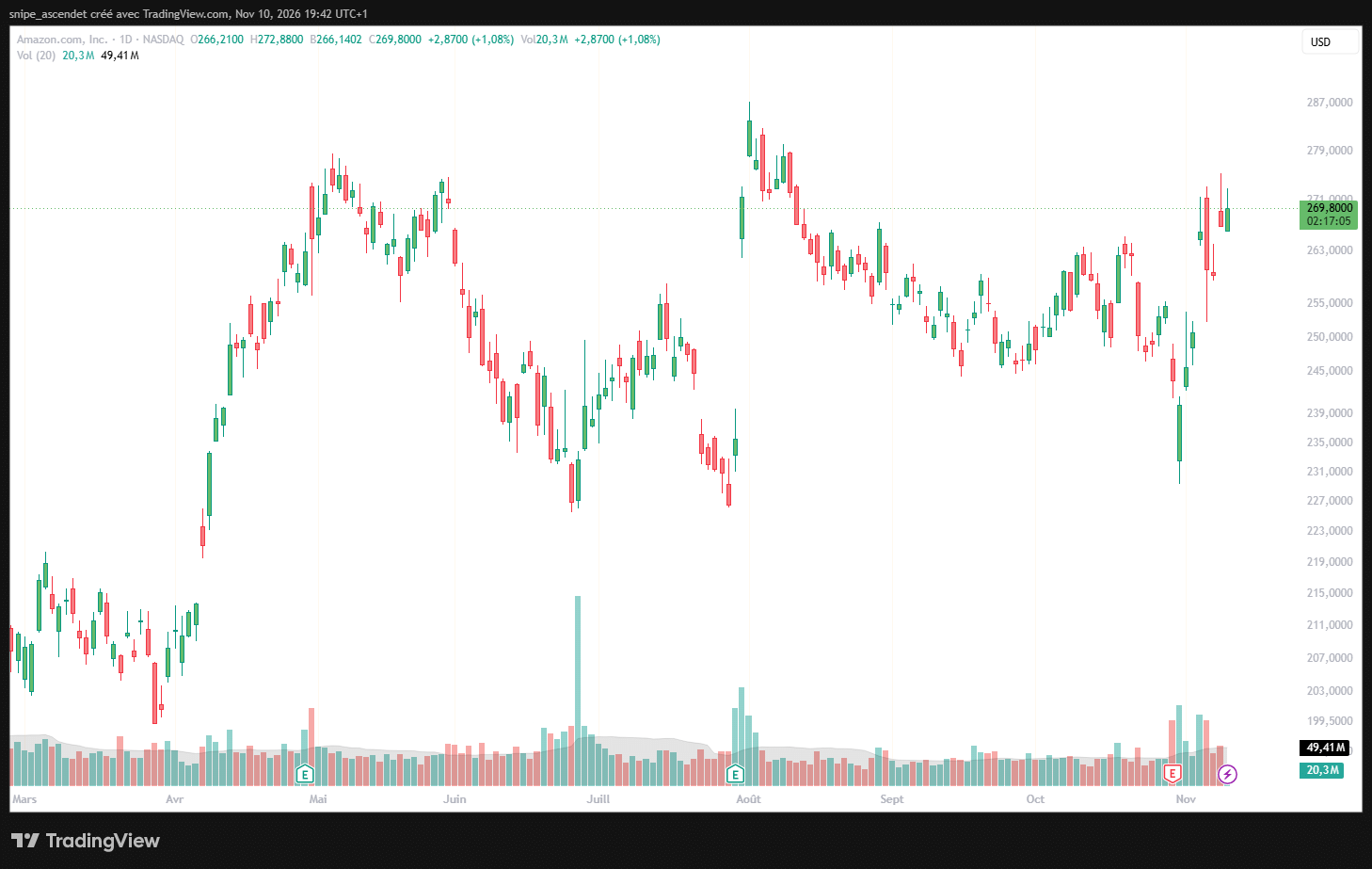
Amazon’s AMZN screenshot showed $269.80, up 1.08% intraday. AWS is part of Anthropic’s multi-chip computing ecosystem through Trainium, and Amazon is an established financial partner. But Amazon is not one of the seven named buyers in the new $26 billion placement. The prospectus separately discusses Amazon’s earlier investment and convertible-note arrangements. Investors should not conflate existing Amazon exposure with a new November 10 commitment of the same type as Nvidia’s or Google’s.
AMD: A Smaller Investment With Strategic GPU Implications
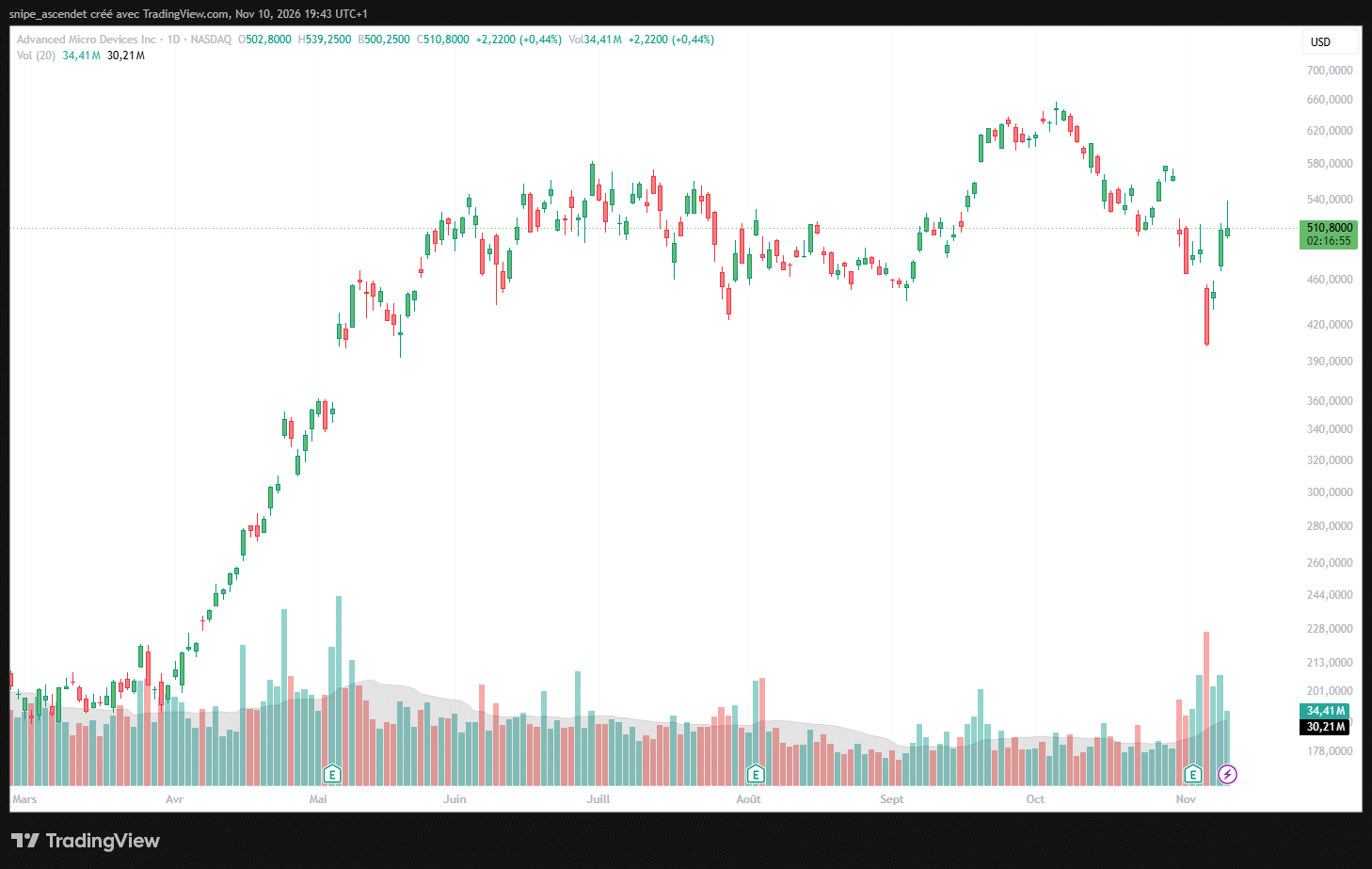
AMD’s daily chart showed $510.80, up 0.44% intraday around 1:43 p.m. Eastern. Its $2.5 billion placement commitment is much smaller than Nvidia’s, but Anthropic identifies AMD GPUs within its broader hardware strategy. The relevant operating test for AMD is not the face value of an equity investment alone. It is whether production deployments lead to profitable accelerator shipments and a sustainable position in the AI infrastructure market.
A $901 Billion Compute Commitment Is Not the Same as $901 Billion of Debt
Anthropic disclosed approximately $900.9 billion of contractual commitments under purchase agreements and leases, including arrangements entered into as of or after September 30. Approximately $70.7 billion is due in the 12 months following September 30, 2026; $451.6 billion is expected before December 31, 2030; and substantially all the remainder is expected between 2031 and 2045. These obligations are not a single borrowing balance, nor are they all immediately payable. Some represent future purchases and lease commitments for capacity that may be used over many years.
Still, the magnitude matters. Anthropic reported $146.6 billion of liquidity as of September 30, comprising cash, short-term investments and undrawn credit availability, before the IPO proceeds. Cash and short-term investments are not the same as undrawn borrowing capacity; contractual commitments are not directly comparable with balance-sheet debt. The key question is whether incoming customer cash, remaining financing capacity and IPO funds can meet obligations without imposing recurring dilution or disproportionate borrowing costs. The financing trade-offs resemble those explored in DualFinances’ comparison of AI data center debt risks.
To assess that cash conversion, start with the cash-flow statement rather than revenue alone. Anthropic recorded $6.569 billion of operating cash inflow in the first nine months of 2026, but that cannot by itself measure free cash flow or its long-term infrastructure burden. Future leases and equipment arrangements can create commitments that are not captured by subtracting one period’s reported capital expenditures. For background, FinanceToTheTop explains how free cash flow is calculated and why accounting definitions matter.
Goldman Sachs’ 2030 Forecast Is Ambitious, Not Company Guidance
According to Financial Times reporting on forecasts shared with prospective investors, Goldman Sachs estimated Anthropic revenue of approximately $52 billion in 2026 and $136 billion in 2027, potentially exceeding $600 billion by 2030. The same report described a forecast of sharply negative cash flow in 2027 and positive annual free cash flow in 2030. Bloomberg separately reported a roughly $685 billion 2030 revenue estimate from Goldman’s analysts. These are reported investment-bank forecasts, not audited company results, committed customer contracts or official Anthropic guidance.
A forward valuation based on such a scenario assumes extraordinary expansion in enterprise adoption, continued pricing power, sufficient chip and energy supplies, and substantial improvements in compute economics. A weaker scenario could feature intense price competition, slower adoption or infrastructure spending that grows faster than gross profit. Investors should therefore consider ranges of possible margins and cash outcomes rather than treating any one banking model as a promised destination.
QQQ Shows the Wider Nasdaq Backdrop Is Still Fragile
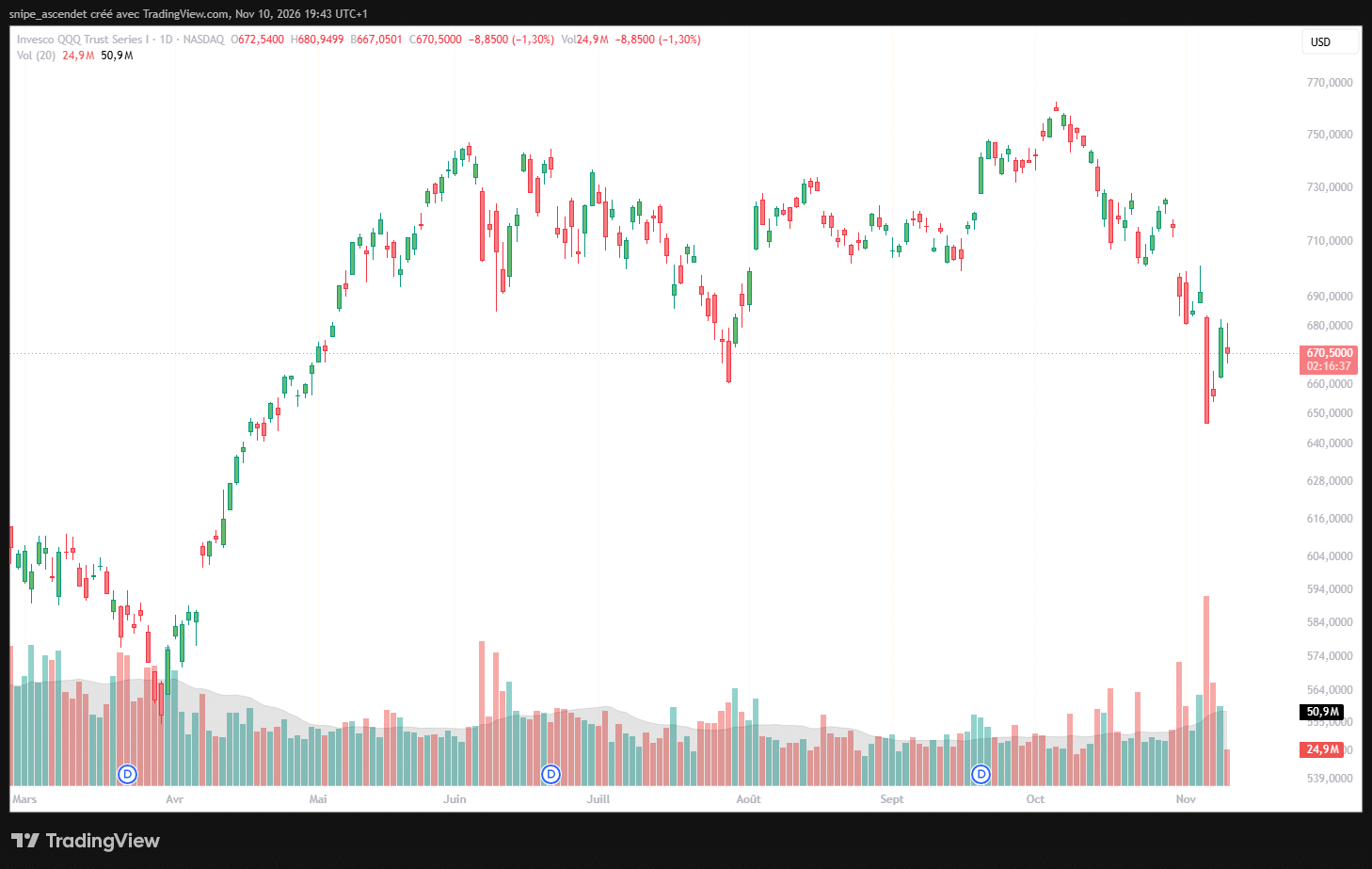
The Invesco QQQ Trust screenshot showed $670.50, down 1.30% intraday around 1:43 p.m. Eastern on November 10. QQQ tracks the Nasdaq-100 and is a useful broad technology-growth reference, not an Anthropic proxy or a measure of expected IPO demand. The chart showed pronounced volatility heading into November. A positive IPO reception could improve sentiment toward AI infrastructure names, while disappointing pricing or weak aftermarket performance could amplify questions over sector valuations. Neither effect is automatic or quantifiable from a single ETF session.
Other parts of the AI supply chain face similar scrutiny. DualFinances’ optical networking analysis found that revenue growth alone has not prevented severe valuation adjustments in infrastructure stocks. And Bourse24’s earlier French-language Anthropic overview offers background on the company’s IPO disclosures before the November 10 deal terms became public.
What Could Move Anthropic and AI Stocks After the Roadshow?
Bull case: Demand scales faster than the compute bill
A strong institutional order book, pricing near the upper end of the filing range and improving evidence of customer retention would support the bull case. Over time, the more important test would be rising gross profit per unit of compute, greater utilization of infrastructure and sustained positive free cash flow. Those outcomes could strengthen the investment thesis for Anthropic and for suppliers, though neither implies a particular stock price.
Bear case: Huge spending commitments overwhelm economics
The bearish case combines discounting pressure on Claude products, aggressive rival models, regulatory or safety constraints, delays bringing new capacity online and dependence on further capital raising. Equity awards and additional share issuance could dilute public investors even if total revenue continues growing. A poor debut could intensify skepticism around similar AI financing structures across semiconductors, cloud providers and data center operators.
The next decisive checkpoints
- Final IPO price, effective registration and first trading date for ANT; the proposed timetable is not a completed listing.
- Any revisions to the share count, underwriting option or $26 billion conditional placement.
- Quarterly realized revenue compared with the $81 billion annualized October run rate.
- Operating cash generation, actual compute expenditure and the timing of the $70.7 billion near-term commitments.
- Post-IPO trading performance relative to the valuation basis, rather than an unexplained comparison of $1 trillion with $1.4 trillion.
The central investment question is whether Anthropic’s accelerating business can produce returns commensurate with its extraordinary compute obligations. The November 10 filing reveals real customer momentum and a very large proposed financing package. It does not yet establish that the company can self-fund its infrastructure strategy or sustain the valuation suggested by the offer range. Those outcomes depend on operational delivery, cash conversion and investor demand after the price is finalized.
Disclosure: This is financial news and analysis, not personalized investment advice. All five supplied TradingView screenshots show an intraday November 10, 2026 snapshot and must not be interpreted as official closing prices. The cover image is illustrative, not a photograph of an identified Anthropic facility.