

Rocket Lab has the strongest operating business of the three frontier aerospace stocks today. Its third-quarter 2026 revenue reached $267.8 million, compared with $42.3 million at AST SpaceMobile and just $5.1 million at Archer Aviation. All three companies reported for the quarter ended September 30, making the revenue comparison unusually clean. Their investment cases, however, depend on very different paths from technology to sustainable cash generation.
The harder test is funding. For the first nine months of 2026, operating cash flow less purchases of property and equipment was approximately negative $211.4 million for Rocket Lab, negative $1.47 billion for AST SpaceMobile, and negative $571.5 million for Archer. These calculations use the cash-flow statements in the companies’ Rocket Lab results, AST SpaceMobile results, and Archer results. None has demonstrated sustained positive free cash flow, and even the company with the most revenue still carries substantial execution risk.
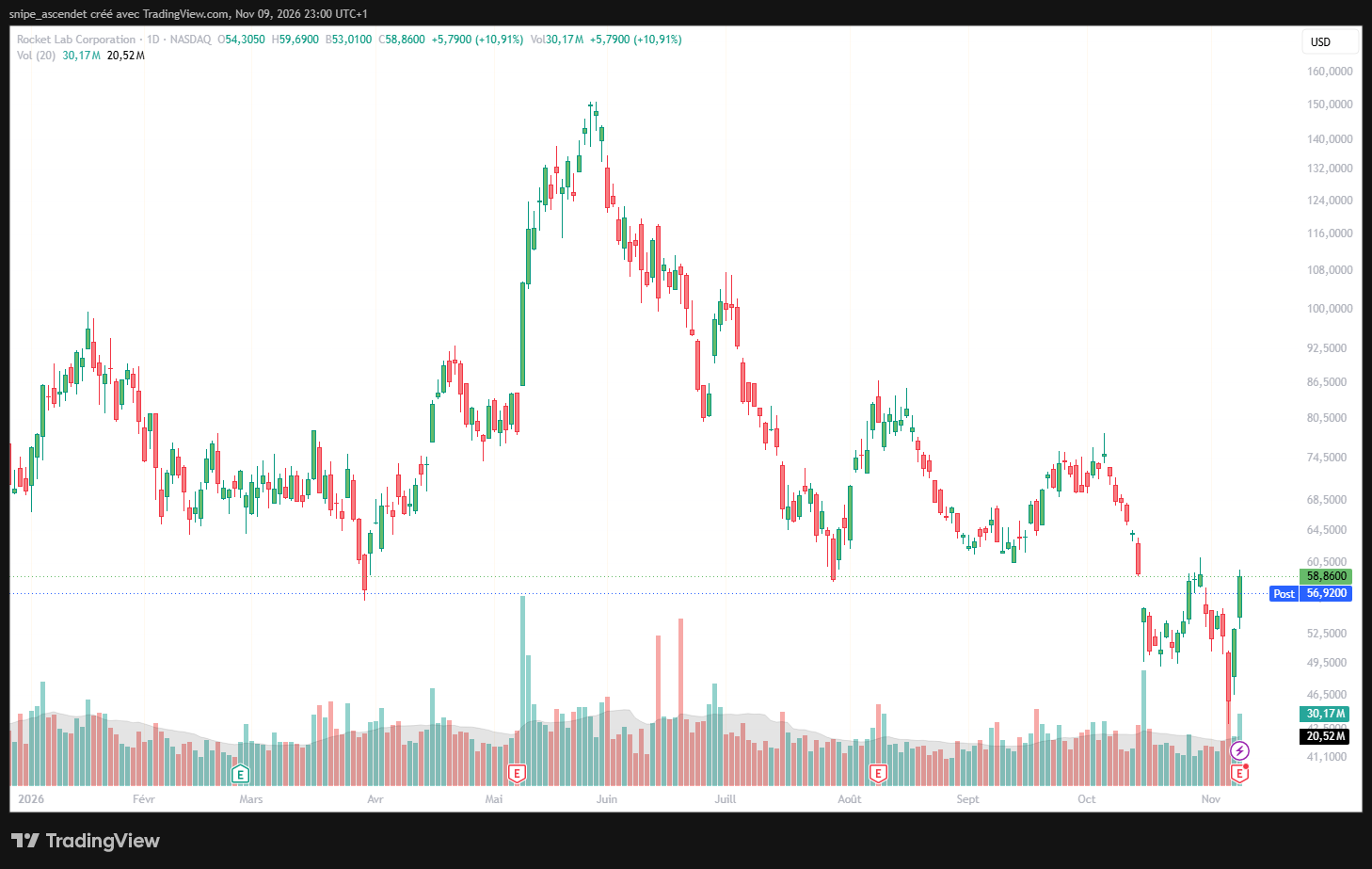
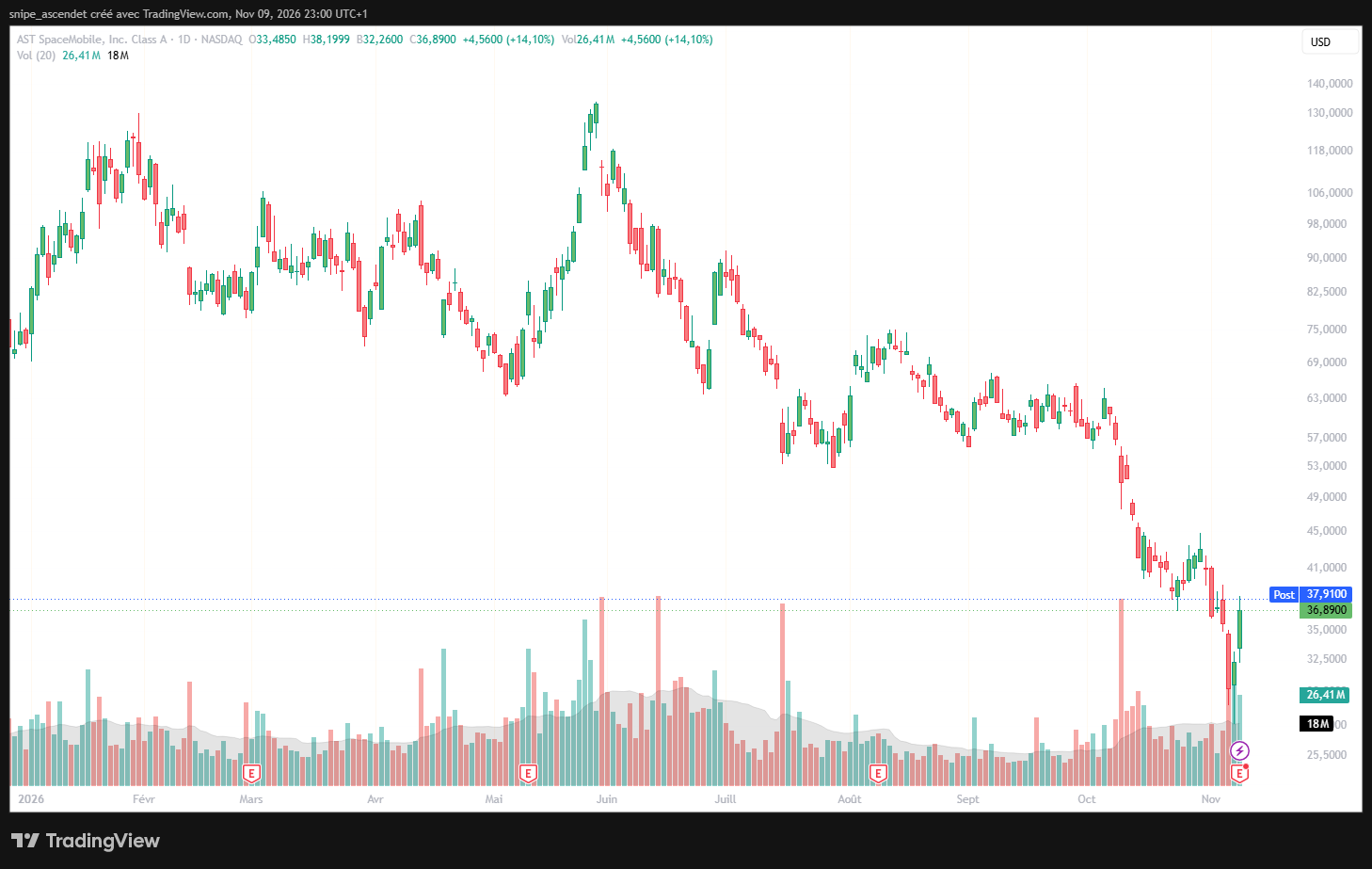
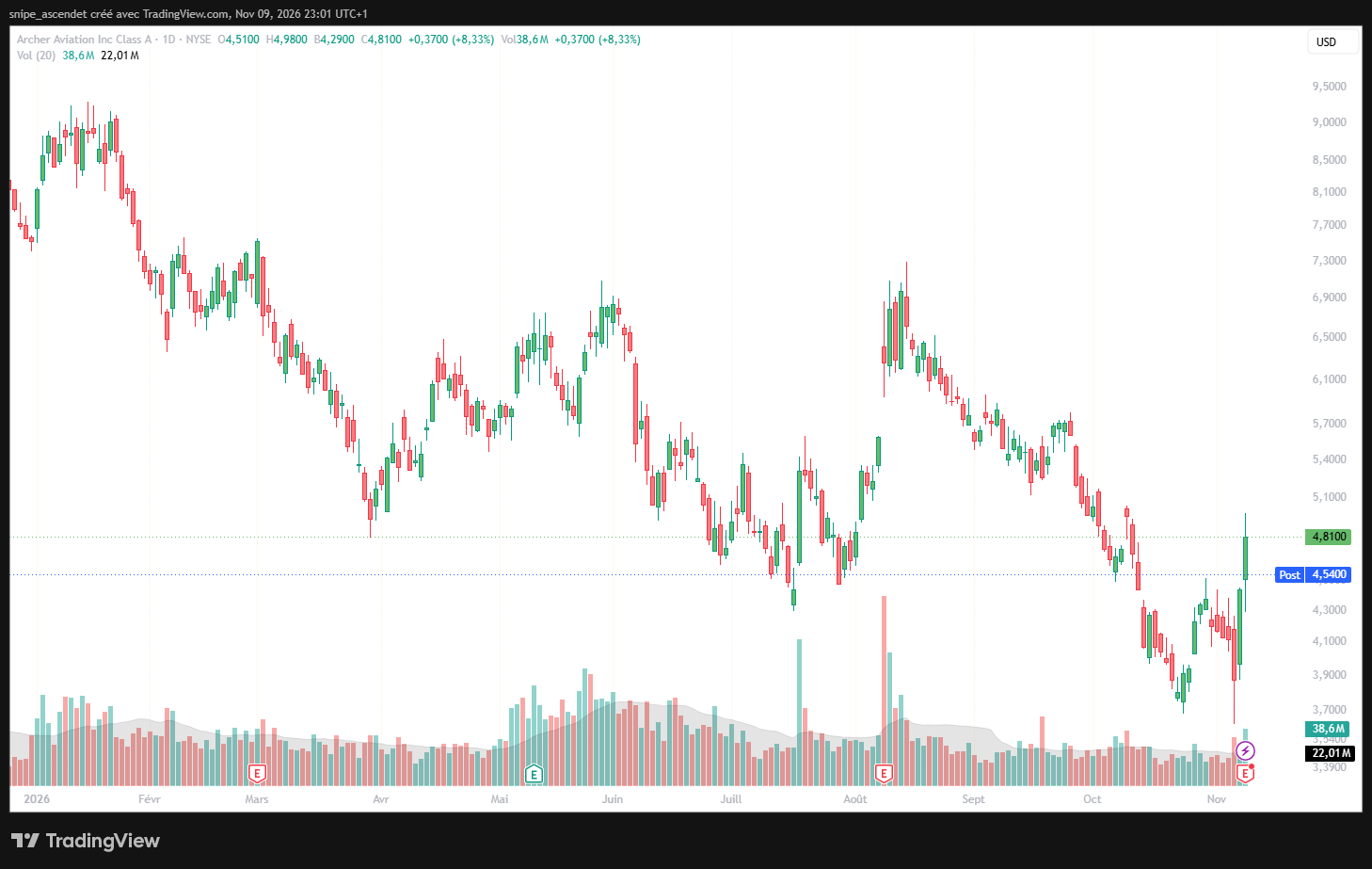
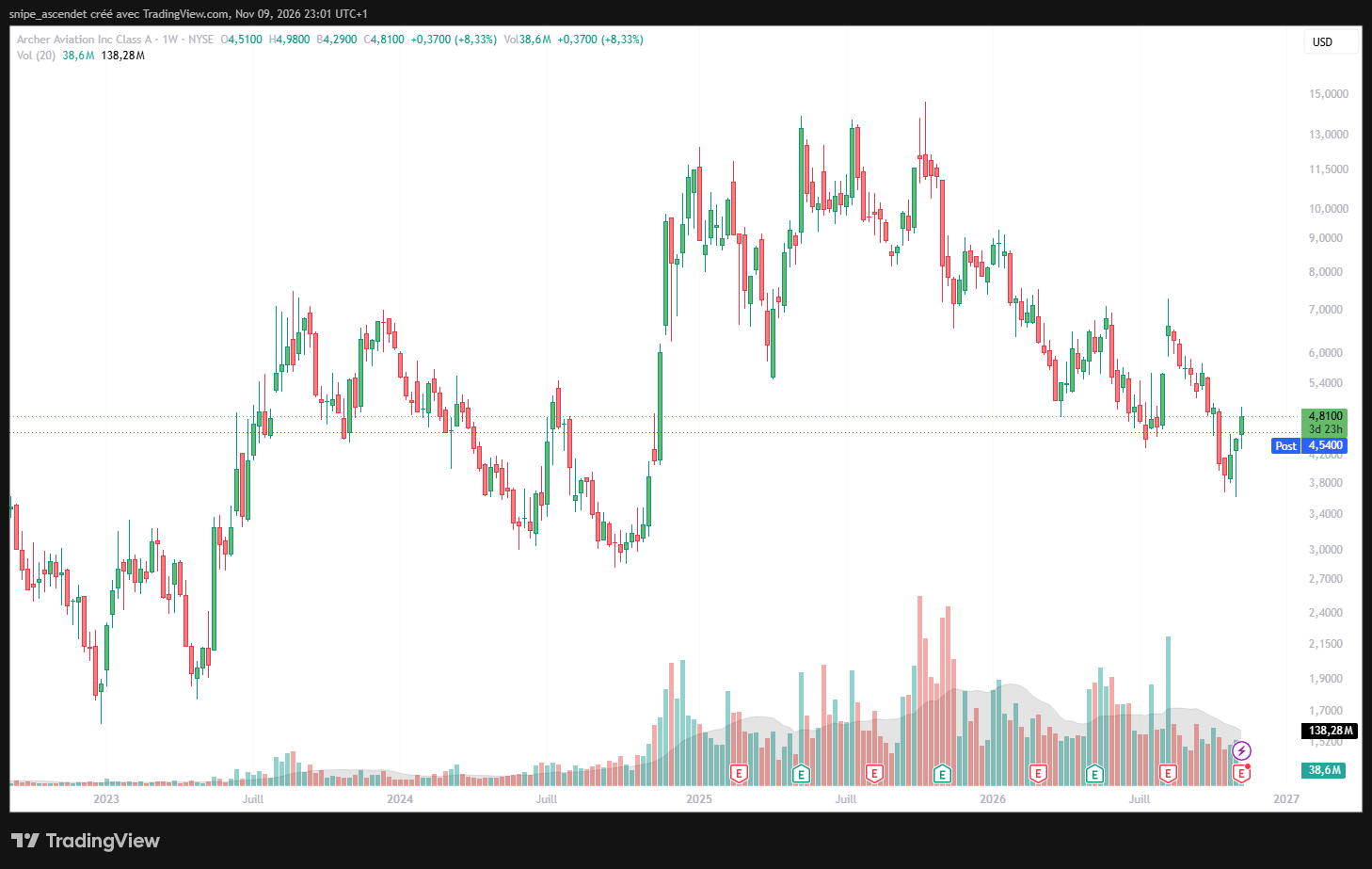
That distinction is especially relevant after a volatile November 9 session. The supplied TradingView daily charts show RKLB at $58.86 (+10.91%), ASTS at $36.89 (+14.10%), and ACHR at $4.81 (+8.33%) for regular-session closing values. The latest quarterly releases were issued after the close, so these same-day percentage gains should not be described as reactions to the newly published figures. Separate after-hours quotations on the screenshots are not official closing prices.
Three companies, three different ways to monetize aerospace technology
| Company | Revenue model today | Potential scale driver | Main constraint |
|---|---|---|---|
| Rocket Lab (RKLB) | Launch services, spacecraft and components | Neutron, satellite contracts and pending Iridium acquisition | Rocket development, contract execution, integration |
| AST SpaceMobile (ASTS) | Gateway deliveries and government milestones | Wholesale direct-to-device mobile connectivity | Constellation cost, coverage and paid adoption |
| Archer Aviation (ACHR) | Early aerospace and propulsion deliveries | Aircraft operations, defense and planned Boeing asset acquisitions | Certification, funding and acquisition integration |
All three need specialized engineering and regulatory access, but their economics differ. Rocket Lab already sells hardware and services to multiple customers. AST SpaceMobile is constructing a network that could eventually earn repeated service payments. Archer is attempting to develop an aircraft business while acquiring a more established defense-related revenue stream. Potential revenue is not the same as recognized revenue, and an acquisition is not consolidated until it closes.
Rocket Lab: the clearest evidence of commercial product-market fit
Rocket Lab’s third-quarter sales increased 73% year over year, with $197.5 million in product revenue and $70.3 million in services. Gross profit was $90.1 million on $267.8 million in revenue, equivalent to a calculated GAAP gross margin of about 33.6%. Those are meaningful operating results, even though the company still recorded a $79.7 million quarterly net loss. Its November 9 earnings statement also disclosed a $3.57 billion backlog, up 52% sequentially.
The principal advantage is diversification within space infrastructure. Electron and HASTE launches supply flight capability; spacecraft, solar and satellite components expand the share of customer spending the company can capture. That makes Rocket Lab less dependent on the profitability of any one launch program than a pure launch-services operator would be. Still, its business remains tied to government budgets, customer schedules and successful execution of complex contracts.
Two decisions shape the next phase. Rocket Lab booked more than $515 million in Neutron launch contracts during the quarter, but said the larger reusable rocket’s first flight is now targeted no earlier than 2027. Contracts for 16 Neutron missions demonstrate commercial interest, not completed launches or profit. Management also says it has funded the pending Iridium Communications acquisition with equity. If completed, Iridium could introduce recurring satellite communications exposure; until closing, its operations should not be counted as Rocket Lab revenue.
Rocket Lab generated $7.2 million of positive GAAP operating cash flow in Q3, an encouraging quarterly milestone that does not establish a durable inflection. On a nine-month basis, operating cash flow remained negative $127.3 million. The company raised nearly $3.9 billion in gross proceeds from at-the-market equity offerings over those nine months, building liquidity but underscoring the cost to shareholders of financing expansion and acquisitions.
AST SpaceMobile: stronger recurring-revenue potential, much heavier construction spending
AST SpaceMobile’s promise is straightforward: deliver mobile broadband directly to ordinary phones through satellites and mobile-network-operator partnerships. If the network reaches sufficient capacity, coverage and paid usage, recurring wholesale connectivity payments could become more attractive than a series of individually negotiated hardware projects. The company describes an ecosystem of more than 60 operators representing over three billion subscribers. That figure is potential reach, not three billion paying satellite customers.
In the third-quarter update, AST SpaceMobile reported $42.3 million of revenue, primarily linked to gateway deliveries and U.S. government milestones. Its $150 million to $200 million full-year revenue outlook remains a company forecast. The current numbers therefore do not yet prove that large-scale recurring cellular subscriptions can support the constellation’s fixed costs.
Execution milestones are substantial. AST says BlueBird 11, 12 and 13 are unfolded and operating in orbit; it targets about 45 BlueBird satellites by mid-2027 and has launch agreements intended to support more than 100 cumulative deployments during 2027–2028. It also announced Blacklift, a reusable rocket targeted for launches beginning in late 2028. Vertical integration could ultimately improve launch access, but developing a rocket also introduces another demanding capital and engineering program into the business model.
The balance sheet deserves equal attention. At September 30, AST held approximately $3.23 billion in cash, equivalents and restricted cash, including roughly $434.6 million of restricted balances. Long-term debt, net, stood at about $4.08 billion. Its first-nine-month purchases of property and equipment exceeded $1.15 billion, before additional spending on spectrum and other investments. A newly announced $1 billion Japanese funding arrangement is described as non-dilutive, but an agreement should not be confused with cash already available at the reporting date. A separate prospective financing pipeline is even less certain.
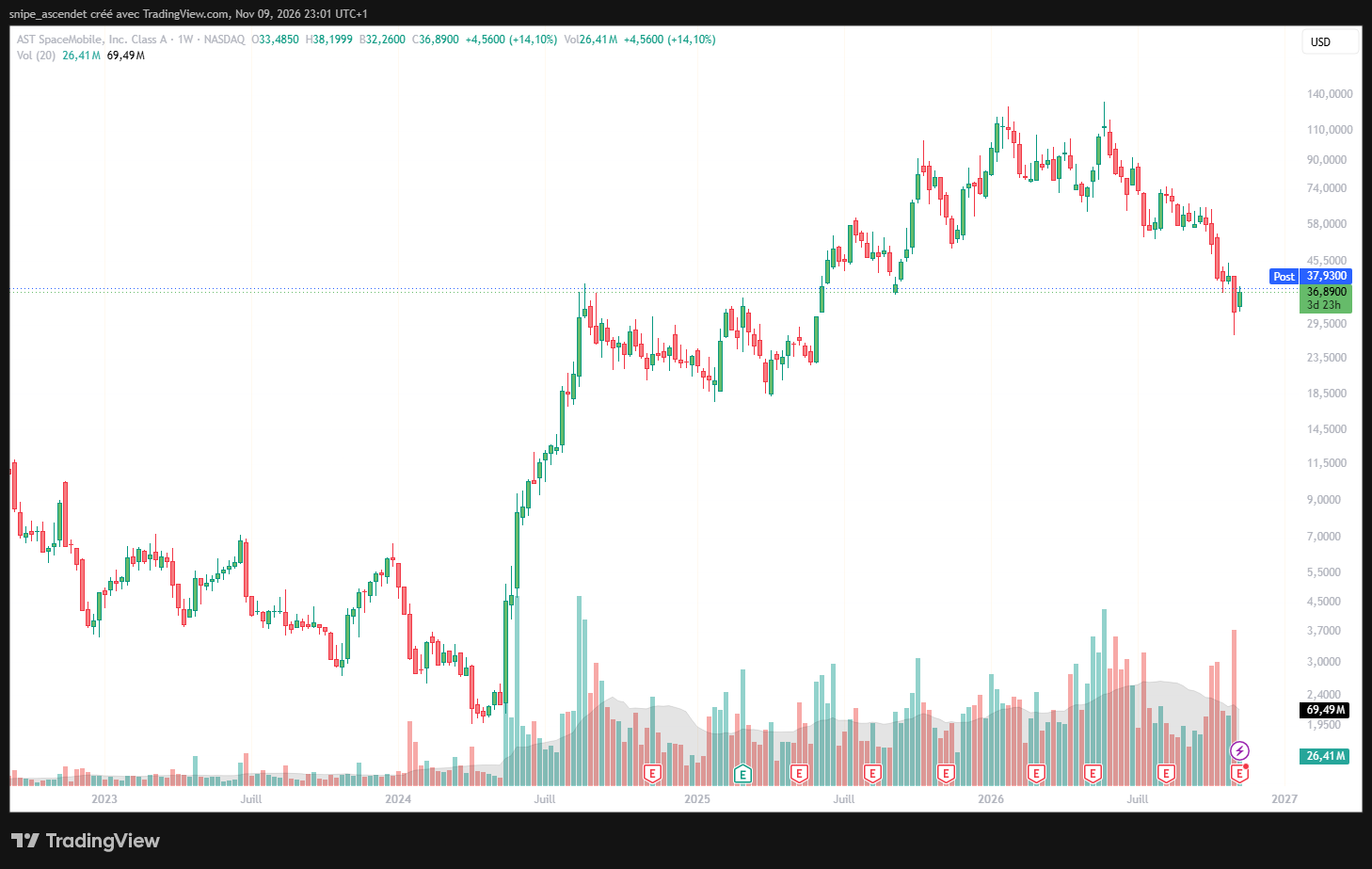
AST’s bull case rests on economies of scale: customers use existing phones, partner carriers provide distribution, and more satellite capacity permits greater utilization. Its bear case is a prolonged mismatch between very large deployment costs and limited paid traffic. Government contracts may diversify revenue, but they do not eliminate the need to demonstrate sustainable economics for the core communications service.
Archer Aviation: an ambitious pivot still waiting for a larger revenue base
Archer reported $5.1 million of Q3 revenue, compared with $5.0 million in Q2, including delivery of its first engines for Anduril’s Omen program. Quarterly net loss reached $274.6 million, and adjusted EBITDA was negative $178.5 million. The figures show an enterprise still investing far more in development and infrastructure than it earns from customers. They are not yet evidence of a mature passenger air-taxi network.
Its November 9 update describes a Market Survey Special Airworthiness Certificate for Midnight that permits specified market-survey operations in Los Angeles. This is regulatory progress, not proof that all commercial passenger-service certifications have been completed. Archer is also testing the turboshaft engine for its Halo/Thunder hybrid autonomous VTOL program with Anduril, targeting full-scale flight tests in 2027.
The bigger near-term business-model change may come from the proposed purchases of Boeing’s Wisk, Insitu and SkyGrid businesses. Archer estimates Insitu alone could contribute more than $200 million in annual revenue and said Boeing would become a major shareholder and strategic partner. Those are prospective transaction benefits, subject to approvals, closing and integration. Adding that revenue directly to Archer’s current quarterly results would misrepresent the business as it exists today.
Archer had $1.354 billion in cash, cash equivalents and short-term investments at September 30, down $207 million during the quarter. Operating activities consumed $164.6 million of cash in Q3, while property and equipment consumed another $31.7 million. Its planned defense expansion could improve the quality and timing of revenue, but it also creates new integration and capital-allocation risks.
The cash-flow comparison reveals the real financing divide
| First nine months of 2026 | RKLB | ASTS | ACHR |
|---|---|---|---|
| Operating cash flow | -$127.3M | -$314.5M | -$470.1M |
| Purchases of property/equipment | -$84.2M | -$1,154.2M | -$101.4M |
| Calculated free cash flow* | -$211.4M | -$1,468.7M | -$571.5M |
| Q3 2026 reported revenue | $267.8M | $42.3M | $5.1M |
*Method: Operating cash flow minus cash purchases of property, equipment and, for Rocket Lab, software. All cash-flow figures cover January 1–September 30, 2026, and are rounded. This simplified free-cash-flow measure excludes acquisitions, spectrum purchases, debt financing and other investing outlays. It is not a claim that all the companies define free cash flow identically.
AST’s large construction bill is a defining feature of a network that must be built before service utilization matures. Rocket Lab’s lower nine-month cash deficit reflects a larger operating revenue base, but its acquisition financing shows it is not self-funding every strategic investment. Archer’s funding demands remain significant compared with its small current revenue stream. As DualFinances has explored in its analysis of capital-intensive AI infrastructure, contract announcements and sufficient cash to complete projects are separate questions.
Revenue quality also matters. Backlog may improve visibility but depends on delivery and contract terms. Satellite service revenue could eventually repeat, but customer adoption and pricing must be established. Defense acquisitions can provide existing revenue, but transaction debt, share issuance and integration costs may reduce the benefit accruing to current shareholders. The same emphasis on actual cash conversion underpins DualFinances’ comparison of energy-infrastructure business models.
Stock performance is not the same as business-model strength
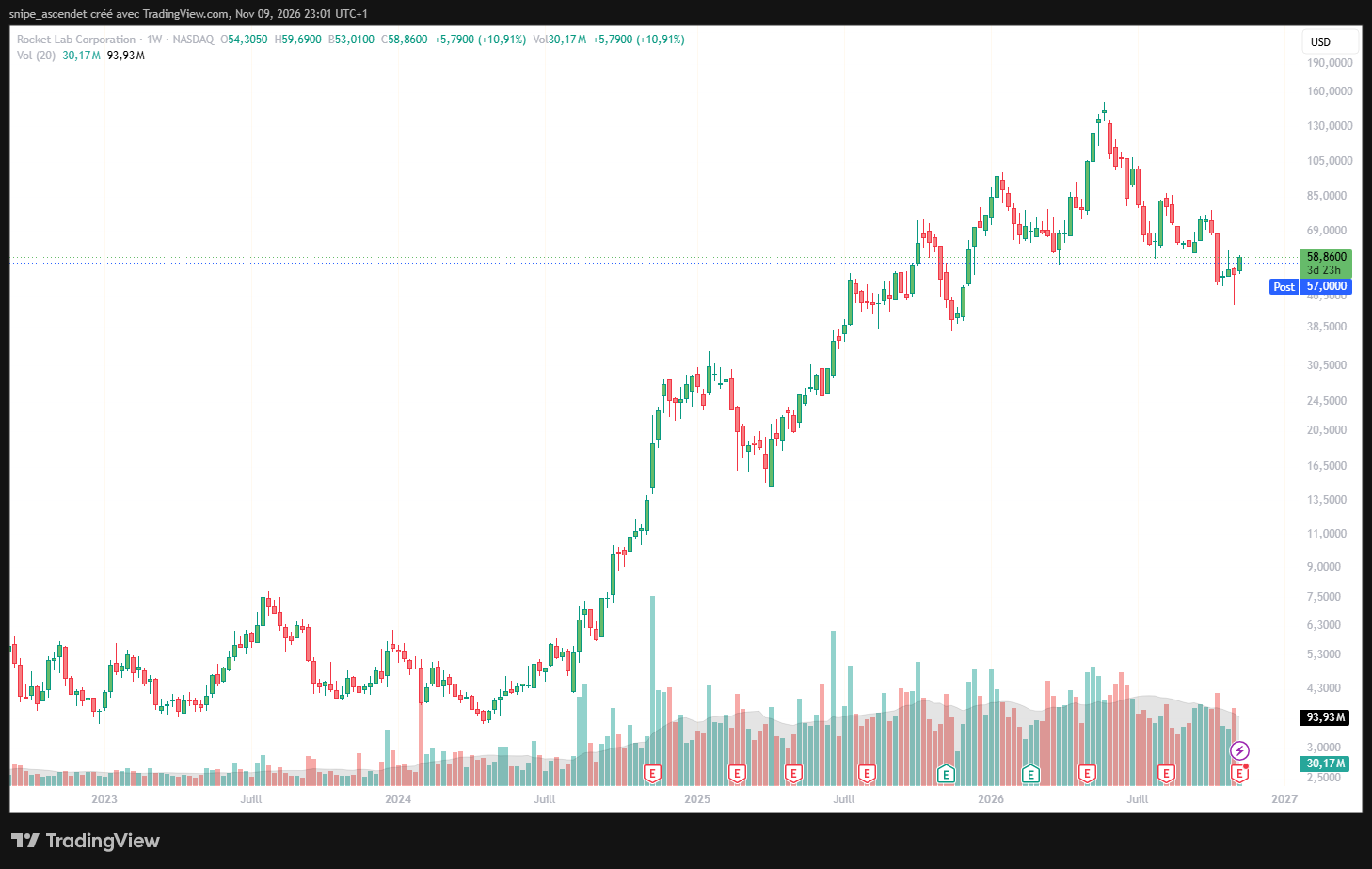
Each of the three stocks rose sharply in the November 9 regular session, as shown in the supplied daily charts, but the longer-term weekly series underline how quickly expectations can reverse. The current share prices alone cannot tell investors which company is least expensive. A meaningful valuation assessment must account for shares outstanding, convertible securities, debt, restricted cash, additional financing, expected margins and the timing of sustainable cash generation.
That sensitivity is especially important for frontier companies whose largest anticipated cash flows lie several years in the future. The site’s earlier review of the fragile Nasdaq rebound illustrates why a strong trading session is not a substitute for evidence of improving financial fundamentals. Neither a single day’s gain nor a distant historical share-price peak establishes a fair value.
The 2027 tests: what would change the ranking?
Rocket Lab bull case: spacecraft orders convert to revenue, Neutron reaches flight milestones, and a completed Iridium acquisition broadens recurring services without overwhelming integration costs. Bear case: launch delays, manufacturing expense and dilution offset operating progress. The essential metric is sustained operating cash generation after capital spending, not merely larger backlog.
AST SpaceMobile bull case: satellite deployment translates into usable coverage, carrier payments and rising network utilization. Bear case: launch schedules slip or revenue ramps more slowly than capital expenditures and financing commitments. Investors should monitor commercial service revenue separately from government and gateway milestones.
Archer bull case: certifications progress, aircraft testing remains on track, and the proposed Boeing transactions close and produce reliable defense revenue. Bear case: approvals and integration take longer, losses persist, and additional funding dilutes shareholders. Insitu’s expected revenue is a catalyst to verify after closing, not a result to book today.
Verdict: Rocket Lab leads today, but the future ranking is open
Rocket Lab ranks first for demonstrated business-model strength because it already sells a relatively broad mix of launch and space-system products at scale, with a large contracted backlog and measurable gross profit. AST SpaceMobile ranks first for potential recurring connectivity economics if its network reaches commercial density, although its capital intensity and debt make the proof substantially harder. Archer remains the most dependent on pending milestones and transactions to establish a durable revenue base.
This is a ranking of today’s evidence, not a price target or a recommendation to buy RKLB over ASTS or ACHR. Stronger operations can still be an unattractive investment at an excessive valuation. All three require continued scrutiny of financing, milestones and the gap between announced opportunities and cash actually received.