

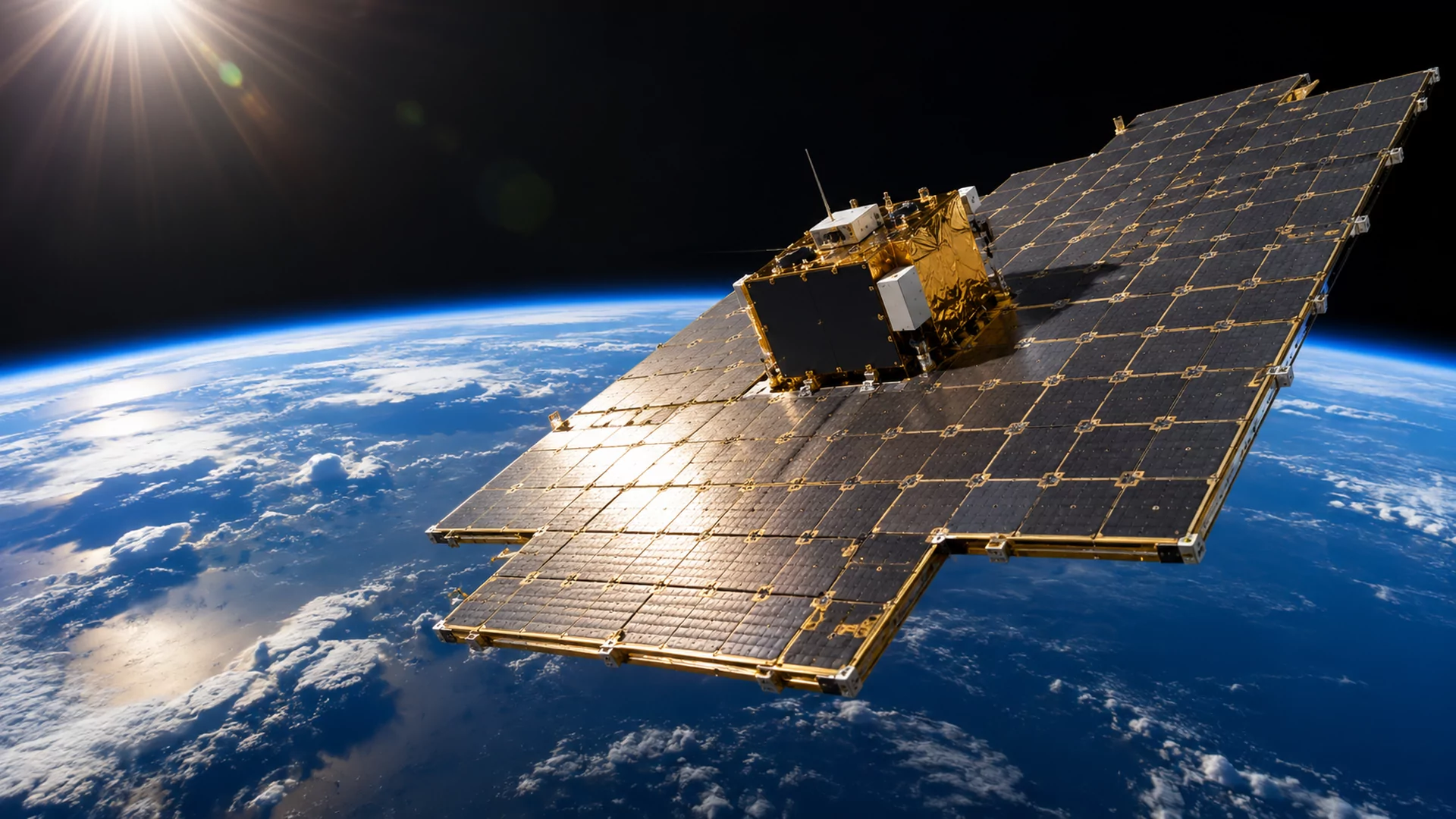
AST SpaceMobile (NASDAQ: ASTS) reported $42.3 million in third-quarter 2026 revenue on November 9, up 34.3% from the previous quarter and 187.1% from a year earlier. But sales fell short of the $44.4 million Zacks estimate, while the company posted a GAAP loss of $0.44 per Class A share. The central question for investors is whether AST SpaceMobile can move beyond equipment deliveries and government milestones to a repeatable business selling cellular connectivity from orbit.
The company has the technology, telecom partnerships and financing plans to make that transition plausible. Its latest results also show how much infrastructure spending remains between the current business and a scaled satellite network. AST SpaceMobile expects initial, intermittent service in selected markets before the end of 2026, not full nationwide continuous coverage.
ASTS Q3 2026 earnings: revenue grows, but estimates are missed
The company’s November 9 earnings release reported $42.321 million of revenue for the quarter ended September 30, versus $31.520 million in the June quarter and $14.739 million a year earlier. The comparison with analysts uses a pre-earnings Zacks consensus; estimate providers may publish different figures.
| Metric | Reported Q3 2026 | Expected (Zacks) | Difference |
|---|---|---|---|
| Revenue | $42.32 million | $44.40 million | -$2.08 million (-4.7%) |
| GAAP loss per Class A share | -$0.44 | -$0.41 | -$0.03 per share |
The $132.4 million net loss attributable to common stockholders widened from $122.9 million a year earlier. Total operating expenses reached $211.0 million, compared with $94.4 million in the third quarter of 2025. They were lower than the $329.1 million recorded in the second quarter of 2026, but the comparison is distorted by a $125.9 million loss on involuntary conversion booked in Q2. On the company’s non-GAAP definition, adjusted operating expenses actually increased to $133.6 million from $119.1 million sequentially.
Revenue growth is real. It is not yet evidence that the satellite connectivity business is self-funding. Investors should avoid reading the decline in GAAP expenses from Q2 as an equivalent improvement in underlying cost discipline.
Where AST SpaceMobile’s revenue really comes from
AST SpaceMobile recorded $20.57 million of product revenue and $21.75 million of service revenue in the third quarter. The release identifies gateway deliveries and completed U.S. government milestones as the drivers of the quarter’s sales. Service revenue rose from $7.09 million in Q2, but its accounting classification does not establish that millions of consumers are already paying for continuous space-based mobile broadband.
That distinction matters because the long-term investment case depends on recurring wholesale connectivity revenue. Under AST SpaceMobile’s partner-first approach, mobile network operators would use the space network to extend their coverage to ordinary phones. The company says it has relationships with more than 60 operators representing over three billion subscribers. Those are potential distribution partners and the combined subscriber populations they serve, not AST SpaceMobile’s own paying satellite users.
The reported cost of product revenue was $22.45 million, exceeding the $20.57 million in product sales. Services generated $21.75 million in revenue against $2.86 million of reported service costs, but milestone-based revenue should not be extrapolated into a mature recurring service margin. Engineering, administration, depreciation and network deployment costs remain substantial.
The evidence investors need next is separately identifiable commercial network revenue, disclosed usage or billing metrics, and a path from gross service margin to operating cash generation.
The fourth-quarter hurdle is much higher than Q3
Management reiterated $150 million to $200 million in full-year 2026 revenue guidance, citing potential upside from recent contract signings. Through September 30, the company had recognized $88.575 million. Simple subtraction shows the revenue it still needs in the fourth quarter:
| 2026 scenario | Full-year sales | Required Q4 sales | Versus Q3 |
|---|---|---|---|
| Low end of guidance | $150.0 million | $61.4 million | +45.1% |
| High end of guidance | $200.0 million | $111.4 million | +163.3% |
Even the bottom of the range requires a meaningful sequential step-up. The high end would require more than doubling quarterly sales. Both outcomes depend on when equipment deliveries and contract milestones qualify for revenue recognition. Management’s forecast should therefore be tested against actual invoices and recognized revenue, not headline contract values.
BlueBird deployment: the commercial network is still being built
The operational update included genuine progress. AST SpaceMobile said BlueBird 11, 12 and 13 are unfolded and operating in orbit. BlueBird 14 through 16 had shipped to Cape Canaveral and were awaiting confirmation of a SpaceX launch date. The company expected satellites 17 through 19 to ship by the end of November for a planned Blue Origin launch in early 2027.
Management is targeting approximately 45 BlueBird satellites in orbit by mid-2027 and says launch arrangements cover the deployment of more than 100 BlueBird satellites cumulatively during 2027 and 2028. These are company targets, not completed launches or guaranteed service availability. Schedule slippage, launch failures, satellite performance and licensing remain material risks.
The company also reported a successful satellite-to-terrestrial network handover test with AT&T and expects initial intermittent service activation in the United States, Canada, Japan, Saudi Arabia and the United Kingdom before year-end. Intermittent service is a different proposition from uninterrupted cellular coverage. Until capacity, latency, availability and customer billing are demonstrated at scale, the monetization thesis remains partly unproven.
New satellite processing chips and an in-house rocket
AST SpaceMobile said it is moving specialized ASIC integration forward to BlueBird 34 and targets a manufacturing rate of six ASIC-equipped satellites a month by December 2026. Management claims the new chips could offer ten times the processing bandwidth of its first-generation BlueBird satellites. That is a stated design objective rather than an independently established network-wide performance result.
It also announced Blacklift, a proposed reusable, 20-ton launch vehicle intended to carry up to five BlueBird satellites per mission beginning in late 2028. Greater control over launch capacity could be strategically valuable, but rocket development adds execution and capital-allocation risk well before the planned first launch.
Cash, debt and capital spending: the biggest test
AST SpaceMobile reported $3.23 billion in cash, cash equivalents and restricted cash at September 30. The unrestricted cash and cash-equivalents line was $2.80 billion; $434.6 million of the broader total was restricted cash. The balance sheet also showed approximately $4.09 billion of current and long-term debt at carrying value. Treating all cash as freely available, or ignoring the debt because the company holds substantial liquidity, would overstate its financial flexibility.
For the first nine months of 2026, net cash used in operating activities totaled $314.5 million. Property and equipment purchases consumed another $1.154 billion. Together, those two cash-flow lines imply approximately $1.47 billion of negative free cash flow on a conventional operating-cash-flow-minus-capex basis for the nine-month period. This is not the quarterly burn rate, and the reported investing section contains other cash uses not included in that calculation.
The company disclosed roughly $1.0 billion of non-dilutive funding linked to a Japanese satellite manufacturing and launch program involving the Japanese government and Rakuten. It also described a prospective $1.2 billion U.S. quasi-governmental financing pipeline for 2027. Neither number should be added mechanically to September’s unrestricted cash balance. The Japanese funding is tied to a designated program, while a financing pipeline is not the same thing as received, unconditional cash.
The risk resembles the broader financing challenge examined in our analysis of AI infrastructure companies funding capital-intensive buildouts: contracts and demand can be substantial while cash payments arrive after years of construction and deployment. For ASTS, potential convertible debt conversions, share issuance and new launch spending also matter to per-share economics.
ASTS stock: Monday’s rally happened before the earnings release
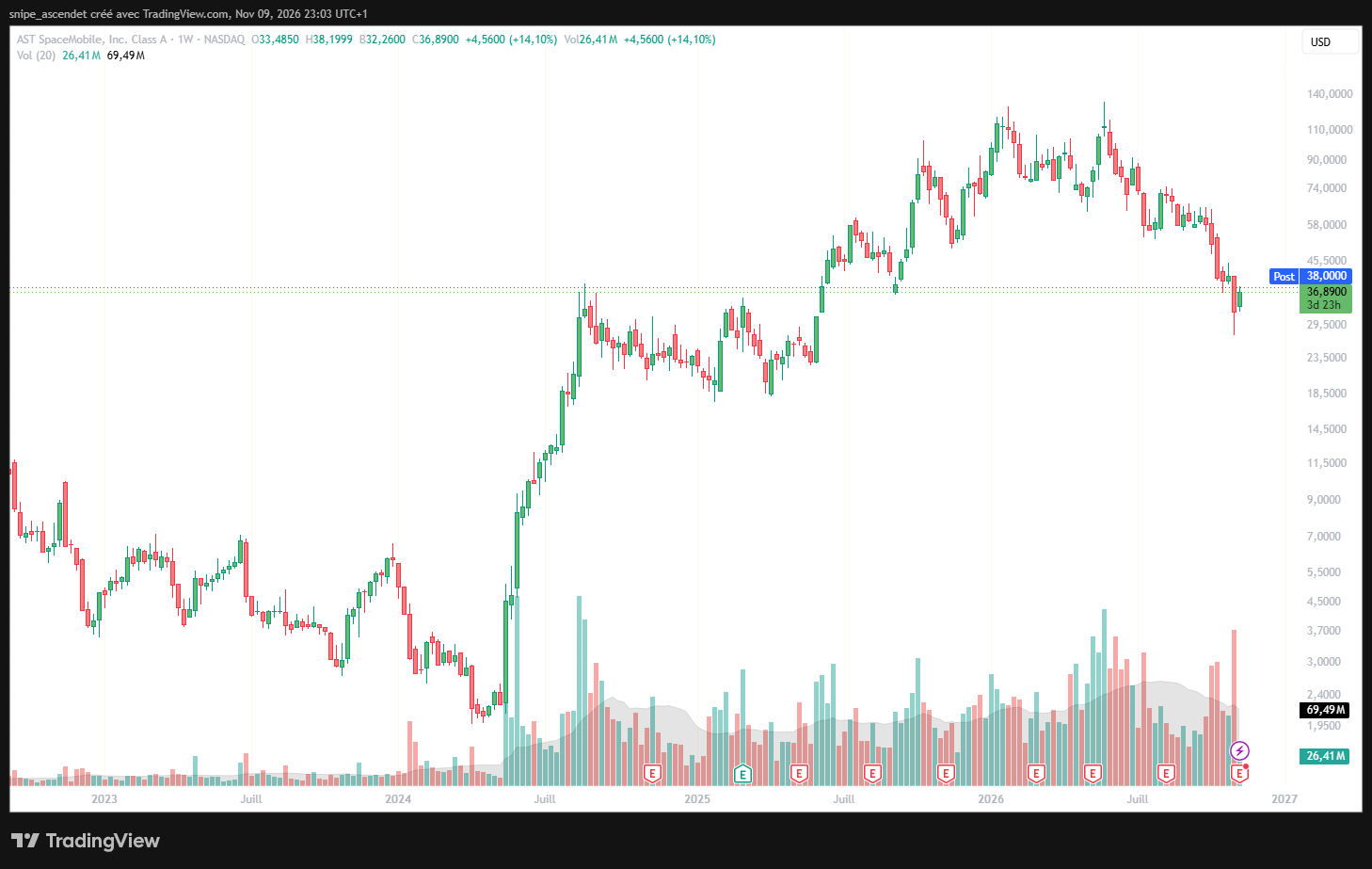
The TradingView daily chart supplied for this report shows ASTS finishing the November 9 regular session at $36.89, up 14.10% from the previous close, on roughly 26.41 million shares traded. That rally preceded the after-close earnings publication; it should not be described as a reaction to the reported numbers. The trading range on the screenshot was $32.26 to $38.20.
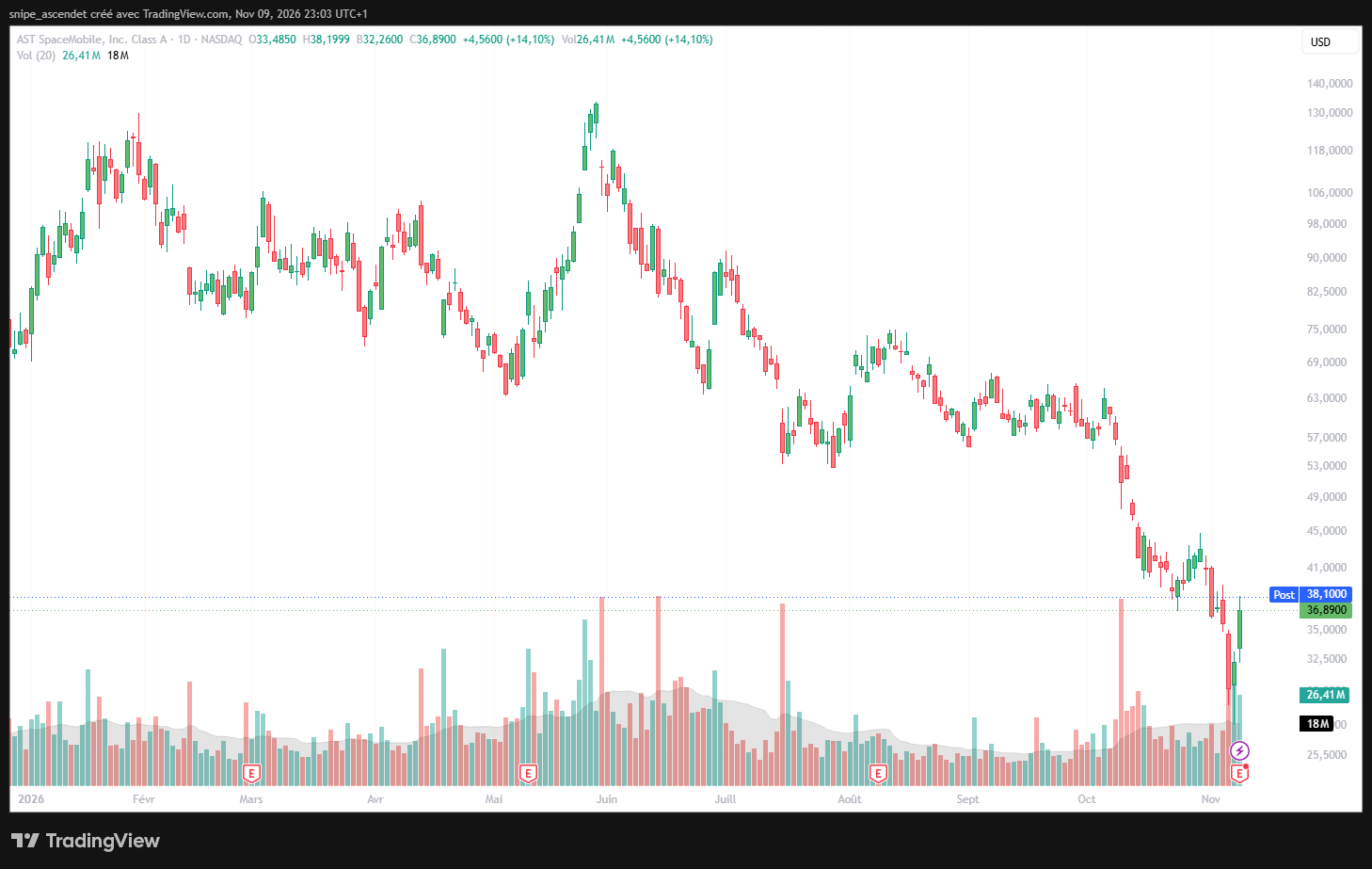
A separate four-hour screenshot taken at approximately 5:03 p.m. Eastern indicated around $38.10 in extended-hours trading, about 3.3% above the displayed regular-session closing price. It is a time-specific indicative after-hours observation, not an official closing price or a final post-earnings verdict. The next regular session may look materially different as investors digest the conference call and the full financial statements.
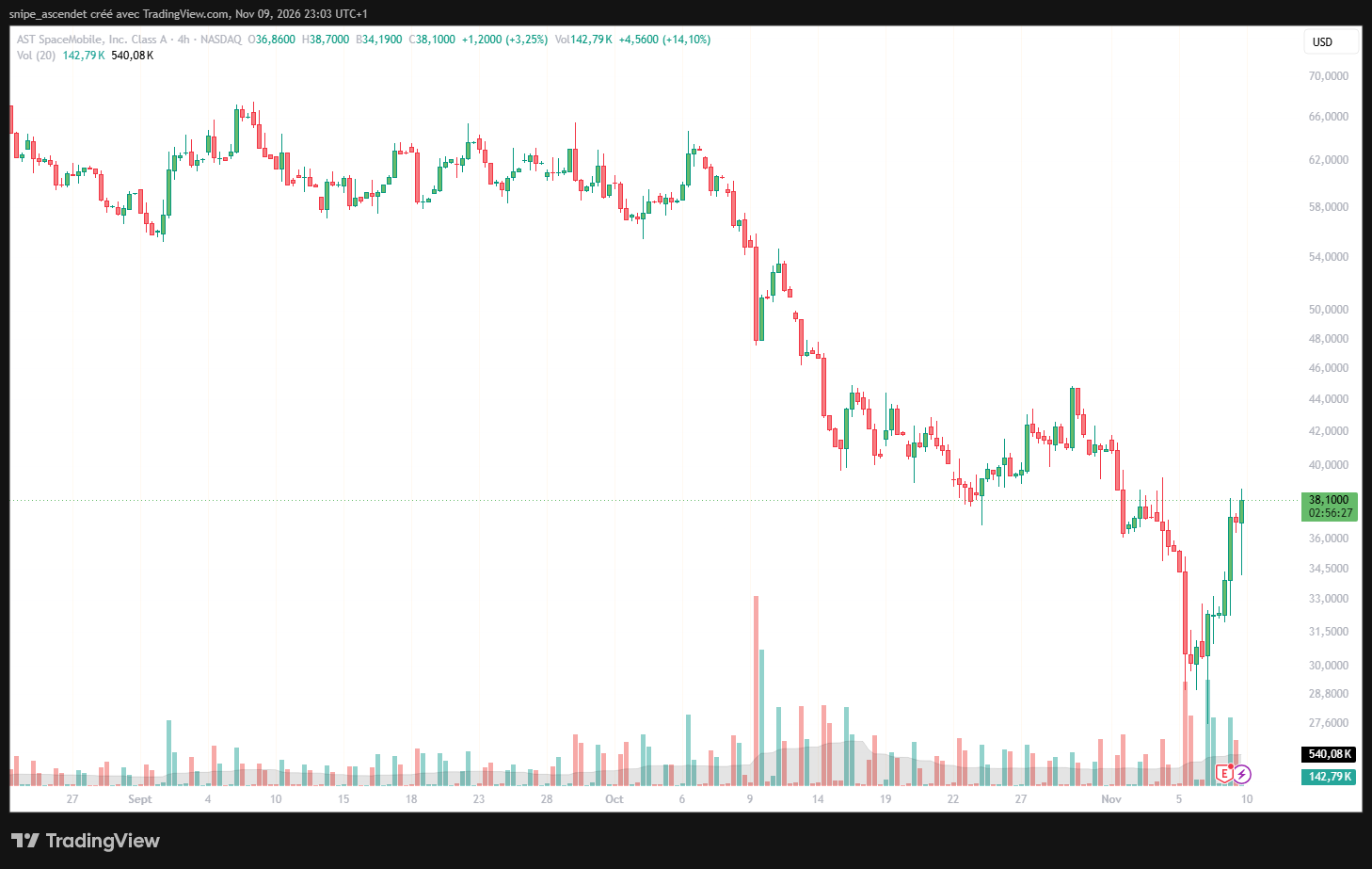
The longer weekly chart makes the valuation problem clear without requiring a speculative price target. ASTS remains far below its mid-2026 trading peaks, and its share price has swung sharply as expectations for launches, financing and commercial service have changed. A rebound in a volatile stock is not the same as a confirmed reversal in the operating business. It also needs to be read against the fragile recovery in high-growth U.S. technology shares.
Globalstar and Iridium show what ASTS has yet to prove
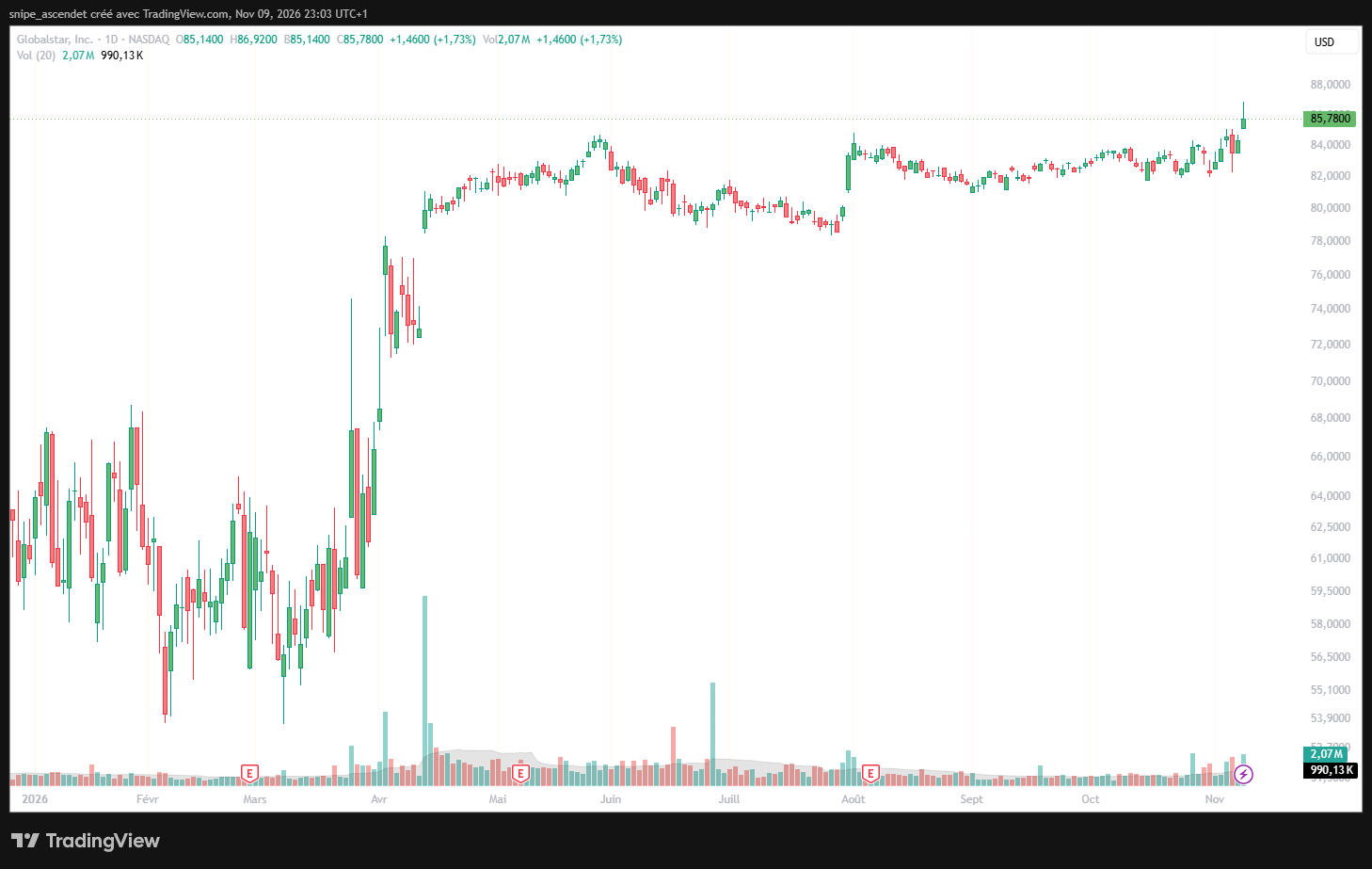
AST SpaceMobile is not directly comparable with every listed satellite operator. Globalstar’s third-quarter report showed $70.9 million in revenue, including $65.4 million of service revenue, while the company continued to invest in its next-generation network. Its shares appeared at $85.78, up 1.73%, on the supplied November 9 TradingView chart. Globalstar’s pending transaction with Amazon also makes its share-price behavior unsuitable as a clean standalone satellite valuation benchmark.
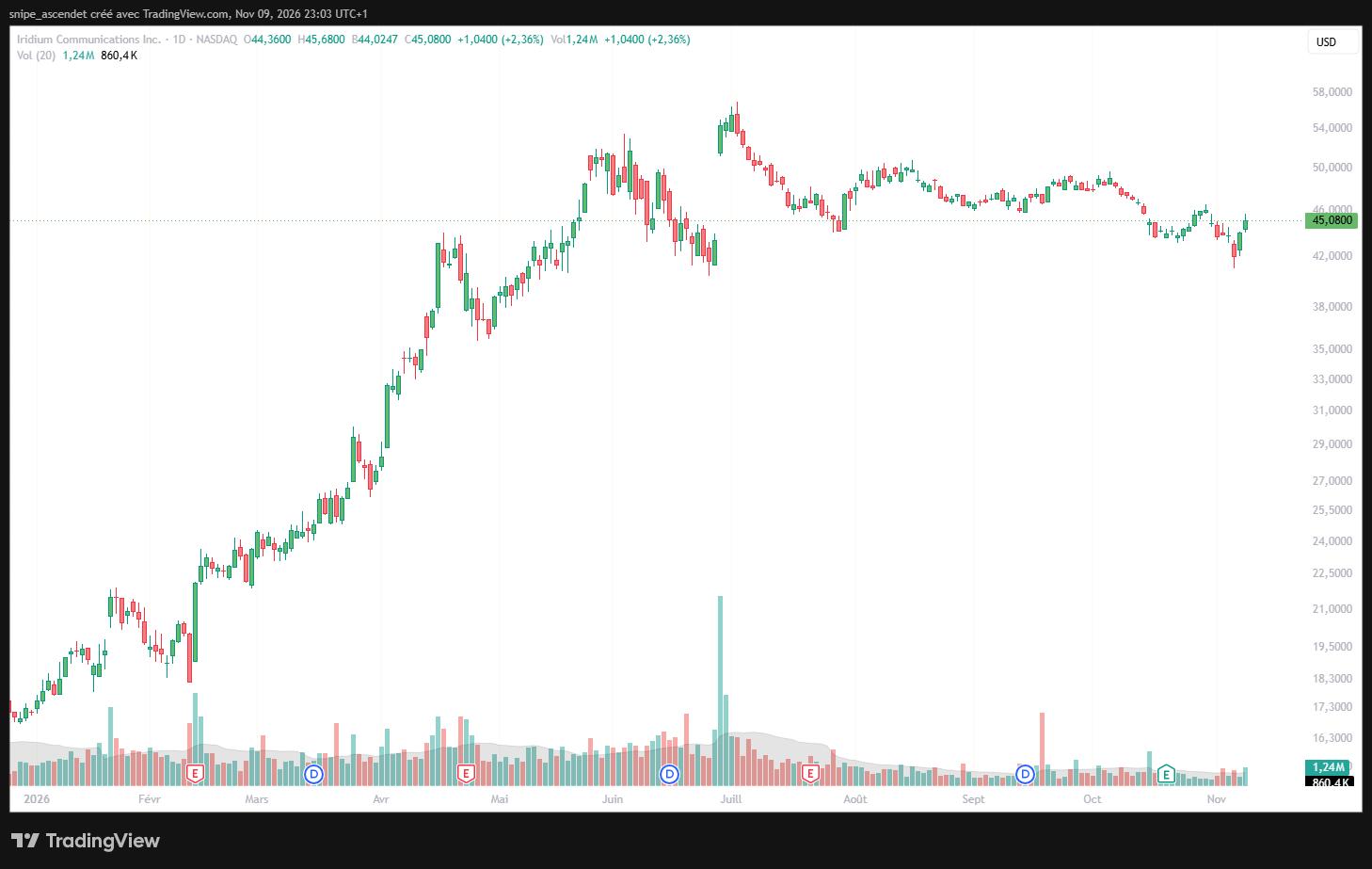
Iridium reported $245.7 million in third-quarter revenue, of which $187.5 million, or about 76%, came from services. That is an established monetization base rather than a projection. Its stock was shown at $45.08, up 2.36%, on November 9. Iridium’s announced acquisition by Rocket Lab is another deal-specific factor, so raw stock prices or movements should not be used to rank the three businesses’ valuations.
The more useful comparison is the composition of revenue. Globalstar and Iridium already report sizable ongoing service businesses, whereas AST SpaceMobile’s latest sales rely on equipment and milestones while its direct-to-device network approaches commercialization. That gap helps explain why the ASTS investment case is so sensitive to operational dates.
What would change the investment case?
Bullish scenario
Launches proceed substantially on schedule, intermittent connectivity develops into broader usable coverage, telecom partners begin generating measurable commercial service revenue, and government work produces repeatable cash receipts. Higher network utilization could eventually spread fixed deployment costs across a much larger paying base. Continued funding access without excessive dilution would strengthen that outcome.
Bearish scenario
Additional launch or regulatory delays defer commercial billing while depreciation, engineering expenses, debt service and satellite investment continue. If large contract announcements do not convert into recognized revenue and cash at the required pace, ASTS could need more capital on unfavorable terms. Competition from alternative direct-to-device architectures and the cost of the Blacklift project add uncertainty.
Three near-term tests are especially useful: whether Q4 revenue reaches at least $61.4 million, whether BlueBird launches match the new timetable, and whether management begins disclosing recurring satellite connectivity revenue distinct from government milestones and gateway deliveries.
The bottom line for ASTS investors
AST SpaceMobile is generating more revenue, and its network deployment continues to advance. Nevertheless, the third-quarter results do not yet establish a scaled, profitable direct-to-device business. Revenue missed the cited analyst estimate, adjusted operating expenses rose sequentially, and the company’s investment needs remain large. The next stage of the thesis is not simply putting more BlueBirds into orbit. It is demonstrating that those satellites can provide reliable connectivity, produce recurring cash receipts and support the financing required to build the full network.
Source and timing note: Financial data reflects AST SpaceMobile’s unaudited November 9, 2026 earnings announcement and the cited Q2 filing. Consensus is Zacks’ pre-release estimate. TradingView screenshots were captured November 9 at approximately 5:03 p.m. Eastern; extended-hours prices may change. Planned launches, program funding and revenue guidance are forward-looking and subject to execution and regulatory risks. This analysis is informational, not personalized investment advice.