

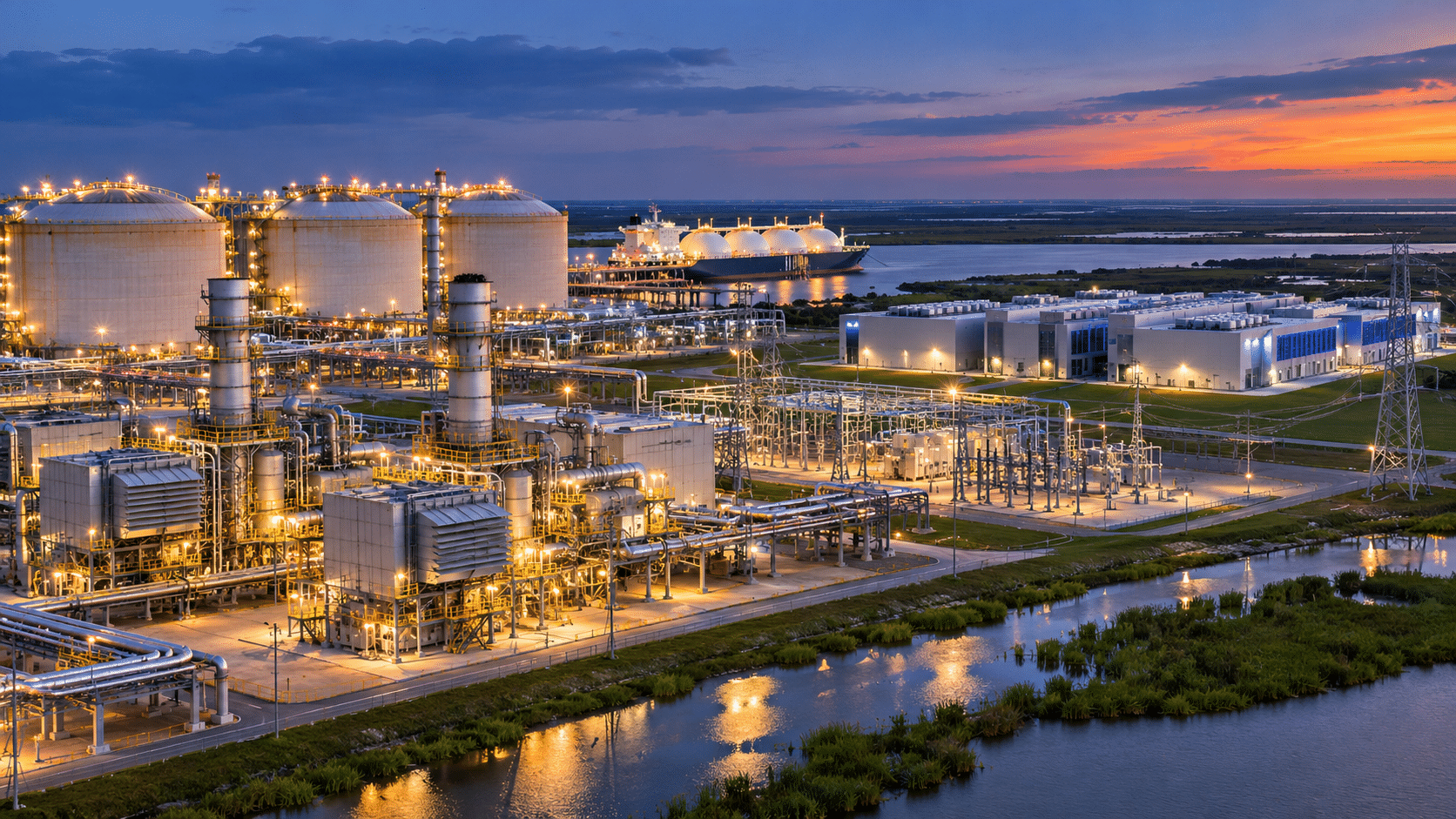
Venture Global (NYSE: VG) has raised its full-year 2026 adjusted EBITDA outlook to $10.0 billion–$10.3 billion, but its possible expansion into AI data center power remains a project rather than a proven earnings stream. The distinction matters for investors: the LNG exporter reported higher revenue and operating profit in the third quarter, while its construction program consumed more cash than operations generated during the first nine months of 2026. The question is whether existing infrastructure and natural gas expertise can support a profitable second business without adding excessive financial risk.
What Changed in Venture Global’s 2026 Outlook?
On November 10, 2026, Venture Global reported third-quarter results for the period ended September 30. Revenue increased 43% year over year, largely as LNG volumes from its Plaquemines operation expanded. The company also raised its full-year consolidated adjusted EBITDA range from $8.7 billion–$9.1 billion to $10.0 billion–$10.3 billion. These are company-reported results and guidance, not estimates of future AI power revenue. See the official earnings release and SEC-filed earnings exhibit.
| Metric | Q3 2026 | Q3 2025 | YoY change |
|---|---|---|---|
| Revenue | $4.756B | $3.329B | +43% |
| Operating income (GAAP) | $2.295B | $1.320B | +74% |
| Net income attributable to common stockholders (GAAP) | $2.546B | $0.429B | +493% |
| Consolidated adjusted EBITDA (non-GAAP) | $2.583B | $1.525B | +69% |
| LNG cargoes exported | 124 | 100 | +24% |
The guidance change can be quantified precisely. The old midpoint was $8.90 billion, calculated as ($8.7 billion + $9.1 billion) / 2. The new midpoint is $10.15 billion. Thus, the midpoint increased by $1.25 billion, or approximately 14.0% ($1.25 billion / $8.90 billion). Venture Global also reported $6.446 billion of adjusted EBITDA during the first nine months of 2026. If that figure and the full-year guidance prove comparable, the new range implies $3.554 billion–$3.854 billion for the fourth quarter. That is an implication of management’s forecast, not a reported Q4 result.
One pricing detail is worth separating from the headline. Venture Global said 99% of available 2026 cargoes were contracted at a weighted-average liquefaction fee of $6.46 per MMBtu. Its guidance for the remaining unsold cargoes assumes a much higher $21–$22 per MMBtu fee, which management linked to market forward prices. Investors should not apply the higher assumption to the entire contracted portfolio. The company estimates that a $1 per MMBtu change in the relevant remaining liquefaction fee assumption would change full-year adjusted EBITDA by $20 million–$30 million.
Why the Earnings Upgrade Is Not the Same as Cash Flow
The company’s headline net income was affected by items that are not equivalent to cash earned from LNG deliveries. Its Q3 consolidated statement of operations recorded a $1.368 billion gain on interest-rate swaps, compared with a loss in the prior-year quarter. This gain helped reported net income, although it is separate from the $2.295 billion GAAP operating profit. Adjusted EBITDA removes specified financing and derivative effects, but it is still not free cash flow. The September 30, 2026 Form 10-Q provides the relevant reconciliations.
Over the first nine months of 2026, operating activities provided $4.743 billion in cash, while capital expenditures consumed $10.742 billion. On the simplified definition, free cash flow = operating cash flow − capital expenditures = $4.743B − $10.742B = −$5.999B. This negative figure reflects heavy infrastructure investment, not necessarily failure of the producing plants. Nevertheless, it means current operating cash did not cover reported capital spending in that period. For a comparison with another capital-intensive business, see our analysis of CoreWeave’s third-quarter cash flow and debt burden.
That is the central investment tension. Venture Global can report strong operating earnings and still rely on financing to complete LNG plants and any new computing-power infrastructure. New power projects must eventually earn returns above their construction, maintenance, operating, interest and refinancing costs.
Can LNG Infrastructure Become an AI Power Business?
Venture Global argues that its existing engineering teams, land, natural gas access, independent electrical networks and water systems could form the basis of an off-grid utility offering for data centers. In October 2026, it announced framework and reservation arrangements with GE Vernova and Baker Hughes covering up to 16 additional combined-cycle power islands, each rated at roughly 720 megawatts. The mechanical total is 16 × 720 MW = 11,520 MW, or 11.52 GW of potential generating-equipment capacity. This is neither capacity already in service nor a guarantee of equivalent sellable AI computing load. The October 15 company announcement explains the phased nature of the arrangements.
The distinction between electricity generation and data center capacity is crucial. A gas-fired plant’s nameplate megawatts are not identical to a data center’s usable IT megawatts. Internal electrical losses, redundancy, cooling and reliability requirements all affect how much computing load a site can support. Venture Global itself described a pathway to approximately 5 GW of compute capacity by year-end 2031 and potentially 10 GW by 2034, rather than promising to turn 11.52 GW of ordered equipment into current data center revenue.
Management’s November 10 prepared earnings remarks set an initial target of roughly 250 MW of computing capacity in late 2028. The company expects to add power islands in stages, subject to customer commitments and commercial decisions. It already has substantial island-mode generation serving its LNG business, but those existing assets should not be treated as spare computing capacity. Nor does an equipment agreement automatically establish an investment-grade data center customer, signed power purchase contract, project financing package or completed permit.
What a workable business model would need
- Customers: long-term agreements specifying capacity, duration, pricing, minimum payments and credit support.
- Infrastructure: constructed and permitted gas generation, data centers, transformers, cooling and dependable fuel supply.
- Economics: revenue per megawatt that covers gas, plant operations, maintenance, infrastructure depreciation and financing costs.
- Risk allocation: contractual clarity on delays, fuel-price exposure, uptime guarantees and demand shortfalls.
The opportunity is real enough to investigate because grid interconnection and power-equipment lead times can constrain data center development. But the company’s proposed advantage is still a management thesis until new commercial contracts, spending and cash returns can be measured. An off-grid configuration also remains subject to environmental approvals, emissions requirements and local permitting.
What the Balance Sheet Says About Expansion Risk
At September 30, 2026, Venture Global reported $3.420 billion of cash and equivalents, $1.694 billion of current debt (net carrying amount) and $42.918 billion of long-term debt (net carrying amount). Combined debt carrying amounts were approximately $44.612 billion. Subtracting unrestricted cash produces an illustrative $41.192 billion net-debt proxy; this is not a management-reported leverage ratio, and it excludes other potentially relevant claims. Restricted cash should not automatically be counted as available debt repayment capacity.
The company also disclosed $1.535 billion of noncurrent restricted cash and $172 million of current restricted cash. The reported debt figures are net of certain accounting adjustments and do not represent principal payable at every maturity. For a full assessment, investors should examine project-level financing, maturities, covenants, interest rates and minority interests. Our comparison of debt and financing risks across AI infrastructure stocks examines similar funding trade-offs.
Expansion is already substantial before considering the AI utility proposal. Plaquemines Phase 1 reached commercial operations on October 31, while management targeted mid-2027 initial LNG production at CP2 and planned additional capacity projects. These milestones can improve future contracted cash generation, but construction schedules and financing requirements can still shift. Any AI initiative competes for capital and management attention with the core LNG expansion, even if management intends to develop it separately.
What Do the VG Stock Charts Actually Show?
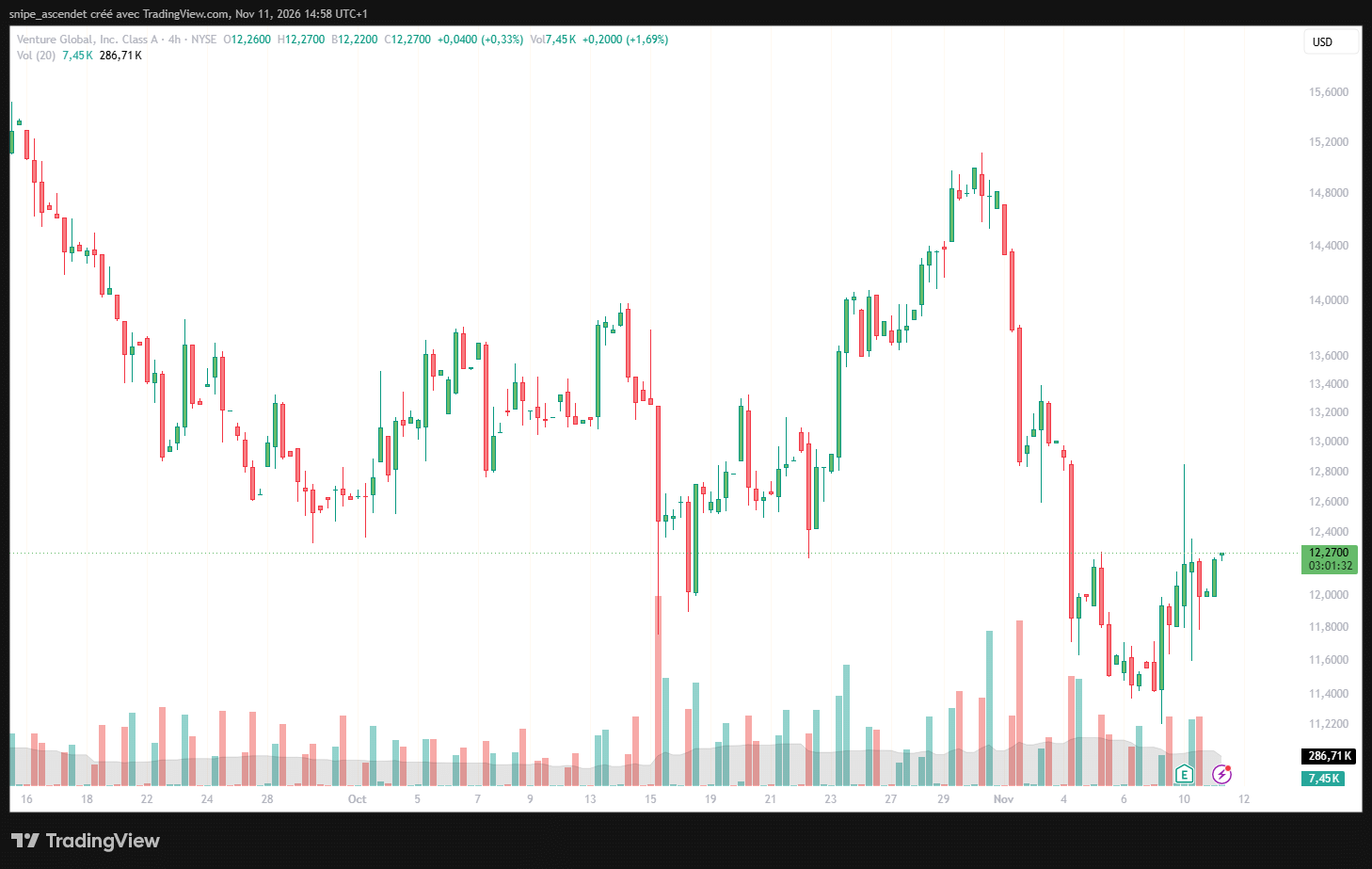
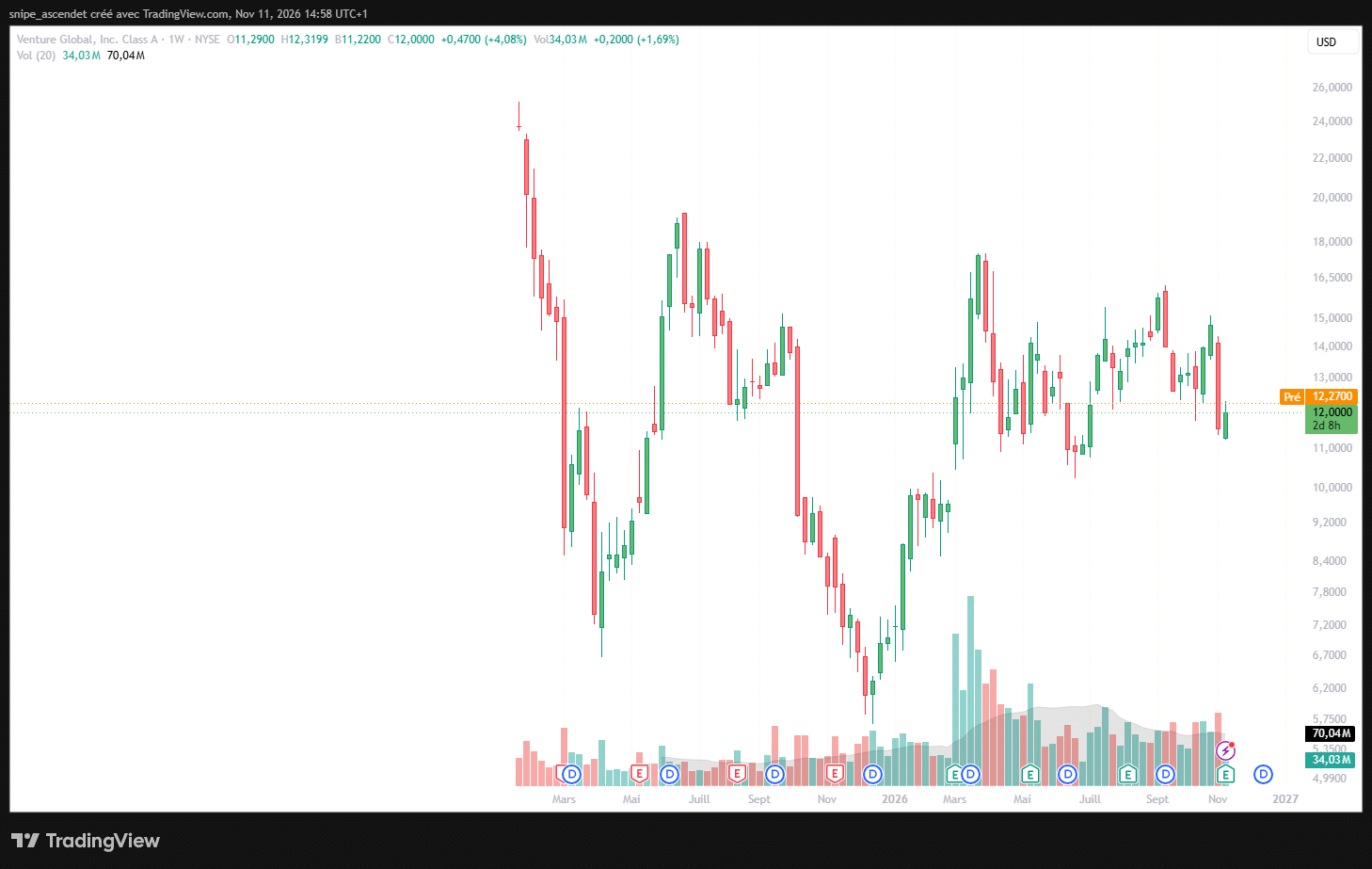
Price action should be dated and separated from the financial statements. The TradingView daily chart, captured on November 11 at 8:58 a.m. Eastern, displayed a $12.00 regular-session reference close and an indicated $12.27 premarket quote. That is about 2.25% above $12.00, but premarket indications may change before or after the opening bell. A final November 11 regular-session close was not yet available at that time.
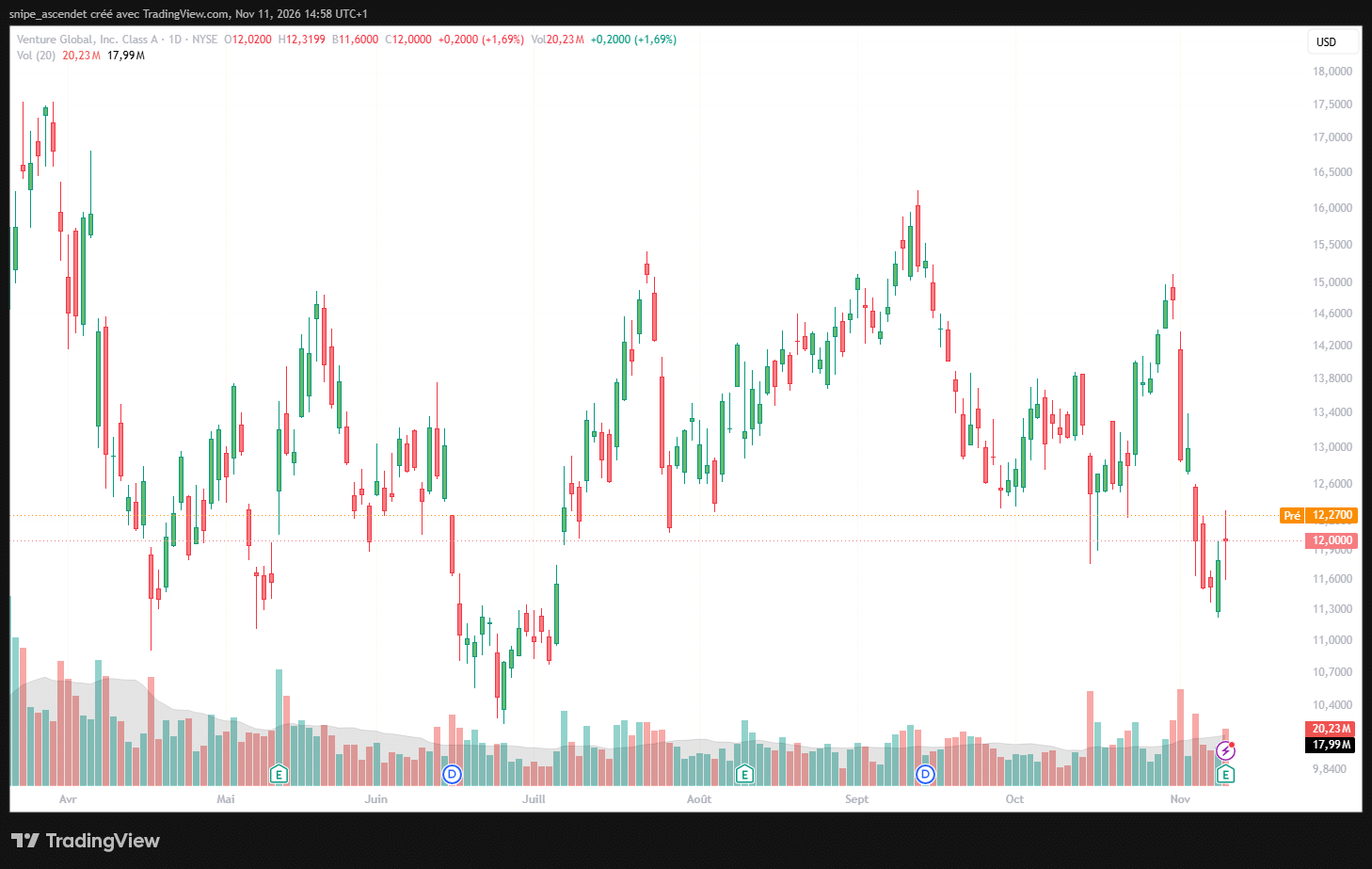
The daily chart places the earnings reaction in context: VG had moved substantially below an earlier September trading peak before the November results. A modest earnings-related uptick therefore would not, by itself, establish a sustained trend reversal. The four-hour chart gives a closer view of the sharp early-November selloff and subsequent stabilization, while the longer weekly chart shows how far the stock has traveled from its early post-listing prices. These are observations of the charts, not forecasts of future returns.
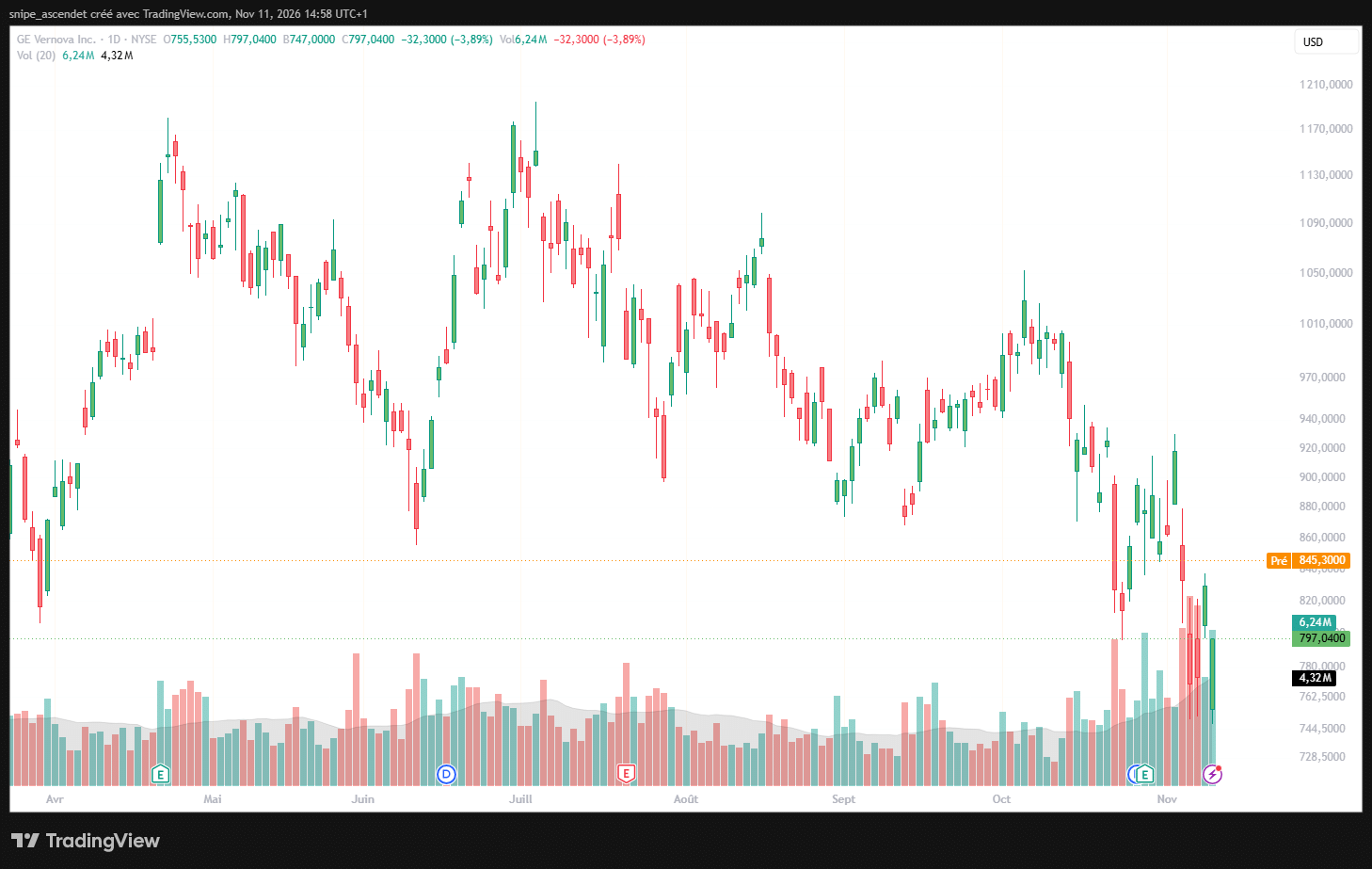
GE Vernova (NYSE: GEV), a supplier under the proposed power expansion arrangements, offers a useful comparison. Its chart shows the market’s separate valuation of a power-equipment company, not a clean read-through to Venture Global’s prospective AI utility profitability. GE Vernova’s October 28 earnings release described robust gas-power orders and a large equipment backlog; supplier equipment sales and an infrastructure operator’s cash flows are different businesses.
How to Evaluate VG Without Paying Twice for the AI Narrative
A conventional valuation should begin with the LNG operations that already exist. For an infrastructure company with substantial debt, enterprise value compared with normalized operating earnings is more informative than a simple share-price comparison. But a forward EV/EBITDA multiple can overstate cheapness when significant capital expenditures remain. For sector context, our GE Vernova, Bloom Energy and Vistra analysis examines how power-related businesses convert demand into cash, although their models differ from Venture Global’s.
A transparent screening example uses the chart’s $12.00 reference price and the 2.517 billion Class A and Class B shares outstanding at September 30, 2026. These historical inputs produce an illustrative equity value of approximately $30.204 billion. Add debt carrying amounts of $44.612 billion and noncontrolling interests of $3.429 billion, then subtract cash and equivalents of $3.420 billion: simplified enterprise value is approximately $74.825 billion. Relative to the $10.15 billion midpoint of 2026 consolidated adjusted EBITDA guidance, that is roughly 7.4 times. This is a dated educational approximation, not a real-time quoted multiple or a full appraisal; different debt and minority-interest definitions, future share counts, leases and valuation adjustments could change the result.
More importantly, an EBITDA multiple does not deduct the company’s $10.742 billion of capital spending during the first nine months. Nor does it assign a validated profit stream to unbuilt data centers. A rigorous scenario analysis would value the current LNG operation using normalized free cash flows, then add a separately discounted AI-project scenario only when customer contracts, capital budgets, project timelines and expected margins become credible. For another example of AI-related growth guidance being tested against capital spending, see our Infineon revenue and free-cash-flow analysis.
The Five Milestones That Would Change the Thesis
- 2026 delivery: whether Venture Global achieves the $10.0 billion–$10.3 billion adjusted EBITDA range without a disproportionate increase in working-capital or financing pressure.
- Core LNG execution: sustained operations at Plaquemines Phase 1 and progress toward CP2’s targeted mid-2027 first production.
- AI contracts: identifiable customers, committed capacity, pricing, duration and credit protection rather than framework equipment reservations alone.
- Capital discipline: disclosure of data center and power plant costs, project financing and risk-adjusted returns before substantial construction.
- Cash conversion: eventual improvement in operating cash flow relative to capital expenditures and obligations to lenders and noncontrolling owners.
Bottom Line: An LNG Stock With AI Power Optionality
Venture Global is not yet an established AI power stock on demonstrated financial results. It is an LNG exporter with improving reported operating performance and an ambitious plan to develop independent gas-fired power and compute infrastructure. Its higher 2026 outlook is backed by actual LNG results; its data center business depends on future customer agreements, permitting, construction, financing and delivery. Investors who distinguish these two sources of value can examine the opportunity without assuming that every prospective gigawatt already belongs in the stock’s earnings multiple.
Data cutoff: company disclosures published through November 10, 2026, and TradingView charts captured November 11, 2026, before the U.S. regular session. Dollar amounts are U.S. dollars. This article is for financial education and is not individualized investment advice.